
Foucault News

News and resources on French thinker Michel Foucault (1926-1984)

Janaka Siyambalapitiya, Xu Zhangand Xiaobing Liu, Is governmentality the missing link for greening the economic growth?
(2018) Sustainability (Switzerland), 10 (11), art. no. 4204.

https://doi.org/10.3390/su10114204

Abstract
The new concept of “green growth” appears to be an economic growth model, which balances environment sustainability and fostering of economic growth. Yet, much of the green growth research has failed to address the real extent of interconnections and complexity of the relationship between governance and economic, social, and environmental structures. Furthermore, current green growth research tends to focus on the country level, such as the Millennium Development Goals and sustainable development indices, which risks ignoring the additional impacts on micro industrial economies. The lack of connection between green growth and good governance-known as environmental governance-is a crucial gap in practical adoption. Therefore, this study uses Foucault’s governmentality lens to view green growth as a technique of government, seeking an environmentally focused eco-governmentality. We examine the transformation, differential definitions, and critical dimensions of green growth in relation to particular case studies taken from China and South Korea and frame them for future sustainable studies. The findings of this study highlight the significant role of interdisciplinary research, as well both bottom-up and top-down initiatives, on enabling the transition to green growth. The proposed research framework and implementation strategy also identifies new avenues for future research and practices in the field of sustainable development, making it one of the study’s key contributions to the literature. © 2018 by the authors.

Author Keywords
Circular economy; Economic growth model; Environmental management; Environmental sustainability; Governmentality; Green growth; Sustainable management

Index Keywords
economic growth, environmental economics, environmental management, government, green economy, growth modeling, interdisciplinary approach, Millenium Development Goal, sustainability, sustainable development; China, South Korea

Cleland, J., Cashmore, E. Nothing Will Be the Same Again After the Stade de France Attack: Reflections of Association Football Fans on Terrorism, Security and Surveillance
(2018) Journal of Sport and Social Issues, 42 (6), pp. 454-469.

DOI: 10.1177/0193723518797028

Abstract
Following the attempted terrorist attack at the friendly match between France and Germany at the Stade de France on November 13, 2015, this article draws on the response of 1,500 association football fans to the threat of terrorism in the world’s most popular sport. Its primary focus was to ask fans to reflect on their own experiences of security and surveillance and what extent the attempted attack on the Stade de France will have on the management of football crowds. Drawing on the themes of surveillance devised by Michel Foucault, the results outline how some fans accept additional measures of security and surveillance as a means of protecting their safety but others resist this as overly excessive and intrusive and argue it negatively affects their match-day experience. The article concludes by reflecting on the management of football crowds given the response by fans and the changes already taking place since November 2015. © The Author(s) 2018.

Author Keywords
football; Foucault; security; surveillance; terrorism

Bert, Jean-François. « Michel Foucault défenseur de l’ethnologie. « La magie – le fait social total », une leçon inédite des années 1950 », Zilsel, vol. 2, no. 2, 2017, pp. 281-303.

DOI: 10.3917/zil.002.0281

Les milliers de pages de notes manuscrites de Michel Foucault, conservées à la Bibliothèque nationale de France (BnF), donnent à voir un auteur bien différent de la caricature que certains spécialistes de l’histoire des sciences humaines et de la philosophie ont dessinée après sa mort. Ces simplifications alternent entre la référence appuyée à sa critique des sciences humaines, dans le sillage de Les mots et les choses (1966), et l’exagération de son rejet de toute démarche de type sociologique, en particulier celle héritière du « vieux réalisme durkheimien », qui n’aurait eu pour effet que de substantialiser les notions de peuple, de souverain et, d’abord, de société. Au début des années 1950, ses lectures attentives de Marcel Mauss et de Claude Lévi-Strauss, de Maurice Leenhardt et d’Abram Kardiner, de Margaret Mead et de Ruth Benedict ou encore de Robert Hertz, d’Émile Durkheim et de Pierre Métais, indiquent tout au contraire que, dès ses années de formation, et alors qu’il était étudiant à l’École normale supérieure, Foucault a voulu créer un rapport de proximité avec des approches de type anthropologique et, plus généralement, émanant des sciences sociales. Au-delà de ces quelques noms d’auteurs, devenus pour certains des « classiques », ses fiches de lecture manifestent également son intérêt pour ce qu’il nomme alors des « formations culturelles », qu’il s’agisse du rêve et de l’imaginaire, de la mort et du langage, de la conscience de soi ou de la folie. Autant de thèmes qui seront bientôt centraux dans sa réflexion…

Foucault, Michel. « La magie – le fait social total », Zilsel, vol. 2, no. 2, 2017, pp. 305-326.

DOI 10.3917/zil.002.0305

– Rapport à la société
– Rapport à la technique qu’elle imite.
– Rapport à la société
D’un côté opposition à la société
– Ségrégation du magicien dans la société, ce qui n’arrive pas au prêtre.
– Le magicien est considéré comme favorable ou défavorable à la société, alors que le prêtre l’est toujours.
La magie, dans une société, apparaît toujours comme virtualité menaçante [pour ?] l’ordre de cette société.
D’un autre, nécessité d’un lien social
– L’intention, le pouvoir magique ne peuvent se déployer que sur la trame d’une croyance magique.
Ex. du magicien cité par Boas qui n’éprouvait plus la virtualité de sa puissance magique parce qu’on ne le croyait plus.
Lévi-Strauss : ce n’est pas parce qu’il réussit qu’on le croit.
– L’acte magique lui-même, la réalisation de cette virtualité n’est possible que par le contexte social de croyances et d’affirmation magique, qui se fait le porteur de l’intention magicienne.
« Derrière le magicien et son bâton, il y a l’anxiété du village en quête de sources ».
Ex. des morts étudié par Mauss, par Cannon.
Mauss cite le cas d’un jeune chef à qui on prédit la mort, et qui meurt au bout de deux jours.
Interprétation de Cannon. Le lien social.
– Rapport à la technique
La magie semble faire corps avec la technique.
Le rite magique que rien ne distingue dans l’esprit du primitif de la précaution technique ; précaution et propitiation semblent se recouvrir et leur unité s’épanouit dans un univers de croyance, qui charge chaque opération technique de tout le poids des valeurs magiques ; à chaque geste technique répond un rite magique avec lequel il communique par le mythe…

Grohmangrohman, S. Making space for free subjects: Squatting, resistance, and the possibility of ethics
(2018) HAU: Journal of Ethnographic Theory, 8 (3), pp. 506-521.

DOI: 10.1086/701113
Open access

Abstract
Anthropologists working on ethics have emphasized the importance of freedom for the becoming of ethical subjects. While some have therefore aligned themselves with the later work of Foucault, his earlier work has been identified as part of a “science of unfreedom” antithetical to the study of ethics. In this article, I suggest that the “early Foucault” can nevertheless be relevant for the anthropology of ethics, specifically by looking at contexts where freedom is not a given, but has to be actively created through the overcoming of conditions of unfreedom. Drawing on Faubion’s discussion of ethical subject positions, as well as Foucault’s work on disciplinary architectures, I discuss how subject positions, ethical and otherwise, are also and especially produced through practices of ordering material and symbolic space. Different socio-spatial orders can therefore either be designed to impede the flourishing of free ethical subjects, or to facilitate it. © The Society for Ethnographic Theory. All rights reserved.

Author Keywords
Ethics; Homelessness; Space and place; Squatting; Subject position; Territoriality

Antonio Pele, La méditation : le nouvel « esprit » du capitalisme ? , The Conversation, February 12, 2019

Abstract
Je souhaiterais identifier les rapports entre la méditation et nos sociétés actuelles. Je ne cherche pas à critiquer la méditation mais à comprendre les raisons de l’enthousiasme qu’elle génère aujourd’hui. Comment cette pratique, qui fut longtemps associée (en Occident) à des conduites jugées « exotiques » voir excentriques, a-t-elle pu se retrouver légitimée par la science, l’économie et le politique ? Pourquoi un tel engouement et surtout qu’est-ce que ce succès peut-il nous dire en retour sur nos sociétés ? J’identifierai trois éléments qui peuvent expliquer – bien que partiellement – les raisons de la diffusion de la méditation aujourd’hui.

Extract

« Entrepreneur de soi-même »

Nos sociétés sont néolibérales dans le sens où la liberté individuelle est une valeur fondamentale, les marchés financiers ont acquis un pouvoir supérieur à celui des États et ces derniers délaissent petit à petit leur mission de « providence ».

Il existe aussi une autre caractéristique du néolibéralisme, qui passe souvent inaperçue mais qui est aussi très proche de notre quotidien. Selon Michel Foucault, cette caractéristique consiste à diffuser le modèle de l’entreprise à tous les secteurs de la vie sociale dont, et en particulier, la façon dont nous appréhendons notre propre personne.

Antonio Pele
Associate professor, Law School of the Pontifical Catholic University of Rio de Janeiro, Université Paris Nanterre – Université Paris Lumières

New Means of Workplace Surveillance From the Gaze of the Supervisor to the Digitalization of Employees by Ivan Manokha, Monthly Review An Independent Socialist Magazine (Feb 01, 2019)

Introduction
In the last twenty years or so, workplace surveillance has attracted a great deal of attention from academics and the mainstream media.1 This is explained by the proliferation of new electronic means of workplace surveillance, which are increasingly adopted by employers. It is now possible to track the movements of employees, record their conversations, register and analyze their performance in real time, and use biometric information for identity and access control, just to name a few examples. Most existing academic analyses of these developments emphasize how new surveillance technologies have enhanced the capacity of employers to monitor employees, often undermining various labor rights, particularly workers’ rights to privacy and equal treatment.2 In different media outlets—including some of the most influential ones, such as the Financial Times, New York Times, BBC, CBS, and Week—discussions of new surveillance technologies have also focused on the increased invasion of employee privacy.3 Most discussions in this area additionally addressed workers’ rights, including the right to privacy and to be free from discrimination.4

[…]

In his early studies, Michel Foucault examined how the architectural design of institutions, like asylums and hospitals, spatially distribute individuals and organize a field of visibility, giving the watchers the power to scrutinize and control the behavior of the watched (patients, workers, prisoners, etc.) and to punish those whose behavior violates the established rules.6 In Discipline and Punish and some of his later writings and lectures, Foucault shows that the nature of power in such institutions is not limited to a power of repression, but also involves the creation of “docile bodies” as the watched, aware that they are under constant surveillance, internalize the existing norms and behave in the required manner without coercion—that is, they exercise power over themselves.7

Josephine Berry, Art and (Bare) Life, A Biopolitical Inquiry. Sternberg Press, 2018
December 2018, English
14 x 22.5 cm, 328 pages, 45 color ill., softcover
ISBN 978-3-95679-393-6
€25.00

Book launch at Imperial College London

Art and (Bare) Life: A Biopolitical Inquiry analyzes modern and contemporary art’s drive to blur with life, and how this is connected to the democratic state’s biologized control of life. Art’s ambition to transform life intersects in striking ways with modern biopower’s aim to normalize, purify, judge, and transform life—rendering it bare. In these intersecting yet different orientations toward life, this book finds the answer to the question: How did autonomous art become such an effective tool of the capitalist state?

From today’s “creative cities” to the birth of modern democracy and art in the French Revolution, Art and (Bare) Life explores how the Enlightenment’s discovery of life itself is mirrored in politics and art. The galvanizing revelation that we are, in Michel Foucault’s words, “a living species in a living world,” free to alter our environment to produce specific effects, is compared here to the discovery that art is an autonomous system that can be piloted toward its own self-determined ends—art for art’s sake. But when both art and the capitalist state seek to change life rather than reflect it, they find themselves set on a collision course.

“Josephine Berry’s Art and (Bare) Life is an exemplary work. Here, for the first time, key concepts of contemporary political philosophy, such as biopower and biopolitics, are embedded within modern art history and theory. Erudite and sensitive to art’s complex field of intentions and outcomes, this in-depth study of aesthetics and politics is a must-read for anyone interested in understanding a foundational and regularly renewed dichotomy: ‘art’ and ‘life.’”
—Angela Dimitrakaki, Senior Lecturer in Contemporary Art History and Theory, University of Edinburgh

“The millennial body of the human is a territory marked by sacred codes, disciplines, and abstractions. To the technologies of biopower Josephine Berry waves the Medusa head of the art of rebellion.”
—Matteo Pasquinelli, Professor in Media Theory, Karlsruhe University of Arts and Design

Ippolito, J. Reading Interventionist Research in Two Urban Elementary Schools Through a Discursive Lens
(2018) Urban Education, 53 (10), pp. 1265-1290.

DOI: 10.1177/0042085915613550

Abstract
In this study, I reframe the debate on minority parents and their children’s educators by moving beyond concerns around student academic achievement and toward the quality of relationships among adult stakeholders. Using an interpretive lens based on Foucault’s notion of discourse, I examine three research vignettes drawn from an interventionist research project in two urban elementary schools. This examination identifies and responds to interpersonal, inter-institutional, and inter-epistemological dysfunctions. I make a concluding case for the transformative potential in the interplay of discourses: When inequalities and exclusions are redressed in the research, the project realizes a discursive and ethical possibility. © The Author(s) 2015.

Author Keywords
discourse; Foucault; interventionist research; minority families; parents; poststructural sociology; research relationships; school–university collaboration; teachers; urban elementary schools

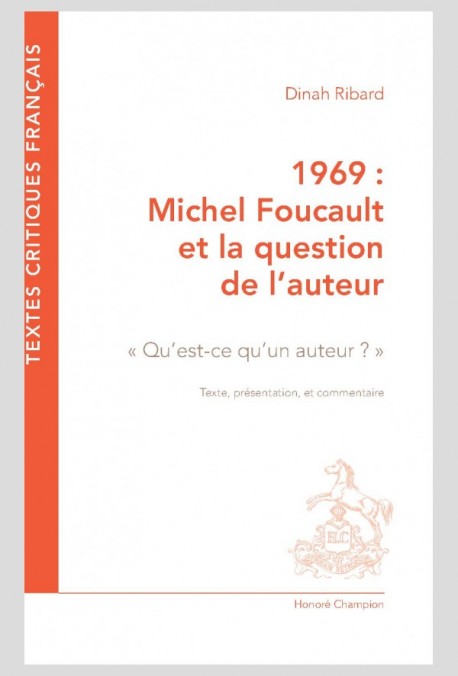
Dinah Ribard, 1969 : Michel Foucault et la question de l’auteur. Qu’est-ce qu’un auteur ?
Texte, présentation, et commentaire

Éditions Honoré Champion, Textes critiques français no 2. 2019. 1 vol., 112 p., broché, 13 × 20 cm. ISBN 978-2-7453-4832-6. 20 €

Qu’est-ce qu’un auteur ? est le texte d’une conférence donnée en 1969 à Paris, puis en 1970 aux États-Unis. Il existe plusieurs manières, fort différentes, de donner un contexte aux propositions avancées par Michel Foucault dans ce texte qui fit événement, de raconter l’histoire de l’impact de sa réflexion sur la théorie, la critique, l’histoire du fait littéraire, d’y réagir enfin. On s’efforce ici d’éclairer ces interprétations, ces récits, leurs évolutions et leurs enjeux, en s’intéressant notamment à leur caractère contradictoire, ainsi qu’à l’importance qu’ont eue, pour l’évolution des études littéraires, des choses que Foucault ne dit pas.

Foucault’s 1969 conference, « What is an author? » has been interpreted in various ways. This essay studies both the context of some of the proposals made by the philosopher, the various and contradictory interpretations it received, and the impact it had on literary studies and their history.

Dinah Ribard est directrice d’études à l’EHESS et membre, au Centre de recherches historiques, du Groupe de recherches interdisciplinaires sur l’histoire du littéraire. Elle a notamment publié Histoire littérature témoignage. Écrire les malheurs du temps avec Christian Jouhaud et Nicolas Schapira (2009) et participé au livre du Grihl, Écriture et action XVIIe-XIXe siècle. Une enquête collective (2016).