Foucault News

News and resources on French thinker Michel Foucault (1926-1984)

stuartelden's avatarProgressive Geographies

Macey---Lives-of-Foucault-(dragged)-650f6b95125d9c2c43a563be8ebe9690.jpgDavid Macey’s biography, The Lives of Michel Foucault has now been republished by Verso, with a new afterword by me.

It’s currently available with a 30% discount on the Verso site, with bundled e-book.

When he died of an AIDS-related condition in 1984, Michel Foucault had become the most influential French philosopher since the end of World War II. His powerful studies of the creation of modern medicine, prisons, psychiatry, and other methods of classification have had a lasting impact on philosophers, historians, critics, and novelists the world over. But as public as he was in his militant campaigns on behalf of prisoners, dissidents, and homosexuals, he shrouded his personal life in mystery. In The Lives of Michel Foucault — written with the full cooperation of Daniel Defert, Foucault’s former lover — David Macey gives the richest account to date of Foucault’s life and work, informed as it is…

View original post 34 more words

stuartelden's avatarProgressive Geographies

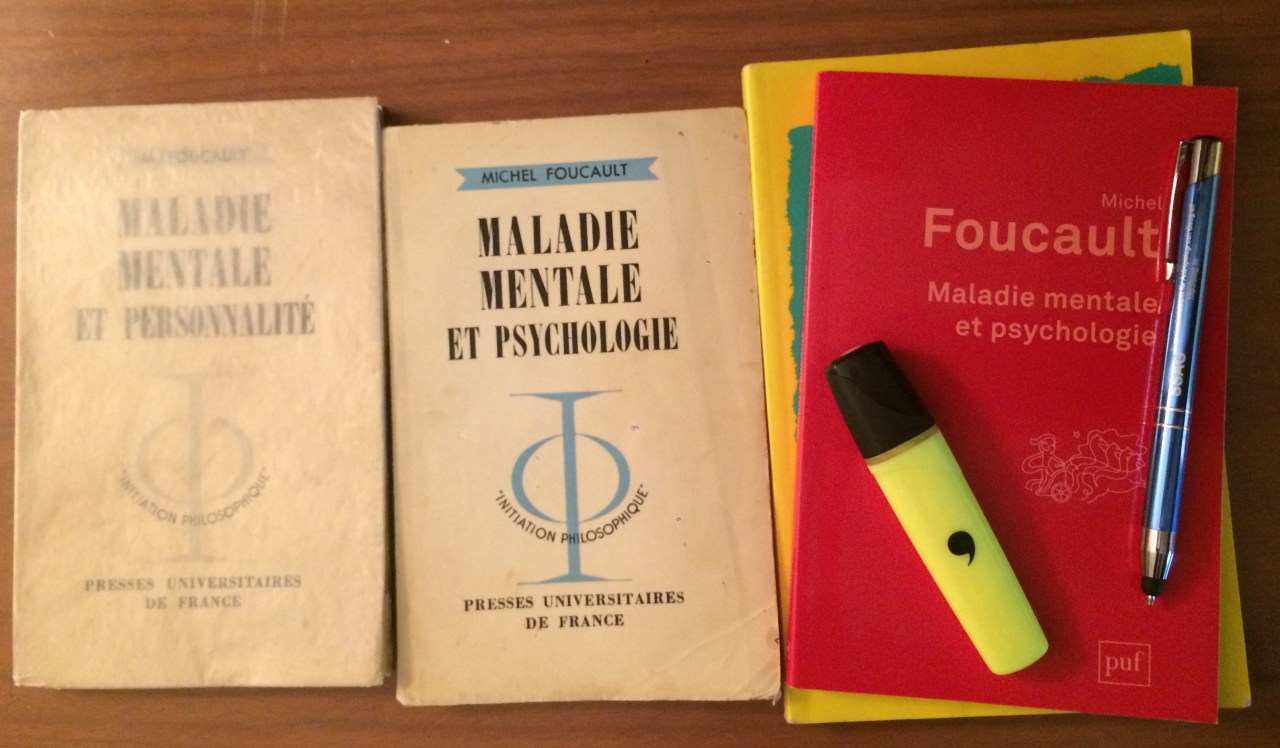
MMPe-MMPs.jpeg First edition (in a protective wrap), second edition, current edition and translation

I’ve been continuing work on The Early Foucault manuscript, which is coming together quite well. After the Christmas and New Year break, I submitted a book review and chapter on quite different topics. I’m now in Paris, where I’ve been spending time at the manuscripts room at the BnF-Richelieu, but also going to the BnF-Mitterand and Bibliothèque Sainte-Geneviève for books and journals. The main thing I’ve been doing with the manuscripts is working on Foucault’s Hegel thesis from 1949, and drafting a section of a chapter discussing this, and going back over some of Foucault’s notes from his own reading in preparation for his early books. To get an idea of what those notes look like, the contents of one box, of preparatory materials for Les mots et les choses [The Order of Things], have been digitized…

View original post 999 more words

Gary Gutting (1942-2019), 3am magazine, First posted: Sunday, January 20th, 2019.

Gary Gutting, emeritus professor of philosophy at the University of Notre Dame, has died.

Professor Gutting worked on philosophy of religion, philosophy of science, contemporary French philosophy, and contemporary analytic philosophy. He was well-known for his substantial work in public philosophy, authoring several columns and conducting a number of interviews with philosophers for The Stone feature in The New York Times. Also, he was the creator and a long-time co-editor of Notre Dame Philosophical Reviews (NDPR). More here at Daily Nous and Leiter Reports.

John Schwenkler, Remembering Gary Gutting, Commonweal
January 20, 2019

After receiving his doctorate in 1968 from Saint Louis University, Gutting’s scholarly work focused originally on twentieth-century French philosophy, especially the work of the philosopher Michel Foucault. Over the course of his career Gutting wrote several books on topics in French philosophy, exploring the work of French intellectuals like Foucault, Gilles Deleuze, Jacques Derrida, Alain Badiou, and Paul Ricouer. (Non-philosophers who are interested in getting a flavor of this project might take a look at Gutting’s 2005 book Foucault: A Very Short Introduction, which is just what its title advertises.)

Haskaj, F. From biopower to necroeconomies: Neoliberalism, biopower and death economies (2018) Philosophy and Social Criticism, 44 (10), pp. 1148-1168.

DOI: 10.1177/0191453718772596

Open access

Abstract
The deaths of millions from war, genocide, poverty and famine are symptomatic of a crisis that extends beyond site-specific failures of governance, culture or economies. Rather than reiterate standard critiques of capitalism, uneven development and inequality, this article probes and maps a shift in both the global economy and logic of capital that posits death as a central activity of value creation. “Crisis,” then, is more than an accidental failure or inconvenient side effect of either global economy or political reality, but pivotal to both. Extending notions of biopower and necropolitics, I argue that, due to the extension of market logic, populations have been reconfigured and reconceptualized as “excess”-not only disposable but also fundamentally valued only in their negation. This devaluation of selected population is devalorization of living labor, thus creating a space for death as a generalized commodity, market and economic activity. Crucially, this shift exceeds the historic understandings of labor, value and politics, forcing a revaluation of biopower and of extant understandings of the global economic and political order. Death as a source of value marks an entirely new space in capital that exceeds its former limits. This process can be seen in examples of genocidal warfare, ethnic cleansing, environmental “disasters” and globalized poverty that function as industries of death, mining the accumulated stored value of life, as death, and as an activity itself, instead of the old extractive exploitation of living labor. © The Author(s) 2018.

Author Keywords
Biopower; Critical theory; Foucault; Genocide; Globalization; Labor; Marx; Necropolitics; Neoliberalism; Political economy

Michael A. Peters and Danilo Taglietti, Deleuze’s rhizomatic analysis of Foucault: Resources for a new sociology?
(2019) Educational Philosophy and Theory

https://doi.org/10.1080/00131857.2018.1551831

Abstract
This paper analyses and examines Deleuze’s Foucault as a means of investigating intellectual resources for a new sociology–one that, in Foucault’s name, is neither foundationalist nor representationalist but genuinely other than the modernist discourse with which the discipline began and grew up. The paper begins with a brief historiography of sociology in order to broach the relationship between Deleuze and Foucault, and then focuses on Deleuze’s book on Foucault as a means of moving ‘from the archive to the diagram’ and to a topology of ‘thinking otherwise’. Finally, the paper moves to reformulate a new vocabulary no longer anchored in modernist categories to a non-dialectical reconfiguration of explanation and comprehension. © 2018, © 2018 Philosophy of Education Society of Australasia.

Author Keywords
Deleuze; Foucault; sociology

Koopman, C. Information before information theory: The politics of data beyond the perspective of communication
(2019) New Media and Society, . Article in Press.

DOI: 10.1177/1461444818820300

Abstract
Scholarship on the politics of new media widely assumes that communication functions as a sufficient conceptual paradigm for critically assessing new media politics. This article argues that communication-centric analyses fail to engage the politics of information itself, limiting information only to its consequences for communication, and neglecting information as it reaches into our selves, lives, and actions beyond the confines of communication. Furthering recent new media historiography on the “information theory” of Shannon and Wiener, the article reveals both the primacy of communication in midcentury information theory, and also a striking resonance between these postwar communication theories and Habermas’s more recent communicative theory of democracy. To achieve a critical perspective beyond communication, the article proposes a media genealogy of the politics of subjects as a methodology for developing an analysis of how information formats us as subjects of data. © The Author(s) 2019.

Author Keywords
Communication; data; formats; Foucault; Habermas; infopower; information; Shannon; Wiener

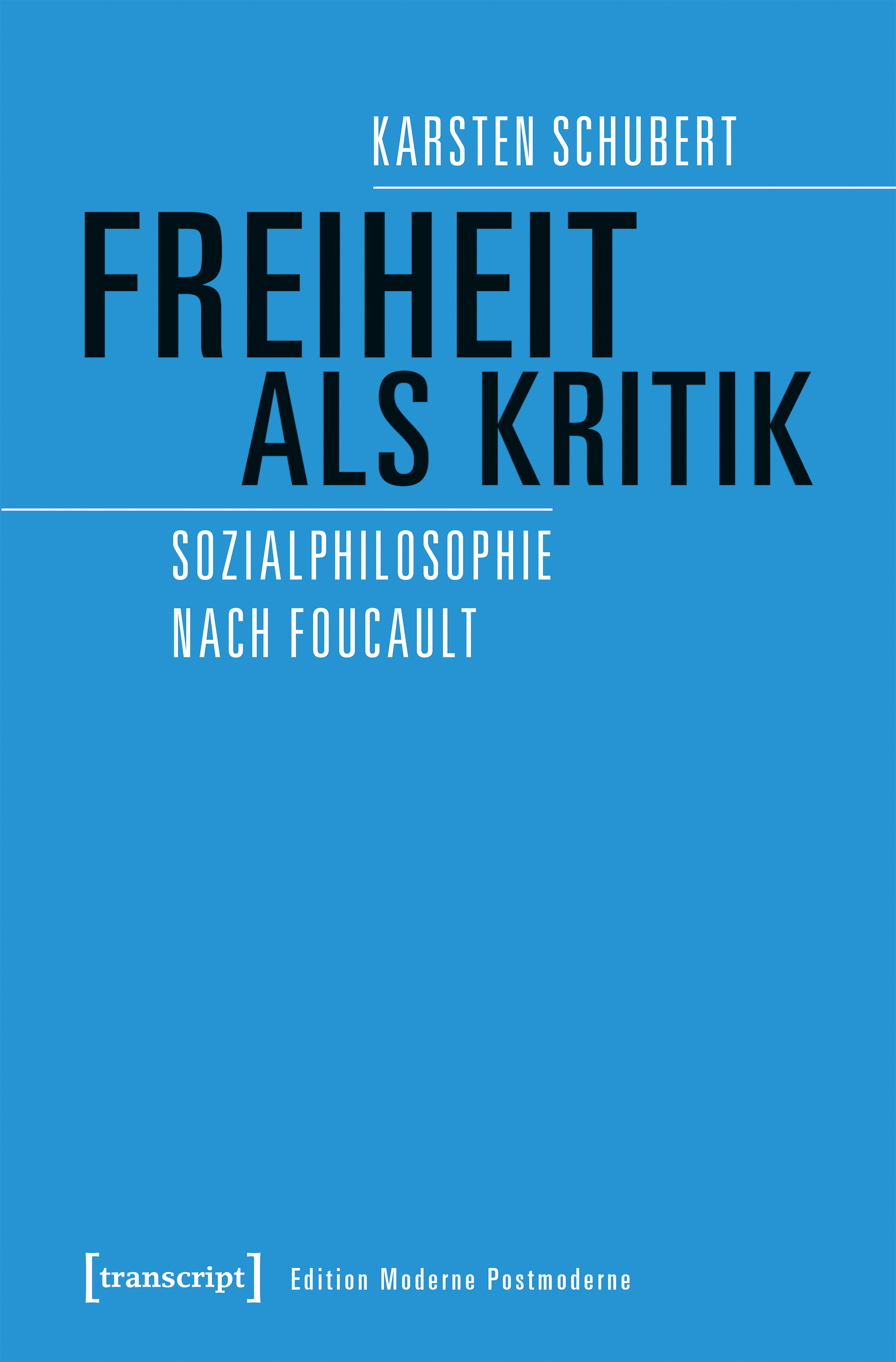
Karsten Schubert Freiheit als Kritik. Sozialphilosophie nach Foucault, Bielefeld: transcript 2018

Leseprobe (PDF)

Wie können Freiheit und Widerstand innerhalb von Foucaults Theorie der Macht und Subjektivierung konzipiert werden? Karsten Schubert liefert die erste systematische Rekonstruktion der sozialphilosophischen Debatte um Freiheit bei Foucault und eine neue Lösung für das Freiheitsproblem: Freiheit als die Fähigkeit zur reflexiven Kritik der eigenen Subjektivierung – kurz: Freiheit als Kritik – ist das Resultat von freiheitlicher Subjektivierung in politischen Institutionen. Der Band zeigt so die Konsequenzen von Foucaults Freiheitsdenken für die Demokratietheorie und die allgemeine sozialphilosophische Freiheitsdiskussion auf.

English
Freiheit als Kritik. Sozialphilosophie nach Foucault. Bielefeld: transcript 2018 (Freedom as Critique. Social-Philosophy After Foucault)
How can we conceptualize freedom and resistance in Foucault’s theory of power and subjectification? Karsten Schubert presents the first systematic reconstruction of the social-philosophical debate about freedom in Foucault’s works and a new solution to the problem of freedom: Freedom as the capability to critically reflect on one’s own subjectification – in short: freedom as critique – is the result of free subjectification through political institutions. The book thereby shows the consequences for Foucault’s thinking of freedom for theories of democracy and the general social-philosophical discussion about freedom.

Karsten Schubert (Dr. phil.), geb. 1985, ist PostDoc-Fellow bei der Bremen International Graduate School of Social Sciences an der Universität Bremen. Er promovierte 2017 in Philosophie an der Universität Leipzig, zuvor war er Visiting Scholar an der Cardozo Law School und der New School for Social Research in New York und lehrte als wissenschaftlicher Mitarbeiter politische Theorie am Institut für Politikwissenschaft der Universität Duisburg-Essen. Seine Forschungsschwerpunkte sind zeitgenössische Sozialphilosophie und politische Theorie, Rechtsphilosophie sowie Queerund Intersektionalitätstheorie.

Borderlands, Issue 17.2, 2018 Migration and Mobility Politics
Open access.

The contributions from Richie Wyver, Steven Farry, Fabiane Ramos, Mahmoud Kesharvarz and Eric Snodgrass, and Lewis Rarm, shine light upon the complex production of otherness both within and across the borders of the contemporary nation-state. The authors employ a range of critical tools, from Bhabha’s mimicry to Foucault’s theories of racism and biopolitics, and ethnographic methods to reveal how constructed borders, national, cultural, and economic, are a form of violence that can dehumanise, remove citizenship rights, and impoverish mobile subjects. This issue is very much in the experimental spirit of Borderlands, which aims to critically work at the intersections of economics, philosophy, law, everyday cultural life, film and media.

Mingjie Tang, L’usage de la subjectivité : Foucault, une archéologie de la relation, L’Harmattan. Collection: Quelle drôle d’époque ! Philosophie Sciences Humaines

Les travaux de Foucault sur l’histoire de la subjectivité analysent la manière dont s’est formé et a fonctionné le concept d’homme : comment il a agrégé des éléments hétérogènes pour imposer son évidence dans notre modernité. La subjectivité s’établit dans le rapport à sa propre vérité comme « noeud » de la véridiction, de la gouvernementalité et de la spiritualité. C’est dans ce « jeu de la connaissance individuelle » que se mettent en place les dispositifs du sujet et leurs conditions, c’est dans l’archéologie de la relation avec la vérité, le pouvoir et le soi que l’on retrouve, peut-être, l’usage de notre subjectivité.

Mingjie Tang est docteure en philosophie et a soutenu sa thèse intitulée Cogito, sujet et subjectivité chez Foucault en 2015 à l’université Paris-I Panthéon-Sorbonne. Elle est actuellement chercheuse à l’Institut de philosophie de l’Académie chinoise des sciences sociales (CASS) en Chine. Son domaine de recherche a trait, notamment, à l’histoire et la philosophie des sciences humaines, aux problématiques du sujet, du discours et des extra-discursivités.

PDF of flyer