Foucault News

News and resources on French thinker Michel Foucault (1926-1984)

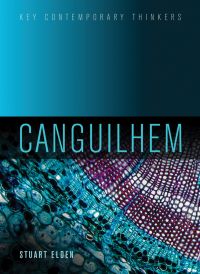
Stuart Elden, Canguilhem, Polity Press, 2019

Georges Canguilhem (1904-95) was an influential historian and philosopher of science, as renowned for his teaching as for his writings. He is best known for his book The Normal and the Pathological, originally his doctoral thesis in medicine, but he also wrote a thesis in philosophy on the concept of the reflex, supervised by Gaston Bachelard. He was the sponsor of Michel Foucault’s doctoral thesis on madness. However, his work extends far beyond what is suggested by his association with these thinkers. Canguilhem also produced a series of important works on the natural sciences, including studies of evolution, psychology, vitalism and mechanism, experimentation, monstrosity and disease.

Stuart Elden discusses the whole of this important thinker’s complex work, including recently rediscovered texts and archival materials. Canguilhem always approached questions historically, examining how it was that we came to a significant moment in time, outlining tensions, detours and paths not taken. The first comprehensive study in English, this book is a crucial guide for those coming to terms with Canguilhem’s important contributions, and will appeal to researchers and students from a range of fields.

Stuart Elden is Professor of Political Theory and Geography at the University of Warwick, and Monash Warwick Professor in the Faculty of Arts, Monash University.

Reviews
“The patience, clarity, and erudition we expect of Stuart Elden’s books are on full display in this exceptional work. More than a simple introduction, Canguilhem enables readers to see the outlines, stakes and details of the works of an important thinker.”
John Protevi, Louisiana State University

“This impressive and meticulously researched volume which includes a wealth of references to archival material provides the first comprehensive introduction in English to a figure recognized as a seminal influence by postwar French thinkers, including Foucault and Althusser.”
Clare O’Farrell, Queensland University of Technology

For other videos on Foucault and other theorists see this youtube channel

Marx as a Critical Vitalist

For other videos on Foucault and other theorists see this youtube channel

19th Annual Meeting of the Foucault Circle

Stonehill College
North Easton, MA, USA

April 5-7, 2019

Friday, April 5th  

3:00pm-5:00pm

Session 1: Confessions of the Flesh & A Preface to Transgression

Wencheng Zhu, Southeast University

Confession or Sign of Subjectivation?: Libido in Foucault’s Les Aveux de la Chair

Daniel Schultz, Oberlin College

Sex as the Seismograph of Subjectivity: Foucault’s Christian Archive

Charles Clements, Tufts University

Where There’s a Will There’s No Gay: Futurity and Nonknowledge in Foucault’s Reading of Bataille

Saturday, April 6th

9:00am-10:20am

Session 2: Archeology, History, and the Rational

Alex J. Feldman, Penn State University

The Real and the Rational in Foucault’s 1978 Debate with the Historians

Robert Leib, Florida Atlantic University

From a Priori History to Paradigmatic Ontology: Reconsidering Philosophical Archaeology from Kant to Agamben

10:40am-12:40am

Session 3: Genealogy and Subjugated Knowledges

Rebecca Longtin, SUNY, New Paltz

Formations and Transformations of the Sensible in Foucault, Rancière, and Wynter

Taryn Jordan, Emory University & Haylee Harrell, Emory University

“Black Foucault”: A Discussion of Genealogy as a Real Problem and a Real Possibility in Black Studies

Rosa Acevedo, University of Oregon

Limits and Paradoxes of Foucault’s Genealogy of Marginalized Lives

12:45-2pm: Lunch

2:00pm-4:00pm

Session 4: Abolition and Incarceration

Joy James, Williams College

The Architects of Contemporary Abolitionism: George Jackson, Angela Davis, and Michel Foucault

Selin Islekel, Loyola Marymount University

Life Without Parole, Death By Incarceration: Biopolitical Aesthetics of the Penitentiary

Joel Michael Reynolds, University of Massachusetts Lowell

Ontological Incarceration: Toward a Genealogy of the Human Genome Project

4:15-5:30pm

Round-table Discussion: Foucault and Christianity

James Bernauer, Boston College | Jared Highlen, Boston College| Steven Ogden, Charles Sturt University

5:45-6:30: Business Meeting

7pm: Dinner

Sunday, April 7th

9:00-11:00am

Session 5: Animality, Religiosity, and Spectral Dreams
Dayne Alexander, Emory University

Animality, Logic and Murmur: Spiraling with the Animal in Michel Foucault’s History of Madness.

Adrian Switzer, Colby College

Aestheticized Transcendence, Archaeological Unreason: The Religiosity of History of Madness

Nicole Ridgway, University of Wisconsin, Milwaukee

Spectral Dreams, Fugitive Pleasures: Art as an Ethical Event of Thought

11:15am-12:35pm  

Session 6: Illegalisms and Dispositifs

Delio Vasquez, University of California, Santa Cruz

Foucault on Political Crime: Towards a Unified Theory of Illegalisms

Ricky Crano, Tufts University

Can There Be a Digital Dispositif?: Visuality and Discourse in the Age of Telematic Culture

Travel to Stonehill College in North Easton, Massachusetts 

Here is a link to the Stonehill College web-page with a campus map and directions to the College:

https://www.stonehill.edu/visitors/directions-campus-map/

Stonehill College is approximately 20 miles south of Boston, MA and 25 miles north of Providence, RI.  Book flights into Boston Logan International Airport or TF Green Airport outside Providence.

Unfortunately, there is no public transit from either airport or either city to Stonehill College.  From the airport use Uber or Lyft ($40-50 each way) or rent a car.  We suggest coordinating travel with other conference attendees in order to share rides and costs.

Lodging

The Marriott Residence Inn in Brockton/Easton (508-583-3600, https://www.marriott.com/hotels/travel/bosbc-residence-inn-boston-brockton-easton/ ) has held a block of rooms at rate of $129 plus taxes for a studio and $139 for a suite.  This rate will be held until March 5th.  Call the hotel directly and let them know that you are traveling for the Stonehill Meeting of the Foucault Circle to get the special rate.  The hotel about a 2 mile walk to the campus location of the conference in Alumni Auditorium.  We are working to see if we can arrange a ride to and from the hotel (more information about that coming).  I will update this information with other local lodging options.

Some may wish to stay in Boston during the conference.  Depending on traffic conditions and starting point in the city it can take between 35 and 60 minutes to drive to Stonehill.

Philosophy is that which calls into question domination at every level and in every form in which it exists, whether political, economic, sexual, institutional, or what have you. To a certain extent, this critical function of philosophy derives from the Socratic injunction “Take care of yourself,” in other words, “Make freedom your foundation, through the mastery of yourself”.

Michel Foucault. 2000. “The Ethics of the Concern for Self as a Practice of Freedom.” In Ethics. Essential Works of Michel Foucault, edited by P. Rabinow. Vol. 2. 281-302. London: Penguin.

Editor: I will be running a reading group in Brisbane, Australia. All details can be found on the reading group website.

Dates
1, 15, 29 March; 12, 26 April; 10, 24 May

Time: 1 – 2.30pm fortnightly on Fridays

Venue: E block Room E351, Queensland University of Technology (QUT), Kelvin Grove, Brisbane, Qld, Australia.
Map of the campus.

Readings

1 March
Michel Foucault and Farès Sassine, There can’t be societies without uprisings, In Foucault and the making of subjects. Eds. Laura Cremonesi, Orazio Irrera, Daniele Lorenzini, Martina Tazzioli, London: Rowman and Littlefield, 2016, pp. 25-51

15 March
Michel de Certeau, Walking in the City, In Michel de, Certeau, The Practice of Everyday Life, University of California Press, 2011.

Program for remainder of semester

We will systematically be reading through Michel Foucault, Wrong-doing, Truth-telling: The Function of Avowal in Justice, Eds. Fabienne Brion, Bernard E. Harcourt, Trans. Stephen W. Sawyer. Chicago: University of Chicago Press, 2014.

29 March
Inaugural lecture and first lecture

12 April
Second lecture and third lecture

26 April
Fourth lecture and fifth lecture

10 May
Sixth lecture

24 May
Interview with André Berten

Keck, C.S. Radical educations in subjectivity: the convergence of psychotherapy, mysticism and Foucault’s ‘politics of ourselves’
(2019) Ethics and Education, 14 (1), pp. 102-115.

DOI: 10.1080/17449642.2018.1554789

Abstract
Foucault’s invitation to the subject is to become free of themselves by learning to think differently. Such a project has as its goal the mastery of the self, and can be understood as a Foucaultian ‘politics of ourselves’. Foucault’s ethical turn is an invitation for subjectivity to undertake its own radical education. Whilst this invitation has characteristics unique to Foucault’s philosophical discipline, I argue that it sheds light upon a diversity of practices of subjectivity from the psychotherapeutic and mystic traditions. By seeing these currently available technologies of self in the Foucaultian lens we are given the opportunity to appreciate their work on subjectivity as necessarily political and social, a radical education not limited to the realm of individualistic aspiration and narcissistic temptations. The paper concludes by drawing attention to some implications for education, and for a teacher education that embraces the ‘radical reflexivity’ of some psycho-spiritual practices.

Author Keywords
Foucault; politics of ourselves; psychotherapeutic and mystic practices; radical education; subjectivity; teacher education

Leman-Langlois, S. State Mass Spying as Illegalism
(2018) Critical Criminology, 26 (4), pp. 545-561.

DOI: 10.1007/s10612-018-9421-z

Abstract
Periodic revelations about the workings of data interception, analysis and collection in Canada have each time prompted successive administrations to amend laws and regulations in order to calm public opinion. This has been referred to as “accountability through scandal” and has, for the most part, produced cosmetic changes rather than significant reform. Most of the practices and the ethos of the organizations have remained the same, setting the stage for the next scandal. This paper reviews the last scandal to befall the Canadian Security Establishment, caused by the Snowden revelations, and the subsequent political response. Approached with part of Foucault’s toolbox it becomes clear that the business of the state and state security requires a particular form of “management of illegalisms,” or differential treatment of rule-breaking, at the higher echelons of state power.

Anton Lee (2018) Review: The Order of Things: Photography from the Walther Collection, History of Photography, 42:3, 306-308.

DOI: 10.1080/03087298.2018.1531600

Review of the exhibition catalog The Order of Things: Photography from the Walther Collection, edited by Brian Wallis (Göttingen: Steidl, 2015)

[,,,]
The paucity of serious attention to The Order of Things is curious, given the book’s value as an independent source of reference for photography scholars and practitioners apart from the concomitant exhibition. It is equally regrettable that the publication has largely been overlooked by the readers of Michel Foucault, despite the fact that the book was named after the French thinker’s influential study originally published as Les Mots et les Choses (1966). Foucault’s preface to his book is reprinted in the catalogue, alongside other new and old essays, including Walter Benjamin’s ‘A Little History of Photography’ (1931), Allan Sekula’s ‘The Body and the Archive’ (1986), George Baker’s ‘August Sander, Degeneration, and the Decay of the Portrait’ (1996), and Geoffrey Batchen’s ‘Ordering Things’ (2015). The book’s importance has been growing ever since it was first published in 2015, in accordance with the reputation of the Walther Collection as one of the world’s most significant collections of historical and contemporary photographs, especially those made in Africa and China. Not only does The Order of Things shed light on the genesis of the collection by providing an interview with Walther, but the book’s theme also attests to the collector’s proclivity for acquiring an entire set or batch of photographs that may or may not have been conceived as a series.

[…]

Book description
Throughout the modern era, photography has been enlisted to classify the world and its people. Driven by a belief in the scientific objectivity of photographic evidence, the systems utilized to classify photographs have shaped modern visual culture. Accompanying the exhibition The Order of Things: Photography from The Walther Collection, this book investigates the production and uses of serial portraiture, vernacular imagery, architectural surveys and time-based performance in photography from the 1880s to the present, bringing together works by artists from Europe, Africa, Asia and North America. Setting early modernist photographers Karl Blossfeldt and August Sander in dialogue with contemporary artists such as Ai Weiwei, Nobuyoshi Araki, Richard Avedon, Zanele Muholi, Stephen Shore and Zhang Huan, The Order of Things illustrates how typological methods in photography have developed globally.

Call for papers
Rencontres Doctorales du Centre Michel Foucault

11-13 septembre 2019
IMEC – Caen

L’Association pour le Centre Michel Foucault propose pour la 8ème année une école doctorale visant à réunir les doctorants travaillant sur, avec et autour de la pensée de Michel Foucault. L’objectif est comme les années précédentes de mettre en relation, le plus agréablement possible et de manière assez informelle, les jeunes chercheurs afin de constituer un réseau de travail national et international, et de leur donner l’occasion de présenter leurs travaux.

Cette rencontre aura lieu du 11 au 13 septembre 2019 à l’Abbaye d’Ardenne à Caen (avec un départ de Paris le mercredi 11 septembre en milieu de journée et un retour le vendredi 13 septembre en fin de journée).

Les frais de séjour sur place et les billets de train à partir de Paris (Paris-Caen-Paris) seront offerts aux intervenants par l’Association pour le Centre Michel Foucault.

Pour que les échanges puissent être les plus féconds possibles – et compte tenu des capacités d’accueil de l’Abbaye – nous limitons le nombre de participants, ce qui impliquera nécessairement un choix de notre part. Les doctorants ayant participé les années passées aux rencontres pourront décider d’y assister, mais la priorité sera donnée aux nouveaux intervenants et aux doctorants en 2ème et 3ème année de thèse.

Les propositions d’intervention (2500 signes max.), portant soit sur une question particulière du travail de thèse, soit sur un problème méthodologique précis, devront nous être envoyées, avec un CV (indiquant obligatoirement l’année et le titre de la thèse, le nom du directeur, de l’université et de l’École doctorale de rattachement) avant le 30 avril 2019. En fonction des demandes, nous établirons et diffuserons un programme le 15 mai 2019.

Contact : journeescmf@gmail.com

Ces rencontres doctorales sont ouvertes à tous les étudiant.e.s sans distinction de nationalité, mais la langue de travail sera le français (avec possibilité éventuelle d’intervenir en anglais).

N’hésitez pas à nous contacter pour toute question.

Très cordialement,
L’Association pour le Centre Michel Foucault