Foucault News

News and resources on French thinker Michel Foucault (1926-1984)

Has Neoliberalism Really Come to an End?
By Daniel Steinmetz-Jenkins. The Nation, 14 April 2022

A conversation with historian Gary Gerstle about understanding neoliberalism as a bipartisan worldview and how the political order it ushered in has crumbled.

The term “neoliberalism” is often used to condemn an array of economic policies associated with such ideas as deregulation, trickle-down economics, austerity, free markets, free trade, and free enterprise. As a political movement, neoliberalism is seen as experiencing its breakthrough 40 years ago with the election into office of Ronald Reagan and Margaret Thatcher. And since the 2007–08 financial crisis, an explosion of academic work and political activism has been devoted to explaining how neoliberalism is fundamentally to blame for the massive growth in inequality.

Yet Gary Gerstle—in his new book, The Rise and Fall of the Neoliberal Order: America and the World in the Free Market Era—argues that this understanding of neoliberalism struggles to explain why it has exerted such a profound influence on both the left and the right. Gerstle—a professor of American history at the University of Cambridge—thinks neoliberalism should be understood as a worldview that promises liberation by reconciling economic “deregulation with personal freedoms, open borders with cosmopolitanism, and globalization with the promise of increased prosperity for all.”
[…]

My book takes Foucault’s insight as inspiration: It argues that neoliberalism’s career has been marked as much by heterodoxy as orthodoxy, by its capacity to make individuals as different as tech hippies and Ronald Reagan, as dissimilar as Barry Goldwater and long-haired university students who wanted to bring down “the system,” feel as though they held the key to unlocking a future of untrammeled personal freedom.
[,,,]

Mitchell Dean, What does ‘Left’ mean?, Verso Blog, 13 April 2022

Mitchell Dean responds to the review of his book The Last Man Takes LSD: Foucault and the End of Revolution (co-written with Daniel Zamora) published in the journal Foucault Studies.

One is always grateful when a reader has taken the time to review a scholarly work in the humanities and social sciences. We have been particularly fortunate to have received quite a number of favourable reviews (for this and its earlier French version) in a number of countries. They have come mainly from the Left (Il ManifestoLiberationNew Statesman, Los Angeles Times, Information) but also from conservative publications (The Spectator). Given that the book departs from Foucauldian orthodoxy in the contemporary Anglophone world, we would not expect acclaim in a journal devoted to him, Foucault Studies. In that sense, Jasper Friedrich’s review provides the reader with a relatively mild critical appraisal and raises interesting points about the nature of our project and the further investigation it opens.

read more

Paolo Vernaglione Berardi, Commenti alla Filosofia. Quaderni di archeologia filosofica. Volume secondo Edizioni Efesto (2022)

Abstract
Nel Medioevo il commento è la lettura di un testo che prelude ad una disputa o segue una presa di posizione dottrinale o metafisica. Questo secondo volume dei “Quaderni” rincorre quel senso aggiornandolo alla questione implicita del pensiero: – quale filosofia nel tempo delle rovine?
In queste pagine sembra condensarsi una pratica che si dice in molti modi ma ha oggi usi rari e dispersi. La forma è quella di chi abita un mondo che la pandemia ha reso evidente senza peraltro averne cambiato il corso. Per questo la mappa disegnata dai testi qui raccolti si riferisce ad un territorio di contestazione e di produzione.
Il luogo di questa archeologia è delimitato dalle parole di Michel Foucault: “preferisco non identificare me stesso”, che è la replica inattuale al bisogno spasmodico di definirsi storico, critico, filosofo, artista, per lo più al maschile.
L’elemento filosofico è invece la presa di parola che chiama Agamben, Bachelard, Benjamin, Canetti, Deleuze, Di Cori, Fontana, Illich, Jesi, Schürmann, Sebald, Tarì, Tiqqun, Comitato Invisibile, come coloro che pensano nel tempo della fine.

Paolo Vernaglione Berardi è insegnante di filosofia e storia e autore di saggi e testi tra cui: Il sovrano l’altro, la storia (2008); Dopo l’umanesimo. Sfera pubblica e natura umana (2009); Filosofia del comune (2012); Michel Foucault: genealogie del presente (2015, a cura di); Scritti su Walter Benjamin (2015, a cura di); La natura umana come dispositivo. Archeologia filosofica, dissolvenza del soggetto, estetica dell’esistenza (2018); Quaderni di archeologia filosofica. Volume primo (2019 con Alessandro Baccarin).
Con Alessandro Baccarin ha fondato nel 2017 il “Laboratorio Archeologia Filosofica” (https://www.archeologiafilosofica.it) e cura per le edizioni Efesto la collana “Archeologia filosofica”.

Keywords
archeologia filosofica, Gilles Deleuze, Elias Canetti, E.W. Sebald, Gaston Bachelard, Giorgio Agamben, Paola Di Cori, Alessandro Fontana, Reiner Schurmann, Ivan Illich, Marcello Tarì, Walter Benjamin, Tiqqun, Comitato Invisibile

Robinson, D., Ilinskaya, S.
Queering the popular utopia through translingual science fiction: Sense8 as cultural translation
(2022) Perspectives: Studies in Translation Theory and Practice

DOI: 10.1080/0907676X.2022.2043396

Abstract
The paper reads the queer utopia fleshed forth in the Wachowskis’ two-season series Sense8 as a heterotopia (Joanne Tompkins, developing an idea out of Foucault) that orients us toward a transformed future that is forever not yet here (José Esteban Muñoz in Cruising Utopia), based on a collectivized and shifting identity-assemblage that is neither sheer anarchistic disruption nor a stable identitarian intersectionality (Jasbir Puar, developing an idea that Brian Massumi develops out of Deleuze and Guattari). In support of this reading, the paper explores the Wachowskis’ queer activism in favor of an extremely broad tolerance for difference (in opposition to rigid identity categories), and reads the high-concept sf premise of instantaneous empath travel and interaction with and as clustermates through Hannah Arendt’s observation that ‘we have arrived in a situation where we do not know—at least not yet—how to move politically.’ Building on that observation, Judith Butler reflects on producing a space of appearance or ‘assembly’ as grounding politics in situated social interaction, as a transition to a reconfigured (restaged, respatialized) ‘reality’ that, as Muñoz says, is not yet here. © 2022 Informa UK Limited, trading as Taylor & Francis Group.

Author Keywords
assemblage; banality; cultural diversity; heterotopia; identity politics; Utopia

Sukhera, J., Poleksic, J., Zaheer, J., Pack, R.
Normalising disclosure or reinforcing heroism? An exploratory critical discourse analysis of mental health stigma in medical education
(2022) Medical Education

DOI: 10.1111/medu.14790

Abstract
Introduction: There has been a proliferation of initiatives targeted towards improving psychological wellbeing among medical learners. Yet many learners do not seek assistance due to stigma against help seeking. Understanding the prevailing discourses on the effects of mental health stigma in the context of medical education will improve insight on how to address stigma and improve wellbeing. In this study, the authors sought to explore discourses on stigma in medical education through a Foucauldian Critical Discourse Analysis.

Methods: The authors assembled several sets of texts related to stigma in medical education. The initial archive consisted of social media discourse and was expanded to include digital news media. Next, the authors conducted semi-structured qualitative interviews with medical students, residents and faculty. Using principles of Critical Discourse Analysis informed by the writings of Michel Foucault, the authors analysed the archive to identify truth statements, representative statements and discursive effects.

Results: Analysis revealed an emancipatory discourse of disclosure that normalised help-seeking, which conflicted with a discourse of performance. Results suggested that public disclosure remains challenging in private contexts due to a medical culture that rewards perfectionism and lauds heroism. Discourses on performance positioned disclosure as disruptive to the system’s need to maintain its own hegemony. Overall, stigma was perceived as rooted within the structural power of the medical education system and society at large. Conclusion: Discourses on stigma in medical education hold implications for the teaching, learning and overall wellbeing of medical learners. The tensions between discourses on disclosure and performance have the potential to perpetuate further distress for learners and worsen asymmetries in power. Interventions to address stigma would benefit from understanding and addressing the role of power and hierarchy in maintaining and dismantling stigma.

He, Y.
Contemporary painting, the ‘loop’ and the Chinese context
(2021) Journal of Contemporary Painting, 7 (1-2), pp. 199-223.

DOI: 10.1386/JCP_00026_1

Abstract
This article explores my own painting practice in relation to my pedagogical experience in both China and the United Kingdom, in order to see how traditional painting and the pedagogy of painting can be repurposed in forms of contemporary painting. Discussion in this article will be based on three examples of my expanded painting practice that engage with the notion of ‘the apparatus’ (Foucault) of painting in relation to the studio, as well as through different materials and mediums: painting, installation, performance, video and so on. The apparatus is, of course, not just about media but about the whole process of painting and its encounter. In these examples of practice, aspects of the apparatus of painting are revisited and re-visioned. Also, these examples demonstrate my thinking around the apparatus of painting’s relation to the loop. Importantly, as a painter, this article offers my practice’s response to the question: how does a contemporary (Chinese) painter go forward in the teaching and making of art? This question is vital, especially when there are (Chinese) traditions and histories that should be acknowledged and drawn on, in order to avoid simply repeating or adopting western modes of art practice. © 2021 Intellect Ltd Article

Author Keywords
apparatus; Chinese ink painting; contemporary painting; experience; loop; painting-related; practice; studio

Zanetti, F.L., Castanheira, K.N.L.
Nietzsche, Feyerabend and Foucault: a dialogue on the eclipse of science in current politics [Nietzsche, Feyerabend e Foucault: um diálogo sobre o eclipse da ciência na política atual]
(2021) Revista de Filosofia: Aurora, 33 (60), pp. 879-898.

DOI: 10.7213/1980-5934.33.060.DS08

Abstract
This study considers science as a space crossed by forces that constitute it from multiple power struggles. Following this context, we aim to understand how science institutionalized as the dominant principle of knowledge in the modern age loses its power in contemporary times. This reflexion leans on Nietzsche/Deleuze, Feyerabend and Foucault. In the end, it is considered that the games of true and false and the removal of the evaluative content — of activity or reactivity, nobility or vileness — from scientific practices have created a favorable environment for the strengthening of the relative truth, fiction and morals. However, in times of crisis, such as health emergencies, scientific knowledge is used as a lifeline © 2021, Revista de Filosofia: Aurora. All Rights Reserved.

Author Keywords
Device; Health surveillance; Power; Science


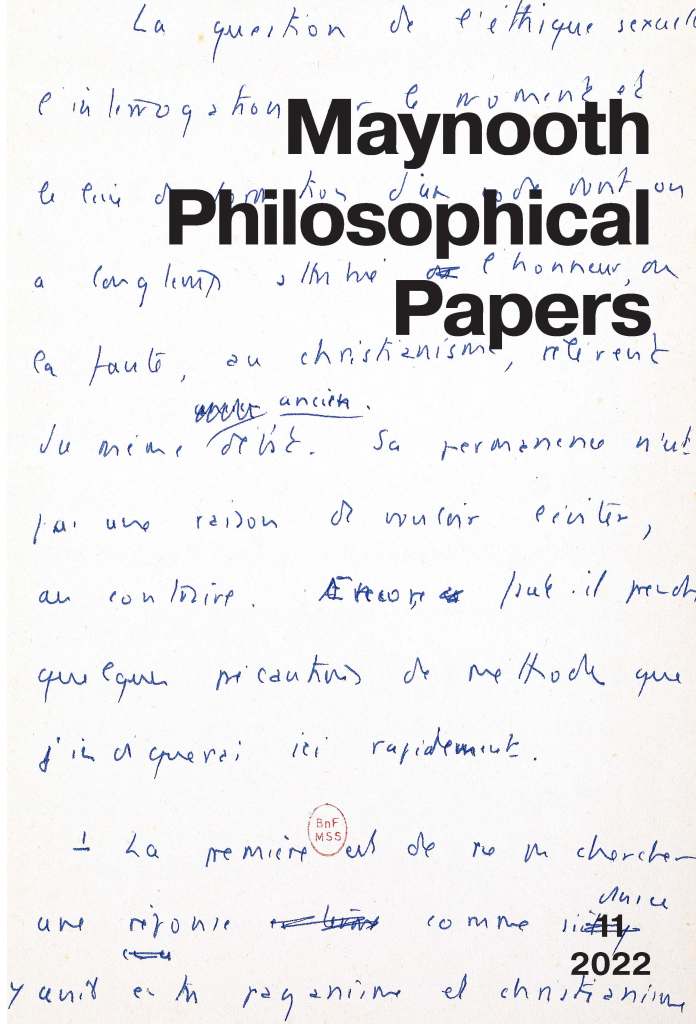
Volume 11 of Maynooth Philosophical Papers contains two articles that are of interest to Foucault scholars.
PDF of Table of Contents

Based on research in the Foucault Archives at the Bibliothèque nationale de France, Philippe Chevallier’s essay formulates, for the first time, a series of hypotheses concerning the stages in which Foucault composed the fourth volume of the History of Sexuality, over a period of more than six years. The three moments Chevallier distinguishes correspond to three different ways of approaching the initial problem, formulated in 1975, of the history of the confession of sexuality. Whereas scholars have hitherto assumed that Foucault abandoned his first project during a long period of doubts or hesitations, the archives show, on the contrary, a continuous and coherent work—which does not exclude major evolutions in terms of the corpus, periods, and themes studied. In particular, over the years Foucault’s project appears increasingly torn between two different histories: a history of confession, which was at the heart of the initial project, and a history of moral experience that, in an analysis of the self, ‘internalizes’ the history of sexuality.

Philipp Rosemann reviews the recently published volume Foucault, les Pères, le sexe (Paris: Éditions de la Sorbonne, 2021), which brings together papers delivered at a conference held in 2018 to mark the launch of the French text of volume 4 of the History of Sexuality. Rosemann’s review essay focuses on the contribution of the Foucault Archives to research on the philosopher’s thought; on critical reactions by patrologists to Foucault’s venture into study of the Church Fathers; and, finally, on the significance of the ‘Christian turn’ in the late Foucault’s lectures and writings.

-Philipp Roseman

Philippe Chevallier, The Birth of Confessions of the Flesh: A Journey through the Archives

The posthumous publication, in 2018, of Foucault’s Confessions of the Flesh, volume four of The History of Sexuality, defied expectations, both by his choice of the ancient authors he studied and by his broadening of the problems he explored. Based on the archives kept at the Bibliothèque nationale de France, this article formulates, for the first time, a series of hypotheses concerning the stages in which Foucault composed this ‘Christian’ volume over a period of more than six years. The three moments distinguished here correspond to three different ways of approaching the initial problem, formulated in 1975, of the history of the confession of sexuality. Whereas scholars have hitherto assumed that Foucault abandoned his first project during a long period of doubts or hesitations, the archives show, on the contrary, a continuous and coherent work—which does not exclude major evolutions in terms of the corpus, periods, and themes studied. In particular, over the years Foucault’s project appears increasingly torn between two different histories: a history of confession, which was at the heart of the initial project, and a history of moral experience, which, in an analysis of the self, interiorizes the history of sexuality.

Philipp W. Rosemann, On the ‘Christian Turn’ in Foucault’s Thought: A propos of Foucault, les Pères, le sexe

The recently published volume Foucault, les Pères, le sexe brings together sixteen papers delivered at a conference held in 2018 to mark the launch of Les aveux de la chair, the posthumous fourth volume of the History of Sexuality. This review essay focuses on the contribution of the Foucault Archives to research on the philosopher’s thought; on critical reactions by patrologists to Foucault’s venture into study of the Church Fathers; and, finally, on the significance of the ‘Christian turn’ in the late Foucault’s lectures and writings.

stuartelden's avatarProgressive Geographies

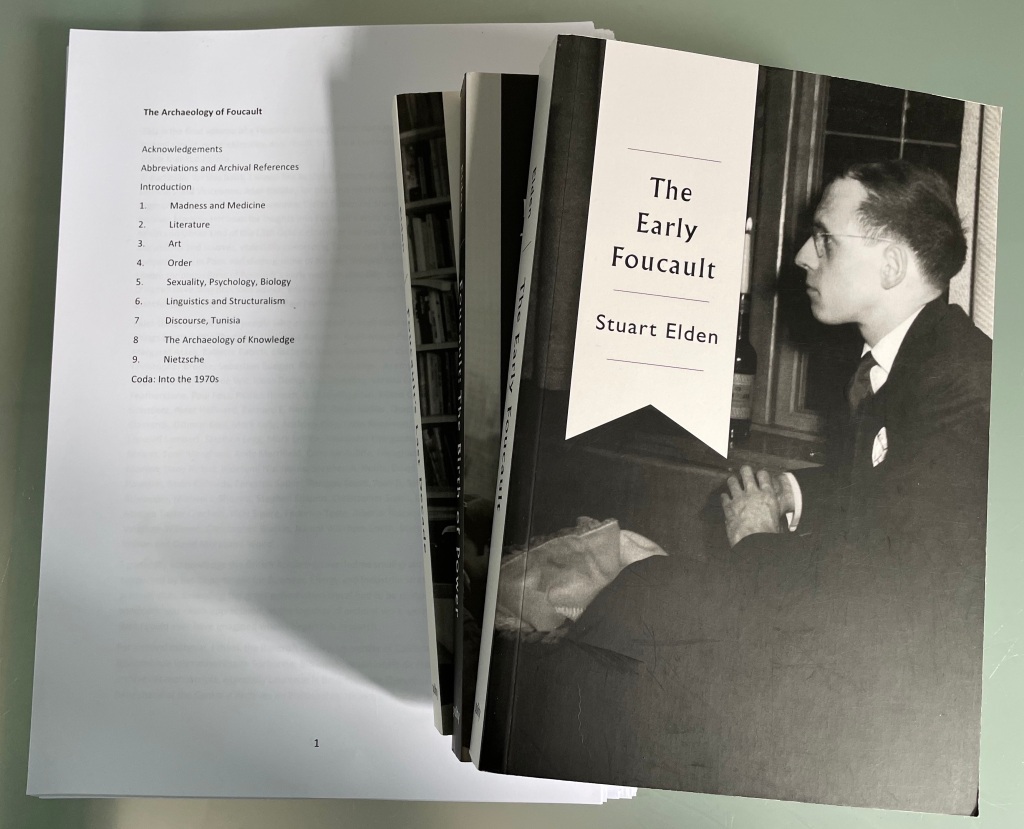
On Wednesday afternoon, I submitted the final, revised manuscript ofThe Archaeology of Foucaultto Polity. I’d submitted the manuscript for review in February during Warwick’s reading week, and had two very positive and useful reports back at the end of March. The final revisions were completed this week, and the book is now in production.

Finishing The Archaeology of Foucault is not just the end of a single book, but the final part of a four-part study. As I’ve said before, I didn’t imagine that it would be this extensive when I began work on Foucault’s Last Decade. But that book became two, with the first two chapters of Last Decade taken out, each split into three, and then each of those six sections developed into the chapters of Foucault: The Birth of Power. For a while I thought that was it, but decided that I should…

View original post 1,232 more words

Hassan, N.R., Lowry, P.B., Mathiassen, L.
Useful Products in Information Systems Theorizing: A Discursive Formation Perspective
(2022) Journal of the Association for Information Systems, 23 (2), pp. 418-446.

DOI: 10.17705/1jais.00730

Abstract
Although there is a growing understanding of theory building in the information systems (IS) field, what constitutes IS theory remains the subject of intense debate. Following Weick’s recommendation to focus on the products of theorizing rather than on what theories are, we assemble and analyze 12 products—question, paradigm, law, framework, myth, analogy, metaphor, model, concept, construct, statement, and hypothesis—that are rarely discussed together in any depth in the IS field and combine them into a coherent theorizing framework. Drawing on Foucault’s thesis of discursive formation we characterize the unique role of each product in IS theorizing and illustrate the usefulness of the framework in relation to both classical IS theorizing in the form of media richness theory as well as next-generation theorizing. © 2022 by the Association for Information Systems.

Author Keywords
Analogy; Concept; Construct; Discursive Formation; Framework; Hypothesis; Information Systems (IS) Theory; Law; Media Richness Theory; Metaphor; Model; Myth; Paradigm; Question; Statement; Theorizing

Index Keywords
Information use; Analogy, Concept, Construct, Discursive formation, Framework, Hypothesis, Information systems theory, Law, Media richness theory, Metaphor, Myth, Paradigm, Question, Statement, Theorizing; Information systems