Foucault News

News and resources on French thinker Michel Foucault (1926-1984)

Pierre Nora : ses années Gallimard,
Par Marie Bellan
Les Echos, Publié le 23 sept. 2022

Dans son dernier ouvrage à caractère autobiographique, l’historien Pierre Nora revient sur ses années d’universitaire et d’éditeur chez Gallimard, son amitié avec les auteurs qu’il a promus et la gestation, entre autres, de son grand oeuvre : « Les Lieux de mémoire ».

Ne dites surtout pas à Pierre Nora qu’il a écrit ses Mémoires, lui qui a pourtant été rendu célèbre par les sept volumes de ses « Lieux de mémoire ». C’est plutôt sous la forme d’un roman d’apprentissage qu’il est revenu, dans un précédent ouvrage, sur ses années de jeunesse ; et qu’il poursuit, cette fois, par ses années d’éditeur chez Gallimard – cinquante-sept ans rue Sébastien Bottin ! – et d’universitaire à l’Ecole des hautes études en sciences sociales (EHESS). A cheval entre deux mondes, donc, celui de l’université d’une part et de l’édition d’autre part, ce qui lui fait dire qu’il est un « marginal central ». Le livre est savoureux car il revient sur les grandes figures intellectuelles qui ont marqué la seconde moitié du XXe siècle – Foucault, Le Goff, Furet – mais c’est aussi une incursion dans l’intimité de la plus prestigieuse des maisons d’édition.
[…]

Michel Foucault. « En dépit de ma fascination pour lui et, de sa part, d’une amitié – que je crois vraie -, quelque chose me séparait de lui, plus que ses opinions politiques ou sa vie personnelle. Quelque chose que je n’arrive pas à appeler autrement que son indifférence à la vérité. […] Chez ce grand philosophe, ce n’est pas la vérité qui compte, c’est l’effet. Foucault est un homme à effet, mais quel effet ! En quelque sorte, d’une manière hautement intellectualisée, il annonçait et préparait le régime de la post-vérité. »
[…]

Ecoutez aussi sur France Culture
Épisode 4/4 : Pierre Nora, faire œuvre de Mémoires
Jeudi 15 septembre 2022

Siniša Malešević (2022) Are We All Foucauldians Now? “Culture Wars” and the Poststructuralist Legacy, Critical Review

DOI: 10.1080/08913811.2022.2122171

ABSTRACT
Michel Foucault’s philosophy has recently come under sharp criticism across the political spectrum. While right-wing and centrist commentators identify Foucault as the intellectual progenitor of “woke” dogmatism and an irrationalist hostility to science, left-wing critics associate his work with neoliberalism and animosity towards the welfare state. Neither critique is grounded in an accurate understanding of the epistemological motivation of Foucault’s project.

Keywords: Foucault, culture wars, identity politics, power, poststructuralism

Pourquoi Michel Foucault n’aimait-il pas les polémiques ?
France Culture, Radio France, Lundi 3 octobre 2022

Radio broadcast

Résumé
Le polémiste n’est-il pas celui qui avance “bardé de privilèges qu’il détient d’avance et que jamais il n’accepte de remettre en question” ?
En savoir plus

“J’aime discuter et aux questions qu’on me pose je tâche de répondre. Je n’aime pas, c’est vrai, participer à des polémiques. Si j’ouvre un livre où l’auteur taxe un adversaire de “gauchiste puéril”, aussitôt je le referme. Ces manières de faire ne sont pas les miennes ; je n’appartiens pas au monde de ceux qui en usent. À cette différence, je tiens comme à une chose essentielle : il y va de toute une morale, celle qui concerne la recherche de la vérité et la relation à l’autre”. Cet extrait d’un texte de Michel Foucault intitulé Polémique, politique et problématisations est paru en 1984, il y a près de 40 ans, mais il semble toujours d’une grande actualité.

Michel Foucault est un philosophe qui a profondément renouvelé nos connaissances sur l’histoire de la folie, de la prison et du pouvoir. Il a été aussi l’un des intellectuels français les plus fermement engagés pour défendre les causes qui lui tenaient à cœur. Pourtant, il n’a jamais confondu l’action politique et la réflexion savante. Le passage cité plus haut est une réponse aux intellectuels communistes qui lui reprochaient son engagement aux côtés des militants d’extrême gauche dans les années 1970. Mais les intellectuels d’extrême gauche s’étaient eux aussi attaqués à Foucault quelques années plus tôt. En 1966, Jean-Paul Sartre avait critiqué son ouvrage intitulé Les Mots et les choses en disant que c’était ” le dernier barrage que la bourgeoisie puisse encore dresser contre Marx”.
Publicité

“Gauchiste puéril”, “complice de la bourgeoisie”, nous avons là deux exemples de propos tenus par des gens appartenant à des camps politiques opposés, mais qui parlaient le même langage, celui du polémiste. Il s’avance, ajoutait Foucault, “bardé de privilèges qu’il détient d’avance et que jamais il n’accepte de remettre en question. Il possède, par principe, les droits qui l’autorisent à la guerre et qui font de cette lutte une entreprise juste ; il n’a pas en face de lui un partenaire dans la recherche de la vérité, mais un adversaire, un ennemi qui a tort, qui est nuisible et dont l’existence même constitue une menace”. Foucault n’ignorait pas que la polémique était une dimension constitutive du champ politique (…)

Bibliographie

Michel Foucault, Polémique, politique et problématisations, dans Dits et écrits, tome 4, Paris, Gallimard, 1994 (1984).

La chronique est à écouter dans son intégralité en cliquant sur le haut de la page. Histoire, économie, sciences, philosophie, histoire de l’art… Écoutez et abonnez-vous à la collection de podcasts “Le Pourquoi du comment” les meilleurs experts répondent à toutes les questions que vous n’osez poser.
Références

Thèmes associés
Sciences et savoirs
Histoire
Jean-Paul Sartre
Michel Foucault

L’équipe
Gérard Noiriel
Production
Daphné Leblond
Réalisation
Corinne Amar

GENEALOGY+CRITIQUE Special Issue, Vol 4 Issue 1, 2018. Articles in German

The collection “Foucault meets Latour,” edited by Simon Ganahl and Patrick Kilian, attempts to confront but also connect the thought of Michel Foucault and Bruno Latour. Equally interested in the question of modernity, both thinkers developed theoretical frameworks and conceptual toolboxes in order to analyze what it means or meant to be modern. The special issue was planned as a comparison of Foucault’s archaeological Order of Things (1966) and Latour’s anthropological Modes of Existence (2012), but transformed into a much broader exploration discovering a variety of linkages between their works. Discussing actor-network theory and dispositif analysis, the so-called post-factual age, the technological unconscious, as well as posthuman approaches to sociology, “Foucault meets Latour” has become a multicentric debate rather than the reconstruction of an intellectual dialogue.

Les archives de Michel Serres entrent à la Bibliothèque nationale de France
Les Univers du livre, 05/10/2022

Ce mercred 5 octobre, la Bibliothèque nationale de France annonce que ses collections seront enrichies par un fonds d’archives de près de 300 cahiers, manuscrits et dactylographies d’œuvres du philosophe et académicien Michel Serres.

Michel Serres (1930-2019) s’était rapproché de la BnF pour la conservation de ses archives. Celles-ci viennent de faire leur entrée par voie de dation dans les collections du département des Manuscrits de la BnF.

Ce riche fonds d’archives composé de cahiers, mais aussi de manuscrits et dactylographies de ses œuvres, ainsi que des cours et conférences qui étaient le matériau de départ de ses livres, sera prochainement mis à disposition des chercheurs pour l’étude et la recherche.

Grande figure intellectuelle du XXe siècle, Michel Serres fut formé après-guerre à l’École navale, ainsi qu’aux mathématiques, aux lettres classiques et à la philosophie. Éclectique et inclassable, il a évolué en marge des grands courants de sa génération, de l’existentialisme au post-structuralisme en passant par le marxisme.

Sa réflexion placée dès 1969 sous le patronage du dieu Hermès, dieu des réseaux, des carrefours et de la communication, n’a cessé de faire se rencontrer dans ses livres tous les savoirs, faisant se rejoindre les connaissances au premier regard les plus éloignées.

Les leçons du Tiers Instruit et du Contrat naturel ont fait date et sont aujourd’hui encore, plus que jamais, d’actualité. Professeur à Clermont-Ferrand où il côtoya Michel Foucault, il continua à enseigner à la célèbre université de Stanford, au côté de son ami René Girard, dont les archives sont elles aussi entrées dans les collections de la BnF en 2018.

Elisabetta Basso, Young Foucault. The Lille Manuscripts on Psychopathology, Phenomenology, and Anthropology, 1952–1955
Foreword by Bernard E. Harcourt. Translated by Marie Satya McDonough. Columbia University Press, 2022

In the 1950s, long before his ascent to international renown, Michel Foucault published a scant few works. His early writings on psychology, psychopathology, and anthropology have been dismissed as immature. However, recently discovered manuscripts from the mid-1950s, when Foucault was a lecturer at the University of Lille, testify to the significance of the work that the philosopher produced in the years leading up to the “archaeological” project he launched with History of Madness.

Elisabetta Basso offers a groundbreaking and in-depth analysis of Foucault’s Lille manuscripts that sheds new light on the origins of his philosophical project. She considers the epistemological style and methodology of these writings as well as their philosophical context and the scholarly networks in which Foucault was active, foregrounding his relationship to existential psychiatry. Young Foucault blurs the boundaries between biography and theory, exploring the transformations—and, at times, contradictions—that characterize the intellectual trajectory of a philosopher who, as Foucault himself put it, “turned to psychology, and from psychology to history.” Retracing the first steps of the philosopher’s intellectual journey, Basso shows how Foucault’s early writings provide key insights into his archaeological work of the 1960s. Assembling a vast array of archival sources—including manuscripts, reading notes, notes for lectures and conferences, and correspondence—this book develops a new and deeper understanding of Foucault’s body of work.

ABOUT THE AUTHOR
Elisabetta Basso is an assistant professor at the University of Pavia and a member of the Centre d’archives en philosophie, histoire et édition des sciences at the École normale supérieure of Paris.

Bernard E. Harcourt is a chaired professor at Columbia University and the École des hautes études en sciences sociales in Paris and has edited a range of works by Foucault in French and English.

Marie Satya McDonough is a Senior Lecturer in the College of Arts and Sciences Writing Program and the Women’s, Gender, and Sexuality Studies Program at Boston University.

CFP: Bridging the Divide: Beyond the Analytic and Continental Division

Submission deadline: November 15, 2022

Conference date(s):
March 2, 2023

Conference Venue:
Département de Philosophie, Université de Poitiers
Poitiers, France

Université de Poitiers, France – UFR Sciences Humaines et Arts

Co-organizers: Camille NERRIERE & Oliver NORMAN

In an interview given to Reason in 2000, John Searle revisited his relationship with continental philosophy. At the same time friendly and hostile, Searle opposed on the one hand Foucault and on the other Derrida. The latter was to be known in the article as practising the method of “terrorism of obscurantism”. Id est, Derrida is an author who knowingly writes in order to not be understood: he is obscure in so far as his constructs are ambiguous and overly complex. And when one tries to understand him, he reserves the right to declare that the reader, or the debater, has not understood. His philosophy would therefore be an exercise in ridiculing the reason of his reader and contradictors. Foucault on the other hand seems to be held in a higher esteem, belonging to a different ilk of continental philosophy, one who does not rely on confusing rhetoric and vague concepts.

Isn’t this obscurity, this complexity, the habitual view of continental philosophy in the eyes of whoever doesn’t practice it? An obscurity against which analytic philosophy attempts to put forward the rigor and clarity of a scientific methodology and an attention to meaningful language. Clarity and rigor against almost poetic, even mystic, effusion, and plays on words from philosophers attempting to achieve a literary status.

Even if this opposition seems to hold, we must recognize that there has been a dialogue between both traditions since the genesis of the division. If it is true that analytic philosophy and its founding fathers (such as Russell, Frege, or Carnap and the Vienna Circle) set themselves against an old metaphysical tradition, it is also true that this opposition implies that they read the philosophers of this tradition, and therefore a dialogue. In this regard, a study of Whitehead, considered as both an analytic philosopher (co-authoring the Principia Mathematica) and a continental philosopher (both based on his later writings and reception via Deleuze) could incite us to question this apparent impermeability between both schools.

Is the opposition between the two schools mere prejudice, born from a misunderstanding of one another’s methods? Did such a misunderstanding result in a rejection of one another by participants on either side of the linguistic barrier of the English language? Can we not find cases in which so-called continental philosophers communicate with analytic philosophers and vice versa : Wahl writes on Carnap, Russell, and logical positivism in L’Expérience métaphysique,Wittgenstein read Heidegger and Kierkegaard, Murdoch builds her thought upon Plato’s theories, considers her Oxford colleagues and the existentialists to be of the same ilk, and incessantly evokes Kant, Hegel, and Derrida in Metaphysics as a Guide to Morals… Is Derrida not, with Searle, one of the forces behind the continued use and debate around the concept of performativity which he inherits from Austin? More recently, French philosopher Jocelyn Benoist attempted to show the common foundations of both analytic philosophy and phenomenology in his work Représentations sans objet : Aux origines de la phénoménologie et de la philosophie analytique (PUF, 2001). Even if these foundations gave way to a difference in responses, differences which constituted the bases for two distinct methodologies, they share a common core: the question of referentiality.

Furthermore, if we can question the methodological opposition, we can also see, in contemporary philosophy, a reprisal of core themes historically associated to continental philosophy in the works of analytic philosophers. This is the case in feminist analytic philosophy, dialoguing with Putnam’s externalist tadition as well as with Butler (cf. Asta, Categories we live by, Oxford University Press, 2019).

This conference will attempt to question once again the possible distinction between analytic and continental philosophies. Far from any dogmatism, we invite proposals on the following themes, allowing either to reject or defend the distinction between the two:

Theme 1: Genesis of the analytic-continental distinction

Theme 2: Against the distinction – Comparative readings of philosophers from both traditions: can the dialogue between thinkers of both schools show that the chasm between them can be abolished?

Theme 3: In defence of the division: Can we, in light of the criticisms, assert a methodological difference between continental and analytic? If the second theme is a dialogue, then the third becomes a dialogue of the deaf, an impossible understanding between the two based on the speaking (and thinking) of a different language.

Keynote speakers

Mélissa Fox-Muraton. Philosophy teacher at the ESC Clermont Business School. Member of the PHIER Research Laboratory, Clermont-Auvergne University.

Elise Marrou, Lecturer, Sorbonne Université, Associate Member of the Husserl Archives

Submission guidelines

The conference is open to both senior and junior researchers, to doctoral students and graduate students largely construed in order to connect the voices of young researchers and their already established and esteemed colleagues.

Potential participants should submit a proposal (including title, keywords, and a max. 500 word abstract), together with a short bio-bibliographical note, to the following address: poitiersconference2023@gmail.com

Submissions must be received by November 15th 2022 at the latest

You will then receive a notification of acceptance or refusal by December 15th 2022

Please note that the Université de Poitiers unfortunately cannot guarantee funding for travel expenses.

Foucault Studies. Number 32, September 2022

Editorial
Sverre Raffnsøe

Articles
Foucault and Brown: Disciplinary Intersections
Niki Kasumi Clements

Askesis and Critique: Foucault and Benjamin
Ori Rotlevy

UK Lockdown Governmentalities: What Does It Mean to Govern in 2020?
Seb Sander

Book Reviews
Chloë Taylor, Foucault, Feminism and Sex Crimes: An Anti-Carceral Analysis. New York, and London: Routledge, 2019. Pp. 272.
ISBN: 9781138367319 (hardback).
Kurt Borg

Aliraza Javaid, Masculinities, Sexualities and Love. Abingdon & New York: Routledge, 2019. Pp. 189.
ISBN: 978-0-8153-8065-8 (hardback).
Andrea Colombo

Cory Wimberly, How Propaganda Became Public Relations: Foucault and the Corporate Government of the Public. Routledge: New York, 2020. Pp. 214.
ISBN: 978-0-367-26314-0 (hardback).
Fabio Cescon

Niki Kasumi Clements, Sites of the Ascetic Self: John Cassian and Christian Ethical Formation. Notre Dame, Indiana: University of Notre Dame Press, 2020. Pp. 280.
ISBN: 978-0-268-10785-7 (hardback).
William Tilleczek

Thomas Lemke, The Government of Things: Foucault and the New Materialisms. New York: NYU Press, 2021. Pp. 312.
ISBN: 9781479829934 (paperback).
Conor Bean

Paul Allen Miller, Foucault’s Seminars on Antiquity: Learning to Speak the Truth. London: Bloomsbury Academic, 2021. Pp. 232.
ISBN: 978-1474278669 (hardback).
Toon Meijaard

Stuart Elden, The Early Foucault. Cambridge: Polity, 2021. Pp. 281.
ISBN: 978-1-5095-2595-9 (hardback).
Jasper Friedrich

Karsten Schubert, Freiheit als Kritik: Sozialphilosophie nach Foucault. Bielefeld: transcript Verlag, 2018. Pp. 359.
ISBN: 978-3-8394-4317-6 (paperback).
Jonas Lang

stuartelden's avatarProgressive Geographies

This is a short account of an interesting event and a rather specialist request for help.

In the late 1960s, 1970s and early 1980s theInstitut collégial européen organised a series of events, most of which were reported in their annual Bulletin. I’m looking for the one reporting on a September 1970 event on structuralism.

The structuralism event was held at the Institut national des sciences et techniques nucléaires de Saclay, about 20 km southwest of Paris. It was co-sponsored by the Collège de France. It was organized by the mathematician André Lichnerowicz, the literary historian Gilbert Gadoffre and the economist François Perroux. Foucault attended and gave a talk on Dumézil. Also in attendance were a range of people including Suzanne Bachelard, Pierre Bourdieu, Georges Canguilhem, André Martinet, Jacques Monod, Clémence Ramnoux, Michel Serres, Gilbert Simonden and René Thom… Roland Barthes was invited but according to Gadoffre, after dithering for a…

View original post 373 more words

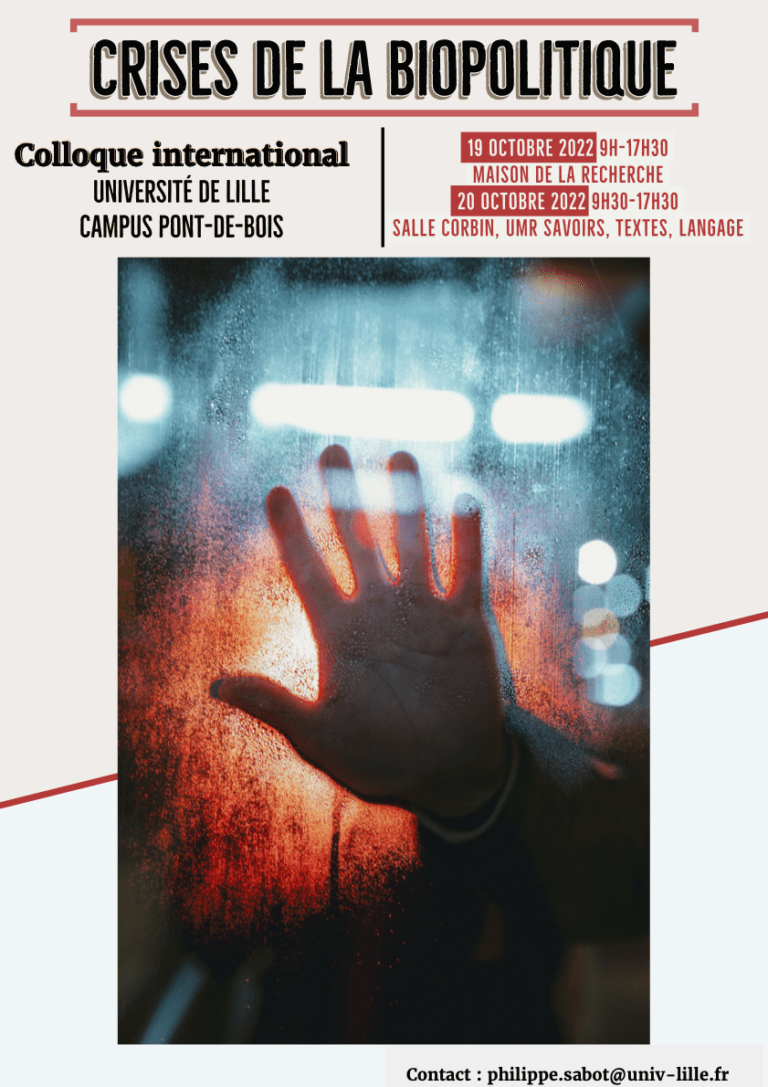
Crises de la biopolitique
Colloque International
Université de Lille, France
19-20 octobre 2022