Foucault News

News and resources on French thinker Michel Foucault (1926-1984)


Foucault Studies. Number 33, December 2022

Editorial
Sverre Raffnsøe et al

Articles
The Use and Misuse of Pleasure: Hadot contra Foucault on the Stoic Dichotomy Gaudium-Voluptas in Seneca
Matteo Johannes Stettler

The Subject of Desire and the Hermeneutics of Thoughts: Foucault’s Reading of Augustine and Cassian in Confessions of the Flesh
Herman Westerink

Philosophy From the texture of Everyday Life: The Critical-Analytic Methods of Foucault and J. L. Austin
Jasper Friedrich

Review essays
Foucault’s New Materialism: An Extended Review Essay of Thomas Lemke’s The Government of Things
Thomas Lemke, The Government of Things. New York: NYU Press, 2021. Pp. 312 (ISBN: 9781479808816 hardback)
Mark Olssen

Book Reviews
Marta Faustino and Gianfranco Ferraro (eds.), The Late Foucault: Ethical and Political Questions. London and New York: Bloomsbury Publishing, 2020. Pp. 304.
ISBN: 978-1350134355 (hardback).
Matteo Stettler

Bibliography of Foucault’s shorter works in English translation
by Richard Lynch.

Richard Lynch has updated his very valuable bibliography of Foucault’s shorter works in English translation. You can find the bibliography and associated material on this page on Foucault News

Daniele Lorenzini will be updating the Bibliography from 2023 onwards.

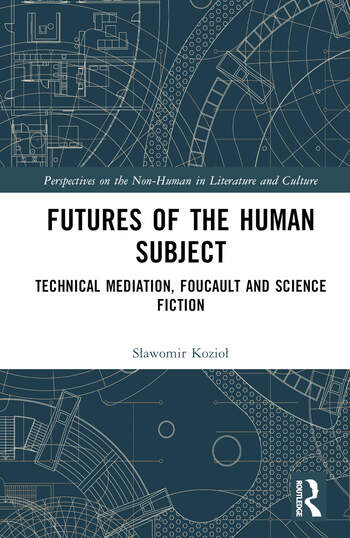
Sławomir Kozioł, Futures of the Human Subject. Technical Mediation, Foucault and Science Fiction, Routledge, 2022

Book Description
Futures of the Human Subject focuses on the representation of the effects of technology use on human subjectivity in several recent near-future science fiction novels. Sharing the idea that human subjects are constructed in the world in which they exist, this volume inscribes itself in the wider field of posthumanism which contests the liberal humanist notion of people as self-contained, autonomous agents. At the same time, it is the first substantial study of literary representations of the human subject carried out within the conceptual framework of Foucault-inflected philosophy of technical mediation, which examines the nature of the relation between people and specific technologies as well as the way in which this relation affects human subjectivity. As such, the book may help readers to exercise more effective control over the way in which they are constituted as subjects in this technologically saturated world.

Table of Contents
Introduction

Chapter 1. Technical Mediation, Subjectivity and Science Fiction

Early philosophy of technology and utopia/dystopia syndrome

Empirical turn

Posthuman perspective

Philosophy of technical mediation—key concepts

Technical mediation and Foucault

Modes of human–technology interaction

Ethics of technology

Science fiction

Chapter 2. The Circle: Embracing Social Media and Personal Transparency

Utopian vision of ICTs as subjectifying discourse

Self-conception, social self and the internet as archive

Subjectifying power of the algorithm

Pressure for social media activity

Gamification and the quantified self

Surveillance and personal transparency

Chapter 3. Rainbows End: New Vistas through Displays in Contacts

New life after Alzheimer’s

Materiality of discourse

Wearing: the physical mode

Cognitive enhancement

Personal interaction and multitasking

Belief circles and play

Cognitive labour and control

Chapter 4. Maddadam trilogy: Alleviating Existential Fears

Life in the Compounds

Ethical subjectification of God’s Gardeners

Makover culture

Producing patients

Becoming Crake

Author
Slawomir Koziol is an assistant professor at the University of Rzeszów, Poland. His academic interests include science fiction, posthumanism, theories of the human subject, philosophy of technical mediation, social space and new-media art. He has published articles in Critique: Studies in Contemporary Fiction, Extrapolation, Miscelánea: A Journal of English and American Studies, Papers on Language and Literature and Science Fiction Studies, among others.

Michael C. Behrent (2022) A Case for the Young Foucault, Critical Review,

DOI: 10.1080/08913811.2022.2152253

ABSTRACT
Between 1949 and 1961 (or, arguably, 1966), three interconnected dimensions of Foucault’s early thought emerged. First, the young Foucault offered a Hegelian perspective on Kant’s notion of the transcendental. The a priori conditions of thought, Foucault suggested, both shape and arise from historical experience. Second, Foucault drew on Heidegger’s study of Kant to argue that modern thought rests on the premise of human finitude and embraces a problematic epistemology rooted in philosophical anthropology. Foucault argued that anthropology enabled a vast extension of the scope of possible knowledge predicated on the falsely modest pretense that human understanding is inherently limited, even as it embraced a diminished conception of human existence. Third, Foucault developed a pointed critique of contemporary psychology and psychiatry, maintaining that they fallaciously seek to acquire positive knowledge of human beings, despite the fact the latter are inherently defined by what Foucault called “negativity.” This three-pronged interpretation of the young Foucault allows us to better situate Foucault’s work in intellectual history, to clarify his key arguments, and to grasp the articulation of his youthful and his mature thought.

Keywords: FoucaultvFreudvHegelvHeideggervNietzschevtranscendentalvyoung Foucault

Piasentier, M.
Foucault, Sellars, and the “conditions of possibility” of science
(2022) Philosophy and Social Criticism

DOI: 10.1177/01914537221131944

Abstract
Foucault and Sellars are representatives of conflicting philosophical traditions: whereas Foucault famously insisted that “power is everywhere,” Sellars proposed the well-known scientia mensura dictum. The tension between the two perspectives seems to be so strong that each of them ends up reducing the other to an epiphenomenal illusion. In this article, I shall attempt to show that the works of Sellars and Foucault are not necessarily irreconcilable. The common ground for this dialogue is what I shall define as a historico-practical conception of science. I will build this concept by tracing a connection between the Foucauldian notion of “conditions of possibility” of science and Sellars’s thesis about the “indispensability” of the manifest image. Finally, I will argue that this conception of science problematizes the clash between the scientific and manifest images of the world, paving the way for a different relationship between naturalism and critical theory. © The Author(s) 2022.

Author Keywords
critical theory; Foucault; naturalism; science; Sellars

Friedman, A.C., Mills, J.P., Gearity, B.
Natural science and culture grapple on the mat: an autoethnography of a wrestler’s rapid weight loss
(2022) Sports Coaching Review

DOI: 10.1080/21640629.2022.2111491

Abstract
Jean-Francois Lyotard’s iconic essay, The Post-modern Condition: A Report on Knowledge (1978) detailed the shifting nature of knowledge in post-industrial society that meant sciences had to find new ways to justify their claims, and education had to bring disciplinary knowledges together. Yet sport sciences and coach education retain a siloed disciplinary nature, and as a result have been criticised for lacking theoretical, critical and practical thought. Rapid weight loss (RWL) in combat and weight class sports is one example of a coach knowledge and practice that retains disciplinary boundaries. Despite a wealth of natural sport science research and recommendations evidencing numerous negative health and performance consequences, RWL remains as common as ever. Not mentioned in the natural scientific literature however, are any deeper social-cultural examinations of how RWL endures. Using a Foucauldian analysis of power relations in an auto-ethnography of one collegiate wrestler’s experiences, we examine the social forces surrounding RWL to demonstrate the importance of Lyotard’s post-modern call to bringing disciplines together for sports science and coach education. © 2022 Informa UK Limited, trading as Taylor & Francis Group.

Author Keywords
Autoethnography; Foucault; natural and social science; rapid weight loss

With all best wishes for Christmas, New Year and the festive season from Foucault News.

Square Michel Foucault, Paris

Gaughwin, M.
“The Apple Way”: Foucault, Design, Consumerism, and the Shaping of Apple Subjects
(2022) Design and Culture

DOI: 10.1080/17547075.2022.2122115

Abstract
The contribution Michel Foucault’s thoughts on power, in particular his ideas of subjectivity, freedom, and action, might have to the study of design’s ontological shaping of people is an emerging field of inquiry in the academy. Using a Foucauldian lens, this paper presents findings from semi-structured interviews with iPhone® users that speak to the ways Apple consumers are constituted into Apple subjects by what I refer to as “the Apple Way.” The ineradicable relationship between discourses of design and consumerism and their imperative to “better” human life is presented as a starting point. The iPhone as a technological device that “makes life better” for Apple consumers is critiqued; data reveals an uneasy reliance people have on the iPhone for their everyday life.

Author Keywords
Apple Inc; consumerism; design; Foucault; iPhone; power

Herzog, B., Lance Porfillio, A.
Talking with racists: insights from discourse and communication studies on the containment of far-right movements
(2022) Humanities and Social Sciences Communications, 9 (1)

DOI: 10.1057/s41599-022-01406-y

Abstract
The rise of the far right is threatening the antifascist consensus that helped rebuild Europe and the world following World War II. Discourse studies have done much to further the understanding of the success as well as the fallacies of the discourses of far-right movements and have provided the means by which to comprehend right-wing communicative strategies. However, it has also been said that the reactions of the democratic majority and the mainstream media have contributed—mainly involuntarily—to the success of right-wing politics. The role of the reactions of society, the democratic majority and the mainstream media in trying to counter right-wing discourses is widely underexplored. The aim of this contribution is to understand the diverse material and symbolic effects of certain practices of political contestation. It aims to help elaborate counterstrategies against the threat of the far right and to present communicative strategies against hate. With the help of such diverse authors as Foucault, Goffman or Habermas, we will show how democratic positions seem to be in an ideological dilemma in which the speech acts that try to counter far-right discourses very often produce the opposite effect. The article can help to overcome the pitfalls and performative contradictions of some discursive practices especially in public communications. © 2022, The Author(s).

Magwa, L., Mohangi, K.
Using theoretical frameworks to analyze democratic student–teacher engagement and autonomous learning for academic achievement in Zimbabwe
(2022) Frontiers in Education, 7, art. no. 925478

DOI: 10.3389/feduc.2022.925478

Abstract
Positive student–teacher engagement that fosters independent and supported learning is the fulcrum for academic success. This paper investigates stakeholder opinions on the intrinsic importance of a democratic student–teacher relationship and autonomous learning in mediating students’ academic progress in Zimbabwean secondary schools. This case study’s qualitative data was gathered through interviews and focus groups. We used Foucault’s theory of power relations and the self-determination theory of motivation to frame our findings. The 40 participants from two secondary schools were general teachers (n = 12), guidance and counseling teachers (n = 2), educational psychologists (n = 2), and form 5 students (n = 24), selected through purposive sampling techniques. The data were analyzed using the thematic content analysis approach. Findings revealed participants’ perceptions that democratic student–teacher relationships and autonomous learning opportunities may serve as a panacea to enhance students’ participation, motivation, and overall academic performance. The study recommends in-service training to teachers regarding policies, directives, and public acts that inform and educate on how student–teacher relationships may be enhanced to foster autonomous learning. Future longitudinal studies could investigate the long-term effects of positive student–teacher engagement and teacher-supported autonomous learning on student academic achievement. Copyright © 2022 Magwa and Mohangi.

Author Keywords
academic achievement; autonomous and guided learning; Foucault’s theory of power relations; self-determination; student-teacher relationship