Foucault News

News and resources on French thinker Michel Foucault (1926-1984)

Jubas, K.
More than a Confessional Mo(ve)ment? #MeToo’s Pedagogical Tensions
(2022) Adult Education Quarterly

DOI: 10.1177/07417136221134782

Abstract
In this article, I explore the pedagogical function of #MeToo, highlighting what it might teach about gender-based mistreatment and mainstreamed feminism. I begin by reviewing linkages between adult education and social movements, then trace the development of #MeToo, drawing on both media and scholarly texts. Next, I apply the concepts of feminist snap and neoliberal feminism, layered on top of Foucault’s thoughts on confession, to examine how #MeToo has been shaped by the newer phenomena of neoliberalism and social media, and the older phenomena of feminism and social inequities. The role of confession in social ideals of the feminine, feminist activism, and neoliberalism becomes a steady consideration. My analysis illuminates tensions in globalized feminist activism, and possibly other types of equity-seeking movements, and the adult learning and education that it fosters. © The Author(s) 2022.

Author Keywords
#MeToo; confession; feminist snap; neoliberal feminism; social movement learning

Poster for sale – click picture

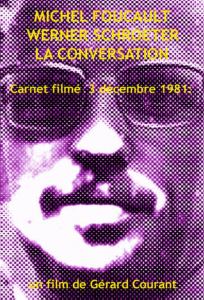
MICHEL FOUCAULT WERNER SCHROETER, LA CONVERSATION (CARNET FILMÉ : 3 décembre 1981)
Année : 1981. Durée : 1 H 30′

Voir aussi BNF Catalogue Général

An English translation of the conversation between Foucault and Schroeter can be found in Foucault at the Movies

Fiche technique : Réalisation, montage, son, effets spéciaux : Gérard Courant.
Voix : Michel Foucault, Werner Schroeter, Gérard Courant.
Postproduction : Gérard Courant, Pierre Laudijois.
Production : Les Amis de Cinématon, Les Archives de l’Art Cinématonique, La Fondation Gérard Courant.

Présentation

Michel Foucault Werner Schroeter, la conversation (1981) est, après Vivre à Naples et mourir (1978) et Il faut le sauver ! (1980) et avant Werner et Nenad (2009), la troisième des quatre rencontres cinématographiques que j’ai eues avec Werner Schroeter. À la différence des deux premières, cette fois-ci, une personnalité extérieure à l’oeuvre du cinéaste allemand s’est jointe à cette rencontre. Mais quelle personnalité ! : le grand philosophe Michel Foucault.

En 1973, à l’époque de la sortie de La Mort de Maria Malibran, Michel Foucault fut enthousiasmé par ce film. À cette occasion, le philosophe écrivit un très beau texte poétique qui enchanta Werner Schroeter et, depuis, chaque fois qu’on lui demandait ce qu’il pensait de ce qu’on écrivait sur ses films, le réalisateur d’Eika Katappa rendait invariablement hommage à ce texte de Michel Foucault, qu’il tenait pour l’analyse la plus pertinente et la plus juste consacrée à son travail. Mais le philosophe et le cinéaste ne se connaissaient pas. Ainsi, quand je lui proposais d’écrire un livre sur son œuvre, Werner Schroeter accepta l’idée avec joie mais il insista pour que j’organise une rencontre informelle entre lui et le philosophe. Ce que je fis. Nous nous rencontrâmes, Werner Schroeter, Michel Foucault et moi, chez le philosophe au début du mois de décembre 1981. La discussion qui s’en suivit se déroula dans les conditions d’une rencontre amicale : Michel Foucault était allongé sur la moquette et Werner Schroeter, assis face à lui, animait l’espace de ses grands gestes et de sa voix puissante. Entre eux, un magnétophone enregistrait leur dialogue. Quant à moi, après avoir mis mon duo en situation, j’avais choisi de rester le plus discret possible afin de ne pas interférer leur dialogue. Ils ont longuement discuté.

La transcription de cette discussion se trouve dans le livre Werner Schroeter, édité en janvier 1982 par la Cinémathèque française et le Goethe-Institut de Paris dans un chapitre intitulé Conversation.

Ce dialogue fut ensuite mis en images. Mais la qualité technique de cet enregistrement est médiocre et, parfois, la conversation est difficilement audible. Nous avons préféré la conserver et la livrer telle quelle au spectateur afin de ne rien manquer de cette rencontre au sommet.

Michel Foucault et Werner Schroeter parlent de la passion, du suicide, de la mort et de l’homosexualité. Ils parlent aussi de Patrice Chéreau, Daniel Schmid, Ingrid Caven, Maria Callas, Jean Eustache, Antonio Orlando, Magdalena Montezuma et Christine Kaufmann.

Les deux hommes abordent aussi les films du cinéaste : La Mort de Maria Malibran, Willow Springs, Le Règne de Naples, Palermo oder Wolfsburg et l’opéra Lohengrin de Richard Wagner, mis en scène par Werner Schroeter.

(Gérard Courant)

[…]

PASSION
Imaginez deux hommes allongés sur la moquette d’un petit appartement, au mois de décembre 1981. Le premier est un immense philosophe chauve. Le second, un jeune cinéaste underground allemand, très grand, les mains pleines de bagues, visage à la Dürer, de longs cheveux blonds portés jusqu’à la taille, qu’il coiffe d’un Stetson. Ils ont en commun l’intelligence, la culture, l’homosexualité et une idée peu commune du suicide : ils disent n’avoir plus peur de la mort. Et comme pour défier cette dernière, ils préféreront toujours la passion à l’amour, parce que, selon le philosophe, « elle est portée à l’incandescence, elle se détruit elle-même ». (1)
(1) Anecdote rapportée par Gérard Courant dans sa monographie (Goethe Institut/Cinémathèque française, 1982)
(Philippe Azoury, Werner Schroeter la mort en face, Libération, 14 avril 2010)

THE STRONG IMPRESSION
The young film critic Gérard Courant brought us together in Paris in Décember 1981. He was working on a book, a companion to my work that would describe my productions of films and live theater in essays and interviews, so a conversation with Foucault fitted into it neatly. The slim volume was published to accompagny a retrospective of my work, arranged by the Goethe Institute in Paris at the Cinémathèque française the following year. My conversation with Foucault was also published in his postumous writings, but when I reread it, I could no longer summon up the strong impression that our meeting had originally made on me.
(Werner Schroeter avec Claudia Lenssen, Days of Twilight Nights of Frenzy : A Memoir, 2017)


Emanuele IULA, “La crisi della parresia. Il problema delle eredità difficili in una prospettiva foucaultiana”, Ho theológos, 2022 (1), pp. 73-92).

Abstract in English
The article aims to offer a deconstruction of the foucauldian notion of parresia. The problem of sexual abuse in the Church and the ecological crisis create an attitude of mistrust vis-à-vis past generations and their legacy. In order to provide both a theoretical and ethical solution to this problem, the article will delineate a second generation parrhesia in which two new elements find a place: a critic of the transmissions happening between different generations and an ethic of the sacrifice for those who receive difficult heritages.

Keywords: parresia, transmission, truth, margins, sacrifice.

Special Issue on Neo-Victorian Heterotopias, Humanities (2022)

Kohlke, Marie-Luise, Elizabeth Ho, and Akira Suwa. 2022. “Heterotopic and Neo-Victorian Affinities: Introducing the Special Issue on Neo-Victorian Heterotopias” Humanities 11, no. 1: 8. https://doi.org/10.3390/h11010008

Wadoux, Charlotte. 2022. ““The World Had Forgotten about Us”: Heterotopian Resistance in Richard Flanagan’s Wanting and Lloyd Jones’s Mister Pip” Humanities 11, no. 1: 9. https://doi.org/10.3390/h11010009

Fritz, Sonya Sawyer, and Sara K. Day. 2022. “Young Adult Crisis Heterotopias and Feminist Revisions in Colleen Gleason’s Stoker and Holmes Series” Humanities 11, no. 1: 16. https://doi.org/10.3390/h11010016

Kohlke, Marie-Luise. 2022. “Heterotopic Proliferation in E. S. Thomson’s Jem Flockhart Series” Humanities 11, no. 1: 15. https://doi.org/10.3390/h11010015

Krentz, Courtney, Mike Perschon, and Amy St. Amand. 2022. “Their Own Devices: Steampunk Airships as Heterotopias of Crisis and Deviance” Humanities 11, no. 1: 14. https://doi.org/10.3390/h11010014

Tronicke, Marlena. 2022. “Heterotopian Disorientation: Intersectionality in William Oldroyd’s Lady Macbeth” Humanities 11, no. 1: 13. https://doi.org/10.3390/h11010013

Ho, Elizabeth. 2022. “Heterotopic Heritage in Hong Kong: Tai Kwun and Neo-Victorian Carceral Space” Humanities 11, no. 1: 12. https://doi.org/10.3390/h11010012

Braid, Barbara. 2022. “Neo-Victorianism as a Cemetery: Heterotopia and Heterochronia in Tracy Chevalier’s Falling Angels and Audrey Niffenegger’s Her Fearful Symmetry” Humanities 11, no. 1: 11. https://doi.org/10.3390/h11010011

Ioannidou, Elisavet. 2022. “From Crisis to Compensation: Reinventing Identity and Place in the Sideshow and the Laboratory” Humanities 11, no. 1: 10. https://doi.org/10.3390/h11010010

Suwa, Akira. 2022. “Heterotopic Potential of Darkness: Exploration and Experimentation of Queer Space in Sarah Waters’s Neo-Victorian Trilogy” Humanities 11, no. 1: 5. https://doi.org/10.3390/h11010005

Esser, Helena. 2021. “Re-Calibrating Steampunk London: Heterotopia and Spatial Imaginaries in Assassins Creed: Syndicate and The Order 1886” Humanities 10, no. 1: 56. https://doi.org/10.3390/h10010056

Mark Shepard, There Are No Facts. Attentive Algorithms, Extractive Data Practices, and the Quantification of Everyday Life, MIT Press, 2022

The entanglements of people and data, code and space, knowledge and power: how data and algorithms shape the world—and shape us within that world.

With the emergence of a post-truth world, we have witnessed the dissolution of the common ground on which truth claims were negotiated, individual agency enacted, and public spheres shaped. What happens when, as Nietzsche claimed, there are no facts, but only interpretations? In this book, Mark Shepard examines the entanglements of people and data, code and space, knowledge and power that have produced an uncommon ground—a disaggregated public sphere where the extraction of behavioral data and their subsequent processing and sale have led to the emergence of micropublics of ever-finer granularity.

Shepard explores how these new post-truth territories are propagated through machine learning systems and social networks, which shape the public and private spaces of everyday life. He traces the balkanization and proliferation of online news and the targeted distribution of carefully crafted information through social media. He examines post-truth practices, showing how truth claims are embedded in techniques by which the world is observed, recorded, documented, and measured. Finally, he shows how these practices play out, at scales from the translocality of the home to the planetary reach of the COVID-19 pandemic—with stops along the way at an urban minimarket, an upscale neighborhood for the one percent, a Toronto waterfront district, and a national election.

Author
Mark Shepard is Associate Professor of Architecture and Media Study at the University at Buffalo, State University of New York, where he directs the Media Arts and Architecture Program (MAAP) and the Center for Architecture and Situated Technologies (CAST). He is the editor of Sentient City (MIT Press). His work has been exhibited at museums, galleries, and festivals internationally.

Review
[…]
In ‘There Are No Facts: Attentive Algorithms, Extractive Data Practices, and the Quantification of Everyday Life’ (The MIT Press, £22.50, ISBN 9780262047470), Mark Shepard, associate professor of architecture and media study at the University of Buffalo, State University of New York, draws from contemporary thinkers like Zuboff and Joy Buolamwini, as well as the likes of Hannah Arendt, Bruno Latour, Friedrich Nietzsche and Michel Foucault, to present a theory of ‘post-truth spatiality’.

Theoretical Puppets: G is for Genealogy (Michel Foucault), December 12 2022
Genealogy is a crucial concept in Foucault’s conception of historical research. Here, he explains the difference between “genealogy” and “archaeology.” He also discusses his important essay on “Nietzsche, Genealogy, History,” underscoring the importance of masquerades and “concerted carnivals.” However, he leaves open the question as to whether or not he himself is part of this historical theater…

Alessandro Michele’s five best moments at Gucci, Hunger, 24 November 2022

Following last night’s news that Michele will be departing Gucci, HUNGER takes a look back at some of his best sartorial moments, as we bid farewell to his double G genius for now.

[…]
Message for the masses

The SS20 Gucci show was opened by a series of ivory and beige reformulated straight jackets. “Biopolitics,” Michele said of the show, “it’s the power over life and body. The power that legitimises some existences, confining others. A power that imposes conducts and paths, that prescribes thresholds of normality, classifying and curbing identity, and chaining it to what is preconceived.” Quoting French philosopher Michel Foucault in his inspiration, the blank-designed jackets represented that through fashion, power is the ultimate force that is exercised. Model Hari Nef even made her own personal protest in the show, writing ‘Mental Health is not fashion’ on her palm. Michele explained that the designs block and restrict to make the individual anonymous, and go past individual expression to reflect upon uniformity. Though with no intention of glamorising mental illness, the message Michele put out was further reinforced when he revealed the jackets were not for sale, and were for those who chose to listen carefully.

[…]

Leib, R.S.
Goffman and Foucault: Framing the micro-physics of power
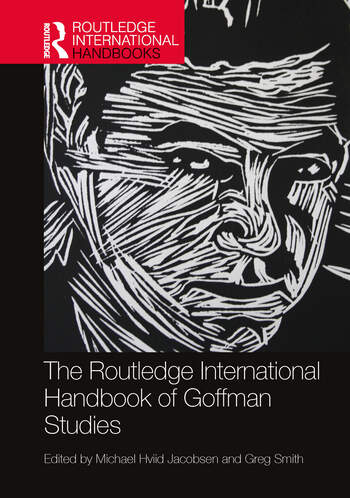
(2022) The Routledge International Handbook of Goffman Studies
Edited By Michael Hviid Jacobsen, Greg Smithpp, Routledge, 349-360.

DOI: 10.4324/9781003160861-33

Abstract
The works of Erving Goffman and Michel Foucault are theoretically and practically complementary in many ways. First, I review areas of overlap between Goffman and Foucault’s perspectives and methods. Second, I describe several higher-order concepts – order, episteme, regime, framing, agonism, and containment – which for both thinkers describe the relations between individuals and institutions. Third, I develop their connection through Foucault’s disciplinary power – highlighting concepts of territory, visibility, documentation, mortification, and looping – which describe the primary techniques of analysing space and controlling the distribution and interaction of bodies within it. Fourth, I argue that their analyses are also complementary under what Foucault calls security power. I establish this by analysing Foucault’s 1978 lectures, Security, Territory, Population (2007), alongside Goffman’s Strategic Interaction (1969). From Foucault, I focus on the concepts of risk, population, and danger, which describe how governments aim to keep all individual choices within an acceptable range. I propose a new figure of selfhood arising through population management, the ‘statistical self’, which describes the risks inherent in one’s demographic identity. From Goffman, I draw concepts of strategic interaction and gameworthiness, and I propose the concept of the ‘security self’, the existential object of an individual’s experience within a security milieu.

Hofmeyr, B.
Knowledge work in the age of control: capitalising on human capital
(2022) Acta Academica, 54 (1), pp. 40-68.

DOI: 10.18820/24150479/aa54i1/3

Abstract
The main claim that I aim to substantiate in this article is that power in the form of control is exerted in a more insidious manner now that knowledge work has become ‘networked’. To this end, I first describe societal control in the current epoch. Given the fact that my focus is on knowledge work, I next revisit the human capital literature with the aim of coming to a more precise understanding of what knowledge work is. The literature on “leveraging human capital” (Burud and Tumolo 2004) evidences how human capital theory draws on the conditions of free-floating control to optimally capitalise on knowledge workers. Models of overt management have come to be replaced by more expansive and insidious models of control that extend beyond the sphere of work into the intimate recesses of private life. Control operative at the societal level (Castells 1996) extends beyond the macro-level (neoliberal), to the meso-level (organisational), and the micro-level (self-governance). Next, I critically consider the implications of these conditions of control for the (self-)governance of the knowledge worker by drawing on Han’s (2017) further specification of control as “smart power”. I come to the conclusion that under the conditions of apparently greater autonomy and discretion that is so pervasive in the management literature discussing knowledge workers, governance as “control” induces constant work erasing the boundaries between work and private life. Neoliberalism with its mantra of investment in human capital has succeeded in producing an optimally efficient, ever-working subject. Throughout my analyses are informed by Foucault’s (2008) concept of “governmentality”, which fuses the presiding rationality (knowledge) with governance (power as control) to throw light on how human conduct is being conducted (orchestrated) for optimal efficiency. © Creative Commons With Attribution (CC-BY).

Author Keywords
control; human capital; Knowledge work; neoliberal governmentality; organisations

Villadsen, K.
Goodbye Foucault’s ‘missing human agent’? Self-formation, capability and the dispositifs (2022) European Journal of Social Theory

DOI: 10.1177/13684310221125350

Abstract
A steady stream of commentary criticizes Foucault’s ‘agentless position’ for its inability to observe, much less theorize, the ways in which human actors manoeuvre, negotiate, transform or resist the structures within which they are situated. This article does not so much refute this critical consensus but seeks to reconstruct a framework from Foucault’s writings, which allows space for ‘human agency’, including individuals’ pursuit of tactics, attempts at solving problems, reactions to unexpected events and their reflexive work on their own subjectivities. The revised analytical framework, ‘dispositional analytics’, integrates the study of self-techniques with the analysis of dispositifs. Recognizing that Foucault’s work eschewed an adequate consideration of individuals’ capacity to affect the forces that bear upon them, the article discusses the sociopolitical conditions for self-formation. Finally, a case study of ‘voice-hearers’ who use self-techniques to reconstitute themselves in opposition to institutional psychiatry is reinterpreted through the framework of dispositional analysis. © The Author(s) 2022.

Author Keywords
Agency; capability; dispositif; Foucault; self-techniques