
Foucault News

News and resources on French thinker Michel Foucault (1926-1984)

Special Issue on Neo-Victorian Heterotopias, Humanities (2022)

Kohlke, Marie-Luise, Elizabeth Ho, and Akira Suwa. 2022. “Heterotopic and Neo-Victorian Affinities: Introducing the Special Issue on Neo-Victorian Heterotopias” Humanities 11, no. 1: 8. https://doi.org/10.3390/h11010008

Wadoux, Charlotte. 2022. ““The World Had Forgotten about Us”: Heterotopian Resistance in Richard Flanagan’s Wanting and Lloyd Jones’s Mister Pip” Humanities 11, no. 1: 9. https://doi.org/10.3390/h11010009

Fritz, Sonya Sawyer, and Sara K. Day. 2022. “Young Adult Crisis Heterotopias and Feminist Revisions in Colleen Gleason’s Stoker and Holmes Series” Humanities 11, no. 1: 16. https://doi.org/10.3390/h11010016

Kohlke, Marie-Luise. 2022. “Heterotopic Proliferation in E. S. Thomson’s Jem Flockhart Series” Humanities 11, no. 1: 15. https://doi.org/10.3390/h11010015

Krentz, Courtney, Mike Perschon, and Amy St. Amand. 2022. “Their Own Devices: Steampunk Airships as Heterotopias of Crisis and Deviance” Humanities 11, no. 1: 14. https://doi.org/10.3390/h11010014

Tronicke, Marlena. 2022. “Heterotopian Disorientation: Intersectionality in William Oldroyd’s Lady Macbeth” Humanities 11, no. 1: 13. https://doi.org/10.3390/h11010013

Ho, Elizabeth. 2022. “Heterotopic Heritage in Hong Kong: Tai Kwun and Neo-Victorian Carceral Space” Humanities 11, no. 1: 12. https://doi.org/10.3390/h11010012

Braid, Barbara. 2022. “Neo-Victorianism as a Cemetery: Heterotopia and Heterochronia in Tracy Chevalier’s Falling Angels and Audrey Niffenegger’s Her Fearful Symmetry” Humanities 11, no. 1: 11. https://doi.org/10.3390/h11010011

Ioannidou, Elisavet. 2022. “From Crisis to Compensation: Reinventing Identity and Place in the Sideshow and the Laboratory” Humanities 11, no. 1: 10. https://doi.org/10.3390/h11010010

Suwa, Akira. 2022. “Heterotopic Potential of Darkness: Exploration and Experimentation of Queer Space in Sarah Waters’s Neo-Victorian Trilogy” Humanities 11, no. 1: 5. https://doi.org/10.3390/h11010005

Esser, Helena. 2021. “Re-Calibrating Steampunk London: Heterotopia and Spatial Imaginaries in Assassins Creed: Syndicate and The Order 1886” Humanities 10, no. 1: 56. https://doi.org/10.3390/h10010056
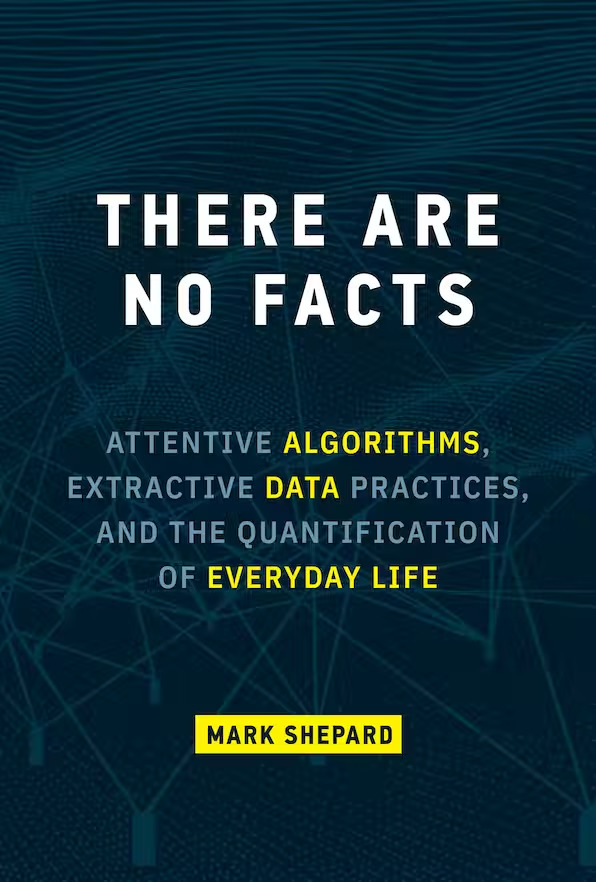
Mark Shepard, There Are No Facts. Attentive Algorithms, Extractive Data Practices, and the Quantification of Everyday Life, MIT Press, 2022

The entanglements of people and data, code and space, knowledge and power: how data and algorithms shape the world—and shape us within that world.

With the emergence of a post-truth world, we have witnessed the dissolution of the common ground on which truth claims were negotiated, individual agency enacted, and public spheres shaped. What happens when, as Nietzsche claimed, there are no facts, but only interpretations? In this book, Mark Shepard examines the entanglements of people and data, code and space, knowledge and power that have produced an uncommon ground—a disaggregated public sphere where the extraction of behavioral data and their subsequent processing and sale have led to the emergence of micropublics of ever-finer granularity.

Shepard explores how these new post-truth territories are propagated through machine learning systems and social networks, which shape the public and private spaces of everyday life. He traces the balkanization and proliferation of online news and the targeted distribution of carefully crafted information through social media. He examines post-truth practices, showing how truth claims are embedded in techniques by which the world is observed, recorded, documented, and measured. Finally, he shows how these practices play out, at scales from the translocality of the home to the planetary reach of the COVID-19 pandemic—with stops along the way at an urban minimarket, an upscale neighborhood for the one percent, a Toronto waterfront district, and a national election.

Author
Mark Shepard is Associate Professor of Architecture and Media Study at the University at Buffalo, State University of New York, where he directs the Media Arts and Architecture Program (MAAP) and the Center for Architecture and Situated Technologies (CAST). He is the editor of Sentient City (MIT Press). His work has been exhibited at museums, galleries, and festivals internationally.

Review
[…]
In ‘There Are No Facts: Attentive Algorithms, Extractive Data Practices, and the Quantification of Everyday Life’ (The MIT Press, £22.50, ISBN 9780262047470), Mark Shepard, associate professor of architecture and media study at the University of Buffalo, State University of New York, draws from contemporary thinkers like Zuboff and Joy Buolamwini, as well as the likes of Hannah Arendt, Bruno Latour, Friedrich Nietzsche and Michel Foucault, to present a theory of ‘post-truth spatiality’.

Theoretical Puppets: G is for Genealogy (Michel Foucault), December 12 2022
Genealogy is a crucial concept in Foucault’s conception of historical research. Here, he explains the difference between “genealogy” and “archaeology.” He also discusses his important essay on “Nietzsche, Genealogy, History,” underscoring the importance of masquerades and “concerted carnivals.” However, he leaves open the question as to whether or not he himself is part of this historical theater…

Alessandro Michele’s five best moments at Gucci, Hunger, 24 November 2022

Following last night’s news that Michele will be departing Gucci, HUNGER takes a look back at some of his best sartorial moments, as we bid farewell to his double G genius for now.

[…]
Message for the masses

The SS20 Gucci show was opened by a series of ivory and beige reformulated straight jackets. “Biopolitics,” Michele said of the show, “it’s the power over life and body. The power that legitimises some existences, confining others. A power that imposes conducts and paths, that prescribes thresholds of normality, classifying and curbing identity, and chaining it to what is preconceived.” Quoting French philosopher Michel Foucault in his inspiration, the blank-designed jackets represented that through fashion, power is the ultimate force that is exercised. Model Hari Nef even made her own personal protest in the show, writing ‘Mental Health is not fashion’ on her palm. Michele explained that the designs block and restrict to make the individual anonymous, and go past individual expression to reflect upon uniformity. Though with no intention of glamorising mental illness, the message Michele put out was further reinforced when he revealed the jackets were not for sale, and were for those who chose to listen carefully.

[…]

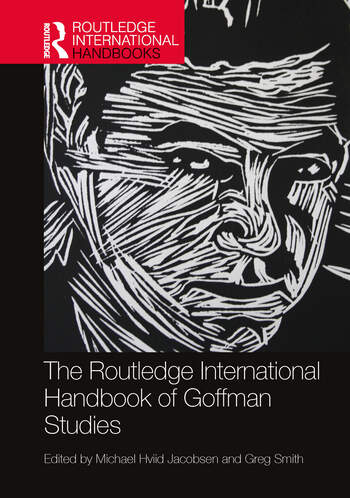
Leib, R.S.
Goffman and Foucault: Framing the micro-physics of power
(2022) The Routledge International Handbook of Goffman Studies
Edited By Michael Hviid Jacobsen, Greg Smithpp, Routledge, 349-360.

DOI: 10.4324/9781003160861-33

Abstract
The works of Erving Goffman and Michel Foucault are theoretically and practically complementary in many ways. First, I review areas of overlap between Goffman and Foucault’s perspectives and methods. Second, I describe several higher-order concepts – order, episteme, regime, framing, agonism, and containment – which for both thinkers describe the relations between individuals and institutions. Third, I develop their connection through Foucault’s disciplinary power – highlighting concepts of territory, visibility, documentation, mortification, and looping – which describe the primary techniques of analysing space and controlling the distribution and interaction of bodies within it. Fourth, I argue that their analyses are also complementary under what Foucault calls security power. I establish this by analysing Foucault’s 1978 lectures, Security, Territory, Population (2007), alongside Goffman’s Strategic Interaction (1969). From Foucault, I focus on the concepts of risk, population, and danger, which describe how governments aim to keep all individual choices within an acceptable range. I propose a new figure of selfhood arising through population management, the ‘statistical self’, which describes the risks inherent in one’s demographic identity. From Goffman, I draw concepts of strategic interaction and gameworthiness, and I propose the concept of the ‘security self’, the existential object of an individual’s experience within a security milieu.

Hofmeyr, B.
Knowledge work in the age of control: capitalising on human capital
(2022) Acta Academica, 54 (1), pp. 40-68.

DOI: 10.18820/24150479/aa54i1/3

Abstract
The main claim that I aim to substantiate in this article is that power in the form of control is exerted in a more insidious manner now that knowledge work has become ‘networked’. To this end, I first describe societal control in the current epoch. Given the fact that my focus is on knowledge work, I next revisit the human capital literature with the aim of coming to a more precise understanding of what knowledge work is. The literature on “leveraging human capital” (Burud and Tumolo 2004) evidences how human capital theory draws on the conditions of free-floating control to optimally capitalise on knowledge workers. Models of overt management have come to be replaced by more expansive and insidious models of control that extend beyond the sphere of work into the intimate recesses of private life. Control operative at the societal level (Castells 1996) extends beyond the macro-level (neoliberal), to the meso-level (organisational), and the micro-level (self-governance). Next, I critically consider the implications of these conditions of control for the (self-)governance of the knowledge worker by drawing on Han’s (2017) further specification of control as “smart power”. I come to the conclusion that under the conditions of apparently greater autonomy and discretion that is so pervasive in the management literature discussing knowledge workers, governance as “control” induces constant work erasing the boundaries between work and private life. Neoliberalism with its mantra of investment in human capital has succeeded in producing an optimally efficient, ever-working subject. Throughout my analyses are informed by Foucault’s (2008) concept of “governmentality”, which fuses the presiding rationality (knowledge) with governance (power as control) to throw light on how human conduct is being conducted (orchestrated) for optimal efficiency. © Creative Commons With Attribution (CC-BY).

Author Keywords
control; human capital; Knowledge work; neoliberal governmentality; organisations

Villadsen, K.
Goodbye Foucault’s ‘missing human agent’? Self-formation, capability and the dispositifs (2022) European Journal of Social Theory

DOI: 10.1177/13684310221125350

Abstract
A steady stream of commentary criticizes Foucault’s ‘agentless position’ for its inability to observe, much less theorize, the ways in which human actors manoeuvre, negotiate, transform or resist the structures within which they are situated. This article does not so much refute this critical consensus but seeks to reconstruct a framework from Foucault’s writings, which allows space for ‘human agency’, including individuals’ pursuit of tactics, attempts at solving problems, reactions to unexpected events and their reflexive work on their own subjectivities. The revised analytical framework, ‘dispositional analytics’, integrates the study of self-techniques with the analysis of dispositifs. Recognizing that Foucault’s work eschewed an adequate consideration of individuals’ capacity to affect the forces that bear upon them, the article discusses the sociopolitical conditions for self-formation. Finally, a case study of ‘voice-hearers’ who use self-techniques to reconstitute themselves in opposition to institutional psychiatry is reinterpreted through the framework of dispositional analysis. © The Author(s) 2022.

Author Keywords
Agency; capability; dispositif; Foucault; self-techniques


Foucault Studies. Number 33, December 2022

Editorial
Sverre Raffnsøe et al

Articles
The Use and Misuse of Pleasure: Hadot contra Foucault on the Stoic Dichotomy Gaudium-Voluptas in Seneca
Matteo Johannes Stettler

The Subject of Desire and the Hermeneutics of Thoughts: Foucault’s Reading of Augustine and Cassian in Confessions of the Flesh
Herman Westerink

Philosophy From the texture of Everyday Life: The Critical-Analytic Methods of Foucault and J. L. Austin
Jasper Friedrich

Review essays
Foucault’s New Materialism: An Extended Review Essay of Thomas Lemke’s The Government of Things
Thomas Lemke, The Government of Things. New York: NYU Press, 2021. Pp. 312 (ISBN: 9781479808816 hardback)
Mark Olssen

Book Reviews
Marta Faustino and Gianfranco Ferraro (eds.), The Late Foucault: Ethical and Political Questions. London and New York: Bloomsbury Publishing, 2020. Pp. 304.
ISBN: 978-1350134355 (hardback).
Matteo Stettler

Bibliography of Foucault’s shorter works in English translation
by Richard Lynch.

Richard Lynch has updated his very valuable bibliography of Foucault’s shorter works in English translation. You can find the bibliography and associated material on this page on Foucault News

Daniele Lorenzini will be updating the Bibliography from 2023 onwards.

Sławomir Kozioł, Futures of the Human Subject. Technical Mediation, Foucault and Science Fiction, Routledge, 2022

Book Description
Futures of the Human Subject focuses on the representation of the effects of technology use on human subjectivity in several recent near-future science fiction novels. Sharing the idea that human subjects are constructed in the world in which they exist, this volume inscribes itself in the wider field of posthumanism which contests the liberal humanist notion of people as self-contained, autonomous agents. At the same time, it is the first substantial study of literary representations of the human subject carried out within the conceptual framework of Foucault-inflected philosophy of technical mediation, which examines the nature of the relation between people and specific technologies as well as the way in which this relation affects human subjectivity. As such, the book may help readers to exercise more effective control over the way in which they are constituted as subjects in this technologically saturated world.

Table of Contents
Introduction

Chapter 1. Technical Mediation, Subjectivity and Science Fiction

Early philosophy of technology and utopia/dystopia syndrome

Empirical turn

Posthuman perspective

Philosophy of technical mediation—key concepts

Technical mediation and Foucault

Modes of human–technology interaction

Ethics of technology

Science fiction

Chapter 2. The Circle: Embracing Social Media and Personal Transparency

Utopian vision of ICTs as subjectifying discourse

Self-conception, social self and the internet as archive

Subjectifying power of the algorithm

Pressure for social media activity

Gamification and the quantified self

Surveillance and personal transparency

Chapter 3. Rainbows End: New Vistas through Displays in Contacts

New life after Alzheimer’s

Materiality of discourse

Wearing: the physical mode

Cognitive enhancement

Personal interaction and multitasking

Belief circles and play

Cognitive labour and control

Chapter 4. Maddadam trilogy: Alleviating Existential Fears

Life in the Compounds

Ethical subjectification of God’s Gardeners

Makover culture

Producing patients

Becoming Crake

Author
Slawomir Koziol is an assistant professor at the University of Rzeszów, Poland. His academic interests include science fiction, posthumanism, theories of the human subject, philosophy of technical mediation, social space and new-media art. He has published articles in Critique: Studies in Contemporary Fiction, Extrapolation, Miscelánea: A Journal of English and American Studies, Papers on Language and Literature and Science Fiction Studies, among others.