
Foucault News

News and resources on French thinker Michel Foucault (1926-1984)

Michel Foucault e os 50 anos de História da Loucura : inflexões, ressonâncias.

29 November – 2 December 2011
Museu de Arte Contemporànea de Niterói
Rio de Janeiro
Brazil

Um evento para a comemoração da passagem dos 50 anos de História da Loucura – será que é a isto a que atende o evento ? Diríamos que sim. Embora saibamos que se trata aqui de uma de suas metades. Porque se trata, é certo, desta evocação. Remontar à letra que desde o livro se deflagra como máquina de guerra. Remontar à letra que é desde o livro. Todavia – ela não se encerra no livro, ela não encerra o livro, pelo contrário, ela o esgarça, ela o desvira para fora, ela o vilipendia de algum modo. Foucault, no curto prefácio à 2ª. edição de História da Loucura, busca situar seu livro ‘numa série de eventos ao qual ele pertence, e que é sua verdadeira lei’. São como pistas de ingresso a sua leitura. São indicativos de que o livro ele não se contém. São sugestões a que se percebam os contornos, os vieses aos quais um livro ele reverbera, ele rebate, ele é emudecido, ele se faz vetor de lutas que em última instância não constavam do projeto a que atendeu o trabalhar até que um livro se faça. Foucault dirá ainda com relação a esta ‘série de eventos’ que ela não está concluída. Disse isto em 1972. Perguntamo-nos no agora, este ano de 2011 : será se encerrara esta série de eventos aludida por Foucault ? Será podemos dizer que tudo o que pode História da Loucura agora é tão somente uma data a que se comemora – data estancada às contendas a que ele atendia, data envelhecida cravada à parede na que se cola os deveres para com a efeméride ? Apostamos que não ! O seminário é esta aposta !
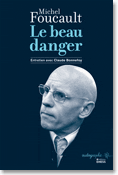
Michel Foucault, Le beau danger. Un entretien de Michel Foucault avec Claude Bonnefoy Édition établie et présentée par Philippe Artières
Novembre 2011 – Ed. EHESS – Coll. Audiographie

Pour la première fois publié, cet entretien de Michel Foucault avec le critique d’art Claude Bonnefoy nous révèle le penseur intime, qui déroule le fil de sa vie pour décrire son rapport à l’écriture. Nous voici dans les coulisses du travail du savant.

Foucault vient d’achever Les Mots et les choses et fait avec Claude Bonnefoy, critique d’art, une expérience de langage : peu habitué du genre de l’entretien, il lui est demandé d’évoquer son rapport à l’écriture. Au début réticent et inquiet, Foucault adopte pour réfléchir à la manière dont il travaille, pour dire ses difficultés d’écrivant, un registre inédit, une langue nouvelle, avoue finalement son plaisir à défaire son langage habituel. Il déroule le fil de sa vie pour dire l’histoire de son écriture, revient sur ses écrits, ceux des autres aussi, décrit le poids de son milieu « médical » où la parole était dévalorisée, les filiations repérables dans son écriture, notamment ce « regard de diagnosticien ».

« […] Quelque chose d’absolument inédit s’énonce lors de cet entretien entre le philosophe et le critique, quelque chose d’inédit survient par la parole. Un événement singulier : la mise en danger de Foucault par lui-même. » (P. Artières) .

« Je me place résolument du côté des écrivants, de ceux dont l’écriture est transitive. Je veux dire dont l’écriture est destinée à désigner, montrer, manifester hors d’elle-même quelque chose qui, sans elle, serait resté sinon caché, du moins invisible. C’est peut-être là qu’existe, malgré tout, pour moi, un enchantement de l’écriture. » (Michel Foucault)

A voir aussi:
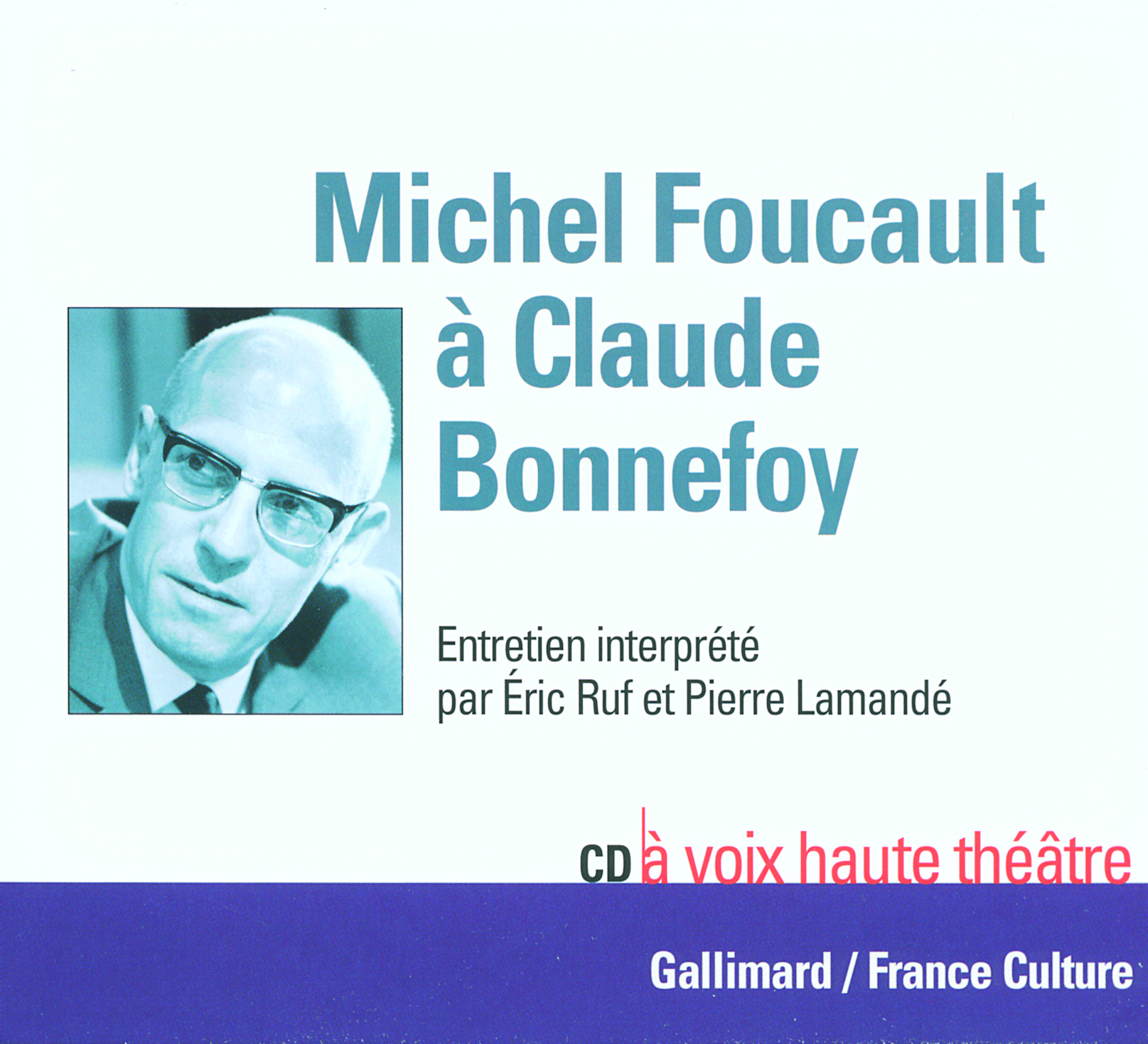
Michel Foucault, (2004) [1969] Michel Foucault à Claude Bonnefoy – Entretien Interprété par Éric Ruf et Pierre Lamandé, Paris: Gallimard. CD

Birkin, Frank and Thomas Polesie (2011). “An Epistemic Analysis of (Un)Sustainable Business”. Journal of business ethics , 103 (2), pp. 239-253
https://doi.org/10.1007/s10551-011-0863-4

Abstract
Michel Foucault famously analysed orders of knowledge, ‘epistemes’, in past European ages. In this study, his analytical method is fruitfully applied to gaining a better understanding of business sustainability within and beyond the Modern episteme. After an introduction to the contextual background for the study, this article provides (i) a justification for the use of a Foucauldian epistemic analytical method, (ii) an outline of the method, (iii) an application of the method to identify four sets of questions (morality, specialisation, anthropologization and mathematicization) that are both direct derivatives of the Modern episteme and problematic for sustainable development, and finally (iv) an application of the method to consider evidence for the emergence of a new episteme. Conclusions are also provided.

The Virtual Academic. Random Sentence Generator

Editor: Update 18 March 2021. It appears this site is now defunct. I have linked to a December 2018 version on the Wayback machine – which is still working.
Update August 2025: Sadly this device is no longer an amusing joke as we have now been overtaken by the LLM behomoth.

This random sentence generator generates some great foucauldian phrases. Here is what the site says about itself:

Too lazy to write it yourself? Let the Virtual Academic do it for you

Need a sentence for your latest article? Write one here! Just select a word or phrase from each drop-down list and click “Write It.”

Don’t like the sentence? You can use the same words in a different sentence by clicking “Edit It.” (Click “Edit It” repeatedly to see several options!) Or to write something completely new, you can change one or more of the words you’ve selected and click “Write It” again. Have fun!

This is what I came up with after entering a few foucauldian variables:  “The culture of the gaze is always already participating in the discourse of power/knowledge.” Not bad at all!

Even better the generator comes with a ready made critique of your efforts:

Smedley, the Virtual Critic(TM) says: ‘Your labored and unoriginal work on the culture of the gaze may seem impressive to the uninitiated.’

Link via Stuart Elden’s blog

Santos, Filipe D. (2011). “Foucault and Lifelong Learning, Governing the Subject – Edited by A. Fejes & K. Nicoll Book Reviews”. Educational philosophy and theory, 43 (8), pp. 898-900.
https://doi.org/10.1111/j.1469-5812.2010.00699.x

Review of A. Fejes & K. Nicoll (eds) Foucault and Lifelong Learning, Governing the Subject, Routledge, 2008.

Extract
This book is the first dedicated solely to a Foucauldian critique of lifelong education and adds to the already extensive educational literature on Foucault and Foucauldian studies. It brings together 15 contributions which were originally presented at the Symposium on Foucault and Lifelong Learning/Adult Education, held at Linköping University, Sweden, 7–11 February 2006. Most of the authors have a previous or a continuing interest in the study of lifelong learning, which seems to enjoy a high political profile in Sweden. Others are established researchers in the field of Foucault and Education, such as Mark Olssen and Gert Biesta. The Symposium grew mainly out of a Scottish-Swedish collaboration with some extra input from Belgium, USA and Australasia, through Nicky Solomon (Sydney) and Marc Olssen (Dunedin). It is divided into three sections: Governing Policy Subjects, Governing Pedagogical Subjects, and Governing Subjects, but can be treated as a unity, as the editors certainly intended.

“Rethinking the Self: Transnational and Transdisciplinary Bioethical and Biopolitical Concerns”

Helsinki Collegium for Advanced Studies,
University of Helsinki,
April 10-12, 2012.

Keynote speakers include Prof. Beverley Skeggs, Goldsmiths, University of London, UK, and Dr. Jenny Slatman, Maastricht University, the Netherlands.

This international and interdisciplinary symposium addresses how cultural, medical and political understandings of the self are shifting and changing in contemporary societies. It explores how humanness is imagined and conceived in various symbolic systems of knowledge, and how gender, disability, class and ethnicity articulate these understandings. With a particular focus on how ideas of the flesh and national identity reconfigure experiences of the embodied self, the symposium aims to bring together scholars whose work engages with issues that range from medical and cultural technologies, globalisation, migration and neoliberalism to phenomenology and ethics, political ideologies and subjectivities, and theories of social transformation.

This symposium aims to create a transdisciplinary dialogue regarding the local and global changing understandings of and practices related to the self by bringing together speakers from a broad range of cultural, methodological, national, disciplinary and transnational foci. It seeks to further conversations and research on topical and vexing questions of the self, especially in relation to recent medical, cultural, technological, political, social and neo-colonial developments. With an emphasis on the biopolitics of bodies, machines and institutional structures, the symposium also addresses the ethics of human selfhood, specifically how we define the human and what is at stake in our definitions of this now global being.

We welcome submissions for papers, poster-presentations and artwork from a broad range of disciplines and fields of research. Topics can include, but are not limited to:

Theories and technologies of the self (Foucault, Agamben, Butler, etc.)
Community belonging and violence
Contemporary medical therapies, technologies and ethics (organ donation and transplantation, gene therapy, HIV therapies, etc.)
Class dimensions of the self (Skeggs, etc.)
The self, disability and monstrosity (Shildrick, etc)
Self harm and narratives of the self
Medicalised race theories
Gender, sexuality and queering the self
Phenomenology, the senses and an embodied sense of self
Ethics and the ethics of the human

If you would like to participate, please submit an abstract of no more than 300 words and a brief biography (max. 100 words) to Suvi Salmenniemi (suvi.salmenniemi@helsinki.fi) and Donna McCormack (donna.mccormack@helsinki.fi) by 1st December 2011 .

Source: Philosophy’s Other

Taylor, Chloe, Disciplinary Relations/Sexual Relations: Feminist and Foucauldian Reflections on Professor–Student Sex. Hypatia, 26: 187–206.
https://doi.org/10.1111/j.1527-2001.2010.01143.x

Abstract
Drawing on Michel Foucault’s writings as well as the writings of feminist scholars bell hooks and Jane Gallop, this paper examines faculty–student sexual relations and the discourses and policies that surround them. It argues that the dominant discourses on professor–student sex and the policies that follow from them misunderstand the form of power that is at work within pedagogical institutions, and it examines some of the consequences that result from this misunderstanding. In Foucault’s terms, we tend to theorize faculty–student relations using a model of sovereign power in which people have or lack power and in which power operates in a static, stable, and exclusively top-down manner. We should, however, recognize the ways in which individuals in pedagogical institutions are situated within disciplinary and thus dynamic, reciprocal, and complex networks of power, as well as the ways in which the pedagogical relation may be a technique of the self and not only of domination. If we reconsider these relations in terms of Foucault’s accounts of discipline and technologies of the self, we can recognize that prohibitions on faculty—student sexual relations within institutions such as the university are productive rather than repressive of desire, and that such relations can be opportunities for development and not only for abuse. Moreover, this paper suggests that the dominant discourses on professor—student relations today contribute to a construction of professors as dangerous and students as vulnerable, which denies the agency of (mostly female) students and obscures the multiplicity of forms of sexual abuse that occur within the university context.

127th Modern langauge Association (MLA) Annual Convention
The convention will begin on Thursday, 5 January, and end on Sunday, 8 January 2012.

This session may be of interest

40. Using Foucault
Thursday, 5 January, 1:45–3:00 p.m., Willow A, Sheraton

Program arranged by the Discussion Group on Interdisciplinary Approaches to Culture and Society

Presiding: Lynne Huffer, Emory Univ.

1. “Eros, Ecstasy, and the Limits of Foucault,” William Junker, Univ. of Chicago

2. “The Archaeology of Biopower: From Plants to Animals in The Order of Things,” Jeffrey T. Nealon, Penn State Univ., University Park

3. “Inhuman Reproductions: Foucault and Feminist Philosophies of Matter,” Rebekah Sheldon, Univ. of Wisconsin, Milwaukee

4. “Foucault the Rhetorician: Postcolonial Discourse and The History of Sexuality,” Jiyoung Ryu, Graduate Center, City Univ. of New York

Histoire de la folie – Institut suédois
26 Novembre 2011
16h
Institut suédois
11 rue Payenne
F-75003 Paris
+ 33 1 44 78 80 20

Conférence, débat, projection et lectures. A l’occasion de la parution d’Un succès philosophique. L’histoire de la folie de Michel Foucault (PUC/IMEC) et de Le Beau danger (éditions de l’EHESS), l’Institut suédois et le Centre Michel Foucault organisent un après-midi autour de L’histoire de la folie à l’âge classique, commencé alors que Michel Foucault était lecteur à l’université d’Uppsala, en Suède, et publié en 1961.

Un livre, désormais classique, qui n’a pas cessé d’être au cœur de toutes les réflexions historiques et médicales autour du phénomène de la folie. Cette rencontre permettra d’entendre des témoins du séjour suédois de Foucault, de questionner le rapport du philosophe au cinéma, de réécouter Foucault nous parler de sa manière d’écrire et de se replonger dans cette histoire de la folie qu’on enferme, du Moyen-Age au 19e siècle. Avec les chercheurs Philippe Artières et Jean-François Bert, le cinéaste suédois Erik M. Nilsson, l’historien Antoine de Baecque, les philosophes Dork Zabunyan, Patrice Maniglier et Frédéric Gros. En collaboration avec les Presses Universitaires de Caen, l’IMEC et les Editions de l’EHESS.

Entrée libre

Play reading: Softcops
Sunday 30 October, 11.30am
Royal Shakespeare Theatre, £10

A script-in-hand reading of Caryl Churchill’s rarely performed masterpiece about the criminal justice system.

The cast includes Arthur Darvill, who plays Rory in Doctor Who, Geoffrey Streatfeild, known to RSC audiences for his performances as Prince Hal and Henry V in the 2006-2008 Histories Cycle and recently seen as Callum in Spooks, and John Marquez, best known for his performance as PC Penhale in ITV’s Doc Martin.

Softcops is inspired by Michel Foucault’s theoretical book Discipline and Punish and explores the ways governments seek to depoliticise subversive acts. Caryl Churchill has written a number of challenging plays including Cloud Nine, Top Girls, The Skriker, A Number and Drunk Enough To Say I Love You?

Director: Elizabeth Freestone

Cast includes: Samuel Collings, Nigel Cooke, Arthur Darvill, John Marquez, Craig Ritchie, Tim Steed, Geoffrey Streatfeild, Howard Ward

Booking Tickets
To book tickets please ring the RSC Ticket Hotline on 0844 800 1110 or book online