Foucault News

News and resources on French thinker Michel Foucault (1926-1984)

Beyes, T., & Michels, C. (2011). The production of educational space: Heterotopia and the business university. Management Learning, 42(5), 521-536. https://doi.org/10.1177/1350507611400001

Abstract:
This article responds to recent calls for rethinking management education and fostering a spatial understanding of educational practices. We propose to introduce Foucault’s notion of heterotopic space and the spatial thought of Lefebvre into the debate about the current and future state of business schools. In particular, we conceptually and empirically discuss the potential for understanding space in a way that addresses its productive force, its multiplicity and its inherent contradictions. Using the example of an experimental teaching project dedicated to the conception and physical design of a city of the future, we reflect upon the possibility of the emergence of ‘other’, heterotopic spaces within an institution of management learning. Our findings suggest that spatial interventions facilitate critically affirmative engagement with the business school by offering an imaginative approach to management education.

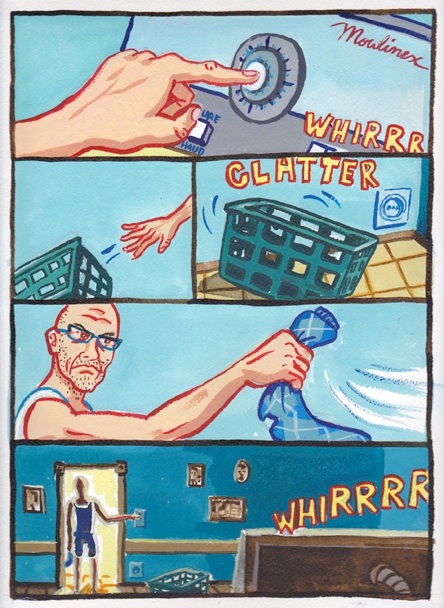
This is the first page from a forthcoming short graphic novel written by Lauren Kinney and drawn by by Matt MacFarland.

I will be posting additional panels on Foucault News as they are produced.

Link to page 1
Link to page 2
Link to page 3
Link to page 4
link to page 5
link to page 6
link to page 7
link to page 8

Linda Graham, (2011), The Product of Text and ‘Other’ Statements: Discourse analysis and the critical use of Foucault. Educational Philosophy and Theory, 43: 663-674.
https://doi.org/10.1111/j.1469-5812.2010.00698.x

Abstract
Much has been written on Michel Foucault’s reluctance to clearly delineate a research method, particularly with respect to genealogy (Harwood, 2000; Meadmore, Hatcher & McWilliam, 2000; Tamboukou, 1999). Foucault (1994, p. 288) himself disliked prescription stating, ‘I take care not to dictate how things should be’ and wrote provocatively to disrupt equilibrium and certainty, so that ‘all those who speak for others or to others’ no longer know what to do. It is doubtful, however, that Foucault ever intended for researchers to be stricken by that malaise to the point of being unwilling to make an intellectual commitment to methodological possibilities. Taking criticism of ‘Foucauldian’ discourse analysis as a convenient point of departure to discuss the objectives of poststructural analyses of language, this paper develops what might be called a discursive analytic; a methodological plan to approach the analysis of discourses through the location of statements that function with constitutive effects.

Mary Gibson, Review Essay: Global Perspectives on the Birth of the Prison, The American Historical Review, Vol. 116, No. 4 (October 2011), pp. 1040-1063
https://doi.org/10.1086/ahr.116.4.1040

In a review essay, “Global Perspectives on the Birth of the Prison,” Mary Gibson surveys the globalization of prison history since the turn of the twenty-first century by focusing on new books about Vietnam, Africa, China, Japan, and Peru. Originating in Europe and the United States, prisons have become the dominant mode of punishment through cross-cultural interaction that makes them truly global institutions. Historiographical interest turned to prisons in 1975 with the publication of Michel Foucault’s landmark work Discipline and Punish: The Birth of the Prison, which challenged the traditional Whig interpretation of the prison as a humane institution of reform. Instead, Foucault and other “revisionist” historians argued that prisons replaced corporal punishment with a more insidious type of discipline typical of the “carceral continuum” of modern society. During the 1980s and 1990s, historians of Europe and the United States both embraced and critiqued the revisionist paradigm. More recently, the focus has shifted to the non-Western world, where the “birth of the prison” occurred in the context of colonialism and imperialism. Rupp argues that new works on Africa, Asia, and Latin America complicate the Foucauldian paradigm by emphasizing the centrality of race and prisoner agency to the theory and practice of punishment.

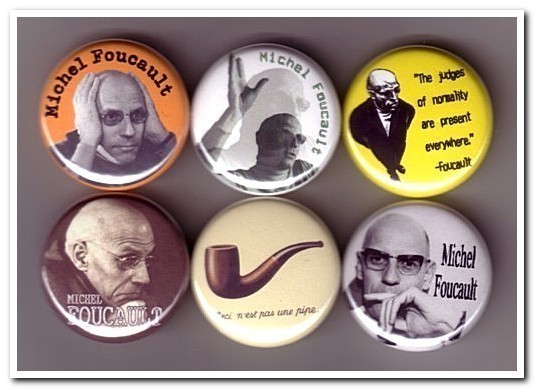
Christmas presents perhaps for the theorist who has everything?
For purchase from this site. They are still going strong in 2025

Fadil, Nadia, Not-/unveiling as an ethical practice, Feminist Review, no.98, July 2011, 83-109
https://doi.org/10.1057/fr.2011.12

Abstract
The practice of Islamic veiling has over the last ten years emerged into a popular site of investigation. Different researchers have focused on the various significations of this bodily practice, both in its gendered dimensions, its identity components, its empowering potentials, as a satorial practice or as part of a broader economy of bodily practices which shape pious dispositions in accordance with the Islamic tradition. Lesser, however, has this been the case for the practice of not veiling or unveiling. If and when attention is accorded to the latter, it is often grasped as a product of integration or an effect secular governmentality, but only rarely as a bodily practice. Drawing on narratives of second generation secular and religious Maghrebi Muslims in Belgium, this paper pursues this second perspective by examining to which extent not-veiling can be understood as a technique of the self (Foucault) that is functional to shaping a liberal (Muslim) subject. While a first part of this article will unpack the ethical substance of such discursive interrogations and point to the ways in which they are intertwined with the enactment of a liberal self, the second part will examine the embodied contours of this problematization, which appeared through the labour upon one’s affect and bodily dispositions that this refusal of the hijab, or the act of unveiling, implies.

Aut Aut. Foucault e la “Storia della follia” (1961-2011), no. 351, July-September 2011

MATERIALI 1
Michel Foucault “Non esiste cultura senza follia” [1961]

Frédéric Gros Nota sulla “Storia della follia”
Daniel Defert L’altra scena della pittura
Pier Aldo Rovatti “Sarai un malato di mente” (una risposta ai detrattori di Foucault)
Mario Colucci La storia negata
Pierangelo Di Vittorio Togliersi la corona. Foucault e Basaglia, storia di una ricezione “minore”
Mauro Bertani Un’opera morale (e la storia della psichiatria)

MATERIALI 2
Michel Foucault Storia della follia e antipsichiatria [1973]

Jean-François Bert, Philippe Artières Foucault 1970. “Storia della follia”, atto III
Colin Gordon La “Storia della follia” in Inghilterra
Alain Beaulieu Foucault e la “Storia della follia” in Nord America
Valentín Galván La ricezione della “Storia della follia” in Spagna
Cesar Candiotto, Vera Portocarrero Effetti della “Storia della follia” in Brasile

This is the second page from a forthcoming short graphic novel written by Lauren Kinney and drawn by Matt MacFarland.

I will be posting additional panels on Foucault News as they are produced.

Link to page 1
Link to page 2
Link to page 3
Link to page 4
link to page 5
link to page 6
link to page 7
link to page 8

CFP: Varieties of Continental Thought and Religion

Deadline: Saturday, December 31
Conference Venue:
Ryerson University
Toronto, Canada

See Immanentism and Religion below for Foucault

Details
We invite submissions from scholars and graduate students based in Canada and abroad on the topic of Continental Thought and Religion. The general theme of the conference is meant to reflect the variety of articulations of religion that have emerged in contemporary European thought. While the focus of the conference is continental thought, we nonetheless conceive the latter in an interdisciplinary manner (including literary theory, social and political thought, psychoanalysis, and religious studies). We also encourage submissions from people interested in exploring possible connections with analytic philosophy.

Confirmed Speakers: John Caputo (Syracuse U.), Bettina Bergo (U. de Montréal), more to be announced in the near future.

In addition to our keynote speaker, John Caputo, we will have four commissioned workshops comprised of two papers and a response, and a series of themed panels. We invite submissions of three-page proposals for essays for the following themed panels with included possible topics:

Phenomenology of Religion
The thought of Chrétien, Henry, Lacoste, Levinas, Marion, and Ricoeur
Topics: the gift; the work of art; appearance and transcendence; call and response

Religion and Politics
The thought of Agamben, Asad, Connolly, Derrida, de Vries, Girard, Habermas, Schmitt, and Taylor
Topics: political theology; the post-secular; sovereignty; religion and violence; pluralism

Religion and Speculative Realism
The thought of Brassier, Harman, Laruelle, and Meillassoux
Topics: materialism; correlationism; nihilism; the things themselves; divine inexistence; ‘future Christ’

Beyond Theism and Atheism
The thought of Caputo, Kearney, Kristeva, Milbank, Vattimo
Topics: kenosis; anatheism; weak theology; a/theology; radical orthodoxy

Continental Thought, Religion, and Aesthetics
The artwork of Bresson, Caravaggio, Celan, Chagall, Dostoyevsky, Dumont, Artemisia Gentileschi, Kahlo, Kapoor, Kiarostami, Kiefer, Malick, Newman, O’Keefe, and Stevens
The thought of Cavell, Cixous, Critchley, Irigaray, Marion, Nancy, and Rancière
Topics: transcendence in art; image and icon; creativity and creation; representation and idolatry

Immanentism and Religion
Agamben, Badiou, Bergson, Deleuze, James, Foucault, Keller, and Žižek
Topics: self-organization; the event; plurality; bio-power; polydoxy

History of Continental Thought and Religion
Spinoza, Kant, Hegel, Marx, Kierkegaard, Nietzsche, Freud, Benjamin, Heidegger
Topics: death of God; reason and faith; scripture and philosophy; religion and fantasy; onto-theology

Please send only one three-page (double-spaced) proposal on one of the above themes and any questions to varieties2012@gmail.com by December 31, 2011. We intend to notify authors about our decisions by February 28, 2012. Other conference details (registration fee, preliminary program, etc.) will be announced in new year.

From the materiali foucaultiani site

HISTOIRE DE LA FOLIE : CINQUANTE ANS APRÈS
Jeudi 15 décembre 2011, 9h30-17h30
Université Paris-Est Créteil
– 61, av. du Général de Gaulle,
Créteil,
bâtiment i, salle 222 –

Conference flyer (pdf)

Matinée Président de séance : Frédéric Gros (Université Paris-Est Créteil)

09h30 Daniele Lorenzini et Arianna Sforzini : Introduction au colloque
10h00 Jean-François Bert (EHESS) : Histoire d’un succès philosophique. L’Histoire de la folie à l’âge classique
10h30 Kojiro Fujita (Université Paris-Est Créteil) : La naissance du cogito chez Foucault
11h00 Discussion
11h15 Pause
11h30 Jérémy Romero (Université Paris-Est Créteil) : La folie et la mort chez Foucault : éléments pour une pensée du dehors
12h00 Emmanuel Gripay (Université Bordeaux III) : La perception morale de la folie : une appréhension néantisante ou objectivante ?
12h30 Discussion

Après-midi – Président de séance : Daniele Lorenzini (Université Paris-Est Créteil/Università « La Sapienza » di Roma)

14h30 Arianna Sforzini (Université Paris-Est Créteil) : La présence du théâtre dans l’Histoire de la folie à l’âge classique
15h00 Caroline Mangin-Lazarus (psychiatre, revue Superflux) : Ignorer la démence dans le droit pénal : une voie politique au moment de la Révolution française ?
15h30 Roger Ferreri (psychanalyste et chef d’un service de psychiatrie infanto-juvénile) : Du fou à la folie, histoire de la folie ou question à la démocratie ?
16h00 Discussion

Infos et contacts : d.lorenzini@sns.it, ari_s86@yahoo.it