
Foucault News

News and resources on French thinker Michel Foucault (1926-1984)

Fitzpatrick , P. and P. Kender. 2015 . Foucault, Surveillance and the Law of the Outside, Surveillance & Society 13( 2 ): 314 – 318.

Full PDF

Introduction
The inside as an operation of the outside: in all his work Foucault seems haunted by this theme of an inside which is merely the fold of the outside, as if the ship were a folding of the sea. – Gilles Deleuze, Foucault (2006: 81) This note could be even shorter than it has to be if a prevalent perspective on our brief were adopted. Broadly, that brief evokes the relation between law and surveillance in Foucault’s work. The standard perspective would render that relation in terms of law’s abjection. A compendious instance comes with the “expulsion thesis” (see Golder and Fitzpatrick 2009: chapter 1). This thesis has it that Foucault expelled law from a modernity formed by and in a conglomerate of disciplinary powers and a biopower made operative through the managed governing of whole populations. More precisely, with the expulsion thesis law is entirely if functionally subsumed within this conglomerate. It has no autonomous existence. Foucault did say as much (e.g. 1981:89 — all unnamed references will be to Foucault). And this does pose an obvious problem for what will be our contrary argument, and especially so in relation to surveillance since Foucault does vividly instance surveillance as subsuming the juridical (2001a:73)
read more

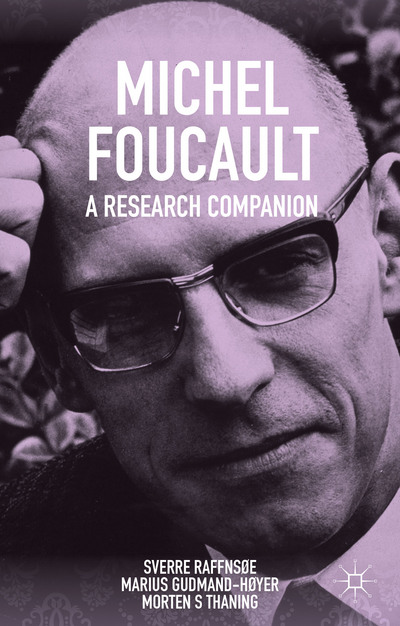
raffnsoeSverre Raffnsøe, Morten S Thaning, Marius Gudmand-Hoyer, Michel Foucault: A Research Companion. Palgrave Macmillan, 2015

Publication Date: November 2015

Michel Foucault continues to be hugely influential. His diagnoses challenge us to rethink crucial phenomena such as madness, discipline, the human sciences, the state, neoliberalism, sexuality and subject formation. Based on his work in its entirety, and with special emphasis on his many recently published lecture series, this book provides an updated, comprehensive and original account of his thought. By reading Foucault as a philosopher, it offers an extensive systematic assessment and discussion of his unique conception of philosophical practice and brings a unifying trajectory in his work to light.

Comment lire L’Archéologie du savoir de Michel Foucault ?, Les Études philosophiques, 2015/3 (N° 153)

English version

Sommaire
Baptiste Mélès
Page 323 à 326 Présentation

Michel Foucault, Texte établi et introduit par Martin Rueff
Page 327 à 352 « Introduction » à L’Archéologie du savoir

Luca Paltrinieri
Page 353 à 376 L’archive comme objet : quel modèle d’histoire pour l’archéologie ?

Jean-François Courtine
Page 377 à 390 Michel Foucault et le partage nietzschéen : Vérité/Mensonge

Baptiste Mélès
Page 391 à 412 Les « règles de formation » comme catégories foucaldiennes

David Rabouin
Page 413 à 430 L’exception mathématique

telemaqueMichel Foucault : héritages et perspectives en éducation et formation. Le Télémaque, 2015/1 (n° 47)

Sommaire
Brigitte Frelat-Kahn, Dominique Ottavi, Alain Vergnioux
Page 7 à 8 Ouverture

Chronique morale
Alain Vergnioux
Page 9 à 15 La philosophie de François Châtelet

Notion
Valentina Crispi
Page 17 à 30 L’interculturalité

Dossier – Michel Foucault : héritages et perspectives en éducation et formation
Hubert Vincent
Page 31 à 37 Présentation

Francois Jacquet-Francillon
Page 39 à 57 Un autre regard sur les disciplines scolaires

Nicolas Guirimand
Page 59 à 70 De la “pédagogisation” des soins des malades chroniques aux dispositifs d’éducation thérapeutique

Hubert Vincent
Page 71 à 86 Foucault éducateur : un art de l’écriture et un modèle d’autoformation

Sílvio Gallo
Page 87 à 95 La production des hétérotopies à l’école : souci de soi et subjectivation

Annie Hourcade Sciou
Page 97 à 108 La question de l’écoute chez Michel Foucault

Edouardo Machado
Page 109 à 120 Foucault, lecteur de Plutarque : de la notion de savoir « éthopoétique » à la construction d’une « esthétique de l’existence »

Étude
Sébastien Urbanski
Page 121 à 138 L’expression de croyances dans les manuels d’histoire pour l’école publique : le cas de la Pologne avant et après 1989

Compte rendu
Alain Vergnioux
Page 139 à 144 Raymond Bénévent, Claude Mouchet, L’école, le désir et la loi. Fernand Oury et la pédagogie institutionnelle. Histoire, concepts pratiques, Nîmes, Éditions Champ Social – Matrice, 2014, 493 p.

With thanks to Sam Matuszewski for this news

American Comparative Literature Association (ACLA) Conference
March 17-20, 2016 — Harvard University
Panel: The New Security State: Surveillance, Counter-Surveillance, and Strategies of Resistance
Organizers: Carlos Rojas (Duke University) and Belinda Kong (Bowdoin College)

Full panel description and submission guidelines can be found here: Deadline for paper submissions is Sept 23 2015

Papers with a foucauldian approach are welcome

Literature has long been closely imbricated with practices of surveillance. Not only does literary production necessarily rely on practices of observation (either at the level of the individual or a broader collectives, as with the close synergy between the rise of the modern novel and Western imperial projects), literature itself has often been the object of close scrutiny by the state and other corporate entities. In this respect, literary representation anticipates—and is symptomatic of—a broader array of technologically-based surveillance practices that have emerged in the modern period. As technological advances continue to enhance the ability of states and corporations to surveil the public, even as the public is also increasingly able to deploy similar technologies to its own ends—including efforts to surveil the operation of the surveillance apparatus itself. This latter practice of counter-surveillance is particularly evident in the ways that citizen videos (and the public circulation of videos originally produced by the state) have helped precipitate a national debate in the US over police brutality, but it also has much broader ramifications.

Our panel will examine some of the implications of these developments as they pertain to the new security state. We are interested not only in how issues of surveillance and counter-surveillance are addressed in literary works, but also how some of the discourses and visual archives generated by these surveillance practices may be approached as virtual literary works in their own right. Potential topics include examinations of state censorship regimes, social media and practices of collective authorship, surveillance video and found footage as a form of textual production, digital archives and shifting loci of identity, practices of exhibitionism and impersonation, selfies and confessional discourses, as well as advances in wearable technologies and cybernetic states.

Full panel description and submission guidelines can be found here: Deadline for paper submissions is Sept. 23 2015

Kaveh Dastooreh, Vers une sociologie foucaldienne. Réunir l’objectivation et la subjectivation, L’Harmattan, 2015

L’œuvre foucaldienne est aussi une œuvre sociologique. Sa pensée conduit à une pratique autoréflexive de la sociologie. Ce qui rapproche Foucault des sociologues, c’est sa compréhension du sujet à travers un social devenu historique ; cette Histoire nous revient en tant que forme culturelle. La question centrale est ce social primordial dans la constitution de l’individu. Sa sociologie met en lumière la question “qui sommes-nous en train de devenir ?” pour construire un diagnostic sociologique à la fois moderne et paradoxal.

The study proposes a reading of the sociological representation of Foucault’s oeuvre: Foucault’s work can be described as sociology, and it can certainly also be said that there is a sociological program underlying his work. The discussion of his work offers an ideal opportunity to trace back the contours of a social criticism and also that of a sociological auto-reflection. Analysis of the related economies of objectivity/subjectivity and their combinations in Foucault’s work provide a better understanding of the originality of his sociology.

Re-reading Foucault: On Law, Power and Rights
Ben Golder, Editor
(New York: Routledge, 2013. 264 pages.)

Reviewed by—Irina Ceric, (Criminology Faculty member, Kwantlen Polytechnic University),
Vancouver, October 2014

Re-reading Foucault is an ambitious and mostly successful attempt to answer the question “Where is the law in Foucault and what has he done with it?” and the contributors’ creative responses demonstrate the breadth of the interdisciplinary analyses emerging in the wake of the translation of Foucault’s later lectures into English. The collection is dedicated to the “interpretive work of re-imagining law in, and through, Foucault’s work” but the key themes—the politics of rights, surveillance, biopolitics and Foucault’s gestures towards the juridical in his lectures on history, knowledge and power—reflect a broader orientation of likely interest to readers in disciplines other than law. To some extent, however, this potential is belied by the book’s initial focus on the so-called expulsion thesis, the notion that “Foucault had expelled law from any significant role in modernity.” Initially straying into the minutiae of the existing literature, the authors taking up the expulsion thesis ultimately succeed in locating this debate within the context of Foucault’s broader political and theoretical development.

read more

Perret, S.
In the name of the nation? The National Award in Narrative Literature, and the democratization of art in Spain (1977–2013)
(2015) Journal of Spanish Cultural Studies, 17 p. Article in Press.

Abstract
This article looks at the history of the National Award in Narrative Literature (El Premio Nacional de Literatura, Modalidad Narrativa) – a governmental prize issued by the Spanish Ministry of Education, Culture and Sports – to examine how the award has contributed to the formation of a particular idea of Spanish literature in the democratic period (1977–2013). On the one hand, drawing from the theories of Rancière and Foucault, I argue that the conferring of the prize represents a specific technique of power that has allowed the Spanish state to attach itself to individual citizens/artists of diverse linguistic and cultural backgrounds and to appropriate their works as “national.” In so doing, I claim that the issuing of the National Award has served the state well in its attempts throughout the democratic period to market Spain as a multicultural, yet cohesive nation state. On the other hand, I discuss how the issuing of the National Award also serves as a platform from which to discuss a wide variety of social issues, paradoxically including ideas that challenge the state’s legitimacy.

Author Keywords
Alfredo Conde; Bernardo Atxaga; biopolitics; Javier Marías; literary prizes; nationalism

Launch of The Funambulist Magazine by Léopold Lambert

Full PDF of announcement which includes links

Editor: Léopold Lambert has written fairly extensively on Foucault on his Funambulist blog. Many of these writings have been collected together as a book The Funambulist Pamphlets, vol.2 Foucault published by Punctum Books in collaboration with the Center for Transformative Media at Parsons The New School.

Last week in New York City, I was thrilled to launch my new project, The Funambulist Magazine at the offices of e-flux. Helping me to introduce the magazine were three of its brilliant contributors, Sadia Shirazi, Olivia Ahn, and Minh-Ha T. Pham (see photos and recording of the event). This new 62-page publication will now be published once every two months in both digital and printed versions. This magazine continues alongside and in parallel with the open-access platforms that constitute the blog and podcast (Archipelago), which both aim at proposing a political discourse about design, territories and the city, as well as to create an international community of thinkers and creators around these questions since 2010.

read more

Gilles Deleuze, The Intellectual and Politics. Foucault and the prison, Interview with Paul Rabinow and Keith Gandal, 25 May 1985, History of the Present, Spring 1986.

PDF of interview