Foucault News

News and resources on French thinker Michel Foucault (1926-1984)

Jessica Whyte on Michel Foucault and ‘the right to intervene’

Audio of talk on the Foucault-Blog

Last year Jessica Whyte from the University of Western Sydney was a visiting scholar at the Zentrum Geschichte des Wissens in Zurich. On October 22, she held a lecture on “A Right of Private Individuals or a Responsibility of States? Michel Foucault and the Right to Intervene”, in which she talked about Foucault’s thoughts on the Iranian Revolution, neoliberal economic policies, the politics of human rights and much more.

Otto Friedrich and Sandra Burton, France’s philosopher of power (1981), Time, November 16 1981, pp. 92-4

Includes some remarks by Foucault. With thanks to Stuart Elden for tracking a copy of this down on the net.

Stephen J. Ball
Subjectivity as a site of struggle: refusing neoliberalism?
(2015) British Journal of Sociology of Education, 18 p. Article in Press.

https://doi.org/10.1080/01425692.2015.1044072

Abstract
This paper extends the author’s previous enquiries and discussions of governmentality and neoliberal policy technologies in a number of ways. The paper explores the specificity and generality of performativity as a particular contemporary mode of power relations. It addresses our own imbrication in the politics of performative truths, through our ordinary everyday life and work. The paper is about the here and now, us, you and me, and who we are in neoliberal education. It draws upon and considers a set of ongoing email exchanges with a small group of teachers who are struggling with performativity. It enters the ‘theoretical silence’ of governmentality studies around the issues of resistance and contestation. Above all, the paper attempts to articulate the risks of refusal through Foucault’s notion of fearless speech or truth-telling (parrhesia). © 2015 Taylor & Francis

Author Keywords

neoliberalism; parrhesia; refusal

dean3Mitchell Dean and Kaspar Villadsen, State Phobia and Civil Society: The Political Legacy of Michel Foucault, Stanford University Press, forthcoming January 2016

Publisher’s page

State Phobia
draws extensively upon the work of Michel Foucault to argue for the necessity of the concept of the state in political and social analysis. In so doing, it takes on not only the dominant view in the human sciences that the concept of the state is outmoded, but also the large interpretative literature on Foucault, which claims that he displaces the state for a de-centered analytics of power. Understanding Foucault means understanding all his interlocutors—whether Marxists, Maoists, neoliberals, or social democrats. It requires turning to Foucault’s colleagues, including Deleuze and Guattari, François Ewald, and Blandine Kreigel, in relation to whom he carved out a position. And it entails an examination of his legacy in Hardt and Negri, the theorists of Empire, or in Nikolas Rose, the influential English sociologist. Foucault’s own view is highly ambiguous: he claims to be concerned with the exercise of political sovereignty, yet his work cannot make visible the concept of the state. Moving beyond Foucault, the authors outline new ways of conceiving the state’s role in establishing social order and in mediating between an inequality-producing capitalist economy and the juridical equality and political rights of individuals. Arguing that states and their cooperation remain of vital importance to resolving contemporary crises, they demonstrate the interdependence of state and civil society and the necessity of social forms of governance.

About the authors

Mitchell Dean is Professor of Public Governance at the Copenhagen Business School and Professor of Sociology at the University of Newcastle, Australia.

Kaspar Villadsen is Associate Professor of Management, Politics, and Philosophy at the Copenhagen Business School.

Johansen, P.H., Chandler, T.L.
Mechanisms of power in participatory rural planning
(2015) Journal of Rural Studies, 40, pp. 12-20.

Abstract
This paper explores the specific mechanisms of power in participatory rural planning projects. It follows up on suggestions in planning literature about directing focus at the relational level in the assessment of power, rather than on who has power and who doesn’t. The paper argues that in such an assessment of power it is needed also to drawn in the social context because different social contexts will be more or less vulnerable to different mechanisms of power. The paper takes the stand the rural settings are especially vulnerable to dis-engagement of local citizens, sub-ordination of the rural by the urban privilege to define the rural qualities and creation of local conflicts and that mechanisms of power that cause such unintended outcomes of rural planning projects should be uncovered. Inspired by Foucault’s interpretation of power the paper carries out a grounded theory inspired analysis of a Danish rural participatory planning project. The paper concludes that rural planning literature and analysis will benefits from paying attention to the three – in rural participatory planning projects – specific mechanisms of power ‘Institutionalising knowledge and competencies’; ‘Structuring of criticism’ and ‘Undermining the objectives of the others’. © 2015.

Author Keywords
Illustrative case study; Participation; Power mechanisms; Power relations; Rural planning

Index Keywords
conflict management, local participation, participatory approach, power relations, rural planning; Denmark

The Analytics of Power Today: A Masterclass with Mitchell Dean

Date: Monday, Dec. 14th, 2015
Time: 8:45am—6:00pm
Place: TBA, University of Queensland, St Lucia, Australia

PDF of flyer

About the Masterclass
Over the last thirty years, we have witnessed three broad movements regarding power. The first is the displacement of the state from the centre of political analysis in favour of governance, networks and the energies found in civil society. The second is the rejection of sovereignty and its models, and notions of social structure, to stress the local, heterogeneous and contingent nature of power (Foucault and Deleuze). The third emphasizes the agency of the non-human, material and vital forces and actors (from Latour to Karen Barad). These three movements deconstruct the idea of power in different ways, denying that it has a source or can be possessed, and even depriving it of any explanatory value at all. In his recent book, The Signa-ture of Power, Mitchell Dean argues that such analyses only capture one pole of that which marks power relations. He proposes ways to analyse both governing and reigning, governmentality and sovereignty, different forms of life and the orders and laws of life, and how we can understand biopolitics, through four different analytical approaches. These might be called an analytics of government, a genealogy of order, an archaeology of glory, and an analytics of sovereignty. The challenge is to convert these into analytical frameworks capable of addressing empirical materials.

Mitchell Dean is Professor of Public Governance at the Copenhagen Business School. He is author of eight books, including Governmentality: Power and Rule in Modern Society, The Constitution of Poverty: Towards a Genealogy of Liberal Governance, The Signature of Power and State Phobia and Civil Society: the Political Legacy of Michel Foucault (forthcoming) He describes his work as at the nexus between political and historical sociology

No Cost: This masterclass has been fully supported by the ARC Governing Performance Project and the School of Social Science, University of Queensland.

RSVP: Alison Gable (a.gable@uq.edu.au) by Thurs, 15th October 2015 to register your interest to attend

Participation in the Masterclass
This Masterclass will dialogically engage with questions of analyzing power today in conversation with Professor Dean and other senior academics. A small number of preparatory readings will be made available prior to the day. The masterclass is of course open to anyone. As the event is limited to 25 participants, it is essential to register your interest early. Preference is given to PhD students and early career academics who are invited to present their own work for collegial discussion and feedback.

Participants who wish to present should submit up to two pages outlining their research, their theoretical approach to power, and their main analytical or conceptual challenges. Twelve papers will be selected and circulated to all participants in anticipation of their presentation and discussion at the Masterclass.

The Neoliberalism Controversy and Saint Foucault
Professor Mitchell Dean

Copenhagen Business School

PDF flyer

WHEN
Tues 15 December 2015
3pm – 5pm

WHERE
Room 116
Sir Llew Edwards Building (14)
The University of Queensland
St Lucia campus

There is currently something of a controversy concerning Michel Foucault and neoliberalism, sparked by a book of that title, edited by Daniel Zamora and Michael Behrent (Polity, 2015). The book has already achieved notoriety in its earlier French form, but it chimed with the recent claim by François Ewald, that Foucault had made an “apology of neoliberalism” in the late 1970s. Here I argue that this controversy signals the end to a rather de-contextualized and ahistorical view of Foucault as a felicitous combination of activist and radical critic of mainstream knowledge and institutions who somehow became the most influential figure in the humanities and social sciences. I offer some reflections both on the habitus and persona of high-status intellectuals and on the social and political contexts in France during a moment of historic rupture with the post-war settlement. I argue that it is possible to identify Foucault’s affirmative views on neoliberalism as an ideal set of principles of social organization, as a language of critique of the welfare state, and as an element of actual political forces within the French Left of the 1970s. I conclude by suggesting that the current discussion might signal a change of Foucault’s status today from “unsurpassable horizon” of critical thought to acknowledged classical thinker, with strengths and limitations, and a series of problems that might not be our own.

Mitchell Dean is Professor of Public Governance at the Copenhagen Business School. He is author of, among others, Governmentality: Power and Rule in Modern Society (Sage, 1999/2010), The Signature of Power (Sage, 2013), and, with Kaspar Villadsen, State Phobia and Civil Society: the Political Legacy of Michel Foucault (Stanford University Press, 2015). He has published extensively in international journals and describes his work as at the nexus between political and historical sociology and political theory and philosophy.

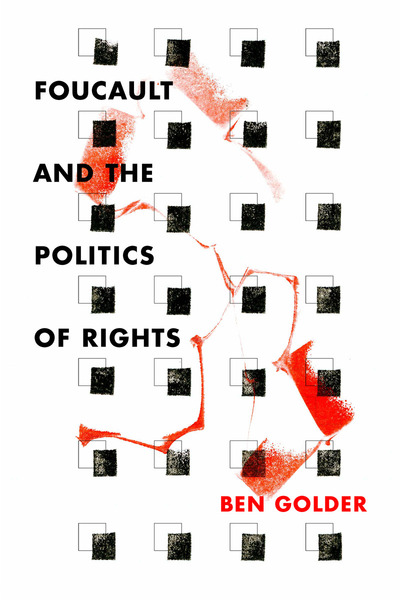
golder2Ben Golder, Foucault and the Politics of Rights, Stanford University Press, 2015, Now available.
Publisher’s page

This book focuses on Michel Foucault’s late work on rights in order to address broader questions about the politics of rights in the contemporary era. As several commentators have observed, something quite remarkable happens in this late work. In his early career, Foucault had been a great critic of the liberal discourse of rights. Suddenly, from about 1976 onward, he makes increasing appeals to rights in his philosophical writings, political statements, interviews, and journalism. He not only defends their importance; he argues for rights new and as-yet-unrecognized. Does Foucault simply revise his former positions and endorse a liberal politics of rights? Ben Golder proposes an answer to this puzzle, which is that Foucault approaches rights in a spirit of creative and critical appropriation. He uses rights strategically for a range of political purposes that cannot be reduced to a simple endorsement of political liberalism. Golder develops this interpretation of Foucault’s work while analyzing its shortcomings and relating it to the approaches taken by a series of current thinkers also engaged in considering the place of rights in contemporary politics, including Wendy Brown, Judith Butler, and Jacques Rancière.

About the author

Ben Golder is Senior Lecturer at the Faculty of Law at the University of New South Wales, Australia.

Editor: Reblogged from Stuart Elden’s site Progressive Geographies

Foucault was interviewed in 1975 for a Brazilian paper:

Q: In your work, the State seems to occupy a privileged place. And the State represents a privileged instance for understanding historical-cultural formations. Could you specify the conditions of possibility which underpin the State?

A: It is true that the State interests me, but it only interests me differentially [différentiellement]. I do not believe that the entirety [ensemble] of the powers which are exercised within a society – and which assure the hegemony of a class, an elite, or a caste in that society – are entirely contained in the State system. The State, with its grand judicial, military and other apparatuses [appareils], only represents a guarantee, the reinforcement of a network of powers which come through different channels, different from these main routes. My problem is to attempt a differential analysis of the different levels of power in society. As a consequence, the State occupies an important place in this, but not a preeminent one (DE no 163, II 812).

“El filósofo responde’, Jornal da Tarde, 1 Nov 1975, pp. 12-13; translated by Plinio-Walder Prado Jr as “Michel Foucault: Les réponses du philosophie”, Dits et écrits text no 163, Vol II, p. 812 (1994 Four Volume edition).

This passage does not appear in the recent reprint of the Portuguese translation of the interview. I guess it must be in the original Portuguese version (which I have been unable to locate) because if not, what is the source for the translation in Dits et écrits? [Update 26 May 2015: the question does appear in the 1975 original – thanks to Andrea Teti for tracking down a copy.]

read more

La bibliothèque de Foucault : Guide des papiers de travail de Michel Foucault.
Inventaire EAD réalisé par l’EHESS et l’ENS Lyon

Foucault’s working manuscript for Les mots et les choses

With thanks to Stuart Elden at Progressive Geographies for this news