
Foucault News

News and resources on French thinker Michel Foucault (1926-1984)

Update on the 13/13 series of seminars from the website

The first seminar will take place  on September 14, 2015.

Thank you very much for your interest in the series Foucault 13/13. The seminar has received an overwhelmingly good response, and we have more applications than available seats. Please accept our apologies. The application process is now officially closed.

However, we will be live streaming the seminars and also arranging to have an overflow room where you could watch the ongoing seminars by audio-visual projection. We are doing everything possible to make this seminar conversation accessible nonetheless.

First, we will be streaming the seminar live on the multimedia page of the new website of the Foucault 13/13 series here: Multimedia.

Second, we will also have an overflow room if you would like to watch the live stream with others in the overflow room while the seminar is going on, and we will try to promote discussion in the overflow room with the help of our teaching assistants.  The overflow room will be located at the Columbia Law School, 435 West 116th Street, NY, and the exact room location will be posted on the blog page of the new website for Foucault 13/13.  The location for the first seminar on September 14, 2015, will be Room 105 at the Columbia Law School, Jerome Greene Hall.

Third, we will also be blogging on issues related to the seminar on the blog page of the new website for Foucault 13/13, and archiving prior recordings of the seminars. Our blog will be open and moderated for comments and you can find it here: http://blogs.law.columbia.edu/foucault1313/ Please do join us in that conversation as well.

We do hope that this will make it possible for you to follow the seminar series closely, even though you will not be able to be in the seminar room in person.  Again, we will do everything possible to make this seminar series accessible to you in overflow and virtually.

Thank you again for your interest.

Please do follow any news and developments regarding the Foucault 13/13 series either on the new website at Microsite or on our FB and/or Twitter pages.

Warm regards,

Bernard E. Harcourt and Jesus R. Velasco

– See more at: http://blogs.law.columbia.edu/foucault1313/2015/09/03/applications-closed-but-live-stream-live/#sthash.diG1j4Df.dpuf
Why Do We Take Selfies? – 8-Bit Philosophy
by Wisecrack

“Wisecrack is a Los Angeles-based media collective run by comedians, academics, filmmakers and artists who are endlessly curious about the world around us. Their channel explores great topics in ways that make them fun, engaging and unexpected.”

This video is essentially about Foucault’s work.

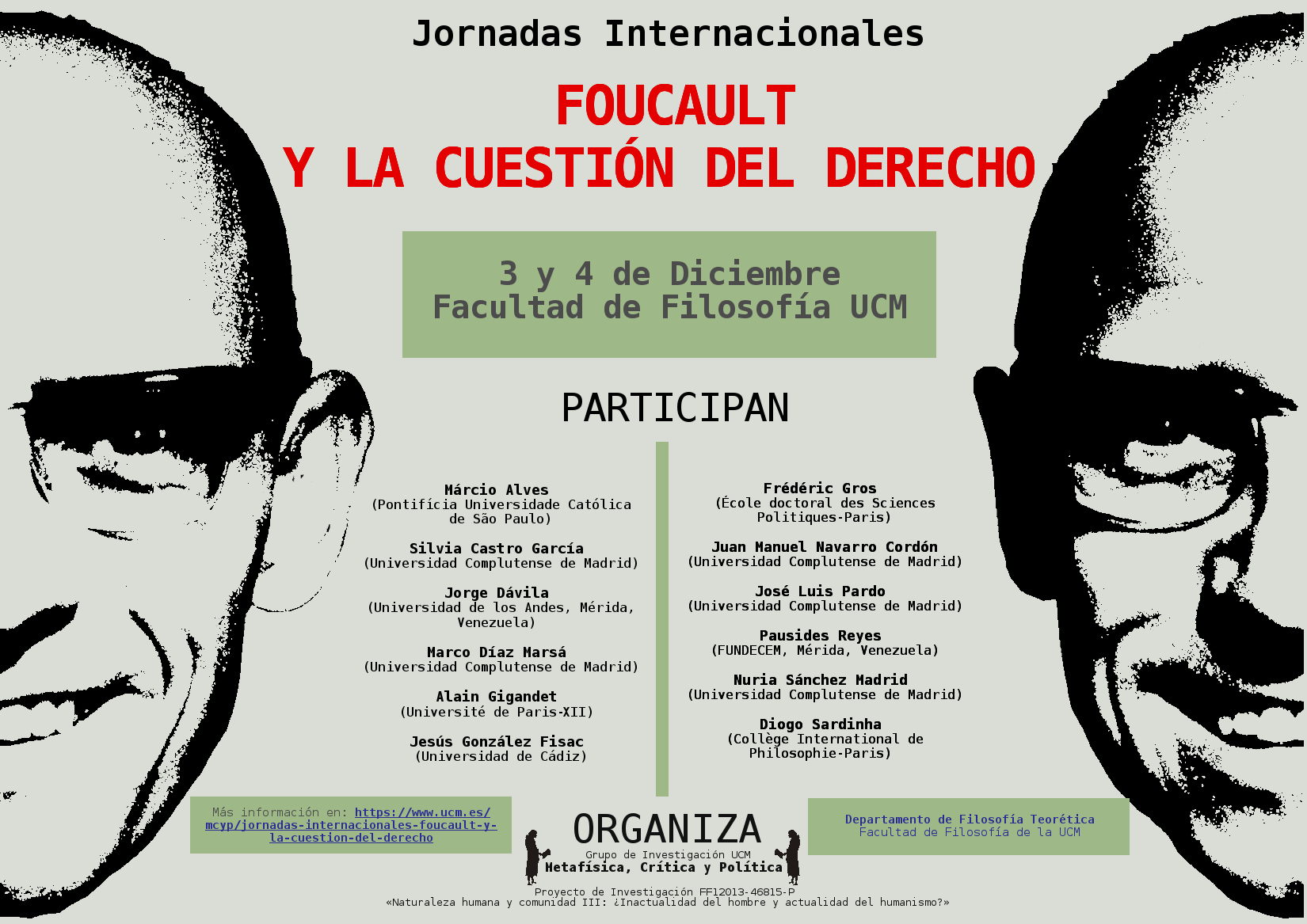
CARTEL_Foucault_y_la_cuestion_del_derecho

Jornadas Internacionales “Foucault y la cuestión del derecho”

Faculty of Philosophy
Complutense University of Madrid
3-4 December 2015.

RESÚMENES

Márcio Alves: “Direito e análise da política em Foucault”
Silvia Castro García: “Breve arqueología del derecho a la última palabra”
Jorge Dávila: “Foucault y la problematización de la relación Ética – Derecho”
MarcoDíaz Marsá: “Sobre “Derecho y Ontología” en Foucault (1978-1984)”
Alain Gigandet
Jesús González Fisac: “El pueblo como sujeto de lo universal. De la gubernamentalidad a la Aufklärung”
Frédéric Gros
Juan Manuel Navarro Cordón
José Luis Pardo
Pausides Reyes
Nuria Sánchez Madrid: “El eclipse del “homo criticus” en la sociedad neoliberal: el diálogo de Wendy Brown con Michel Foucault”
Diogo Sardinha:”Une minorité qui ne fait pas loi. Le Kant des Lumières relu par Foucault”

For the archives on the early history of the reception of Foucault’s work in English. This appears to be a roneotype with original illustrations.

David Brown, “A Note on Michel Foucault’s Discipline and Punish [1981] AltCrimJl 17; (1981) 4(1) Alternative Criminology Journal 116

With thanks to Brendon Murphy for this news

aids6n-8-web

Keri Blakinger, On Freddie Mercury’s birthday, 11 other HIV-related deaths, New York Daily News, September 5, 2015

Michel Foucault
An acclaimed French philosopher, Michel Foucault was best known for works like “Discipline and Punish” and “The History of Sexuality.”He died in 1984 of AIDS-related illness.

Michel Foucault va faire son entrée dans La Pléiade,

L’œuvre du philosophe sera publiée le 5 novembre par la Bibliothèque de la Pléiade, aux éditions Gallimard.

Le Monde.fr avec AFP | 20.07.2015 à 19h13

Michel Foucault va faire, bientôt, son entrée dans la Bibliothèque de la Pléiade. C’est le 5 novembre, a confirmé au Monde Gallmard, que paraîtront les deux volumes regroupés sous le titre Œuvres dans la prestigieuse collection.

Figure de la philosophie des années 1960, historien, militant, titulaire d’une chaire au Collège de France, Michel Foucault est mort en 1984, à l’âge de 57 ans. Un peu plus de trente ans après sa mort, celui qui a écrit sur le pouvoir, la médecine ou la sexualité est célébré comme l’un des plus grands penseurs du XXe siècle. Il est aussi l’un des auteurs de sciences humaines les plus cités au monde. L’an dernier, ses archives, classées « trésor national » par le gouvernement français, ont été rachetées par la Bibliothèque de France.

Auteur de plusieurs ouvrages à son sujet, c’est le philosophe Frédéric Gros qui dirige la publication des œuvres de Michel Foucault par la Pléiade. Histoire de la folie, Naissance de la clinique, Les Mots et les Choses, L’Archéologie du savoir, L’Ordre du discours, Surveiller et punir, les trois volumes de LHistoire de la sexualité ainsi qu’une sélection d’articles vont ainsi être rassemblés.

« Devenir un classique, c’est bien sûr ambigu dans le cas de Foucault, a expliqué Frédéric Gros au magazine Télérama. Il ne construisait pas son œuvre dans la perspective d’être réuni un jour en un tout, clos sur lui-même. Sa vision de l’écriture était différente, davantage située dans la discontinuité, la rupture, et dans le fait de privilégier les infra-écritures, les marges littéraires. »

With thanks to Stuart Elden at Progressive Geographies for this news

David Banks, The Conservative Hacker – Cyborgology, August 26, 2015

“Lone Hacker in Warehouse” by Brian Klug

“Lone Hacker in Warehouse” by Brian Klug

The hacker label is, as Foucault might say, a “dubious unity.” The single phrase can barely contain its constituent multitude. Even if every single person that self-identified as a hacker had a stable definition, the media would warp, expand, and misunderstand the definition to include all sorts of other identities, tactics, and personas. We cannot know what is in the hearts and minds of every person that feels an allegiance to the hacker brand but this past week’s Ashley Madison hack, where deeply private information was leaked supposedly in the name of consumer protection, forces a conversation about the politics of hacking. Are hackers fundamentally conservative if not in intention, then in deed?

read more

Todd Meyers interviews Paul Rabinow
On the Logic of Anthropological Inquiry: A Conversation with Paul Rabinow, Los Angeles Review of Books, November 4th, 2013

FOR DECADES Paul Rabinow has been producing scholarship that tightens the aperture around what it means to write and think with anthropology. His work is ambitious and broad-reaching, yet at its core there is a preoccupation with the details of practice as well as modes of inquiry and their ethical, conceptual, tangible dimensions — the stuff of “doing” fieldwork in the interpretive social sciences. Rabinow’s work operates through numerous valences: it is driven by personal intellectual commitments articulated in a distinct voice, yet remains fiercely collaborative; it tackles areas seemingly absent of human presence (the laboratory, the administrative life of private and public sector biosciences research, the domain of concepts), yet is densely populated by actors throughout — furthermore, he insists on asking what it is to be human and what it means to make claims on life and living today. Across numerous books, articles, and interventions, Rabinow’s efforts have remained inventive, unquiet, and experimental.

[…]
irst with Bennett and then with Stavrianakis, we worked together almost every day. This practice is accelerative and challenging. Its advantage is a flow of ideas and narration not interrupted by longer and shorter stretches of time with bureaucracy, irritations of the rampant pettiness and gossip that abounds, et cetera. The price to be paid aside from being neglected and even scorned was the risk of insularity. We hoped to counter that tendency by strong dialogue with thinkers such as Foucault, Dewey, Weber, Seneca, and Aristotle. One can easily imagine how this strategy was received in certain quarters — even philosophers complaining about the use of German and Greek terms!

Source: Assassines: Le Blog de Farès Sassine: Entretien inedit avec Michel Foucault 1979

Friday, 22 August 2014

Entretien inedit avec Michel Foucault 1979

Cet entretien d’août 1979 a longtemps été inédit en français. Il n’a été publié dans sa langue originelle qu’en 2013 dans la luxueuse revue annuelle lyonnaise Rodéo précédé et suivi d’un dossier bien fourni. Aujourd’hui en août 2014 il reparaît dans une nouvelle et belle traduction arabe due à Ahmad Beydoun dans la revue beyrouthine Kalamun.

Sur les circonstances de cet entretien, cf. notre article publié dans Rodéo 2013 et sur ce blog et intitulé « Foucault en l’entretien », août 2014.

FS : Si on parle de l’Iran : près de dix mois ont passé, n’est-ce pas, depuis votre première prise de position sur la révolution iranienne, prise de position qui a d’abord scandalisé et ensuite fortement marqué les milieux intellectuels français. Ces dix mois ont assisté au départ du souverain iranien et à la tentative des mollahs d’installer un gouvernement, possibilité que vous aviez évoquée et à laquelle vous aviez refusé de réduire le soulèvement iranien. Ailleurs dans le monde ce fut le soulèvement nicaraguayen, le drame des réfugiés indochinois… Il est peut-être temps d’évaluer rétrospectivement vos diverses prises de position à l’égard des questions iraniennes. Qu’est-ce qui vous a porté à vous intéresser à l’Iran ?

MF : Tout simplement la lecture d’un livre déjà ancien que je n’avais pas encore lu, et que, à la faveur d’un accident et d’une convalescence, j’ai eu le temps de lire avec soin l’été dernier et c’est le livre de Ernst Bloch Le Principe Espérance[1].

Ça m’a beaucoup frappé, parce que c’est un livre qui est finalement assez peu connu en France, a eu relativement peu d’influence, et qui me paraît poser un problème tout à fait capital. C’est-à-dire le problème de cette perception collective de l’Histoire, euh, qui commence à se faire jour en Europe au Moyen Age sans doute, et qui est la perception d’un autre monde ici-bas, la perception que la réalité des choses n’est pas définitivement instaurée et établie mais qu’il peut y avoir, à l’intérieur même de notre temps et de notre histoire, une ouverture, un point de lumière et d’attraction qui nous donne accès, dès ce monde-ci, à un monde meilleur.

Or cette perception de l’Histoire est à la fois un point de départ de l’idée même de Révolution et, d’autre part, une idée d’origine religieuse. Ce sont essentiellement des groupes religieux et surtout les groupes religieux dissidents qui, à la fin du Moyen Age et au début de la Renaissance, ont porté cette idée que, à l’intérieur même du monde d’ici-bas, quelque chose comme une Révolution était possible. Voilà. Alors, euh, ce thème m’a beaucoup intéressé car je le crois historiquement vrai, même si Ernst Bloch ne donne pas de tout cela une démonstration très satisfaisante en termes de science historique. Je crois que c’est une idée, qui est tout de même…

read more

zurn-diltsActive Intolerance: Michel Foucault, the Prisons Information Group, and the Future of Abolition
Edited by Perry Zurn, Andrew Dilts
Palgrave Macmillan:November 2015

This book is an interdisciplinary collection of essays on Le Groupe d’information sur les prisons (The Prisons Information Group, the GIP). The GIP was a radical activist group, extant between 1970 and 1973, in which Michel Foucault was heavily involved. It aimed to facilitate the circulation of information about living conditions in French prisons and, over time, it catalyzed several revolts and instigated minor reforms. In Foucault’s words, the GIP sought to identify what was ‘intolerable’ about the prison system and then to produce ‘an active intolerance’ of that same intolerable reality. To do this, the GIP ‘gave prisoners the floor,’ so as to hear from prisoners themselves what to resist and how. The essays collected here explore the GIP’s resources both for Foucault studies and for prison activism today.