
Foucault News

News and resources on French thinker Michel Foucault (1926-1984)

Michel Foucault, Language, Madness, and Desire. On Literature, University of Minnesota Press, 2015
Edited by Philippe Artières, Jean-François Bert, Mathieu Potte-Bonneville, and Judith Revel
Translated by Robert Bononno

As a transformative thinker of the twentieth century, whose work spanned all branches of the humanities, Michel Foucault had a complex and profound relationship with literature. And yet this critical aspect of his thought, because it was largely expressed in speeches and interviews, remains virtually unknown to even his most loyal readers. This book brings together previously unpublished transcripts of oral presentations in which Foucault speaks at length about literature and its links to some of his principal themes: madness, language and criticism, and truth and desire.

The associations between madness and language—and madness and silence—preoccupy Foucault in two 1963 radio broadcasts, presented here, in which he ranges among literary examples from Cervantes and Shakespeare to Diderot before taking up questions about Artaud’s literary correspondence, lettres de cachet, and the materiality of language. In his lectures on the relations among language, the literary work, and literature, he discusses Joyce, Proust, Chateaubriand, Racine, and Corneille, as well as the linguist Roman Jakobson. What we know as literature, Foucault contends, begins with the Marquis de Sade, to whose writing—particularly La Nouvelle Justine and Juliette—he devotes a full two-part lecture series focusing on literary self-consciousness.

Following his meditations on history in the recently published Speech Begins after Death, this current volume makes clear the importance of literature to Foucault’s thought and intellectual development.

Contents

Editors’ Introduction
Note on the Text
Language, Madness, and Desire
Language and Madness
The Silence of the Mad
Mad Language
Literature and Language
Session 2: What Is Literature?
Session 2: What Is the Language of Literature?
Lectures on Sade
Session 1: Why Did Sade Write?
Session 2: Theoretical Discourses and Erotic Scenes
Editors’ Notes
Scott McLemee, The Afterlife of the Mind. Essay on Michel Foucault’s posthumous publications
Inside Higher Ed, August 12, 2015

Franz Kafka left explicit directions concerning the journals, letters and manuscripts that would be found following his death: they were to be burned — all of them — unread. Whether he expected Max Brod, the executor of his estate, to follow through with his instructions is a matter of some debate. In any case, Brod refused, and the first volume of Kafka’s posthumous works came out shortly after the author’s death in 1925.

The disregard for his wishes can be explained, if not justified, on a couple of grounds. For one thing, Kafka was a lawyer, and he must have known that expressing his intentions in a couple of notes wouldn’t be binding — it takes a will to set forth a mandate in ironclad terms. And, too, Brod was both Kafka’s closest friend and the one person who recognized him as a writer of importance, even of genius. Expecting Brod not to preserve the manuscripts — much less to leave them unread! — hardly seems realistic.

On the other hand, Kafka himself destroyed most of his own manuscripts and did so in the same way he told Brod to do it, by setting them on fire. It is reasonable to suppose he meant what he said. If so, world literature has been enriched by an act of blatant disloyalty.

“Don’t pull the Max Brod trick on me,” Michel Foucault is said to have admonished friends. The philosopher and historian did Kafka one better by including a blunt, categorical line in his will: “No posthumous publications.” Be that as it may, in late spring the University of Minnesota Press issued Language, Madness, and Desire: On Literature, a volume of short texts by Foucault originally published in France two years ago and translated by Robert Bonnono. The same press and translator also turned the surviving pages of an autobiographical interview from 1968 into a little book with big margins called Speech Begins After Death. The title is kind of meta, since Foucault, like Kafka, seems to be having an unusually wordy afterlife.

read more

Sverre Raffnsøe, Marius Gudmand-Høyer, Morten S. Thaning, What is a dispositive? Foucault’s historical mappings of the networks of social reality. On Academia.edu.

Note
The present working paper represents an earlier version of our article “Foucault’s dispositive: The perspicacity of dispositive analytics in organizational research”, reviewed and published by Organization (Sept. 17, 2014; DOI: 10.1177/1350508414549885). We have chosen to distribute it since this paper, compared to the later, thoroughly revised article, presents more details pertaining to Foucault’s use of the dispositive as an analytical concept, as well as a number of the more general implications of this type of historico-philosophical social analytics.

Abstract
This article advances the ‘dispositive’ (le dispositif) as a key conception in Foucault’s work. As developed in his annual lectures in 1978 and 1979, the dispositive represents a crucial constituent of societal analysis on par with the familiar analytics of power/knowledge and the governmentality perspective – indeed it forms a lesser known intermediary between these. Foucault’s dispositional analysis articulates a history of connected social technologies that we have constructed to relate to each other. Expounding these points, the article distinguishes various dispositional prototypes and develops key ‘socio-ontological’ implications of the analysis. Reinstating the proper analytical status of the dispositive contributes to the reception of the important notion; the interpretation of Foucault’s entire oeuvre; and a resourceful approach to the study of contemporary societal problems.

Keywords
Michel Foucault, dispositive (dispositif), historico-philosophical social analytics, law, discipline, security, history of governmentality

Denison, J., Mills, J.P., Konoval, T.
Sports’ disciplinary legacy and the challenge of ‘coaching differently’
(2015) Sport, Education and Society, 12 p. Article in Press.

DOI: 10.1080/13573322.2015.1061986

Abstract
Be empowering. Be athlete-centered. Be autonomy supportive. These are three related topics currently being promoted by sport psychologists and sport pedagogists in an effort to recognize athletes’ unique qualities and developmental differences and make coaching more holistic and coaches more considerate. This has led us to ask, how likely are such initiatives to lead to coaches putting their athletes at the center of the coaching process given that coaches’ practices have largely been formed through relations of power that subordinate and objectify athletes’ bodies through the regular application of a range of disciplinary techniques and instruments [e.g. Barker-Ruchti, N., & Tinning, R. (2010). Foucault in leotards: Corporeal discipline in women’s artistic gymnastics. Sociology of Sport Journal, 27, 229–250; Heikkala, J. (1993). Discipline and excel: Techniques of the self and body and the logic of competing. Sociology of Sport Journal, 10, 397–412; Gearity, B., & Mills, J. P. (2012). Discipline and punish in the weight room. Sports Coaching Review, 1, 124–134]?

In other words, to try to develop athlete-centered coaches capable of coaching in ways that will empower their athletes without also problematizing the discursive formation of coaches’ practices concerns us [Denison, J., & Mills, J. P. (2014). Planning for distance running: Coaching with Foucault. Sports Coaching Review, 3, 1–16]. Put differently: how can athlete empowerment initiatives be anything more than rhetoric within a disciplinary framework that normalizes maximum coach control? It is this question that we intend to explore in this paper. More specifically, as Foucauldians, we will argue that coaching with greater consideration for athletes’ unique qualities and developmental differences needs to entail coaching in a less disciplinary way and with an awareness and appreciation of the many unseen effects that disciplinary power can have on coaches’ practices and athletes’ bodies. © 2015 Taylor & Francis

Author Keywords

athlete-centered; Coaching; disciplinary power; empowerment; foucault

Burman, E.
Knowing Foucault, knowing you: ‘raced’/classed and gendered subjectivities in the pedagogical state
(2015) Pedagogy, Culture and Society, 25 p. Article in Press.

DOI: 10.1080/14681366.2015.1057215

Abstract
This article evaluates the continuing contemporary relevance of Foucauldian analyses for critical educational and social research practice. Framed around examples drawn from everyday cultural and educational practices, I argue that current intensifications of psychologisation under neoliberal capitalism not only produce and constrain increasingly activated and responsibilised educational subjects but do so via engaging particular versions of feminisation and racialisation. Like Hacking’s ‘looping effect’, Foucauldian ideas may themselves now figure within prevailing technologies of subjectivity but this means we need more, as well as more than, Foucault. © 2015 Pedagogy, Culture & Society

Author Keywords

biopower; discourse; emotions; feminisation; pedagogy of affects

Flanagan, K.
A Genealogy of Public Housing Production: Practice, Knowledge and the Broadacre Housing Estate
(2015) Housing, Theory and Society, 22 p. Article in Press.

DOI: 10.1080/14036096.2015.1054947

Abstract
The rise of neoliberalism in the 1970s and its consequences for housing policy have long interested researchers. This study treats neoliberalism as a discursive practice that produces knowledge, including our knowledge of the past. Using a Foucauldian approach to the analysis of historical files housed in the archives of one Australian state, I examine the emergence of the “failed” broadacre public housing estate as an object of discourse. I argue that this object emerged as a localized effect of a reconfiguration in what Foucault refers to as the “discursive constellation” which placed neoliberalism at a higher level within that constellation. The effect was to change the conditions of possibility for the production of knowledge within lower discursive levels, and in the case of housing policy, it became difficult to know that broadacre development was anything other than a mistake and a failure. I argue that widespread acceptance of this view within the policy community today arises from a set of relations between knowledge and power predicated upon particular discursive rules and procedures of control. Recognition that our knowledge is conditional is the first step in a process of critique that can transform our responses to locational disadvantage, poverty and stigmatization.

Angus, Gail and Winslade, John M. (2015) “How Foucault’s Panopticon Governs Special Education In California,” Wisdom in Education: Vol. 5: Iss. 1, Article 2.

Abstract
Special education laws in California function to create compliance by creating an environment of constant surveillance and monitoring from a range of perspectives. Even those who do the monitoring are themselves subject to this surveillance. This process is explained with reference to Bentham’s design of the panopticon and analyzed in relation to Foucault’s concept of governmentality. The intent here is to show how professionals’ and laypersons’ actions are governed by seeking to avoid being seen to behave incorrectly or getting caught behaving inappropriately. The governing of people’s lives is thus dispersed through professional decision-making and reporting. The intent of this article is not to single out the monitoring of special education laws for negative criticism. It is, however, the intent to open up a field of study as illustration of how governmentality functions throughout society.

Keywords
panopticon, special education, California, governmentality, monitoring, surveillance

Authors

Gail Angus graduated from the EdD program at California State University San Bernardino. She currently works at Collaborative Learning Solutions.

John Winslade
is a professor in the Department of Special Education, Rehabilitation and Counseling at California State University San Bernardino.

Ettlinger, N., Hartmann, C.D.
Post/neo/liberalism in relational perspective
(2015) Political Geography, 48, pp. 37-48.

DOI: 10.1016/j.polgeo.2015.05.009

Abstract
Within a decade of the new millennium new left governments in many countries across Latin America developed new constitutions that bespeak a new, postneoliberal era, supplanting neoliberal hegemony. Debates about postneoliberalism-as-governance or as a discourse lack resolution. Drawing from Foucault’s lecture series The Birth of Biopolitics, which engages the relation between neoliberalism and liberalism, as well as from his general analytic approach, we cast postneoliberalism, neoliberalism, and liberalism in relational terms relative to principles not time periods, and offer precision on how different discourses co-exist and become mutually entangled and politicized in the context of neoliberal practices. We reference points in our argument with empirical research in various Latin American contexts, and in the penultimate section we thread the argument through current dynamics in one context, Nicaragua. Although overall we concur with the critical literature about the neoliberal character of pink-tide governments in practice, in the final section we depart from the prevailing approach that focuses on formal government as the bellwether of change and conclude by drawing attention to prospects for postneoliberal practices in the microspaces of daily life. Drawing from Foucault’s late scholarship on ethics and mindful of the longstanding role of informality in Latin American political economy, we clarify how postneoliberal values can materialize in everyday life while formal governmental actions and policies persist as neoliberal amid liberal, postneoliberal, as well as socialist discourses. © 2015 Elsevier Ltd.

Author Keywords

Feminism; Foucault; Informal; Latin America; Liberalism; Neoliberalism; Nicaragua; Postneoliberalism

Danielle Guizzo and Iara Vigo de Lima

“Foucault’s contributions for understanding power relations in British classical political economy”, Journal EconomiA, 2015, Volume 16, Issue 2 (in press)
doi:10.1016/j.econ.2015.06.002

Abstract
This paper analyzes the strategic role played by British classical political economy in constructing new technologies of power. Michel Foucault drew attention to a change that political economists promoted concerning the role of the state, which has been overlooked by historians of economic thought. This paper explores the main arguments provided by the most important British political economists of the 18th and 19th centuries on what concerns population management, State’s role and economic dynamics in order to examine Foucault’s considerations. Although British classical political economy consolidated the mechanism of markets and economic individuality, thus creating a system of truth that changed economic norms and practices, its discourse also established a political conduct that was responsible for creating mechanisms of control that disseminated new forms of power relations.

Key Words: British classical political economy; Genealogy of power; Liberal art of government; Biopolitics.

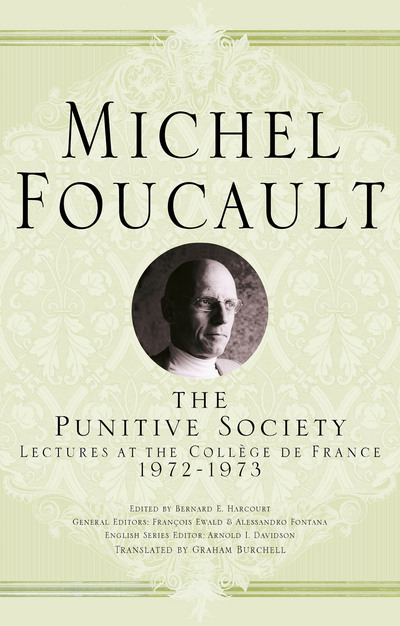
punitive1Michel Foucault, The Punitive Society: Lectures at the Collège de France, 1972-1973, Editors: Bernard E. Harcourt, François Ewald, Alessandro Fontana, Trans. Graham Burchell, Palgrave Macmillan, September 2015

‘Unfortunately, when we teach morality, when we study the history of morals, we always analyze the Groundwork of the Metaphysics of Morals and do not read [Colquhoun], this character who is fundamental for our morality. The inventor of the English police, this Glasgow merchant … settles in London where, in 1792, shipping companies ask him to solve the problem of the superintendence of the docks and the protection of bourgeois wealth. [This is a] basic problem …; to understand a society’s system of morality we have to ask the question: Where is the wealth? The history of morality should be organized entirely by this question of the location and movement of wealth.’
Michel Foucault

These thirteen lectures on the ‘punitive society,’ delivered at the Collège de France in the first three months of 1973, examine the way in which the relations between justice and truth that govern modern penal law were forged, and question what links them to the emergence of a new punitive regime that still dominates contemporary society.

Presumed to be preparation for Discipline and Punish, published in 1975, in fact the lectures unfold quite differently, going beyond the carceral system and encompassing the whole of capitalist society, at the heart of which is the invention of a particular management of the multiplicity of interweaving illegalisms.

The lectures, which stand as an essay in its own right, bring together hitherto unpublished historical material concerning classical political economy, the Quakers, English ‘Dissenters,’ and their philanthropy – the discourse of those who introduce the penitentiary into the penal – and the moralization of the worker’s time. Through his criticism of Thomas Hobbes, Michel Foucault offers an analysis of civil war that is not the war of all against all, but a ‘general matrix’ that makes it possible to understand the functioning of the penal strategy, the target of which is less the criminal than the social enemy within. The Punitive Society is one of the great texts recounting the history of capitalism. Our human sciences prove to be, in the Nietzschean sense, ‘moral sciences.’

Michel Foucault, acknowledged as the pre-eminent philosopher of France in the 1970s and 1980s, continues to have enormous impact throughout the world in many disciplines.

Arnold I. Davidson,
Series Editor, is the Robert O. Anderson Distinguished Service Professor at the University of Chicago, USA, and Professor of the Philosophy of Cultures at the Università Ca’Foscari, Venice, Italy. He is co-editor of the volume Michel Foucault: Philosophie.

Graham Burchell is a translator. As well as translating Foucault’s lectures at the Collège de France he has written essays on Foucault’s work and was an editor of and contributor to the influential volume The Foucault Effect: Studies in Governmentality.