
Foucault News

News and resources on French thinker Michel Foucault (1926-1984)

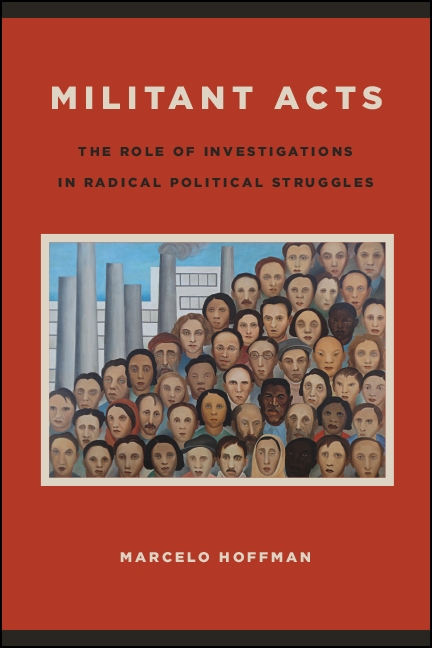
Marcelo Hoffman, Militant Acts. The Role of Investigations in Radical Political Struggles, SUNY Press, Release Date: January 2019
ISBN13: 978-1-4384-7261-4

Summary

Offers a history of the role of investigations in radical political struggles from the nineteenth century forward.

Militant Acts presents a broad history of the concept and practice of investigations in radical political struggles from the nineteenth century to the present. Radicals launched investigations into the conditions and struggles of the oppressed and exploited to stimulate their political mobilization and organization. These investigations assumed a variety of methodological forms in a wide range of geographical and institutional contexts, and they also drew support from the participation of intellectuals such as Marx, Lenin, Mao, Dunayevskaya, Foucault, and Badiou. Marcelo Hoffman analyzes newspapers, pamphlets, reports, and other source materials, which reveal the diverse histories, underappreciated difficulties, and theoretical import of investigations in radical political struggles. In so doing, he challenges readers to rethink the supposed failure of these investigations and concludes that the value of investigations in radical political struggles ultimately resides in the possibility of producing a new political “we.”

“The kind of archival and synthetic work on investigations that this book evinces has been accomplished nowhere else. Hoffman’s survey provides the reader with an understanding of how investigations fit into the theoretical practice of many important Marxist thinkers, along with an argument for their utility. Further, original insights into these thinkers, which enhance or even contradict our available understandings with better historical evidence, are offered.” — William S. Lewis, author of Louis Althusser and the Traditions of French Marxism

“Hoffman focuses on a distinctive, yet little recognized practice of resistance and shows how it impacts and is impacted by the theories of ideology and power in which it was employed. The scholarship is not only sound, but truly pathbreaking in its treatment of various traditions, languages, and even its usage of extremely diverse source materials.” — Kevin Thompson, DePaul University

Marcelo Hoffman is an independent scholar who received his PhD in international studies from the University of Denver and the author of Foucault and Power: The Influence of Political Engagement on Theories of Power. He recently served as a Visiting Specialist Professor at the Institute of Philosophy and Human Sciences of the State University of Campinas in Brazil.

Gordon Hull, Foucault’s “Analytic Philosophy of Politics”, New APPS: Art, Politics, Philosophy, Science, 02 July 2018

The current issue of Foucault Studies contains the first English translation of a lecture Foucault gave in Japan in 1978.  This “Analytic Philosophy of Politics” is essential reading if you have an interest in the transition between Foucault’s “power” and “ethics” work and/or his later understanding of power and resistance.  The Tokyo lecture underscores a profound continuity in his thought along a number of lines. Here are a few things that emerged for me on a first reading (there are also references to Confucianism that I am totally unqualified to address, so I will simply note that they are present):

(1) Foucault proposes that the question of power emerges in the wake of fascism and Stalinism, which he treats as both singular but as tied to “a whole series of mechanisms that already existed within social and political systems” (189).  That is, movements now challenge “this overproduction of power that Stalinism and fascism clearly manifested in its stark and monstrous state” (189).  The emphasis on Stalinism and fascism corresponds to the lectures that bookend Society must be Defended a few years prior, where Foucault begins by critiquing “totalitarian” discourses in the form of orthodox Marxism and closes with an analysis of state racism (exemplified by the Nazis) as a form of biopower.  So too, at the beginning of SMD, he refers to some of the same movements – anti-psychiatry, the recovery of “subjugated knowledges” that are the examples in the Tokyo lecture.

read more

Interview with Shelley Tremain by Dave O’Brien on
Foucault and Feminist Philosophy of Disability, University of Michigan Press 2017
September 11, 2018 Podcast, New Books Network

How should we understand disability? In Foucault and Feminist Philosophy of Disability (University of Michigan Press, 2017), Dr. Shelley Tremain explores this complex question from the perspective of feminist philosophy, using the work of Michel Foucault. The book is a fascinating critique of much contemporary philosophy and policy, providing a detailed, but easy to follow overview of key works in feminism and in Foucault’s thought. The book places these discussions in the context of inequalities within academic philosophy itself, drawing attention to the marginalisation of key questions of disability and gender from contemporary philosophy as it is currently organised. Overall the book is important reading not only for disability studies and philosophy, but anyone wanting to understand how society disadvantages difference. You can read more of Dr. Tremain’s work, and key debates on philosophy and disability as part of the Discrimination and Disadvantage blog. Editor: January 2026. This blog no longer exists. The link is to the blog as it is archived on the Wayback Machine

Seyla Benhabib, Below the Asphalt Lies the Beach. Reflections on the legacy of the Frankfurt School, Boston Review, A political and literary forum, October 09, 2018

[…]
The Dialectic of Enlightenment is a bridge text to a broader conception of critical theory—of oppositional and emancipatory knowledge—that emerged in the last decades of the twentieth century. Although Michel Foucault quipped that he had never read the Dialectic of Enlightenment (published in 1944), his work replaced the creative subject that Horkheimer took from Hegel, Marx, and Lukács with a theory about how subjectivity is created. History is a not a record of the deeds of a collective or singular subject, he argued; rather, it is formed by a series of epistemes—configurations of power-knowledge—each giving shape to different conceptions of knowledge and action. In the essay “Nietzsche, Genealogy, History,” Foucault explains that whereas archaeology digs into the layers of what is manifest in the present, genealogy searches for the breaks and displacements between the source and the phenomena. Genealogy searches for emergence (Herkunft), but emergence does not mean a smooth evolution from a known original (Ursprung). Just as there is no continuous narrative that can be told of a unified collective subject unfolding in history, so too genealogy does not trace an uninterrupted line of development from the past to the present, providing a narrative of improved knowledge and moral progress. Instead, society is constituted by a discontinuous and fragmentary series of power-knowledge configurations, full of displacements and erasures. Knowledge is not just emancipatory but also disciplinary; power can only be confronted by power. “The ‘Enlightenment,’ which discovered the liberties, also invented the disciplines,” he writes in Discipline and Punish (1975).

read more

Alessandro Baccarin, Paolo Vernaglione Berardi, Archeoligia filosofica laboritorio. Un pò di storiaIl laboratorio, l’associazione, gli scritti, la collana editoriale

Tre anni fa abbiamo iniziato a ragionare intorno alla possibilità di rendere quello strano campo della ricerca filosofica che ha nome “archeologia filosofica”, un vero e proprio spazio di elaborazione.

Nasce così il *Laboratorio “archeologia filosofica”*, un laboratorio nomade che realizza incontri, seminari e testi sulla via aperta da Michel Foucault con L’ Archeologia dei saperi e percorsa da Enzo Melandri, uno dei grandi filosofi dimenticati del secondo Novecento.
L’archeologia risale agli apriori storici che hanno informato le epoche del pensiero per far emergere i rapporti tra saperi, poteri e soggettività.
Il metodo è genealogico, secondo l’accezione che ha in Nietzsche perchè scopre, alle spalle dei dispositivi di sapere-potere, i rapporti di forza, i conflitti, le convergenze e le tracce delle dislocazioni di valori in cui si compie il pensiero.
Giorgio Agamben ha dato al vasto campo di ricerca intorno ai dispositivi di sapere e alle soglie economico-teologiche della storia occidentale il nome di archeologia filosofica, indagando le figure dell’ homo sacer, della nuda vita, dell’uso dei corpi e dell’inoperosità come le più essenziali problematizzazioni filosofiche.

read more

Latest updates

Una storia inattuale. Recensione dei  libri di Ermanno Castanò e Tiziana Villani nel Quaderno XXIV (download pdf)
di Paolo Vernaglione Berardi

In una nota di preparazione alle tesi Sul concetto di storia Walter Benjamin esprime l’idea dell’animalità che solo nella modernità è diventata la questione dell’animale. Essa infatti è divenuta l’idea del rapporto dell’uomo con l’animale oggi degradata a discorso biologico, etologico, cognitivo sull’animale, e sull’animale umano alla fine della storia…

Le rovine selvagge (pdf)
di Stefania Consigliere

Levi- Strauss’ structuralism, with its fluctuating distinction between “hot” and “cold” societies, is both an apex and a turning point in the history of anthropology: refusing the hierarchies of progress while naturalizing human worlds, bringing reason to its further stretches while opening ways to narrative approaches. It seemed impossible, in his time, to appreciate diversity without falling into the conservative, or even reactionary, field. But things have changed: mixing present day Amazonia and ancient Greece into the landscape of ruins in  which we dwell, this paper explores the possibilities of reenchantment  that  open  up  when  –  overcoming  ancient  scotomas  –  we  make acquaintance with the ghosts of modernity…

La terra di nessuno. Droni, filo spinato e guerra ai migranti
di Alessandro Baccarin

Alla fine della guerra fredda, a ridosso della prima guerra del Golfo, negli ambienti intellettuali statunitensi legati agli ambienti militari e diplomatici venne elaborata una nuova dottrina bellica centrata sulle nuove frontiere tecnologiche e digitali che l’evento bellico in quegli anni si accingeva a toccare e superare…

Una questione di stile. Per Alessandro Fontana
di Paolo Vernaglione Berardi

Un’eredità senza testamento segna il limite del diritto pubblico fondato sul contratto. Un testamento senza eredità è la traccia dell’emergere di una scrittura senza soggetto in cui appare la distanza tragica di giustizia e diritto…

Orazio Irrera, La raison nègre et le corps d’extraction. Esprit, n. 450, décembre 2018, pp. 100-105.

En combinant le schéma marxiste de l’accumulation primitive et la biopolitique foucaldienne, Achille Mbembe propose une généalogie du sujet de race comme « corps d’extraction ».

Un des aspects les plus remarquables du projet annoncé par un ouvrage comme Critique de la raison nègre est la tentative de mettre en place un cadre conceptuel et historique large et cohérent aboutissant sur une généalogie du lien de sujétion raciale qui charpente notre modernité. Ipso facto, il serait trop restrictif de qualifier cette modernité d’européenne ou d’occidentale, et il conviendrait plutôt de la désigner comme globale, tout comme l’a été l’entreprise coloniale et impériale des puissances européennes, qui ont justement investi l’espace à une échelle transcontinentale[1].

Mais, à la différence d’Edward Said[2], qui considérait davantage l’orientalisme comme une sorte de matrice des rapports coloniaux et raciaux de pouvoir, l’angle d’attaque de Mbembe est plutôt ancré sur ce qu’il appelle la raison nègre, qui fait de l’Afrique le site géographique et géopolitique où puise son entreprise critique. C’est à partir de là que cette généalogie de la fabrication de sujets de race se précise dans toute sa spécificité historique, en se proposant de relier principalement trois moments majeurs : l’esclavage alimenté par la traite atlantique qui trouve dans l’espace de la plantation son foyer d’expérience privilégié ; la colonie, où l’assujettissement racial se remodèle en fonction de la mise en place d’institutions et de techniques de gouvernement liées à la constitution des grands empires coloniaux ; et enfin, l’apartheid, où les formes de ségrégation raciale amènent à une intensification ultérieure de l’expérience de soi comme sujet de race. Néanmoins, comme le point de départ de toute généalogie est toujours fixé dans et par le présent, la démarche généalogique de Mbembe s’organise autour du diagnostic d’un présent global marqué par ce qu’il qualifie de «devenir nègre du monde», qui se présente comme l’issue à la fois «de la planétarisation des marchés, de la privatisation du monde sous l’égide du néolibéralisme et de l’intégration croissante de l’économie financière, du complexe militaire post-impérial et des technologies électroniques et digitales [3]».

Orazio Irrera

\Maitre de conférences en philosophie de l’Université Paris 8, Orazio Irrera a récemment dirigé, avec Salva Vaccaro, La Pensée politique de Foucault (Kimé, 2017).
suite

Matko Krce-Ivančić (2018) Governing through anxiety. Journal for Cultural Research, 22(3), 262–277.
https://doi.org/10.1080/14797585.2018.1537587

ABSTRACT
This article examines anxiety, arguing that it is a systemic feature of neoliberalism which regenerates the economy and acts in a conservative manner, thereby effectively preventing social change. Anxiety is explored using psychoanalytic theory to extend Foucault’s conception of neoliberal governmentality as proposed in his lectures on neoliberalism at the Collège de France. Relying on Foucault’s notion of governmentality as an analytic perspective, this article does not present the economy or the state as the origin of power in neoliberalism. Rather, these are seen as mediums of power, whereas the anchorage point of power relations is understood to be a particular form of governmentality. In neoliberalism, this anchorage point of power is largely supported and strongly characterised by anxiety. While examining the psychic life of power in neoliberalism, I avoid positioning and thus analysing anxiety either on the individual or the macro level of society. Rather, showing that anxiety exposes the weakness of such clean divisions, it is argued that neoliberal subjects are nowadays governed through anxiety.

KEYWORDS: Anxiety, choice, Foucault, governmentality, neoliberalism, psychoanalysis

Marc Schuilenburg and Rik Peeters, Smart cities and the architecture of security: pastoral power and the scripted design of public space, City Territory and Architecture (2018) 5, 13

DOI10.1186/s40410-018-0090-8

Abstract
The architecture of security is often thought of in terms of situational crime prevention and defensible space. In this article, we argue that the emergence of smart cities and smart technology compel a broader conceptualisation of the design of security, which has the potential to transform the governance of our urban landscape. Drawing on the case of the city of Eindhoven’s “De-escalate” project—in which sound, smell and lighting programming combined with data analysis is used to reduce violence and aggression in the inner-city entertainment area—we show that the securitisation of urban space can also be pursued by positive triggers for behaviour. The case allows us to rethink the architecture of security in terms of pastoral power—Foucault’s notion of governing individuals and populations through care and protection. In sharp contrast with more hostile forms of situational crime prevention and defensible space, which seek to “design out” unwanted behaviour by closing of spaces, pastoral architecture is inclusive and provides “scripts” for desirable behaviour in public space. Moreover, this architecture is incorporated and designed into the existing built environment, operates through psychological triggers rather than physical ones, and is principally developed by private companies rather than the state.

Keywords: Smart city, Smart technology, Pastoral power, Architecture, Securitisation

Francescomaria Tedesco, Sovereign Excess, Legitimacy and Resistance, Routledge, 2018

Description
When talking about his film Salò, Pasolini claimed that nothing is more anarchic than power, because power does whatever it wants, and what power wants is totally arbitrary. And yet, upon examining the murderous capital of modern sovereignty, the fragility emerges of a power whose existence depends on its victims’ recognition. Like a prayer from God, the command implores to be loved, also by those whom it puts to death. Benefitting from this “political theurgy” as the book calls it (the idea that a power, like God, claiming to be full of glory, constantly needs to be glorified) is Barnardine, the Bohemian murderer in Shakespeare’s Measure for Measure, as he, called upon by power to the gallows, answers with a curse: ‘a pox o’ your throats’.

He does not want to die, nor, indeed, will he. And so, he becomes sovereign. On a level with and against the State.

Table of Contents
Preface

1. “Tell the bastards nothing!”. The ideology of the scaffold

2. Fault lines

3. That sovereign, a true Machiavellian

4. Machiavelli and Shakespeare

5. Sovereign excess. Death penalty and recognition

6. Hinneni

7. Tu es/Tuer

8. I will not consent to die

9. Conclusion

About the Author
Francescomaria Tedesco is assistant professor at the University of Camerino (Italy), where he teaches Political Philosophy.

Randell-Moon, H., 2018. Digital Cartography Enterprise: Neoliberalism, Governmentality and Digital Infrastructure. Westminster Papers in Communication and Culture, 13(2), pp.77–95.
DOI:http://doi.org/10.16997/wpcc.293

Abstract
The Gigatown competition (2013–2015) was a joint initiative between the telecommunications company Chorus and the New Zealand government to award a New Zealand town ‘the fastest internet in the Southern Hemisphere’ through a social media competition. In this paper, I argue the competition stimulated a range of activities that cohere with creative and smart city policies, the growth of information and communications technology (ICT) and immaterial labour, and the participatory turn in urban governance and planning. In its attempt to remake city-space as receptive for an imagined ICT future, the competition exemplifies what I call a Digital Cartography Enterprise. This term captures both the neoliberal and post-industrial spatial rationalities of urban planning and policy with respect to securing ICT-readiness as well as the governmentalised disciplining of the population to creatively subsidise such a venture through appeals to their entrepreneurialism in a social media competition.

Keywords: digital infrastructure, governmentality, neoliberalism, competitio, urban plannin, social media