Foucault News

News and resources on French thinker Michel Foucault (1926-1984)


materiali foucaultiani volume VI, number 11-12 (January-December 2017)

TABLE OF CONTENTS

Le confessioni della carne  (pp. 3-6)

Laura Cremonesi, Orazio Irrera, Daniele Lorenzini, Martina Tazzioli

FULL ARTICLE

Michel Foucault et la subjectivation

Introduzione. Soggettivazione e assoggettamento, a partire da Foucault  (pp. 9-14)

  Laura Cremonesi, Orazio Irrera, Daniele Lorenzini, Martina Tazzioli

FULL ARTICLE

Subjectivité et normativité chez Canguilhem et Foucault  (pp. 15-38)

  Pierre Macherey

FULL ARTICLE

N’être personne ! Variations sur les usages critiques de la fonction-sujet  (pp. 39-48)

Guillaume le Blanc

FULL ARTICLE

Le gouvernement du désir. Foucault à l’épreuve du libéralisme  (pp. 49-62)

Miguel de Beistegui

FULL ARTICLE

Sulle parrhèsia(e) di Foucault  (pp. 63-81)

  Étienne Balibar

FULL ARTICLE

Regimes of Visibility

The Dis-Time of Security and Visibility in Contemporary Governmentalities. An Interview with Didier Bigo  (pp. 83-92)

  Didier Bigo

FULL ARTICLE

Seeing and Saying. Foucault’s Analytic of Knowledge Production  (pp. 93-117)

  Deirdre McDonald

FULL ARTICLE

Saggi

Foucault’s 1978 Lectures and the Archaeology of Probability and Statistics  (pp. 119-139)

  Laurence Barry

FULL ARTICLE

Foucault, 1978: The Biopolitics of Translation and the Decolonization of Knowledge  (pp. 141-172)

  Jon Solomon

FULL ARTICLE

Michel Foucault and China. A Missed Appointment  (pp. 173-193)

  Alain Brossat
FULL ARTICLE

Tyler King, The Hacker ‘Ethic:’ Digital Infrastructures as the Battleground of Conflicting Liberalism, Society and Space, 2018

[…]

Although increased internet security and greater public internet access may seem somewhat counterintuitive, both ideals were mobilized and justified through liberal means in order to promote this state agenda. Michel Foucault’s (1977-1978: 18-20) analysis of the development of traditional, physical infrastructures of mobility in the modern city serves as an analogy for Clinton’s liberal internet security and increased public access agenda. As described by Foucault in his collection of lectures titled “Security, Territory, Population”, modern towns needed a wide array of interconnected roads in order to ensure growth in trade, which simultaneously created more points of insecurity. This growth in insecurity also had the corollary effect of restricting the state’s ability to know or predict all that was happening (or would happen) within their jurisdiction. A new form of government rationality, what Foucault (1977-1978) originally called the “apparatus of security”, and later “governmentality”, was needed in order to successfully regulate the unpredictability that arose within the modern city.

Foucault also describes security in the liberal state as having three main traits: it deals with possibilities and probabilities (for example, through the development of statistics) rather than absolutes; it conducts cost-benefit analyses in order to determine courses of action; and it avoids binary markers of the accepted and the forbidden, instead electing to create a broader spectrum of the permissible (Gordon 1991: 20). Like the physical infrastructures of the modern city, the expansion of cyber space during the Clinton administration created similar tensions between the need for economic growth and the potential for increased points of insecurity. Furthermore, the lack of any “real” physical or spatially demarcated borders in cyber space undoubtedly created additional challenges for national security.[1]

Antonio Pele (2018) Human Dignity in the Renaissance? Dignitas Hominis and “Spiritual counter-subjectivity”: a Foucauldian Approach. Philosophy & Social Criticism
https://doi.org/10.1177/0191453718814874

Abstract:

The historical making of human dignity is usually understood either as a result of a progressive history of the recognition of the human being’s worthiness or as an upward equalization of ranks. The present article offers a novel and different analysis. It takes the Renaissance idea of dignitas hominis as an object of study and reframes it through Michel Foucault’s insights on ‘archaeology’, power and subjectivity. In doing so, the article demonstrates how dignitas hominis was produced within the so-called Renaissance episteme and as a result of what Foucault defines as the ‘pastorate counter-conducts’. Therefore, the article argues the dignitas hominis narrative aimed to debunk the authority of the ecclesiastical authorities and moulded other ways of ‘being conducted’ and of ‘conducting oneself’ in spiritual life. More radically, this narrative fashioned a ‘spiritual counter-subjectivity’ that removed confession as the main technique producing the Christian subject.

stuartelden's avatarProgressive Geographies

EF21.jpeg

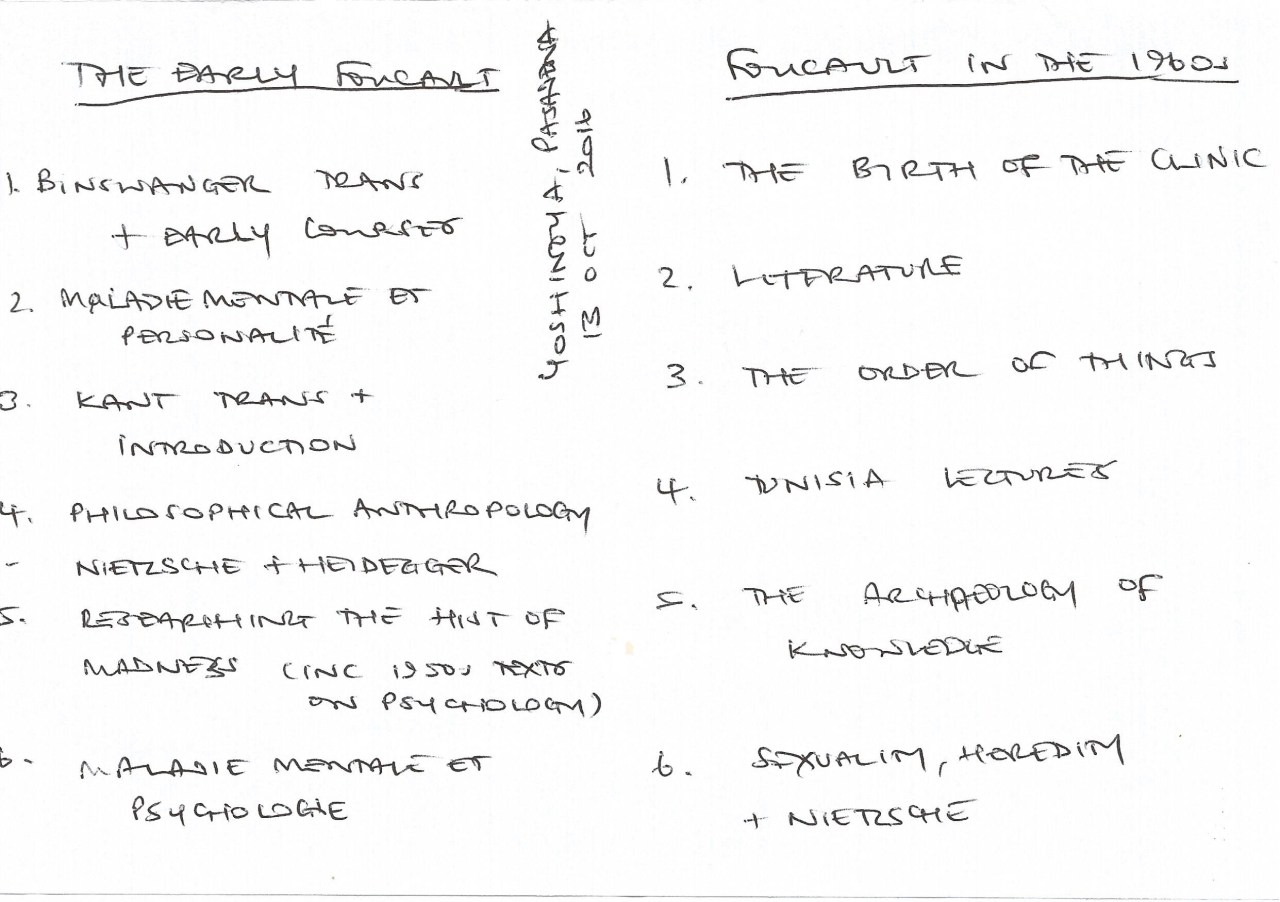
Just over two years ago, while I was having something to eat in Pasadena, before a conference on Early Modern Literary Geographies, I sketched out how a pair of books on Foucault’s work up until 1969 might look. I’ve been working on the earlier of the two books since, albeit with the detour of the Canguilhem study and the final work on Shakespearean Territories. Although The Early Foucault is far from finished, it’s come a long way in that time. The chapters have increased to nine and changed some of their arrangement, though it covers all of this and more, as I learn more about this period. Increasingly though I’m finding I’m gathering sources, making notes and thinking about the 1960s book.
The Early Foucault-Foucault in the 1960s

Term 1 is when I do most of my teaching, and the first half of the term is always the busiest time of year…

View original post 1,349 more words

stuartelden's avatarProgressive Geographies

CFP: Violence, Space and the Archives – National University of Ireland, Galway, 23-24 May 2019

We invite paper submissions from across the disciplinary spectrum for a conference on ‘Violence, Space and the Archives’ to examine the challenges and possibilities presented by archival work that interrogates the imbrications of violence and space.

Many research projects concerned with the spatial, contextual, and/or historical specificities of violence involve the assembling of an empirical corpus, however defined, in order to (re)construct moments of struggle and contestation. Archives are often constituted by, and reflect, the concerns of power. The archive is a site of silence as much as a site of statement. Still, archival collections often allow the voices of the dispossessed, the marginal, and those most subject to regimes of power, to speak, albeit often through a narrowed aperture. Along with the strategic concerns of officialdom, the archives may also give voice to alternative…

View original post 239 more words

Arona Moreau, Le Biosiècle: Bioéconomie, biopolitique, biocentrisme, Paris: L’Harmattan, 2018

Ce siècle qui avance est le Biosiècle, le siècle qui consacre le vivant dans ses dimensions multiples. De l’économie à l’histoire, en passant par la politique et la philosophie, la bioquestion se retrouve au centre des débats, avec une grande diversité d’auteurs et de travaux, de pratiques et d’actions menant globalement à une ère nouvelle, celle de la vie dans son caractère à la fois entier et transversal. Ce livre est tout à la fois une critique positiviste de la modernité et un pari progressiste sur le futur. Il intègre, au-delà de l’analyse, un certain engagement de la part de l’auteur et s’inscrit ainsi dans une perspective objectivement révolutionnaire. Entre la vocation pastorale de l’État moderne et l’incertitude historicoécologique de notre époque, il appelle à un retour au sens des choses et à l’émergence d’un rapport nouveau non pas avec le seul univers mais avec la vie et le vivant. Le Biosiècle constitue en toute logique le chemin de notre temps contemporain, la Bioquestion la question d’Aujourd’hui dans toute sa plénitude, le Bioparadigme l’orientation critique et historique la plus globale de notre époque et l’Homobio l’homme le seul à faire naître pour pouvoir se mener vers cette ère nouvelle, la seule rationnelle, la seule encore soutenable et vivable.

Arona MOREAU est né en 1975 à Saint-Louis du Sénégal. Il est sociologue, politologue, spécialiste des questions de développement politique, économique et social. Il est l’auteur de l’ouvrage Pour refaire l’Afrique… par où commencer ? (L’Harmattan, 2008) et aussi fondateur du Parti citoyen lancé depuis mai 2006 au Sénégal.

Tarasova, E.
(Non-) Alternative energy transitions: Examining neoliberal rationality in official nuclear energy discourses of Russia and Poland
(2018) Energy Research and Social Science, 41, pp. 128-135.

DOI: 10.1016/j.erss.2018.04.008

Abstract
Neoliberal trends are a part of the sociopolitical contexts that shape present-day energy transitions. Economic arguments extensively used in nuclear energy discourses regarding the Nuclear Renaissance period may indicate that neoliberal trends have penetrated discussions about energy transitions. This article examines the presence of neoliberal rationality in the official nuclear energy discourses coming from Russia and Poland. These countries are interesting in respect to their relatively recent changes towards a market economy. Neoliberal rationality is defined in the article as the combination of market rationality, limited role of state, political consensus, governance structures and securitization, following Foucault and Brown. Discourse analysis of the energy policies and speeches of politicians that contain statements about nuclear energy development is carried out. The analysis confirms the significant presence of these themes in nuclear energy discourses as well as discourses reflecting the specificities of the two countries. The combination of the defining features of neoliberal rationality in official nuclear energy discourses seem to leave limited space for challenging nuclear energy development and discussing alternative energy transitions. © 2018 Elsevier Ltd

Author Keywords
Energy transition; Market rationality; Neoliberalism; Nuclear energy

Kaveh Dastooreh (2018) Ethical imagination and the new possibilities of subjectivity: a global perspective on the culture of the self and its evolution in Kurdistan, Reflective Practice

DOI: 10.1080/14623943.2018.1539663

ABSTRACT
This paper is written with the hope of not only presenting an ethics that could speak to some of our contemporary subjective and ethical issues but also to introduce some of the pragmatic and aesthetic practices, as they are styled and heightened by a culture in Kurdistan that we call ‘the culture of the self’. It was a culture of elaborating the self and it contained many elements of an ethical perspective. At the beginning of the twentieth century, this culture gradually gave way to a normative and moralistic one. What we acquire from this historical approach is the need to explore the possibility of the re-emergence of a new culture of the self that makes the conditions of subjectivity imaginable. Such a goal will be conceivable if any modern inspiration from ‘the culture of the self’ is to be realized under the direction of a ‘creative’ interpretation; an ethical imagination will be at the heart of this reflective culture.

KEYWORDS: Ethics, culture of the self, creativity, imagination, reflective practice

Stephen Legg and Deana Heath (Eds.), South Asian Governmentalities: Michel Foucault and the Question of Postcolonial Orderings, Cambridge University Press, 2018

Flyer – PDF

This volume analyses the ways in which the works of one of the most influential philosophers of the twentieth century, Michel Foucault, have been received and re-worked by scholars of South Asia. South Asian Governmentalities surveys the past, present, and future lives of the mutually constitutive disciplinary fields of governmentality – a concept introduced by Foucault himself – and South Asian studies. It aims to chart the intersection of post-structuralism and postcolonialism that has seen the latter Foucault being used to ask new questions in and of South Asia, and the experiences of post-colonies used to tease and test the utility of European philosophy beyond Europe. But it also seeks to contribute to the rich body of work on South Asian governmentalities through a critical engagement with the lecture series delivered by Foucault at the Collège de France from 1971 until his death in 1984, which have now become available in English.

Table of Contents

  1. Introducing South Asian governmentalities Deana Heath and Stephen Legg
  2. Governmentality in the East Partha Chatterjee
  3. Pastoral care, the reconstitution of pastoral power and the creation of disobedient subjects under colonialism Indrani Chatterjee
  4. The abiding binary: the social and the political in modern India Prathama Banerjee
  5. Colonial and nationalist truth regimes: empire, Europe and the latter Foucault Stephen Legg
  6. Law as economy/economy as governmentality: convention, corporation, currency Ritu Birla
  7. Do elephants have souls? Animal subjectivities and colonial encounters Jonathan Saha
  8. Plastic history, caste and the government of things in modern India Sara Hodges
  9. Changing the subject: from feminist governmentality to technologies of the (feminist) self Srila Roy
  10. The tortured body: the irrevocable tension between sovereign and biopower in colonial Indian technologies of Rule Deana Heath
  11. The subject in question Gerry Kearns

Amazon India

Amazon US

Amazon UK

Cambridge UK

Cambridge India

Hunkin, E.
If not quality, then what? The discursive risks in early childhood quality reform
(2018) Discourse, pp. 1-13. Article in Press.

DOI: 10.1080/01596306.2018.1453780

Abstract
This paper reports on the findings of a genealogical study and argues that the global discourse of quality in early childhood education and care (ECEC) is based on a number of problematic assumptions that converge to identify ‘quality’ as the site of government investment. Using the Australian policy context as an example, the assumption that only quality ECEC is beneficial for children is linked to the historical privileging of mother-care and the male breadwinner through family policy. Using Foucault’s notion of the ‘art of government’, the implications of the discursive logics of quality are outlined, including how ‘not quality’ childcare is positioned as potentially harmful, yet, the workforce can never be ‘quality enough’. It is recommended that early childhood sector academics, advocates and professionals work to introduce new discursive statements to the global policyscape, in order to create and foster diverse representations and understandings of the benefits and value of ECEC. © 2018 Informa UK Limited, trading as Taylor & Francis Group

Author Keywords
discourse; early childhood; policy; Quality; reform