Foucault News

News and resources on French thinker Michel Foucault (1926-1984)

Editor: This press release along with many other items relating to Foucault’s stay in Tunisia from 1966 to 1968 can be found in the select bibliography I posted yesterday.

Press release on the Centre Michel Foucault site in Paris

PDF in French

Translations into other languages

English
Italian
Portuguese
Spanish
German

Geoff Shullenberger, How We Forgot Foucault, American Affairs, Vol V no.2, Summer 2021

Late last year, British trade minister Liz Truss caused a stir with a speech that pinned the failures of the British education system on “postmodernist philosophy,” which, she said, “puts societal power structures and labels ahead of individuals and their endeavours.” Due to the influence of such views, she went on, students learn about racism and sexism rather than being taught to read and write, and are instilled with a relativistic denial of objective truth. The progenitor of this baleful worldview, Truss told her audience, was the French philosopher Michel Foucault.

Truss’s rant seemed to embarrass the UK’s Conservative government, which removed the transcript from its website. But it’s unclear why it was seen as so scandalous: it was merely a variant of a story told time and again in recent decades by conservatives and centrist liberals alike across the anglophone world. According to this narra­tive, a cluster of ideas originating in continental Europe, especially France, has invaded educational institutions and undermined the values of Western culture and the pursuit of objective scientific truth. Under the sway of this “postmodern” worldview, we are told, stu­dents learn to fault the West for the sins of racism, sexism, and colonialism, and to embrace both moral and epistemological relativism.

[…]

Michel Foucault in Tunisia: A select bibliography

Editor: In light of a number of stories that have been circulating in the media and more broadly online in recent weeks, I have put together a select bibliography relating to Foucault’s time in Tunisia from 1966 to 1968, with a view to making accurate information widely available.

The link to the bibliography can also be found on the Bibliographies page on Foucault News.

I wish to thank all the researchers who have helped in compiling this bibliography.

M. Francyne Huckaby (2008) Making Use of Foucault in a Study of Specific Parrhesiastic Scholars, Educational Philosophy and Theory, 40:6, 770-788.

DOI: 10.1111/j.1469-5812.2007.00369.x

Abstract
In this article, I describe how I made use of Foucault theoretically and methodologically in a study of five specific parrhesiastic scholars. Such scholars challenge hegemony in educational policies and practices, and advocate for educational reform and societal structures that move toward equity instead of marginalization. The article begins by exploring Foucault’s notion of specific intellectuals through the experiences of the scholars. It then moves to an explanation of why the five scholars selected for this study should be considered specific parrhesiastic scholars. An account of how I made use of Foucault in this study follows. My interpretation of Foucault’s work into a research methodology for this project has been a process of identifying illustrations of technologies of the self and technologies of power in text, dialogue, and narrative—qualitative data, which I analyzed using a framework that merged these technologies into the analytical categories of (1) application of logos, (2) engagement with politeia, and (3) practice of techne toubiou.

Keywords:
Foucault parrhesia practices of self technologies of power specific intellectuals methodology

Laufer, L.
Michel Foucault: The Queer Gender for Psychoanalysis?
(2020) Psychoanalytic Inquiry, 40 (8), pp. 579-590.

DOI: 10.1080/07351690.2020.1826214

Abstract
Why should a practitioner of psychoanalysis read Foucault? Is Foucault still a “hot topic” for psychoanalysts in 2019? To prevent psychoanalysis from becoming a dead language, reading and re-reading Michel Foucault proves highly relevant, as it also implies reading queer, gay, lesbian, and gender studies. This article draws on queer authors such as Gayle Rubin, Eve Kosofsky-Sedgwick, and Judith Butler, as well as Freud, Lacan, and Allouch to reflect on how sexuality and gender identity can possibly be conceived in the Freudian field and beyond a hetero-normative gender binary perspective. Both with and after Foucault, as the genealogist of Freudian psychoanalysis, what would psychoanalysis be without discourses on heterosexual families, Oedipus, sexuality, sexual etiology, and infantile sexuality? Reading Foucault sets forth a new erotology and thus amounts to rediscovering “the political honor of psychoanalysis.”. ©, Copyright © Melvin Bornstein, Joseph Lichtenberg, Donald Silver.

Index Keywords
article, female, gender identity, heterosexuality, homosexual female, human, human experiment, infant, language, male, physician, psychoanalysis, reading

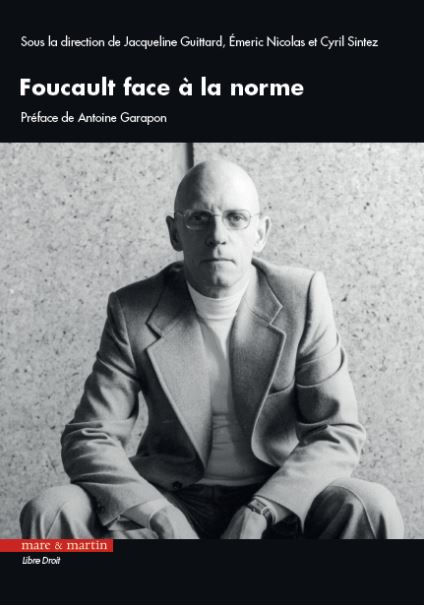
Foucault face à la norme
Sous la direction de : Jacqueline Guittard, Emeric Nicolas, Cyril Sintez
Mare & Martin, 2020

En 1975, dans Surveiller et punir, Michel Foucault décrivait « […] une nouvelle forme de “loi” : un mixte de légalité et de nature, de prescription et de constitution, la norme. » Cette affirmation résultait de son analyse du système carcéral comme instrument du pouvoir normalisateur de la société moderne. Que dirait-il aujourd’hui de l’évolution démesurée des normes de toute nature dans les sociétés de contrôle biosécuritaires en train d’advenir sous nos yeux ? Cet ouvrage relève le défi pluridisciplinaire de cerner le concept de norme chez Foucault comme sa posture normative, susceptibles de nourrir la réflexion critique du chercheur et du citoyen, également pris dans le dédale normatif contemporain.

Préface de Antoine Garapon

Jacqueline Guittard est Maître de conférences en langue et littérature française à l’université de Picardie Jules Verne, chercheuse au Centre d’études des relations et contacts linguistiques et littéraires.

Émeric Nicolas est Maître de conférences, habilité à diriger des recherches, en droit privé à l’université de Picardie Jules Verne, membres du Centre de droit privé et de sciences criminelles et du Centre de recherche juridique Pothier.

Cyril Sintez est Maître de conférences en droit privé à l’université d’Orléans, membre du Centre de recherche juridique Pothier.

Contributions de Mark Antaki, Amélie Bescont, Mathilde Briard, Maxime Charité, Hervé Couchot, Vincent Forray, Pierre-Anne Forcadet, Benoît Frydman, Antoine Garapon, Nathan Genicot, Thierry Guilbert, Nicolas Guillet, Jacqueline Guittard, Rafaell Suguimoto Herculano, Emmanuel Jeuland, Joan Le Goff, Simon Lemoine, Jean-Arnaud Mazères, Dominique Messineo, Émeric Nicolas, Sébastien Pimont, Marie-Andrée Plante, Guillaume Roux, Raphaël Serres, Cyril Sintez.

Danielle Guizzo (2021) Reassessing Foucault: Power in the History of Political Economy, International Journal of Political Economy, 50:1, 60-74.
DOI: 10.1080/08911916.2021.1894828

Abstract
This article examines Michel Foucault’s contributions to the study of power in the history of political economy. It employs Foucault’s readings on economic thought to investigate two moments in the history of political economy: classical political economy and Keynesian economics, in which economic reasoning and practice affected the creation and dissemination of power relations in the social realm. By reconsidering the ontological dynamics that encompass the modern role of the state, economic policies and civil society, the article explores how power displays a changing face in light of different discursive and non-discursive elements throughout the history of political economy, in which “economic knowledge” and “scientific discourses” are reconceived as political apparatuses. The article concludes how a closer look into Foucault’s historical ontology allows for a reassessment of the field of action of political economy, showing its consequences in the political field, in the interpretation of historical facts and in the analysis of power/truth. More specifically, how moments in the history of political economy can be reconsidered not simply as systems of economic ideas, but as political apparatuses that create power.

Keywords:
Genealogy, history of political economy, Michel Foucault, ontology, power

Listik Y. (2021) A Biopolitical Account of Social Pathology: Viewing Pathology as a Political-Ontological Issue. In: Harris N. (eds) Pathology Diagnosis and Social Research. Political Philosophy and Public Purpose. Palgrave Macmillan, Cham. https://doi.org/10.1007/978-3-030-70582-4_7

Open access

Abstract
This chapter will argue that the study of social pathologies is not solely a sociological concern. It is crucial to offer an assessment of the ontological implications of this distinctive approach. In arguing for this shift to a more pronounced ontological analysis, the chapter will employ a biopolitical framework. Considering that the social pathologies manifest within capitalism are entwined within its ontological conditions and assumptions, it is apparent that what one frames as “the pathological” cannot be described as merely contingent or isolated from broader discourses. It is thus not merely theoretically inadequate, but politically problematic to frame capitalist rationality as a pathological intrusion on to what would otherwise be a “healthy” subject.


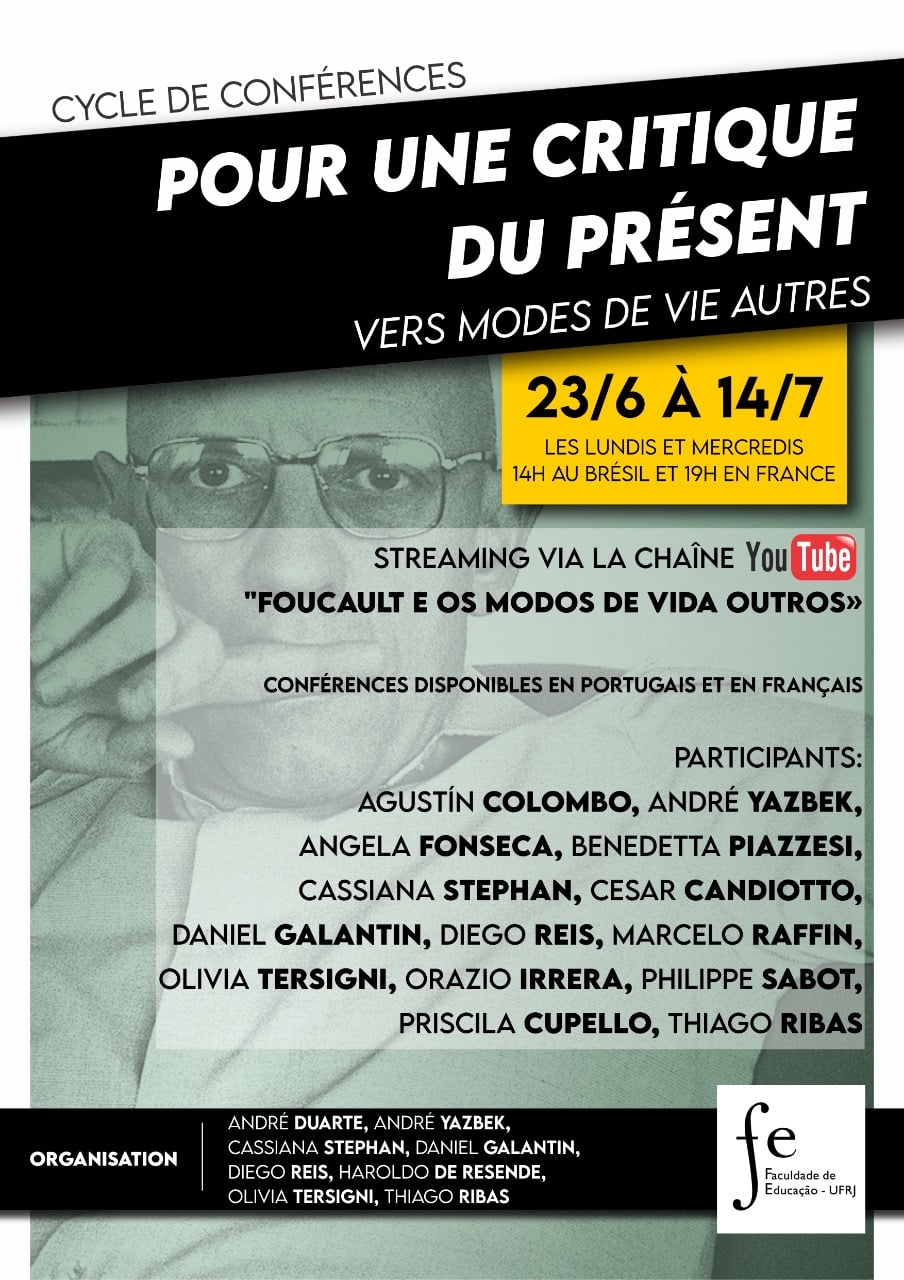
Pour une critique du présent : vers modes de vies autres

Nous vous invitons à participer à notre cycle de conférences portant sur le rapport entre la critique du présent et les modes de vies autres.

Les séances auront lieu les lundis et les mercredis, à 14h00 au Brésil et à 19h00 en France, du 23 juin au 14 juillet. Toutes les communications seront traduites du français vers le portugais et du portugais vers le français, afin de faciliter les échanges entre les participantes.

Les conférences seront diffusées en direct sur la chaîne YouTube « Foucault e os modos de vida outros » :

https://www.youtube.com/channel/UCN9l4T4d_P_Xyy_dWoWmHKw

Consultez le PROGRAMME :

23/06 – Conférence d’ouverture : Cesar Candiotto (PUC/PR)

28/06 – Philippe Sabot (Université de Lille) & Cassiana Stephan (UFPR)

30/06 – Angela Fonseca (UFPR) & Daniel Galantin (PUC/PR)/Thiago Ribas (UFRJ)

05/07 – Marcelo Raffin (Universidad de Buenos Aires) & Diego Reis (UFPB)

07/07 – André Yazbek (UFF) & Olivia Tersigni (Scuola Normale Superiore di Pisa / Université Paris X)

12/07 – Orazio Irrera (Université Paris VIII & Benedetta Piazzesi (Scuola Normale Superiore / Université Paris VIII

14/07 – Agustín Colombo (Université catholique de Louvain) & Priscila Cupello (UFRJ)

Ce cycle est rattaché à la Faculté d’Éducation de l’UFRJ et son organisation compte sur la participation des chercheurs.es et professeurs.es des différentes institutions :

André Duarte (Universidade Federal do Paraná);
André Yazbek (Universidade Federal Fluminense);
Cassiana Stephan (Universidade federal do Paraná);
Daniel Galantin (Pontifícia Universidade Católica do Paraná);
Diego Reis (Universidade Federal da Paraíba);
Haroldo de Resende (Universidade Federal de Uberlândia);
Olívia Tersigni (Scuola Normale Superiore di Pisa / Université Paris 10);
Thiago Ribas (Universidade Federal do Rio de Janeiro)

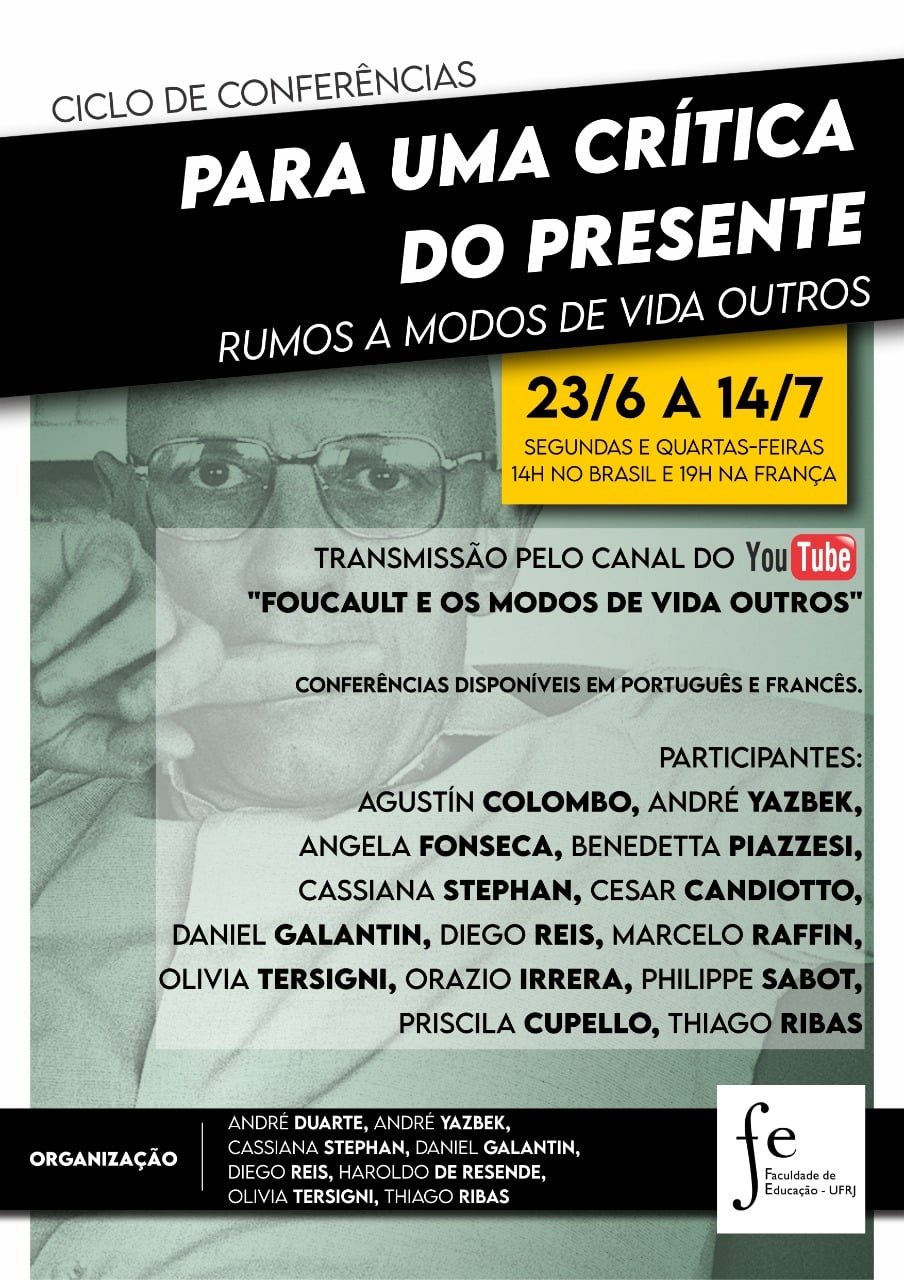
Para uma Crítica do Presente: rumo a modos de vida outros

Convidamos a todas e a todos para participarem do nosso ciclo de conferências que tem como tema a crítica do presente e a sua relação com modos de vida outros.

Os encontros ocorrerão sempre nas segundas-feiras e nas quartas-feiras, às 14hrs do Brasil e às 19hrs da França, do dia 23 de junho ao dia 14 de julho. Todas as comunicações serão traduzidas conforme a necessidade, tanto do francês ao português quanto do português ao francês, possibilitando a troca de questões e o acompanhamento simultâneo do evento por parte do público nacional e internacional.

As conferências serão transmitidas ao vivo pelo canal do Youtube “Foucault e os modos de vida outros”:
https://www.youtube.com/channel/UCN9l4T4d_P_Xyy_dWoWmHKw

Confiram a
PROGRAMAÇÃO:

Dia 23/06 Conferência de abertura com Cesar Candiotto (PUC/PR)

Dia 28/06 Conferências de Philippe Sabot (Université de Lille) & Cassiana Stephan (UFPR)

Dia 30/06 Conferências de Angela Fonseca (UFPR) & Daniel Galantin (PUC/PR) / Thiago Ribas (UFRJ)

Dia 05/07 Conferências de Marcelo Raffin (Universidad de Buenos Aires) & Diego Reis (UFPB)

Dia 07/07 Conferências de André Yazbek (UFF) & Olivia Tersigni (Scuola Normale Superiore di Pisa / Université Paris X)

Dia 12/07 Conferências de Orazio Irrera (Université Paris VIII & Benedetta Piazzesi (Scuola Normale Superiore di Pisa / Université Paris VIII

Dia 14/07 Conferências de Agustín Colombo (Université catholique de Louvain) & Priscila Cupello (UFRJ)

O evento está cadastrado como ação de extensão da Faculdade de Educação da UFRJ e sua organização conta com a participação de professores e pesquisadores de diferentes universidades:

André Duarte (Universidade Federal do Paraná);
André Yazbek (Universidade Federal Fluminense);
Cassiana Stephan (Universidade federal do Paraná);
Daniel Galantin (Pontifícia Universidade Católica do Paraná);
Diego Reis (Universidade Federal da Paraíba);
Haroldo de Resende (Universidade Federal de Uberlândia);
Olívia Tersigni (Scuola Normale Superiore di Pisa / Université Paris 10);
Thiago Ribas (Universidade Federal do Rio de Janeiro)