Foucault News

News and resources on French thinker Michel Foucault (1926-1984)

Barnes, Naomi, Bedford, Alison (Eds.), Unlocking Social Theory with Popular Culture, Remixing Theoretical Influencers, Springer, 2021

This book demonstrates how pop culture examples can be used to demystify complex social theory. It provides tangible, metaphorical examples that shows how it is possible to “do philosophy” rather than subscribe to a theorist by showing that each theorist intersects and overlaps with others.

The book is embedded in the literary theory that tapping into background knowledge is a key step in helping people engage with new and difficult texts. It also acknowledges the important role of popular culture in developing comprehension.

Using a choose your own adventure structure, this book not only shows students of social theory how various theories can be applied but also reveals the multitude of possible pathways theory provides for comprehending society.

Naomi Barnes is a Lecturer in Literacy at Queensland University of technology. Her research is in digital rhetoric the relationships humans have with each other on online, particularly in social media. She uses the socio-cultural theories and philosophical traditions which help us better understand how technology has changed the way we communicate. Naomi has published academic papers that use cyborgs, chthonic monsters and Frankenstein for theory building.

With a background in secondary English and History education, Alison Bedford was awarded her doctorate in English Literature in 2019 and now works both in the secondary and tertiary sectors. Alison’s thesis applied Foucault’s theory of ‘founders of discursivity’ to Mary Shelley’s Frankenstein to argue that Shelley established the moral space that the genre of science fiction now occupies. Her research interests include science fiction as a genre and its social function; secondary History curriculum and pedagogy, and popular culture.

Table of contents (16 chapters)

Remixing Influencers: Academics Reading and Writing About Philosophy and Pop Culture
Barnes, Naomi (et al.)

Westworld
Thomas, Matthew Krehl Edward (et al.)

The Circle of Hegemony
Prosser, Howard

Where the Truth Lies: Peirce Through the Lens of
Ferguson, Joseph (et al.)

Playing Language Games with BB8
Grant, Rhiannon

The Years and Years of Late Modernity: Ulrich Beck and Risk Society
Barnes, Naomi

Orange is the New Other
Bedford, Alison (et al.)

‘Down Here, It’s Our Time’: Bronfenbrenner’s Ecological Systems and
Quickfall, Aimee

Choose Your Driver: How
Johnson, Karl

5 Ways Hogwarts Helps Us Understand Foucault’s ‘Docile Bodies’
Firth, Katherine

Power, Knowledge and Palpatine
Norman, Pat

A Thousand Gateaux: Rethinking Deleuze and Guattari Through
Sidebottom, Kay

“You Pass Butter”: The Messages of Media and Technology in
Holland, Travis

Ordinary Care in Extraordinary Worlds: Murakami and Decentered Care in
Valentine, Riley Clare

Distribution of the Sensible in Besźel and Ul Qoma: Reading Rancière Alongside Miéville’s
Záhora, Jakub

Coming of Age: Towards a Theory of Critical Editorship
Barnes, Naomi

Gøtzsche-Astrup, Johan. “The Political Signification of Riots: A Dispositive Perspective on the 2011 England Riots.” Journal of Sociology, (August 2021). https://doi.org/10.1177/14407833211037399.

Abstract
This article suggests a new perspective on the political signification of riots, using the 2011 England riots as a case. The sociological literature tends to look for the political signification of riots in the riots themselves. Drawing on Michel Foucault’s notion of the dispositive, the article develops a new approach that analyses the optical grids in which riots are made visible as objects for thought and action that can be either political or apolitical. By analysing the case of the 2011 England riots, the article shows how the dispositives that made the riots visible make it possible to ascribe a both obscure and radical political signification to the riots. The article opens up a new line of inquiry about the relation between riots and politics, and allows us to reconsider the political signification of riots.

Keywords
disorder, dispositives, Foucault, protest, riots

Soussloff, Catherine M. “Painting for Fools.” Theory, Culture & Society, (August 2021).
https://doi.org/10.1177/02632764211013379.

Abstract
Manuscripts and notes by Michel Foucault on the visual arts recently deposited at the Bibliothèque Nationale reveal a reliance on canonical oil paintings by the ‘old masters’; a respect for the primary sources in the history of European art; an understanding of the necessity of research in both literary and visual sources, particularly self-portraits; and a sense of the value that a certain philosophical milieu – beginning with Sade and Nietzsche and expanding to his near contemporaries, Bataille, Blanchot, and Klossowski – could offer to an understanding of paintings. The essay argues that Pierre Klossowski’s monumental drawing La Nef des fous (1990) provides an essential key for understanding the place of Hieronymus Bosch’s painting of the same title in History of Madness and the centrality of theories of similitude to Foucault’s thinking about visuality ca. 1960–74. The later significance of the figure of the artist for Foucault can be traced to these earlier writings on painting and madness.

Keywords
aesthetics, art, Foucault, History of Madness, Klossowski, painting, visuality

stuartelden's avatarProgressive Geographies

Acid Horizon podcast: ‘Foucault (With Hair)’ – discussion of The Early Foucault

On this episode, Adam and Will are joined by Stuart Elden to discuss his latest book, The Early Foucault. We discuss the academic experiences and personal relationships that were formative in the Foucault’s development as an intellectual. The conversation ranges from Foucault’s early interest in Hegelianism to the influence of Canguilhem, Hyppolite, Barraqué, Althusser, and others!

Available in different forms –

Google podcastApple Podcast

PatreonYoutube

View original post

Tuomo Tiisala, Foucault, Neoliberalism, and Equality. Critical Inquiry, Autumn 2021, Volume 48 Issue 1
https://doi.org/10.1086/715986

Abstract
This article presents a new account of the relationship between Michel Foucault’s work and neoliberalism, aiming to show that the relationship is significantly more complicated than either Foucault’s critics or defenders have appreciated in the recent controversy. On the one hand, I argue that Foucault’s salutary response to some of Gary Becker’s ideas in the lecture course from 1979 should be read together with the argument of Discipline and Punish. By means of this contextualization I show that Foucault’s sympathetic response to Becker is limited to the domain of penal practices, specifically concerning the question of how to resist their rationality of normalization, and thus it involves no broader commitment to neoliberal economic theory or its political implications. On the other hand, however, I argue that there is a strategic allegiance between Foucault’s work and the ascendance of the neoliberal rationality of governing, although it has nothing to do with his sympathetic engagement with Becker’s work. Instead, I explain how Foucault’s focus on the political stakes of subjectivity has helped to congeal, in the posthumous neoliberal context, a conception of politics that leaves out the topic of economic equality. To explain how Foucault’s work has had this unintended yet lasting effect, I introduce the concept of topical exclusion. It designates a social mechanism of producing ignorance, which operates by directing attention instead of creating false consciousness. The strategic relationship between Foucault’s work and neoliberalism today illustrates that this type of explanation is essential in the analysis of power relations. Thus, my account motivates the adoption of topical exclusion as a conceptual supplement that equips the Foucaultian framework to study cases in which relations of power harness, produce, and sustain ignorance, not knowledge.


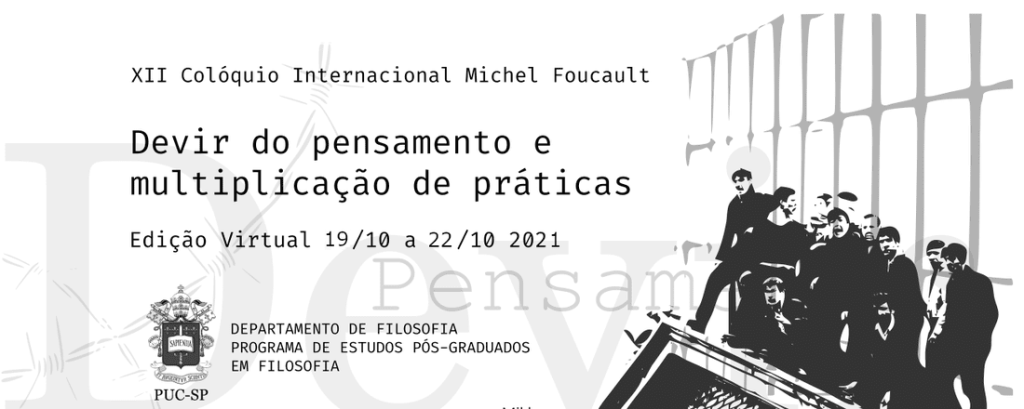
XII Colóquio Internacional Michel Foucault: Devir do Pensamento e Multiplicação de Práticas
19/10/2021 – 22/10/2021

Sobre o evento
Pensamentos que compõem reflexões construídas no passado fazem-se pensamento vivo quando se prestam a reflexões no presente. É assim que as filosofias historicamente elaboradas, pertencentes que são ao próprio tempo no qual se circunscreveram, permanecem válidas para a atualidade, qualquer atualidade, inclusive a nossa. Assim, um pensamento é vivo quando capaz de mover-se no tempo e mover outros tempos; quando provoca desdobramentos a partir dele e para além dele, em pensamentos novos; quando seus desdobramentos são palpáveis em práticas concretas.

O legado de Michel Foucault, seus escritos e seus ditos, cumpre há mais de cinquenta anos as características de um pensamento vivo. Com uma peculiaridade, porém. É que além de gerar outros pensamentos e outras práticas, seu próprio pensamento vem se desdobrando a si mesmo na medida da inesperada proliferação e divulgação de trabalhos que foram realizados pelo próprio autor mas que permaneceram até recentemente pouco ou nada conhecidos.

Este movimento do pensamento vem se fazendo em sucessivos conjuntos de publicações. O primeiro conjunto, é claro, são os numerosos livros publicados durante a vida de Foucault. Em seguida, dez anos após sua morte, a publicação, em quatro volumosos tomos, de trabalhos diversos pronunciados (ditos) e redigidos (escritos) ao longo de sua trajetória e em diferentes contextos, precisamente sob o título Dits et écrits. Segue-se a edição gradativa dos treze Cursos ministrados no Collège de France. E quando tudo parecia já estar dito e escrito, um instigante conjunto de trabalhos quase desconhecidos vem à luz. São publicações novas em sua maioria extraídas das milhares de páginas que compõem os arquivos inéditos – ainda em fase de organização – depositados na Bibliothèque Nationale de France, tais como: artigos, entrevistas, cursos, organizados em diferentes coleções (como, por exemplo, a coleção Philosophie du présent); edições posteriores de Cursos (como Mal faire, dire vrai e Cours sur la sexualité); o 4º volume de História da Sexualidade (Les aveux de la chair).

Nesse contexto, o XII Colóquio Internacional Michel Foucault – Devir do pensamento e multiplicação de práticas – convida ao intercâmbio de saberes e experiências, propondo uma imersão no fluxo deste movimento.

Lynne Huffer, Foucault’s Strange Eros, Columbia University Press, 2020

Interview with author

Review in Foucault Studies

What is the strange eros that haunts Foucault’s writing? In this deeply original consideration of Foucault’s erotic ethics, Lynne Huffer provocatively rewrites Foucault as a Sapphic poet. She uncovers eros as a mode of thought that erodes the interiority of the thinking subject. Focusing on the ethical implications of this mode of thought, Huffer shows how Foucault’s poetic archival method offers a way to counter the disciplining of speech.

At the heart of this method is a conception of the archive as Sapphic: the past’s remains are, like Sappho’s verses, hole-ridden, scattered, and dissolved by time. Listening for eros across fragmented texts, Huffer stages a series of encounters within an archive of literary and theoretical readings: the eroticization of violence in works by Freud and Eve Kosofsky Sedgwick, the historicity of madness in the Foucault-Derrida debate, the afterlives of Foucault’s antiprison activism, and Monique Wittig’s Sapphic materialism. Through these encounters, Foucault’s Strange Eros conceives of ethics as experiments in living that work poetically to make the present strange. Crafting fragments that dissolve into Sapphic brackets, Huffer performs the ethics she describes in her own practice of experimental writing. Foucault’s Strange Eros hints at the self-hollowing speech of an eros that opens a space for the strange.

ABOUT THE AUTHOR
Lynne Huffer is Samuel Candler Dobbs Professor of Women’s, Gender, and Sexuality Studies at Emory University. She is the author of five books, including Mad for Foucault: Rethinking the Foundations of Queer Theory (Columbia, 2009) and Are the Lips a Grave?: A Queer Feminist on the Ethics of Sex (Columbia, 2013).

Rajendran, P.
Parrhesia and clinical practice: A case study of Dr. Esdaile’s mesmeric hospital in Hooghly
(2021) Rupkatha Journal on Interdisciplinary Studies in Humanities, 13 (2), pp. 1-13.

DOI: 10.21659/RUPKATHA.V13N2.05

Abstract
This paper seeks to explore the complex negotiation between mesmerism (as unauthorised medical practice) and the State by analyzing the singular example of Dr. James E. Esdaile, a Scottish civil surgeon stationed in Hooghly, Calcutta, in the 1840-50s; one of the few known medical practitioners of mesmerism in colonial India. His diary titled Mesmerism in India, and its Practical Application in Surgery and Medicine contains a record of every patient who walked into Esdaile’s clinic in Hooghly complaining of pain, the subsequent interaction that took place between the doctor and the patient, usually in the form of a simple sequence of questions and answers, and a description of the procedure by which the patient was treated. The documentation of Esdaile’s controversial clinical practice offers several important insights into the practice of parrhesia (a theory of truth-telling proposed by Foucault) in conjunction with the practice of mesmerism as medicine. Within the annals of medical history, clinical egodocuments such as Esdaile’s surgical diary exemplify the emergence of a difficult relationship between the historical subject and the desire to speak the truth. It reveals how a unique moment in colonial medical history becomes emblematic of a negative relationship with the parrhesiastic act. © AesthetixMS 2021.

Author Keywords
Colonial medicine; Esdaile; Mesmerism; Parrhesia; Surgical diary

Perry Zurn and I are pleased to announce that Intolerable: Writings from Michel Foucault and the Prisons Information Group (1970-1980) is to be published by the University of Minnesota Press at the end of this month. Perry and I are co-editors of the volume and Perry and Erik Beranek are the principal translators.

Intolerable UM Book Page:

In celebration, we have organized a book launch event via Zoom on Friday, September 3rd, 2:00-4:00 PM ET/6:00-8:00 PM UTC  and we want to invite all those who may be interested to attend and participate. The panelists for the session include renowned scholars from Foucault studies and critical prison studies. Please join us.

Registration is via Eventbrite:

The event is open to all, so please feel free to share this information with your networks! We’re all very much looking forward to the conversation.

Kevin Thompson
Professor of Philosophy
Director of Graduate Studies
Co-Director of the Minor in Bioethics & Society Neuroscience Program, Affiliated Faculty DePaul University
2352 N. Clifton, Suite 150
Chicago IL  60614
773.325.4866 (office)
773.325.7265 (department)
kthomp12@depaul.edu

Gravesen, J.D., Birkelund, R.
The discursive transformation of grief throughout history
(2021) Nursing Philosophy

DOI: 10.1111/nup.12351

Abstract
In recent decades, the phenomenon of grief, when you lose a loved one, has been the subject of exploration and discussion among researchers. Because of this, prolonged grief is now recognized as a possible mental disorder as the latest version of the diagnosis manual; ‘International Classification of Diseases’ (ICD-11) being published in 2018 is featuring a new diagnosis called ‘prolonged grief disorder’. The commencement of this new disorder indicates a shift in the way grief is being articulated why the notion of rupture from the French philosopher Michel Foucault is applied as a philosophical approach in this paper. A Foucault-inspired discourse analysis has been prepared and by considering the issue historically and tracing how the concept of grief has been articulated in different time periods throughout history, the aim is to map out the discursive transformation that has taken place and to gain insight into how the societal context has supported and enabled this transformation. This paper takes a historical look back from the 1800s to present and identifies when changes can be observed in the way grief is being articulated. These changes or ruptures are identified in the work of Søren Aabye Kierkegaard, Sigmund Freud and Margaret Stroebe & Henk Schut who all must be assumed to have contributed significantly to how grief is perceived in various historical time periods. The discourse analysis identifies how prominent thinkers have articulated grief in each period and how today’s perception of grief, as a possible mental disorder, both relates to these prominent thinkers but also reflects dominant societal values and ideologies. © 2021 John Wiley & Sons Ltd

Author Keywords
bereavement; foucault; grief; medicalization; mental disorder; pathologization