Foucault News

News and resources on French thinker Michel Foucault (1926-1984)

J M Moore, Review: Penal Theories and Institutions: Lectures at the College de France 1971–1972, The British Journal of Criminology, Volume 62, Issue 1, January 2022, Pages 254–256,
https://doi.org/10.1093/bjc/azab044

Extract
Between 1970 and his death in 1984 (with the exception of a sabbatical in 1977), Michel Foucault delivered an annual series of lectures at the Collège de France. Using tape recordings as well as Foucault’s and others’ notes, the lectures have, since 1997, been published in French (with English translations appearing from 2003). The second lecture series, Penal Theories and Institutions, delivered between November 1971 and March 1972, is the final set of lectures to be published. It is not surprising these lectures have been published last. There were no recordings of the lectures and the editor, Bernard Harcourt, has recreated them from Foucault’s notes. Foucault’s original notations have been included, with crossed out passages detailed in the footnotes. These footnotes are supplemented by extensive endnotes providing context and links to Foucault’s wider scholarship and social activism.
[…]

Museum Thresholds The Design and Media of Arrival
Edited By Ross Parry, Ruth Page, Alex Moseley. Routledge 2020. Copyright year 2018.

Editor: I came across this volume doing a search on Richard Rogers, one of the two architect behind the Georges Pompidou centre in Paris, (the other was Renzo Piano). Richard Rogers has just died.

Richard Rogers, Architect Behind Landmark Pompidou Center, Dies at 88

Book Description
Museum Thresholds is a progressive, interdisciplinary volume and the first to explore the importance and potential of entrance spaces for visitor experience. Bringing together an international collection of writers from different disciplines, the chapters in this volume offer different theoretical perspectives on the nature of engagement, interaction and immersion in threshold spaces, and the factors which enable and inhibit those immersive possibilities.

Organised into themed sections, the book explores museum thresholds from three different perspectives. Considering them first as a problem space, the contributors then go on to explore thresholds through different media and, finally, draw upon other subjects and professions, including performance, gaming, retail and discourse studies, in order to examine them from an entirely new perspective. Drawing upon examples that span Asia, North America and Europe, the authors set the entrance space in its historical, social and architectural contexts. Together, the essays show how the challenges posed by the threshold can be rethought and reimagined from a variety of perspectives, each of which have much to bring to future thinking and design.

Combining both theory and practice, Museum Thresholds should be essential reading for academics, researchers and postgraduate students working in museum studies, digital heritage, architecture, design studies, retail studies and media studies. It will also be of great interest to museum practitioners working in a wide variety of institutions around the globe.

Shahzada Rahim, Debunking the Sovereignty: From Foucault to Agamben, Modern Diplomacy, October 25, 2021

“Citing the end of Volume I of The History of Sexuality, Agamben notes that for Foucault, the “threshold of modernity” is reached when politics becomes bio-politics—when power exercises control not simply over the bodies of living beings, but, in fact, regulates, monitors, and manufactures the life and life processes of those living beings.” For Agamben, the term politics in the western context is effectively a politics of Sovereignty and consequently, for Agamben, Sovereignty itself is inherently bio-political.

In the latter context, the term bio-politics is not modern rather it is ancient. Here, Agamben comes in disagreement with Hannah Arendt and Michel Foucault. Perhaps, this is why, Agamben dedicated his widely cited work “Homo Sacer” to reconcile the bio-political theory of Hannah Arendt and Michel Foucault to grasp the decisive moment of the Modernity. In order to reconcile the bio-political theory of Hannah Arendt and Michel Foucault, Agamben uses the concept of “Bare Life” or “Sacred Life“.
[…]

Alain Brossat, Son cœur mis à nu – l’impossible biographie de Michel Foucault, Ici et Ailleurs, 11 août 2017 (Première publication : avril 2009)

Il m’a fallu un peu de temps avant de déceler le piège que comportait l’invitation qui m’a été adressée par Stéphane Nadaud à venir parler ici autour d’un énoncé en apparence excitant, voire sulfureux – « Foucault et le sexe ». Un piège qu’il aura bien fallu s’efforcer de déjouer, une fois détecté… En quoi consiste ce piège, cela s’énonce aisément : soit il s’agit de présenter un exposé académique sur ce que Foucault a élaboré au fil de son Histoire de la sexualité inachevée, un genre d’exercice auquel je m’efforce de me soustraire autant que je le peux (vous êtes, ici, assez grands pour lire les livres par vous-mêmes et en faire votre profit, non moins que moi) ; soit il s’agit de faire vibrer la corde de l’ « existentiel » en tentant d’entrelacer vie et œuvre, de faire apparaître de supposées « contaminations » de l’œuvre par la vie, la vie personnelle, envisagée sous son angle à la fois le plus intime, le plus dérobé et donc le plus affriolant, pour le chercheur, la vie personnelle sous l’angle du sexe – si ce n’est, directement, la « vie sexuelle ». Or, il se trouve que cette seconde option, contrairement à ce qu’on pourrait imaginer, m’est apparue encore plus triste et rebutante que la première, tant j’en réprouve les prémisses, disons, théoriques, et, davantage encore, peut-être, tant je ne parviens à y associer aucun désir – désir de voir, de savoir, de me faire enquêteur dans cette direction.

Il me fallait donc trouver un moyen de ne pas saisir ces deux perches qui m’étaient tendues et tenter d’imaginer un moyen de dégagement… Plus facile à dire qu’à faire. J’étais dans cet embarras lorsque m’est revenu en mémoire un livre au vague parfum de scandale, en France du moins, et que j’avais durablement négligé de lire pour cette raison même – la biographie de Foucault publiée au début des années 1990 par un universitaire états-unien, James Miller et intitulée, tout un programme, The Passion of Michel Foucault. Je me suis donc dit, au vu de la « mauvaise réputation » de ce livre, qu’il pourrait constituer un bon truchement pour détourner la commande qui m’était adressée et j’ai donc entrepris de la lire avec soin, dans sa version originale, en anglais – puisqu’il semblerait que la version française publiée par les Editions Plon soit quelque peu caviardée, à la demande des héritiers de Foucault. C’est donc de ce livre que je vais vous parler, espérant que ce sera une façon utile de traiter « de biais » le sujet que les organisateurs du séminaire ont annoncé.
[…]

The Telos Press Podcast: Linus Recht on Foucault, Plato, and the Ethics of the Self in the Internet Age
By Telos Press, Tuesday, December 14, 2021

In today’s episode of the Telos Press Podcast, David Pan talks with Linus Recht about his article “After Desire: Foucault’s Ethical Critique of Psychological Man and the Foucauldian Ethos of the Internet Age,” from Telos 196 (Fall 2021). In their conversation they discussed Foucault’s critique of the psychological self and his search for a form of selfhood that would allow for continual reinvention and the discovery of new pleasures; how a reading of Platonic psychology demonstrates the weakness of Foucault’s critique of the psychological self as a historical construct; how contemporary social media has translated Foucault’s ethics of the self into reality; and how the ubiquity of mobile phones and similar devices in our everyday life, particularly the way that they subject us to a constant stream of distracting stimuli, suggests that Foucault’s notion of what the self could be might actually be a recipe for misery.

If your university has an online subscription to Telos, you can read the full article at the Telos Online website. For non-subscribers, learn how your university can begin a subscription to Telos at our library recommendation page. Print copies of Telos 196 are available for purchase in our online store.

Wishing everybody a Happy Christmas and New Year.

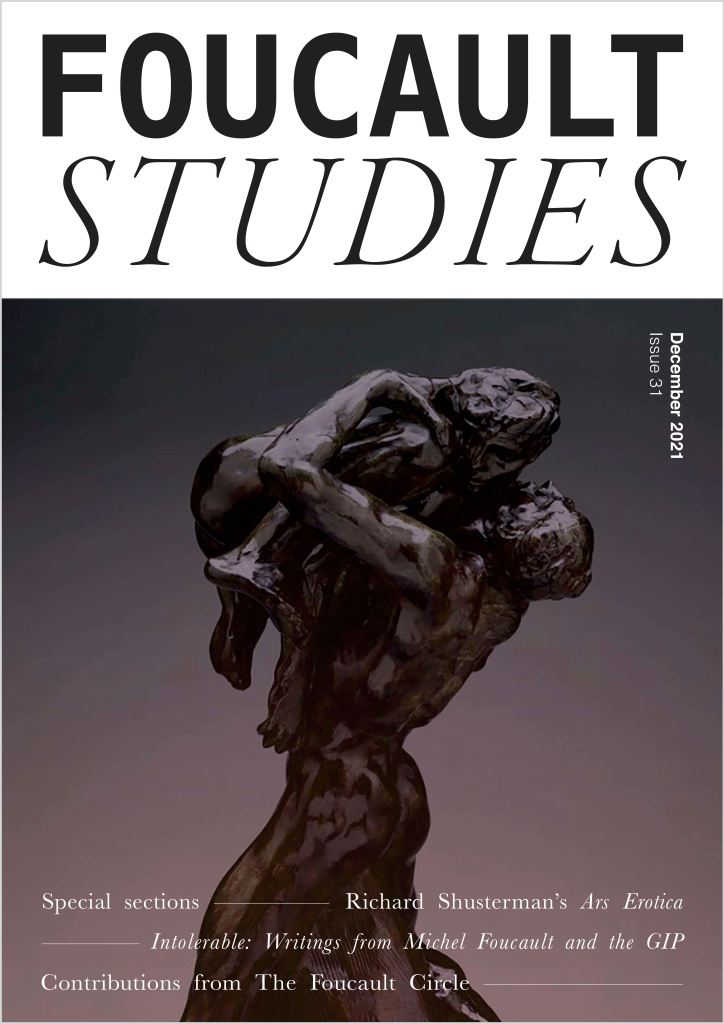
Foucault Studies. Issue 31, December 2021
Open access

Editorial
Sverre Raffnsøe et al.

Symposium: Ars Erotica
Sexuality and/as Art, Power, and Reconciliation
Preface to symposium on Richard Shusterman’s Ars Erotica. Sex and Somaesthetics in the Classical Arts of Love:
Stefano Marino

Ars Erotica and Sôphrosunê: Examining Shusterman’s Nietzsche
Catherine Botha

On the Interest in the Art of Loving: Richard Shusterman’s Ars Erotica
Leonardo Distaso

Beauty between Repression and Coercion: A Few Thoughts on Richard Shusterman’s Ars Erotica: Sex and Somaesthetics in the Classical Arts of Love
Leszek Koczanowicz

Sex, Emancipation, and Aesthetics: Ars Erotica and the Cage of Eurocentric Modernity
Response to Botha, Distaso, and Koczanowicz
Richard Shusterman

Symposium: Intolerable
Intolerable: A book symposium

“Let those who have an experience of prison speak”: The Critique & Praxis of the Prisons Information Group (1970-1980)
Bernard E. Harcourt

Challenge to What Is: The Effect and Aftermath of Exposing Intolerable Conditions of Confinement
Liat Ben-Moshe

The Problem of Concealment: Reformism, Information Struggles, and the Position of Intellectuals
Delio Vásquez

Shirts and Hearts
Sarah Tyson

Abolitionist Broken Windows and the Violence of Power Relations
Ren-yo Hwang

Reform, Abolition, Problematization
Kevin Thompson

Abolition and the Prophetic Imagination
Perry Zurn

Two Friends and a Camera: Foucault, Livrozet, and the Guerilla Art of Documentary Film
Perry Zurn

Special section: Contributions from The Foucault Circle

Coordinator’s introduction
Edward McGushin

The Forgotten Spanish Charity: Love, Government, and The Poor
Martin Bernales-Odino

Genopower: On Genomics, Disability, and Impairment
Joel Michael Reynolds

Articles

Foucault’s Outside: Contingency, May-Being, and Revolt
Luke Martin

Faux Amis, Vrais Amis? Amis.
Jonas Oßwald

Book Reviews

Dianna Taylor, Sexual Violence and Humiliation: A Foucauldian-Feminist Perspective (Interdisciplinary Research in Gender). London and New York: Routledge, 2020. Pp. 128.
ISBN: 978-1-138-58143-2 (hardback). ISBN: 978-0-429-50542-3 (e-book).
Sara Cohen Shabot

Pierre Hadot, The Selected Writings of Pierre Hadot: Philosophy as Practice. London: Bloomsbury, 2020. Pp. 320.
ISBN: 9781474272971 (hardback).
Émile Levesque-Jalbert

Mona Lilja, Constructive Resistance: Repetitions, Emotions, and Time. London: Rowman & Littlefield, 2021. Pp. 184.
ISBN: 9781538146484 (hardback).
Marco Checci

Robert Mitchell, Infectious Liberty. Biopolitics between Romanticism and Liberalism. New York, NY: Fordham University Press, 2021. Pp. 304.
ISBN: 9780823294596 (paperback).
Antonia Karaisl

Marco Checchi, The Primacy of Resistance: Power, Opposition and Becoming. London: Bloomsbury Academic, 2021.
ISBN: 9781350124462 (e-book).
Tomas Pewton

Mitchell Dean and Daniel Zamora, The Last Man Takes LSD: Foucault and the End of Revolution. London: Verso, 2021. Pp. 256.
ISBN: 9781839761393 (hardback).
Jasper Friedrich

Lynne Huffer, Foucault’s Strange Eros. Columbia: Columbia University Press, 2020. Pp. 280.
ISBN: 9780231197144 (hardback).
Theo Mantion

David Macey, The Lives of Foucault. A Biography. London: Verso, [1993] 2019. Pp. 613.
ISBN: 9781788731041 (hardback).
Mike Gane

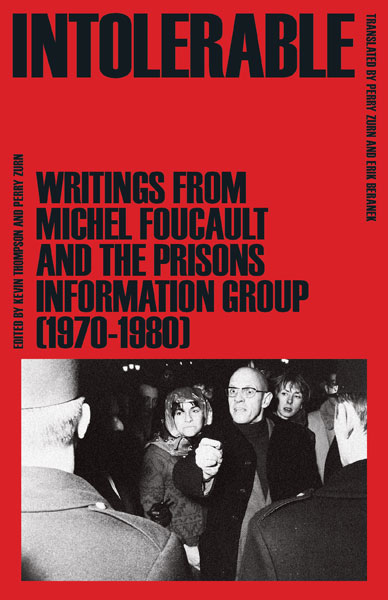
Interview podcast with Kevin Thompson and Perry Zurn, editors of Intolerable. Writings from Michel Foucault and the Prisons Information Group (1970-1980), UNIVERSITY OF MINNESOTA PRESS 2021, New Books Network, Dec 20, 2021

Intolerable: Writings from Michel Foucault and the Prisons Information Group (1970-1980) (University of Minnesota Press, 2021), edited by Kevin Thompson and Perry Zurn, is a groundbreaking collection of writings by Michel Foucault and the Prisons Information Group documenting their efforts to expose France’s inhumane treatment of prisoners

Founded by Michel Foucault and others in 1970-71, the Prisons Information Group (GIP) circulated information about the inhumane conditions within the French prison system. Intolerable makes available for the first time in English a fully annotated compilation of materials produced by the GIP during its brief but influential existence, including an exclusive new interview with GIP member Hélène Cixous and writings by Gilles Deleuze and Jean Genet.

These archival documents–public announcements, manifestos, reports, pamphlets, interventions, press conference statements, interviews, and round table discussions–trace the GIP’s establishment in post-1968 political turmoil, the new models of social activism it pioneered, the prison revolts it supported across France, and the retrospective assessments that followed its denouement. At the same time, Intolerable offers a rich, concrete exploration of Foucault’s concept of resistance, providing a new understanding of the arc of his intellectual development and the genesis of his most influential book, Discipline and Punish.

Presenting the account of France’s most vibrant prison resistance movement in its own words and on its own terms, this significant and relevant collection also connects the approach and activities of the GIP to radical prison resistance movements today.

Kevin Thompson is professor of philosophy at DePaul University. He is author of Hegel’s Theory of Normativity.

Perry Zurn is assistant professor of philosophy at American University. He is coeditor of Curiosity Studies: A New Ecology of Knowledge (Minnesota, 2020) and Active Intolerance: Michel Foucault, the Prisons Information Group, and the Future of Abolition.

Kirk Meighoo is Public Relations Officer for the United National Congress, the Official Opposition in Trinidad and Tobago. His career has spanned media, academia, and politics for three decades.

Teófilo Espada-Brignoni, The Performance of Authenticity, The Makings of Jazz and the Self in Autobiography, Rowman & Littlefield, 2021

In The Performance of Authenticity: The Makings of Jazz and the Self in Autobiography Teófilo Espada-Brignoni analyzes the autobiographies of New Orleans musicians (Baby Dodds, Sidney Bechet, Pops Foster, and Lee Collins) who throughout their texts construct New Orleans jazz as an authentic musical expression grounded in their experiences and culture. The author argues the autobiographies reproduce and reinterpret modernist conceptions of authenticity to assert and affirm authority over the public representations and discussions of jazz. Through the autobiographers’ use of ideas about authenticity, they establish the value of their narratives but at the same time reinforce some of the power dynamics they set out to criticize. Their narratives also reveal the complex ethics that emerged during the first decades of the music and problematize modernist values such as individualism, the dichotomy of work and life, as well as the self and the social. The book adopts Foucauldian and social-constructivist perspectives, complementing analysis of the autobiographies by drawing from literary theory, psychology, sociology, and jazz scholarship.

Caleb Smith, Disciplines of Attention in a Secular Age, Critical Inquiry 2019 45:4, 884-909

“Our inventions are wont to be pretty toys, which distract our attention from serious things,” Henry David Thoreau writes in Walden (1854).1 In the century and a half since Thoreau withdrew to the Massachusetts woods, his thinking about modernity and mental life has become our common sense. New machines of work and play, so the story goes, are destroying our capacity to pay attention. We are always in touch but never really intimate, always moving but never in a natural rhythm. “Why should we live with such hurry and waste of life?” (W, p. 90).
[…]
the distracted today turn to disciplines of attention, adapting the religious practices of older or distant societies to new situations that seem to have little to do with ritual or faith. Mindfulness training, transcendental meditation, regimens to sharpen our focus and extend our concentration—these are the spiritual exercises of our secular age.
[…]
In this essay I offer a genealogy of attentive reading as a secular spiritual exercise. Beginning with the transatlantic reform movements of the early nineteenth century, I take up a handful of sermons, lectures, and other texts that made the problem of attention their explicit topic. “The degree of attention we pay,” one minister preached in 1850, “depends upon our own disposition to attend. This shows us that the matter, after all, is very largely one of discipline.”14 I explore how reformers sought to capture and direct attention in the service of social control. I also dwell for a while with Thoreau, for whom a heightened attentiveness seemed to open a way out of the grips of power, toward a kind of redemption. As Theo Davis suggests, Thoreau’s work has become a touchstone for thinking about “reading as attending.”15 Our disciplines of attention were born, I argue, when reformers trained in an Anglo-Protestant tradition reconceived ancient religious practices for the purposes of secular pedagogy and self-culture, as a remedy to the psychic damage wrought by modernity.

[…]
The new spiritual exercises promised to repair the damage history does to the self—not by remaking historical conditions but by retraining will and perception. They are disciplines, but they are also therapeutic and ethical practices, in Michel Foucault’s sense.