Foucault News

News and resources on French thinker Michel Foucault (1926-1984)

Goodley, C., Perryman, J.
Beyond the ‘terrors of performativity’: dichotomies, identities and escaping the panopticon
(2022) London Review of Education, 20 (1), art. no. 29

DOI: 10.14324/LRE.20.1.29

Abstract
This article examines the influence of Stephen Ball’s work through the eyes of two former teachers turned academics who met through a mutual interest in his paper, ‘The teacher’s soul and the terrors of performativity’. We note our personal reactions to this particular paper and how Ball’s body of work has and continues to influence our thinking, careers and research. We note that his highly readable, provocative style of writing and passionate denunciation of league tables, inspections and the associated paraphernalia of control that appear central to neoliberal models of educational governance continue to prove useful in understanding global educational policy. This article also critically engages with the effects of such a seminal paper on the lived experience of the teaching profession. The first author argues that while Ball’s writing is useful to understand the pressures and struggles that teachers face, Ball’s use of Foucauldian notions such as ‘docile bodies’ and ‘subject-position’ can be seen to flatten out teachers, rendering them passive bystanders rather than agentic professionals. The second author revisits and recalls the influence of the paper on her early work, particularly on her concept of ‘panoptic performativity’, and the impact that the paper, and Stephen Ball’s work in general, continues to have on the wider field. © 2022, Claire Goodley and Jane Perryman.

Author Keywords
accountability; figured worlds theory; Michel Foucault; performativity; performativity; Stephen J. Ball; teachers

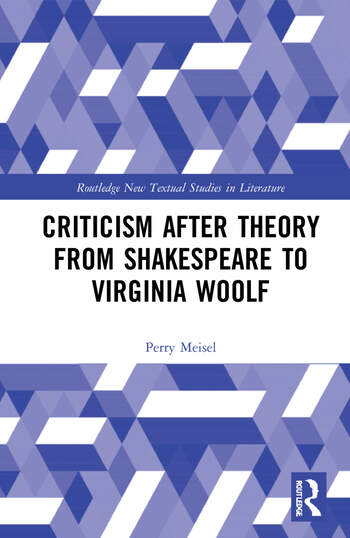
Perry Meisel, Criticism After Theory from Shakespeare to Virginia Woolf,
Routledge, 2022

Book Description
The argument of this book is a simple one: that criticism after theory is a single movement of thought defined by synthesis and continuity rather than by conflict and change. The most influential figures in criticism since Saussure—Bakhtin, Derrida, and Foucault—are wholly consistent with Saussure’s foundational Course in General Linguistics (1916) no matter the traditions of complaint that have followed in Saussure’s wake from Bakhtin forward. These complaints vitiate—despite themselves and often hilariously so—the misconceptions that have made cottage industries out of quarrels with Saussurean semiology that are based on notions of Saussure that are incorrect. The materialist criticism dominant today is actually dependent upon on the legacy of a presumably formalist structuralism rather than a step beyond it. New Historicism, postcolonialism, gender studies, environmental criticism, archive studies, even shared and surface reading are, like deconstruction, the by-products of Saussure’s structuralism, not its foils. Saussure’s sign is sensory and concrete. Language and materiality are not distinct but one and the same—history, society, the psychological subject, even the environment are systems of signs, material archives read and reread by futures that produce the past after the fact. Without Saussure, contemporary criticism would have no identifiable or effective source. The book begins with chapters on Saussure and Derrida, Bakhtin and Shakespeare, and Freud and Foucault followed by chapters on Victorian and American fiction, D.H. Lawrence and modern poetry, Virginia Woolf and Melanie Klein, and the historicist tropology of psychoanalysis. It concludes with a coda in life writing on the author’s epileptic disability.

Table of Contents
Introduction: The Durability of the Linguistic Metaphor, Chapter 1: “The Word Within”: Egger, Saussure, Derrida, Chapter 2: Bakhtin, Shakespeare, and the Novel, Chapter 3: Deferred Action from Freud to Foucault, Chapter 4: Form and History from Dickens to Woolf, Chapter 5: Henry James and the Body English, Chapter 6: Sinclair Lewis and the American Language, Chapter 7: Black and Tan: DuBois, Faulkner, and The Joy Luck Club, Chapter 8: D.H. Lawrence: The Poem As Environment, Chapter 9: Mrs. Woolf, Mrs. Klein, Chapter 10: The Feudal Unconscious: Capitalism and the Family Romance, Coda: The Challenge of Temporal Lobe Epilepsy

Author
Perry Meisel, Professor of English at New York University for over 40 years until his retirement in 2016, has written on literature, music, theory, psychoanalysis, and culture since the 1970s. His articles have appeared in The New York Times Book Review, The Village Voice, Partisan Review, The Nation, The Atlantic, Raritan, October, and many other publications. He is the author of The Myth of Popular Culture (Blackwell, 2010), The Literary Freud (Routledge, 2007), The Cowboy and the Dandy (Oxford, 1999), The Myth of the Modern (Yale, 1987), The Absent Father (Yale, 1980), and Thomas Hardy (Yale, 1972). He is coeditor, with Haun Saussy, of Saussure’s Course in General Linguistics (Columbia, 2011), and coeditor, with Walter Kendrick, of Bloomsbury/Freud: The Letters of James and Alix Strachey, 1924–25 (Basic Books, 1985). He is also the editor of Freud: A Collection of Critical Essays (Prentice-Hall, 1981). He received his B.A. Summa cum laude from Yale in 1970. He also received his M.Phil. (1973) and Ph.D. (1975) from Yale. He is the recipient of Yale’s Wrexham Prize and Thomas G. Bergin Cup and research grants from the National Endowment for the Humanities and the Spencer Foundation. He is a member of Phi Beta Kappa and PEN and has been a Fellow of the New York Institute for the Humanities and the Institute for the History of Psychiatry at Weill-Cornell Medical College.

Cabrera, J.C.M.
This is not a pipe Iconicity in Magritte’s language paintings
(2022) Iconicity in Language and Literature, 18, pp. 193-211.

DOI: 10.1075/ill.18.10cab

Abstract
A significant part of René Magritte’s pictorial work is devoted to the challenging relationships between images and written words. In this paper, I will look into two series of Magritte’s language paintings addressing these relationships: The Treachery of Images (also known as This is not a pipe) and The Interpretation of Dreams. In both series, painted images of written words and phrases are juxtaposed to painted images of objects in order to show that words and images should not be taken as the real objects they depict or refer to. I will show that, in addition to this obvious interpretation, there are much more interesting and challenging issues concerning the iconicity of the relationships between written words and the images depicting the objects denoted by them in Magritte’s paintings. To illustrate this point, I will elaborate on the calligram approach to the Treachery of Images proposed by Michel Foucault and Douglas Hofstadter by exploring the subliminal iconic relationships between the image of the pipe and the shape of the letters in the painted sentence (ceci n’est pas une pipe ‘this is not a pipe’). In addition, I will show that this analysis can be extended to the paintings entitled The Interpretation of Dreams. These analyses might shed a new light on these enigmatic works of art. © 2022 John Benjamins Publishing Company.

Judy, R.S.
Vorticist Confucianism: Ezra Pound’s translation practice in Confucius as modernist self-fashioning
(2022) Asia Pacific Translation and Intercultural Studies, 9 (2), pp. 134-150.

DOI: 10.1080/23306343.2022.2123189

Abstract
This article argues that Ezra Pound’s Confucius, which brings together his translations of three classics of Confucian philosophy (The Great Learning, The Doctrine of the Mean, and the Analects), can be read as a form of modernist self–fashioning. The work enacts many of Pound’s early Vorticist aesthetic principles, but does so in a way that makes the translator an obtrusive character who talks back to and appropriates these ancient texts as vehicles for his aesthetic ideology. This ironic, meta–historical practice of translation can, I contend, be understood as a kind of Foucauldian “technology of the self”–i.e., a technique of self–understanding that alters and gives new meaning to life and character. Speaking through the texts he embodies Confucianism but also subsumes them to the vortex of meanings we associate with the writer Ezra Pound. Moreover, in crafting himself as an American Confucian steeped in transcultural imaginings (American, European, and Chinese), Pound’s translation practice in Confucius develops around a set of concerns that are still relevant to the contemporary world—i.e., the rise of the global subject, the return of authoritarianism and decline of American liberal democracy, and the problematic role of tradition(s) in forging a new, global aesthetic vision.

Author Keywords
Confucianism; Ezra pound; Foucault; technologies of the self; Vorticism

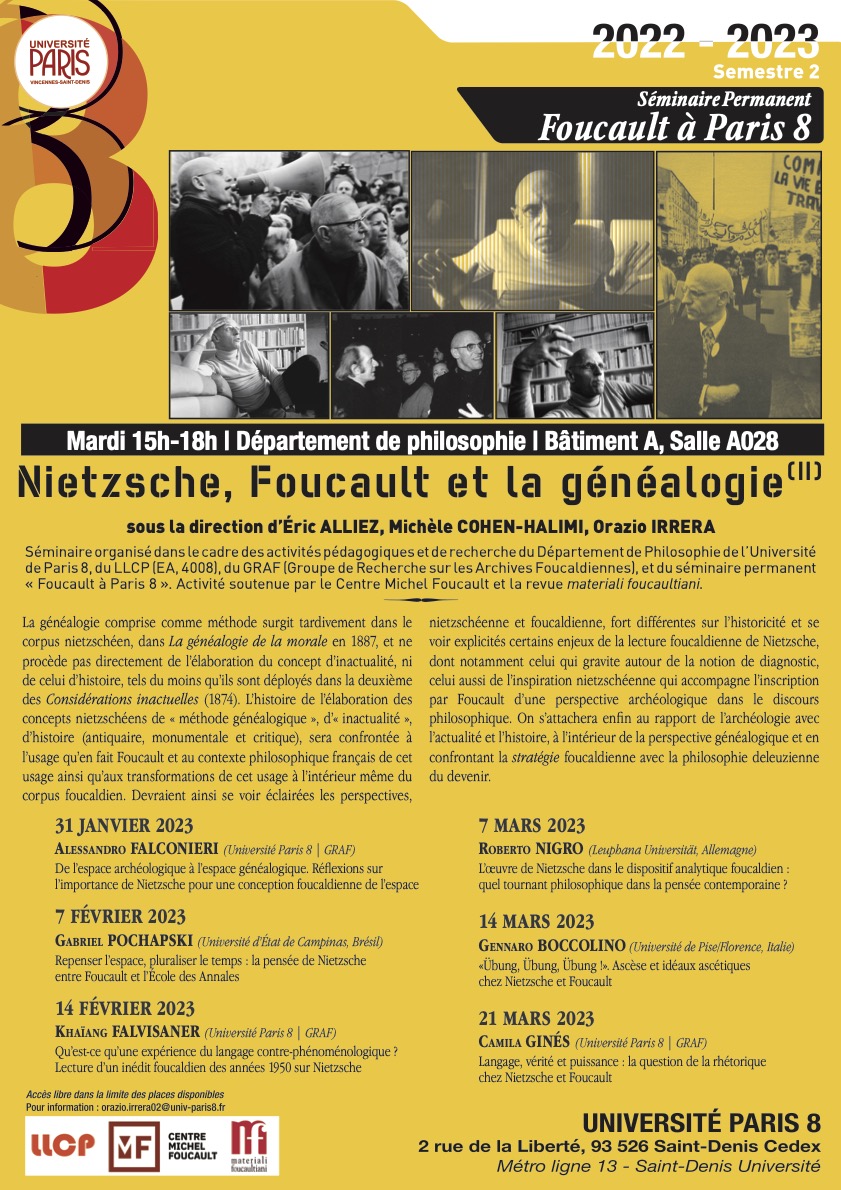
Nietzsche, Foucault et la généalogie » (II)
sous la direction d’Éric ALLIEZ, Michèle COHEN-HALIMI, Orazio IRRERA

Mardi 15h-18h | Département de philosophie | Université Paris 8 | Bâtiment A, Salle A028

Séminaire organisé dans le cadre des activités pédagogiques et de recherche du Département de Philosophie de l’Université de Paris 8, du LLCP (EA, 4008), du GRAF (Groupe de Recherche sur les Archives Foucaldiennes), et du séminaire permanent « Foucault à Paris 8 ». Activité soutenue par le Centre Michel Foucault et la revue materiali foucaultiani.

La généalogie comprise comme méthode surgit tardivement dans le corpus nietzschéen, dans La Généalogie de la morale en 1887, et ne procède pas directement de l’élaboration du concept d’inactualité, ni de celui d’histoire, tels du moins qu’ils sont déployés dans la deuxième des Considérations inactuelles (1874). L’histoire de l’élaboration des concepts nietzschéens de « méthode généalogique », d’« inactualité », d’histoire (antiquaire, monumentale et critique), sera confrontée à l’usage qu’en fait Foucault et au contexte philosophique français de cet usage ainsi qu’aux transformations de cet usage à l’intérieur même du corpus foucaldien. Devraient ainsi se voir éclairées les perspectives, nietzschéenne et foucaldienne, fort différentes sur l’historicité et se voir explicités certains enjeux de la lecture foucaldienne de Nietzsche, dont notamment celui qui gravite autour de la notion de diagnostic, celui aussi de l’inspiration nietzschéenne qui accompagne l’inscription par Foucault d’une perspective archéologique dans le discours philosophique. On s’attachera enfin au rapport de l’archéologie avec l’actualité et l’histoire, à l’intérieur de la perspective généalogique et en confrontant la « stratégie » foucaldienne avec la philosophie deleuzienne du devenir.

Programme

31 janvier 2023
Alessandro FALCONIERI – (Université Paris 8 | GRAF)
« De l’espace archéologique à l’espace généalogique. Réflexions sur l’importance de Nietzsche pour une conception foucaldienne de l’espace »

7 février 2023
Gabriel POCHAPSKI (Université d’État de Campinas, Brésil)
« Repenser l’espace, pluraliser le temps : la pensée de Nietzsche entre Foucault et l’École des Annales »

14 février 2023
Khaïang FALVISANER (Université Paris 8 | GRAF)
« Qu’est-ce qu’une expérience du langage contre-phénoménologique ? Lecture d’un inédit foucaldien des années 1950 sur Nietzsche »

7 mars 2023
Roberto NIGRO (Leuphana Universität, Allemagne)
« L’œuvre de Nietzsche dans le dispositif analytique foucaldien : quel tournant philosophique dans la pensée contemporaine ? »

14 mars 2023
Gennaro BOCCOLINO (Université de Pise/Florence, Italie)
« “Übung, Übung, Übung !”. Ascèse et idéaux ascétiques chez Nietzsche et Foucault »

21 mars 202
Camila GINÉS (Université Paris 8 | GRAF)
« Langage, vérité et puissance : la question de la rhétorique chez Nietzsche et Foucault »

Eric Schliesser, Foucault on Enlightenment, and Journalism, Digressions and Impressions (blog), 19 January 2023.

[…]
Foucault redefines the nature of journalism from, say, the reporting of news, to this more ontological or existential question pertaining in tricky ways to identity, ‘what are we now?’ To be sure, Foucault does not legislate that journalism is not about reporting the news anymore, but we might say that what is thought or taken to be worthy to be reported must pertain to this kind of salience. What’s interesting about this claim is that it prefigures, but also reminds us of what we already know, that ‘All the News That’s Fit to Print’ reflects the question of (our potentially fleeting) identity. The expanding lifestyle pages, perhaps, suggest that the oblique mirror that contemporary journalism provides us with to answer this question is more suggestive of our desires and fantasies than anything else.
[…]

Abigail A. Dumes, What Long Covid Shows Us About the Limits of Medicine, The New York Times, March 17 2022

Long Covid symptoms, such as fatigue, shortness of breath, cognitive difficulties, erratic heart rate, headache and dizziness, can be debilitating and wide-ranging. There is uncertainty about what ultimately causes long Covid and how to adequately respond to it.

In conventional medicine, illnesses without definitive markers of disease are often described as “medically unexplained.” As a medical anthropologist who has studied the controversy over whether treated Lyme disease can become chronic, I’ve been struck by the similarities between long Covid and other contested illnesses like chronic Lyme disease and myalgic encephalomyelitis, more familiarly known as chronic fatigue syndrome.
[…]

At the heart of conventional medicine is a foundational distinction between symptoms and signs. Symptoms like fatigue and joint pain are subjective markers of disease, while signs like fever and arthritis are considered objective markers. Unlike symptoms, signs can be observed and measured by a practitioner, often with the aid of technologies such as blood tests and radiologic imaging.

When it comes to making a diagnosis, signs trump symptoms. This enduring hierarchy can be traced to the late 18th and early 19th centuries in the United States and Europe, when physicians who had relied on external symptoms for diagnosis shifted to a focus on internal anatomy and pathology by using technologies like microscopes. The French philosopher Michel Foucault observed that during that time, medicine transitioned from a practice in which the physician asked, “What’s the matter with you?” to a practice in which the physician asked, “Where does it hurt?” The first question invites a patient’s description of symptoms; the second question leads to a location on the patient’s body that can be observed and measured by the physician.

[…]

Kurtuluş, G. & İnci, M. (2023). NEOLİBERALİZMİN BORÇLU İNSANINA DAİR ELEŞTİREL BİR ÇÖZÜMLEMENİN ÇÖZÜMLEMESİ: SQUID GAME, Marmara Üniversitesi İktisadi ve İdari Bilimler Dergisi, 44 (2) , 303-315 . Retrieved from https://dergipark.org.tr/en/pub/muiibd/issue/74273/1225246

Abstract
Neoliberal politikalardan hareketle, finansın artan rolü ve borçlu bireyin normalleştirilmesi üzerine tartışmalar devam etmektedir. Bununla birlikte, neoliberalizmin inşası üzerine yapılan eleştirel çalışmalar artık sadece akademik araştırmalarla sınırlı kalmamakta; günümüz iletişim araçları aracılığıyla sayıca artmaktadır. Bunun çarpıcı bir örneği, 2021 yılının Eylül ayında bir dijital platform aracılığıyla yayına giren Squid Game dizisidir. Dizide Güney Kore’nin gerçek bir borç krizi yaşadığı yansıtılmaktadır. Aynı zamanda, neoliberalizm altında yoksullaşan bireylerin çaresizliği betimlenmektedir. Bu çalışmanın amacı, neoliberalizmin borçlu insanının iktidar, para ve ölüm ilişkisi çerçevesinde diyalektik bir çözümlemesini ortaya koymaktır. Bu çözümleme, Güney Kore ekonomisinde yaşanan neoliberal dönüşüm sürecini temel almakta ve Squid Game dizisindeki oyun metaforu ile ilişkilendirmektedir.

Keywords
Borç, Foucault, İktidar, Oyun, Para, Squid Game

A critical analysis of the neoliberal debtor: Squid Game

Abstract
Debates continue on the increasing role of finance and the normalization of the debtor individual based on neoliberal policies. Critical studies on the construction of neoliberalism are no longer limited to academic research; increasing through mass media. A dramatical example is the Squid Game series, which was released on a digital platform in September 2021. It is reflected in the series that South Korea is experiencing a real debt crisis. At the same time, the helplessness of individuals impoverished through neoliberalism is depicted as a cause and effect relationship. The aim of this study is to present a dialectical analysis of the debtor of neoliberalism within the framework of the relationship among power, money, and death. This analysis is based on the neoliberal transformation process in the South Korean economy and relates it to the game metaphor in the Squid Game series.

Strausz, Erzsébet (2022) Writing with Foucault: openings to transformational knowledge practices in and beyond the classroom, Critical Studies on Security
DOI: 10.1080/21624887.2022.2134698

ABSTRACT
This article engages questions of authority and authorship in the discipline and the IR classroom, driven by a search for affirmative horizons within critical scholarship and academic practice. Prompted by a series of ‘failures’ attached to the social and disciplinary performance of ‘expertise’ in the context of violent conflict, I explore the practice of writing as it unfolds from Michel Foucault’s lesser cited essays and interviews as a generative, creative resource. I follow Foucault in breaking down the normalised perceptions of the ‘author function,’ revealing writing as an act that diagnoses, discovers, and potentially transforms writer, reader and the social structures that the writing addresses. Foucault’s experimental ethos brings to light the complex life worlds of sense-making through the vehicle of writing. It also invites us to embrace the transgenerational heritage that quietly structures our relationships to knowledge together with the multiple selves that arise and are co-present in the text. I enter such processes of negotiation and transgression in Foucault’s work and my own writing through a series of vignettes, which aim to actualise the ‘method’ these gestures may harbour for making ‘uncommon sense’ and re-inhabiting research and pedagogical practice as continuous, self-reflexive and self-authori(zi)ng journeys.

KEYWORDS:
Foucault, author function, narrative writing, critical pedagogy, creative methods, everyday IR

Adamiak, M.
Being otherwise: On the possibility of a non-dualistic approach in feminist phenomenology
(2022) Technoetic Arts, 20 (1-2), pp. 11-25.

DOI: 10.1386/tear_00078_1

Abstract
This article reflects on the current philosophical tendency to construct non-dualistic subjectivity models in response to the criticism of the traditional authoritarian human subject. Following thinkers such as Emmanuel Lévinas, Michel Foucault or Jacques Derrida, the literature has largely identified traditional metaphysics based on dualistic hierarchies as the major source of violence. Perceiving phenomenology as a method that focuses on the concepts of the lived experience and situatedness, I combine this approach with the feminist calls for dismantling the hierarchical relationship of subjectivity to the world. I draw on the concepts of Sonia Kruks, Linda Martin Alcoff, Sara Heinämaa, Judith Butler, Bonnie Mann and Johanna Oksala to inquire how dualism-overcoming phenomenology can be applied to feminist thought. I focus in particular on the approach that Oksala outlines in her book, Feminist Experiences: Foucauldian and Phenomenological Investigations, where she proposes a transcendental view on feminist experience. Intriguingly, she understands transcendental as situated – historically, culturally and politically. Consequently, my final question concerns the possibility of combining the two usually conflicted approaches: transcendental and historical regarding the fundamental phenomenological distinction between the empirical and the transcendental.

Author Keywords
gender; lived experience; metaphysics; situatedness; subjectivity; transcendentalism