Foucault News

News and resources on French thinker Michel Foucault (1926-1984)

Hodges BD, Martimianakis MA, McNaughton N, Whitehead C. Medical education… meet Michel Foucault. Medical Education. 2014 Jun;48(6):563-71.
doi: 10.1111/medu.12411. PMID: 24807433.
Abstract

Context: There have been repeated calls for the greater use of conceptual frameworks and of theory in medical education. Although it is familiar to few medical educators, Michel Foucault’s work is a helpful theoretical and methodological source.

Methods: This article explores what it means to use a ‘Foucauldian approach’, presents a sample of Foucault’s historical-genealogical studies that are relevant to medical education, and introduces the work of four researchers currently undertaking Foucauldian-inspired medical education research.

Results: Although they are not without controversy, Foucauldian approaches are employed by an increasing number of scholars and are helpful in shedding light on what it is possible to think, say and be in medical education.

Conclusions: Our hope in sharing this Foucauldian work and perspective is that we might stimulate a dialogue that is forward-looking and optimistic about the possibilities for change in medical education.

Faubion, James. “Michel Foucault”. Encyclopedia Britannica, 6 Jan. 2023, https://www.britannica.com/biography/Michel-Foucault.

Education and career
The son and grandson of a physician, Michel Foucault was born to a solidly bourgeois family. He resisted what he regarded as the provincialism of his upbringing and his native country, and his career was marked by frequent sojourns abroad. A distinguished but sometimes erratic student, Foucault gained entry at the age of 20 to the École Normale Supérieure (ENS) in Paris in 1946. There he studied psychology and philosophy, embraced and then abandoned communism, and established a reputation as a sedulous, brilliant, and eccentric student.

After graduating in 1952, Foucault began a career marked by constant movement, both professional and intellectual. He first taught at the University of Lille, then spent five years (1955–60) as a cultural attaché in Uppsala, Sweden; Warsaw, Poland; and Hamburg, West Germany (now Germany). Foucault defended his doctoral dissertation at the ENS in 1961. Circulated under the title Folie et déraison: histoire de la folie à l’âge classique (“Madness and Unreason: A History of Madness in the Classical Age”), it won critical praise but a limited audience. (An abridged version was translated into English and published in 1965 as Madness and Civilization: A History of Insanity in the Age of Reason.) His other early monographs, written while he taught at the University of Clermont-Ferrand in France (1960–66), had much the same fate. Not until the appearance of Les Mots et les choses (“Words and Things”; Eng. trans. The Order of Things) in 1966 did Foucault begin to attract wide notice as one of the most original and controversial thinkers of his day. He chose to watch his reputation grow from a distance—at the University of Tunis in Tunisia (1966–68)—and was still in Tunis when student riots erupted in Paris in the spring of 1968. In 1969 he published L’Archéologie du savoir (The Archaeology of Knowledge). In 1970, after a brief tenure as director of the philosophy department at the University of Paris, Vincennes, he was awarded a chair in the history of systems of thought at the Collège de France, France’s most prestigious postsecondary institution. The appointment gave Foucault the opportunity to conduct intensive research.
[…]

David McGrogan, A Foucauldian Defense of Liberalism, Law & Liberty, March 27 2023

We should not settle for the nominal freedom of a relentlessly micromanaged society.

There is a strong case to be made that Michel Foucault was the most important and influential thinker of the second half of the twentieth century. He was not a nice man. And many of his conclusions were odious. But he discerned the path on which modernity was walking better than almost anybody else.

The most useful of Foucault’s contributions were not published in book form but were delivered as lectures, posthumously compiled and translated. Those gathered in the collection Security, Territory, Population are far and away the most significant. In them, Foucault provides a complete conceptualisation of the evolution of modern governance, showing how it is characterised, above all, by “governmentality” or what has elsewhere been called the “conducting of conduct.”

[…]

David McGrogan is Associate Professor of Law at Northumbria University. He blogs at News From Uncibal.

Daniele Lorenzini, Philosophy Colloquium: Genealogy as a Practice of Truth: Nietzsche, Foucault, Fanon

Presented by the Philosophy Department at The New School for Social Research.
Thursday, April 20, 2023, 6:00PM to 8:00PM (EDT)
6 E 16th St Wolff Conference Room/D1103
The New School
66 West 12th Street
New York, NY 10011

This paper has two main, interconnected goals. On the one hand, the argument is that, even though the major forms taken by genealogy throughout the history of philosophy seem to make it impervious to truth, there is an important sense in which genealogy, specifically as conceived of and practiced by Nietzsche and Foucault, is a practice of truth. How to make sense of this claim? The first two sections of the paper address this question and show that the (Nietzschean and Foucauldian) genealogist aims to produce “new truths” that function as disruptive ethico-political forces destabilizing current modes of thinking and being, and creating the concrete possibility for the emergence of new possibilities for thought and action. The third and final section of the paper, on the other hand, builds on these insights to argue that Fanon’s psychiatric writings, too, can be construed as genealogical practices of truth. By doing so, the presenter will not only muster further evidence for the conclusions in section II, but also provide an alternate framework to make sense of Fanon’s contribution to critical theory broadly construed—one that doesn’t reduce him neither to the tradition of historical materialism nor to critical phenomenology or phenomenological psychiatry alone.

Schmidgen, Henning, et al. “From the Archive to the Computer: Michel Foucault and the Digital Humanities.” Journal of Cultural Analytics, vol. 7, no. 4, Mar. 2023, doi:10.22148/001c.55795.

Abstract
Michel Foucault famously introduced the method of “discourse analysis” in the humanities, especially in historiography. In his Archaeology of Knowledge, originally published in 1969, in particular, Foucault argues for making the history of knowledge the object of discourse analyses. In the context of the current surge of interest in discourse analysis in the field of computer science, however, there are hardly any references to Foucault, partly because he never defined a methodological process that could be operationalized. Nonetheless we argue for re-reading The Archaeology of Knowledge in the context of computer science and the digital humanities. As a matter of fact, there are considerable affinities between Foucault’s search for the regularities of discourse and current projects dealing with the digitization of texts, their indexing, distributional features, stylometry, etc. We show that these projects were already quite prominent in Foucault’s day, to the point that historian Emmanuel Le Roy Ladurie could assert, in 1968, that “the future historian will be a programmer.” A year later, Foucault’s Archaeology of Knowledge actively responded and constructively took up the challenge – which, given the recent advances in machine learning and computational linguistics, strikes us as a crucial move today.

bertJean-François Bert, Jérôme Lamy (dir.), Michel Foucault : un héritage critique, Paris, CNRS Éditions, 2014, 416 p., ISBN : 9782271081469.

Updated 2023. Now available in Open Edition Books
BERT, Jean-François (dir.) ; LAMY, Jérôme (dir.). Michel Foucault, un héritage critique. Nouvelle édition [en ligne]. Paris : CNRS Éditions, 2014 ( Disponible sur Internet : http://books.openedition.org/editionscnrs/50867. ISBN : 9782271142306. DOI : https://doi.org/10.4000/books.editionscnrs.50867.

Infos

Présentation de l’éditeur

Les écrits de Michel Foucault sont stratifiés, hiérarchisés, entre les livres, les entretiens et les cours au Collège de France, mais ils sont surtout disséminés dans leurs usages. Désormais, et en plus de l’histoire des sciences et de la philosophie, les « effets » Foucault sont palpables sur la théorie de la littérature et du cinéma, l’histoire culturelle et sociale, les théories du genre, la pensée politique, les sciences de gestion…

C’est dans ce chantier ouvert que se situe cet ouvrage. Il s’agit pour Jérôme Lamy, Jean-François Bert et leur équipe de spécialistes de resituer et d’analyser une pensée empruntant des questionnements à d’autres champs, de la psychologie à l’économie, de la science politique à la géographie, tout en ne se réclamant pas de ces sciences humaines et sociales. Pour comprendre la position de Foucault, les grands axes méthodologiques qu’il a parcourus sont retracés, telle l’archéologie, l’épistémè, la problématisation. Les concepts, des ouvrages maintenant classiques aux cours et à l’histoire de la sexualité, sont également revisités. Cette lecture critique des écrits et des usages de Foucault permet de le confronter aux analyses les plus récentes en sciences sociales, comme les postcolonial studies, ou de suivre les dialogues engagés (parfois à distance) avec des auteurs comme Norbert Elias, Michel de Certeau et Pierre Bourdieu.

Un inventaire aussi rigoureux qu’éclairant.

Directeurs

Jean-François Bert est maître d’enseignement et de recherche à l’université de Lausanne, IRCM.

Jérôme Lamy est chercheur à l’université de Versailles Saint-Quentin-en-Yvelines.

Compte rendu de Alexandre Klein

Trente ans après sa mort, l’ombre imposante du philosophe Michel Foucault (1926-1984) plane encore sur de nombreuses recherches, particulièrement dans le domaine des sciences humaines et sociales (SHS). Pour certains, il y serait même devenu omniprésent1. En effet, des travaux politiques ou juridiques aux recherches sur le genre ou la prison, en passant les études postcoloniales, l’anthropologie, l’ethnologie, la sociologie, l’architecture, l’histoire, les cultural studies, la philosophie ou les STS, celui qui appela à user de son œuvre comme d’une boîte à outils fait aujourd’hui l’objet d’usages multiples, se voyant même parfois usé jusqu’à la corde. Si nul ne doute du succès certain de la pensée de Foucault, reprise et citée abondamment, tant pour être critiquée, encensée, que justement commentée, rares sont ceux qui peuvent prétendre à une vue globale des emprunts, déplacements, transferts, usages, utilisations ou hommages auxquels ses travaux et réflexions sont soumis. Il convenait donc, au-delà de la présentation des possibles usages contemporains de la pensée et des concepts foucaldiens, de se situer par rapport à ce corpus devenu aujourd’hui un pôle méthodologique incontournable, notamment pour les SHS morcelées de la fin du XXe siècle et du début du XXIe siècle.

suite

Juignet, Patrick. Michel Foucault et le concept d’épistémè. Philosophie, science et société. 2015. https://philosciences.com/10

L’œuvre de Michel Foucault est discontinue. Nous nous intéresserons ici à la période que l’on peut approximativement situer entre 1965 et 1977, période pendant laquelle il a développé et utilisé le concept d’épistémè. Ce concept a eu une carrière limitée ; apparu dans Les Mots et les Choses en 1966, il a été délaissé au bout de douze ans, car Michel Foucault a considéré que son utilisation aboutissait à une impasse.

Plan de l’article :

1. Une définition de départ pour le concept d’épistémè
2. Le concept d’épistémè combine plusieurs aspects
3. Les trois épistémès en Occident
4. Le point de vue “archéologique” change la définition
5. L’épistémè n’est ni l’esprit d’une époque, ni un moment de civilisation
6. Critiques des résultats de Michel Foucault
7. Un emploi précis du concept d’épistémè est-il possible ?

Ákos Cseke, La vie pour la vérité. Etudes sur le dernier Foucault, Collection : Ouverture Philosophique, L’Harmattan, 2023

La transcription des derniers cours de Michel Foucault donnés au Collège de France a sans doute bouleversé notre vision de sa pensée. Comment interpréter le changement de style et de contenu inhérent à ses œuvres finales ? Le présent ouvrage essaie d’attirer l’attention sur quelques aspects moins étudiés de cette « philosophie tardive », en particulier sa lecture du cynisme antique et du christianisme patristique et médiéval, notamment de saint Augustin, en mettant l’accent sur le thème de la vraie et belle vie dans l’esthétique foucaldienne de l’existence.

Ákos Cseke est docteur en philosophie médiévale par l’Université de Sorbonne Paris-IV. Habilité à diriger des recherches, il était professeur à l’Université catholique de Budapest entre 2005 et 2021. Actuellement, il vit à Paris. Traducteur hongrois de Michel Foucault, Jean-Luc Marion ou Pierre Hadot, il est auteur de huit livres de philosophie en hongrois, dont une monographie sur le dernier Foucault.

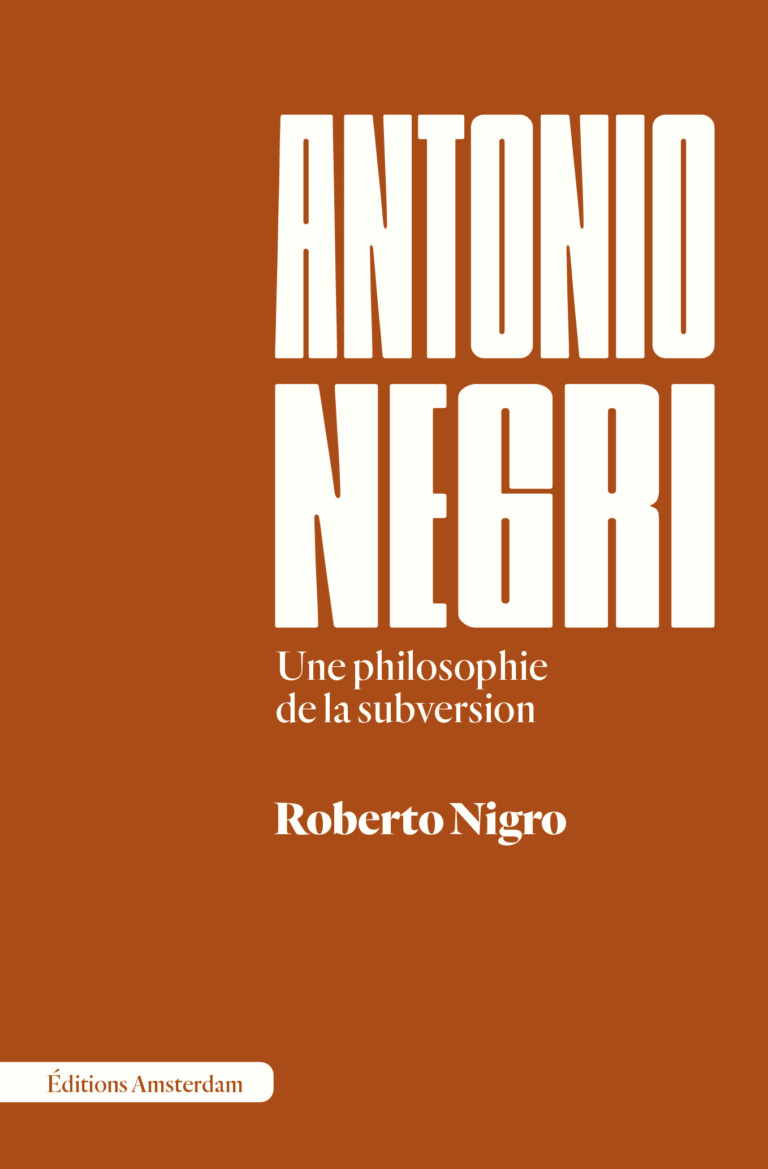
Roberto Nigro, Antonio Negri. Une philosophie de la subversion (Éditions Amsterdam, 2023)

« Le nouveau marxisme de Negri est un rempart contre les dérives post-modernes, contre l’idée d’une fin de l’histoire et de la lutte des classes. Il s’oppose à la représentation de la domination capitaliste comme totale et absolue. »

Cet ouvrage est la première introduction en langue française à l’ensemble de l’œuvre du philosophe et militant Antonio Negri : en effet, ses commentateurs se sont jusqu’à présent en général intéressés exclusivement ou bien à sa période italienne ou bien à ses développements ultérieurs. Son auteur, Roberto Nigro, s’attache à en montrer la cohérence et à la resituer dans ses contextes historiques changeants. Il en souligne le caractère fondamentalement politique, y compris dans ses moments les plus « philosophiques ». Il ne néglige pas les débats qu’elle a suscités, et il relance la discussion sur certaines des thèses de Negri qui ont le plus prêté à discussion. Il insiste sur le dialogue nourri par le philosophe italien avec certains auteurs, en particulier Spinoza, Marx, Althusser, Foucault et Deleuze, pour dégager l’originalité de son intervention dans les champs théorique et politique. Enfin, il insiste sur l’actualité des thèses et des outils conceptuels élaborés par Negri, notamment son affirmation d’un primat de la puissance de la multitude sur toutes les opérations de capture dont elle fait l’objet par les appareils du pouvoir.

Andrey Gordienko, The Epistemic State of Exception, The Philosophical Salon, 3 April 2023

Agamben’s “Configuration of Facts” and Foucault’s “Regime of Truth”

In “The Central Bankers’ Long COVID,” Fabio Vighi observes that the contemporary paradigm of government by crisis fosters a rhetoric of exclusion, which neutralizes dissensus and positions the official narrative of emergency capitalism as the sole bearer of truth. A permanent epistemic state of exception establishes a watertight regime of opinions, which blocks any potentially heretical inquiry into the “ideological sickness” of our socioeconomic system.[i] Before developing this concept further, it is important to note that the expression “epistemic state of exception” constitutes a useful pleonasm. As Giorgio Agamben demonstrates, every state of exception presupposes “the ultimate configuration of facts” that authorizes a suspension of the rule.[ii]

read more