Foucault News

News and resources on French thinker Michel Foucault (1926-1984)

Nyman, S. The Birth of AI-driven Nudges (2023) Proceedings of the Annual Hawaii International Conference on System Sciences, 2023-January, pp. 5252- 5261.
https://hdl.handle.net/10125/103276

Abstract
AI methods allow for a multitude of new forms of managerial control. One is algorithmic nudging, in which organizations use AI methods to control workers through targeted recommendations. Drawing upon Michel Foucault’s analytical strategies, the paper examines the intellectual heritage and ideological roots of AI-nudges. Scholars have commented on the resemblance between algorithmic nudging and Taylorist scientific management. However, as this paper shows the discourse of AI-nudges also shares significant linages with other subsequent opposing managerial paradigms. Building on the analysis of AI-nudges linages, the paper discusses how their use implies three contestable presumptions 1) that work can be codified, 2) that workers require autonomy over their work, and 3) that there is no existing conflict of interest between workers and the organization. © 2023 IEEE Computer Society. All rights reserved.
Author Keywords
Algorithmic control; Algorithmic management; Critical IS research; Genealogy; Nudging
Index Keywords
Algorithmic control, Algorithmic management, Algorithmics, Critical IS research, Genealogy, Michel Foucault, New forms, Nudging, Workers’

Crampton, J. W. (2001). Maps as social constructions: power, communication and visualization. Progress in Human Geography, 25(2), 235–252.
https://doi.org/10.1191/030913201678580494

Two developments in cartography mark an epistemic break with the assumption that maps are unproblematic communication devices. These are 1) investigations of maps as practices of power-knowledge; and 2) ‘geographic visualization’ (GVis) which uses the map’s power to explore, analyze and visualize spatial datasets to understand patterns better. These developments are key components of a ‘maps as social constructions’ approach, emphasizing the genealogy of power in mapping practices, and enabling multiple, contingent and exploratory perspectives of data. Furthermore, this approach is an opportunity for cartography to renew its relationship with a critical human geography.

Colloque: La gouvernementalité : histoire et usages d’un concept fuyant

Du jeudi 11 au vendredi 12 mai 2023
Sur place et en ligne
425, rue De La Gauchetière Est
Montréal (Québec)
H2L 2M7

90e Congrès de l’Acfas
Le 90e Congrès de l’Acfas, organisé en collaboration avec l’Université de Montréal, HEC Montréal et Polytechnique Montréal

Parmi les concepts qu’a légués Michel Foucault, celui de « gouvernementalité » constitue à la fois l’un des plus féconds et des plus fuyants. On ne compte plus, surtout en langue anglaise, les travaux qui s’en réclament. Quoique l’usage de ce concept paraisse avoir été plus limité dans le monde francophone, rares ont été, en tout cas, les bilans des recherches qu’il a permis de stimuler.

Ce colloque sera l’occasion de dresser un inventaire des usages qui sont faits de ce concept et des significations qui lui sont associées. Il s’agira, par le fait même, d’en évaluer la portée et les limites pour la recherche en sciences sociales. Le colloque permettra en outre de comparer et de mettre en dialogue des approches et des méthodologies qui, bien qu’elles empruntent à un même héritage, varient de manière significative. À cet égard, il importera de départager ce qui relève, d’une part, des méthodes d’analyse et du choix des objets qu’il permet d’appréhender, et, d’autre part, des postulats ontologiques qui lui sont implicites, renvoyant à des conceptions spécifiques — et critiquables — de l’action sociale.

Conférence d’ouverture

Guerre sociale, guerre culturelle, guerre civile: les avatars d’une gouvernementalité martiale sous le néolibéralisme
Colin Gordon (Royal Brompton & Harefield NHS Trust)

Critiques et résistances

La politique comme lutte des arts de gouverner : gouvernementalité néolibérale et gouvernementalité socialiste aujourd’hui
Pierre Sauvetre (Université Paris Nanterre)

La gouvernementalité foucaldienne : de la métaphysique de la liberté à l’analytique des arts de la gouverne
Marcelo Otero (UQAM – Université du Québec à Montréal)

La technologie politique du crédit et l’économie morale de la dette
Jean Francois Bissonnette (UdeM – Université de Montréal)

Enjeux épistémologiques et méthodologiques

(Dé)stabiliser un concept, (re)situer des pratiques : la mise en œuvre des gouvernementalités
Claudia Marson (Celsa Sorbonne Université )

Exercice(s) de convocation d’un concept fuyant?
Sylvain Lafleur (UdeM – Université de Montréal)

Penser l’amour avec la gouvernementalité : médier les rationalités politiques, affectives et sécuritaires
Anne-Marie D’aoust (UQAM – Université du Québec à Montréal)

Colonialité, postcolonialité

Penser la gouvernementalité coloniale : une entrée par les archives
Théophile Lavault (Université de Bourgogne)

Gouvernementalité raciale et humanité : Analyse des modes de savoir et de gouvernement dans la modernité coloniale
David Moffette (Université d’Ottawa)

Gouvernance des migrations, gouvernementalité néolibérale et responsabilité du chercheur
Hervé Nicolle (Université de Nanterre)

The Weakerthans, Our Retired Explorer (Dines with Michel Foucault in Paris, 1961). Frome the 2003 album Construction Site

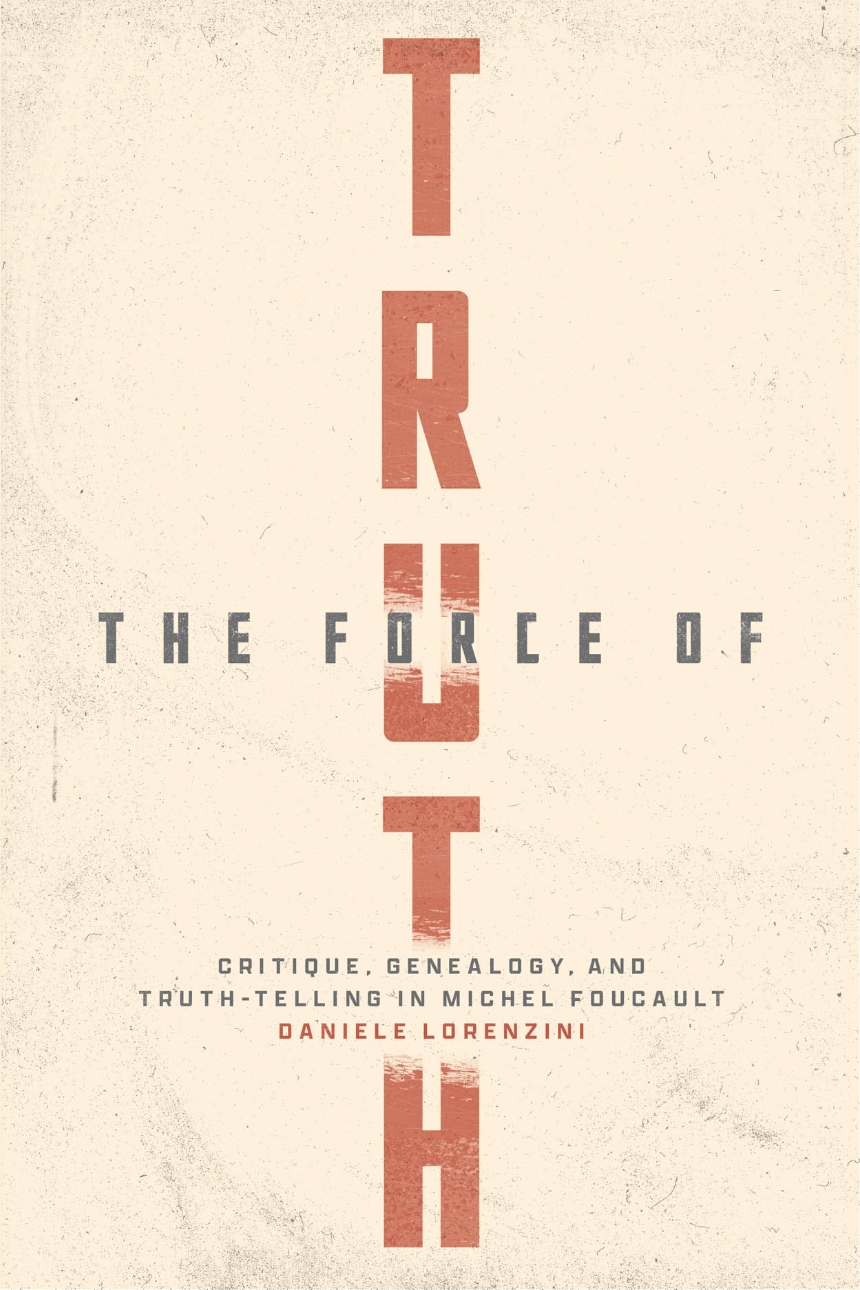
Daniele Lorenzini, The Force of Truth. Critique, Genealogy, and Truth-Telling in Michel Foucault, The University of Chicago Press, forthcoming September 2023

A groundbreaking examination of Michel Foucault’s history of truth.

Many blame Michel Foucault for our post-truth and conspiracy-laden society. In this provocative work, Daniele Lorenzini argues that such criticism fundamentally misunderstands the philosopher’s project. Foucault did not question truth itself but what Lorenzini calls “the force of truth,” or how some truth claims are given the power to govern our conduct while others are not. This interest, Lorenzini shows, drove Foucault to articulate a new ethics and politics of truth-telling precisely in order to evade the threat of relativism. The Force of Truth explores this neglected dimension of Foucault’s project by putting his writings on regimes of truth and parrhesia in conversation with early analytic philosophy and by drawing out the “possibilizing” elements of Foucault’s genealogies that remain vital for practicing critique today.

Nikolaas Cassidy-Deketelaere. The Normal and the Phenomenological, Paris Institute, February 10 2023

In his introduction to Georges Canguilhem’s The Normal and the Pathological, Michel Foucault makes an observation that we nowadays seem increasingly at risk of forgetting: far from being irreconcilably opposed to one another, the two main theoretical styles of continental philosophy—i.e., phenomenology and critical theory—are both rooted in Edmund Husserl’s attempt at establishing philosophy as a rigorous science. In other words, both the “philosophy of experience, of sense and of subject,” like that of Jean-Paul Sartre or Maurice Merleau-Ponty, as well as the “philosophy of knowledge, of rationality and of concept,” such as found in Jean Cavaillès or Gaston Bachelard, are ultimately phenomenological in aspiration, namely as “two modalities according to which phenomenology was taken up in France.”1 This ought not to be surprising, as Husserlian phenomenology (reacting to psychologism) and critical theory (reacting to early sociology and aided by Karl Marx) are both fundamentally antipositivist projects: the experience in which science takes nature to be given as simply there is inherently naïve; instead, experience gains its meaning and validity only in logical connection. The failure to secure these logical structures is what produced the notorious ‘crisis’ of the European sciences.
[read more]

Psychoanalysis & Philosophy: Existentialism to Post-Modernism, Freud Museum, London, UK

From Heidegger and Sartre to Foucault and Lacan. An online course with Keith Barrett, taking place over two afternoons.

15 June, 1:30 pm – 16 June, 5:00 pm
£36 – £45

In the period immediately following World War II, existentialism was the leading philosophical movement in European thought, and Jean-Paul Sartre, its most famous exponent, was a colossal figure on the intellectual scene. Sartre’s aim of providing an alternative way of understanding human beings to that of Freud’s psychoanalysis, was a determining factor in the writing of his early masterpiece Being and Nothingness (1943) – in which he proposed an entirely new discipline: ‘existential psychoanalysis’. By the mid 1960’s however, Sartre was no longer the leading figure in French intellectual life: his dominant position had been taken over by others, including Michel Foucault and Jacques Lacan, who took their philosophical inspiration from his great German predecessor Martin Heidegger.

On this course we will examine in detail the relation of psychoanalysis to existentialism, and see how the growing ascendency of Heidegger’s thought drove the leading exponents of French theory beyond existentialism towards post-modernism. In the Anglo-Saxon world, meanwhile, the post-Second World War period saw the beginning of a long-running and heated debate on the scientific status of psychoanalysis, and we will review them main positions and arguments in this debate.

This course will take place over 2 days: 15 and 16 June 2023, from 13.30 – 17.00 each day (time includes a tea break). All attendees will also receive access to the recording.

Keith Barrett BA PhD received his first degree in philosophy from Oxford University after having spent three years working as a nursing assistant in psychiatric hospitals. It was in this practical context that Keith first encountered existentialism and psychoanalysis. He then began postgraduate studies on both Freud and Heidegger, leading finally to a PhD from the Wellcome Centre for the History of Medicine at UCL for a dissertation on ‘Freud’s Self-Analysis’. Keith has been a philosophy teacher for over 20 years, and has been delivering courses at the Freud Museum for over a decade, where he has developed a series of introductory lectures on Freud, psychoanalysis after Freud, and exploring the overlap of philosophy and psychoanlaysis.

The Panopticon Effect, 99% invisible, 03.28.23 Podcast and transcript

In the Netherlands, about an hour and a half south of Amsterdam, there’s a city called Breda. Like many Dutch towns, it has cozy narrow streets, canals and plenty of bicycles. But there’s one historic building – right in the middle of town that really stands out from the rest.
[…]
Inside the building, there’s a wide-open circular hall the size of half a football field with the sprawling dome overhead. Along the curved brick walls, there are hundreds of heavy orange doors spread out evenly across the four floors. And behind most of these doors are small rooms that were once prison cells. When this place was first built in 1886, it was a penitentiary. But not a typical one. This was a panopticon.
[…]
Over time, the panopticon has turned into something way bigger than just a blueprint for penitentiaries. It’s become the metaphor for the surveillance state. Philosopher Michel Foucault had probably the most popular take on the panopticon concept. He used it to warn society that what actually keeps all of us in check isn’t necessarily that someone is watching you. It’s just the feeling that someone might be watching you. But very few actual prisons were built around this idea.

Bstieler, Michaela and Gianluca Crepaldi. “Working-Through Wellness: Critical Perspectives on the Contemporary Wellness Dispositif.” Genealogy+Critique 9, no. 1 (2023): 1–21. DOI: https://doi.org/10.16995/gc.9543

Abstract
In this paper, we examine the institutionalised demands and imperatives that govern the contemporary working subject. Our starting point is the thesis advanced by both Alain Ehrenberg and Eva Illouz that since the 1960s institutions are no longer characterised by a strict culture of prohibition and discipline. Instead, institutions seem to be increasingly animated by the norms and practices of a “culture of self-care”, enriched by therapeutisation (Ehrenberg) and emotionalisation (Illouz). However, this does not mean that the disciplinary regimes that Foucault focuses on are simply disappearing. They persist, albeit in a different form, and we demonstrate this by looking at three central aspects of contemporary wellness: (a) specific spatial arrangements, (b) the performance of bodily practices and techniques and (c) ritualised interactions. We argue that in wellness facilities disciplinary regimes become effective through interpellations that are inscribed in rigid temporal-spatial orders and demand the body’s docility. Insofar as this process relies on those norms that Ehrenberg and Illouz reserve for post-Fordist labour, the wellness space can ultimately be understood as a labour space. For what is at stake is the productivity of the subject.

Keywords: well-being, subjectivity, neoliberalism, labour, normativity, capitalism, temporality, Alain Ehrenberg, Eva Illouz, Michel Foucault

Ivan Segré, Destitution: Lacan, Foucault et la cabale, Lundi matin, no. 376, 31 mars 2023

Sur la base de certains énoncés de Lacan et de Foucault, qu’il s’efforce d’élucider, Ivan Segré propose une sorte de généalogie de la notion de « critique ». Partant des observations de Foucault relatives à la critique biblique au XVIe siècle, il aboutit, via Lacan, à une réflexion sur la contingence du pouvoir. Le chemin est escarpé, mais le détour vaut le coup d’œil.

Dans l’histoire des sciences humaines, l’interprétation des rêves a d’une certaine manière succédé à celle de la Bible. Or l’herméneutique biblique avait une histoire, depuis les philologues grecs et latins de l’antiquité jusqu’à ce tournant historique que Pierre Gibert a appelé « l’invention critique de la Bible [1] » et qu’il situe entre le XVe et le XVIIIe siècle. C’est à cette « invention » que Michel Foucault se réfère lorsqu’il pose la question « Qu’est-ce que la critique ? » ; et qu’il répond :

« Et si la gouvernementalisation, c’est bien ce mouvement par lequel il s’agissait dans la réalité même d’une pratique sociale d’assujettir les individus par des mécanismes de pouvoir qui se réclament d’une vérité, eh bien, je dirais que la critique, c’est le mouvement par lequel le sujet se donne le droit d’interroger la vérité sur ses effets de pouvoir et le pouvoir sur ses discours de vérité ; la critique, ce sera l’art de l’inservitude volontaire, celui de l’indocilité réfléchie. La critique aurait essentiellement pour fonction le désassujettissement dans le jeu de ce qu’on pourrait appeler, d’un mot, la politique de la vérité. »[2]

[1] L’Invention critique de la Bible. XVe-XVIIIe siècle…
[2] Qu’est-ce que la critique, Vrin, 2015..

Lire la suite

»