
Foucault News

News and resources on French thinker Michel Foucault (1926-1984)

Tony Schirato, Geoff Danaher and Jen Webb, Understanding Foucault: A critical introduction, 2nd edition, Allen and Unwin. Available March 2012

Publisher’s page

Michel Foucault is now regarded as one of the most important thinkers of the twentieth century. He is known for his sensibility of critique and his commitment to movements for social change. His analysis of the ways our notions of truth, meaning, knowledge and reason are shaped by historical forces continues to influence thinkers around the world.

Understanding Foucault offers a comprehensive introduction to Foucault’s work. The authors examine Foucault’s thinking in the context of the philosophies he engaged with during his career, and the events he participated in, including the student protests of 1968. A unique feature of the book is its consideration of the recently published lectures and minor works, and the authors show how these illuminate and extend our understanding of Foucault’s major books.

Understanding Foucault is an accessible and authoritative introduction to the thinking of the important French philosopher Michel Foucault. This second edition has been completely revised and covers his full body
of work, including the lectures and other works translated recently resulting in a new understanding of Foucault’s oeuvre.

Table of Contents
Preface
Acknowledgements
Glossary of theoretical terms
1. Questions of method
2. Power and knowledge
3. Governmentality
4. Liberalism and neo-liberalism
5. Subjectivity and technologies of the self
6. Critique and ethics
Bibliography
Index

Tarver, E.C. (2011), New Forms of Subjectivity: Theorizing the Relational Self with Foucault and Alcoff. Hypatia, 26: 804-825.
https://doi.org/10.1111/j.1527-2001.2011.01235.x

Abstract
Taking seriously Linda Martin Alcoff’s suggestion that we reevaluate the extent to which poststructuralist articulations of the subject are truly socially constituted, as well as the centrality of Latina identity to her own account of such constitution, I argue that the discussion Alcoff and other Latina feminists offer of the experience of being Latina in North America is illustrative of the extent to which the relational and globally situated constitution of subjects needs further development in many social-constructionist accounts of selfhood. I argue, however-contra Alcoff-that Michel Foucault’s mode of investigating subjectivation, particularly as it is articulated in his later work, has room for just such an account, especially when it is supplemented by postcolonial theory. With this end in mind, I take as a case study the public discourse surrounding Sonia Sotomayor prior to her confirmation as the first Latina woman to serve on the United States Supreme Court, suggesting that an analysis of this discourse (including its position within and contribution to wider discourses of ethnicity, race, gender, and class) shows why the accounts of relational subject-constitution offered by both Foucault and Alcoff are indispensable.

Evans, Patrick. (2011). “Modernity and the Holocaust counter-memorial: Janet Frame’s American fiction”. Journal of Commonwealth literature (0021-9894), 46 (3), p. 513.
https://doi.org/10.1177/0021989411409800

Abstract
Janet Frame’s novels Intensive Care (1970/1987), Daughter Buffalo (1972), and Living in the Maniototo (1979) were written in the United States and, like her final novel, The Carpathians (1988), in part set there. These works might be termed her “American” fiction, as against the fiction of her earlier “European” phase, to which it is linked by the common experience of western modernity and episodes of the Cold War and, more particularly, the analogies with Jewish experience in Nazi Germany first expressed in Faces in the Water (1961). This article examines Frame’s more specific explorations of Holocaust themes in some of this later fiction and An Autobiography (1989), and suggests a recontextualization of her work in recent theories of Holocaust remembering and especially in Foucault’s concept of the counter-memorial, which emphasizes the importance of individual, idiosyncratic and small-scale remembering and the formal implications this has for art.

This is the third page from a forthcoming short graphic novel written by Lauren Kinney and drawn by by Matt MacFarland.

I will be posting additional panels on Foucault News as they are produced.

Link to page 1
Link to page 2
Link to page 3
Link to page 4
link to page 5
link to page 6
link to page 7
link to page 8

The Foucault Society, NYC

2011 Colloquium Series: New Research in Foucault Studies

Our popular Colloquium Series continues next week! We are delighted to invite you to another evening of critical dialogue and light refreshment. Join the discussion, celebrate the end of the semester and find out how you can help shape the Foucault Society’s agenda for 2012. All are welcome.

Dominique E. Johnson, Ph.D.
“Critical Dilemmas and Methodological Regimes: Toward a Genealogy of an Empirical Borderland”

Wednesday, December 14, 2011
7:30-9:30pm

CUNY Graduate Center
365 Fifth Avenue, Room 5409
New York, NY
USA

Abstract:
This paper engages in a Foucaultian critique of quantitative methodologies. Situating Foucault’s discussions of the carceral society and regimes of verification in the context of work by Patricia Hill Collins and Sandra Harding, I examine the dilemmas that emerge when using critical theory to frame quantitative social research. The paper looks carefully at the silencing of intersectional identities that often occurs when quantitative data is used for the construction, maintenance and representation of social identities, and argues that these dilemmas challenge us to expand our conceptualizations of what it is to do quantitative research, particularly for intersectional analysis. Engaging both the risks and opportunities that arise from seeking to enter the quantitative matrix, the paper concludes by considering the various implications of living and working in the empirical borderlands while making a critical intervention into existing methodological regimes.

Speaker bio:
Dominique Johnson (Ph.D., Urban Education, Temple University) is Assistant Professor of Law and Society and a member of the Women and Gender Studies convening group in the School of Social Science and Human Services at Ramapo College of New Jersey. Dr. Johnson is currently the Chair of the American Democracy Project at Ramapo College.

About the Colloquium Series:
The Foucault Society’s Colloquium Series provides a forum for new research and works-in-progress, and offers an opportunity for both junior and senior scholars to share new work with a friendly and supportive audience of colleagues.

Open to the public. All are welcome. We will have wine and snacks.  Suggested donation: $5.
RSVPs are appreciated.  E-mail:  foucaultsocietyorg@gmail.com.

About the Foucault Society:
The Foucault Society is an independent, nonprofit educational organization offering a variety of forums dedicated to the critical study of the ideas of Michel Foucault (1926-1984).  All of our events are open to the public. We welcome new participants who have an interest in Foucault’s work and its impact on diverse areas of inquiry, including critical social theory, philosophy, politics, history, culture, gender/sexuality studies, and the arts.

Website
Facebook
Twitter:  @foucaultsociety

E-mail: foucaultsocietyorg@gmail.com
Directions to the CUNY Graduate Center.

Critical Theories
Villanova University’s 17th Annual Conference in Philosophy

Conference date:
Friday, March 30 2012 – Saturday, March 31 2012

Conference Venue:
Department of Philosophy, Villanova University
Villanova, United States

Submission deadline: Wednesday, February 1 2012

Keynote Speaker: Nancy Fraser

As the “Occupy X” movements spread across the United States and resistance movements continue in the Middle East, we recognize the pressing need for continued engagement with critical theory in it myriad forms. Since its inception in the 1920s, critical theory has sought to interrogate oppressive structures and imagine possibilities for human emancipation. During the present age of global capital and neoliberal governance, however, resistance has often appeared futile. But the economic crises of the 21st century have reawakened the call for critique both in theory and practice. As global political conditions radically shift and new modes of oppression and resistance materialize, examining historical iterations of critical theory and various contemporary critical theories appears ever more urgent.

Possible topics include but are not limited to the following:

The idea, method, and definition of “critique”; ideology; emancipation; discourse and the public sphere; problems and questions of modernity and Enlightenment; dialectics and materialism; redistribution and recognition; politics and the (im)possibility of democracy; and the relationship between critical theory and aesthetics, deconstruction, and other forms of theory (e.g., sociology, postcolonial theory, queer theory, feminism, and race theory).

Possible figures include but are not limited to the following:

Karl Marx, Herbert Marcuse, Theodor Adorno, Walter Benjamin, Max Horkheimer, Jürgen Habermas, Allison Jaggar, Karl-Otto Apel, Cornelius Castoriadis, Hannah Arendt, Charles Mills, Richard Rorty, Max Weber, Mikhail Bakhtin, Enrique Dussel, Angela Davis, Axel Honneth, Iris Marion Young, Seyla Benhabib, Michel Foucault, Louis Althusser, Jean Baudrillard, Paulo Friere, Pierre Bourdieu, Judith Butler, Erich Fromm, Guy Debord, Giorgio Agamben, Jacques Rancière, Johann Löwenthal, Paul Ricoeur.

Submission Guidelines:

We encourage submissions from faculty members, graduate students, and independent scholars of abstracts (300-500 words) or papers (3,000 to 4,000 words). Please format these for blind review, including a cover sheet with name, contact details, institutional affiliation, and paper title.

Please email your submissions or any questions you may have to: villanovaphilosophy@gmail.com by February 1, 2012.

Source: Philevents

Foucault and the Courage of Truth: A Roundtable

Goldsmiths, University of London (UK)
Education Building, Room 109

10:00 a.m. – 1:00 p.m.
Friday, January 13, 2012

Professor Arnold I. Davidson (University of Chicago) is joined by
Judith Revel (Université Paris 1 Pathéon-Sorbonne)
Miguel De Beistegui (University of Warwick)
Orazio Irrera (Université Paris 7-Denis Diderot)

in a roundtable discussion on Michel Foucault, with special reference to The Courage of Truth, the last course of lectures Foucault delivered at the Collège de France in 1984.

This event if free and open to all, but places are limited, so to be sure of attending, please email martinatazzioli@yahoo.it

Organised by the Department of Politics at Goldsmiths and by mf / materiali foucaultiani.

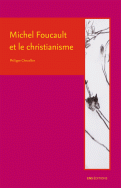
Philippe Chevallier (2011) Michel Foucault et le christianisme, ENS Éditions ISBN-10 2-84788-325-8 ISBN-13 978-2-84788-325-1 ISSN 1765-8128

pdf flyer

Résumé
Des premiers rites baptismaux à la confession moderne, les références au christianisme sont constantes dans l’œuvre de Michel Foucault. Cette constance s’inscrit dans un questionnement philosophique plus large sur notre actualité : comprendre le rapport que nous avons aujourd’hui à nous-mêmes demande de s’interroger sur les actes de vérité que l’Occident a instaurés depuis les premiers siècles chrétiens. Que faut-il dire et manifester de soi pour être transformé dans son être, pardonné, sauvé, jugé ou guéri ? Ce livre propose une étude critique de l’ensemble des lectures chrétiennes de Foucault, avec une attention particulière portée au cours Du gouvernement des vivants (1979-1980). Ni chronologique ni thématique, le parcours suivi espère retrouver la logique d’un travail à la fois philosophique et historique : quand et comment le christianisme a-t-il été constitué par Foucault en objet de recherche, avec quelles pratiques de lecture et quelles conséquences sur l’interprétation ? Attentif aux mots plus qu’aux choses, le philosophe repère les glissements sémantiques successifs qui annoncent, entre le iie et le ive siècle de notre ère, le passage du monde antique à un univers inédit : celui de la perfection impossible et des fidélités difficiles. Loin de l’image facile d’un christianisme ascétique et intransigeant, Foucault définit l’originalité chrétienne comme la reconnaissance et l’institution paradoxale d’un rapport précaire à la vérité.

Philippe Chevallier est docteur en philosophie de l’université Paris-Est. Il a récemment publié Être soi, Actualité de Søren Kierkegaard (François Bourin, 2011). Il travaille actuellement à la Bibliothèque nationale de France.

INTRODUCTION
MICHEL FOUCAULT : BIBLIOGRAPHIE

PREMIERE PARTIE : LE CHRISTIANISME COMME OBJET HISTORIQUE, UNE QUESTION DE METHODE

Chapitre un. Définition du modèle stratégique
Usage des concepts dans l’historiographie de Michel Foucault
La stratégie comme connexion de l’hétérogène
Les « formes de rationalité » sont-elles des idéalités ?

Chapitre deux. Le christianisme au risque de l’analyse stratégique
Le christianisme éclaté : 1973-1977
Le christianisme comme « gouvernementalité » : 1978
Un nouveau regard sur les institutions politiques : Église et État • Pastorat chrétien et marxisme : un miroir déformant ? • Évaluation critique de l’histoire pastorale
Le christianisme comme « régime de vérité » : 1980
Origine et mutation de la notion de « régime de vérité » • Postérité de la notion de « régimes de vérité » : vers l’éthique ? • Une double réduction de l’objet « christianisme »

Chapitre trois. Foucault et l’historiographie de l’Antiquité tardive

DEUXIEME PARTIE : UNE LECTURE SINGULIERE DES PERES

Chapitre quatre. Le christianisme dans le texte
Limites de la première histoire de l’aveu (1974-1978)
Spécificité de la forme religieuse de l’aveu • La confession est-elle une pratique coercitive ? • Les manuels des confesseurs comme pratique discursive
Le retour au texte : le virage de 1980
Abandon du principe d’exemplarité • Quoi de neuf ? Œdipe • Du fils Œdipe aux Pères chrétiens : radicalisation d’une lecture

Chapitre cinq. Conséquence sur l’usage des textes : lire et traduire les Pères
Lire : des choix classiques
Traduire : Foucault, traducteur sourcier
Citer : la citation comme pratique de lexicalisation

Chapitre six. Vers une « anarchéologie » du christianisme

TROISIEME PARTIE : UNE INTERPRETATION DU CHRISTIANISME COMME VOIE MOYENNE

Chapitre sept. Le christianisme comme Orient perdu
Tragédie de l’homme occidental
Une expérience d’abord littéraire
L’expérience de la transgression : Georges Bataille • L’être du langage, l’être : Roger Laporte, Maurice Blanchot • L’Orient, tentation originelle du christianisme : Pierre Klossowski, Gustave Flaubert
Le retour de la métaphysique

Chapitre huit. La relève d’un temps précaire
Premières hypothèses sur la différence chrétienne
La différence entre le moine et le pénitent
Les techniques de soi chrétiennes dans le monachisme • Les techniques de soi chrétiennes avant le monachisme • Pourquoi le laïc ne peut être gouverné comme le moine
La différence entre le salut et la perfection

CONCLUSION

Appendice : possibilité de compléter l’histoire stratégique du christianisme

Beyes, T., & Michels, C. (2011). The production of educational space: Heterotopia and the business university. Management Learning, 42(5), 521-536. https://doi.org/10.1177/1350507611400001

Abstract:
This article responds to recent calls for rethinking management education and fostering a spatial understanding of educational practices. We propose to introduce Foucault’s notion of heterotopic space and the spatial thought of Lefebvre into the debate about the current and future state of business schools. In particular, we conceptually and empirically discuss the potential for understanding space in a way that addresses its productive force, its multiplicity and its inherent contradictions. Using the example of an experimental teaching project dedicated to the conception and physical design of a city of the future, we reflect upon the possibility of the emergence of ‘other’, heterotopic spaces within an institution of management learning. Our findings suggest that spatial interventions facilitate critically affirmative engagement with the business school by offering an imaginative approach to management education.

This is the first page from a forthcoming short graphic novel written by Lauren Kinney and drawn by by Matt MacFarland.

I will be posting additional panels on Foucault News as they are produced.

Link to page 1
Link to page 2
Link to page 3
Link to page 4
link to page 5
link to page 6
link to page 7
link to page 8