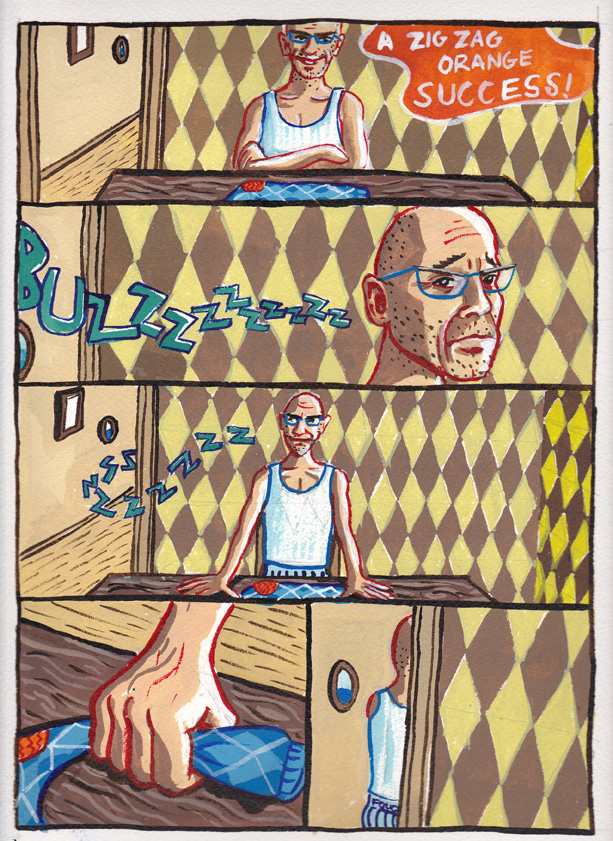
This is the fifth page from a forthcoming short graphic novel written by Lauren Kinney and drawn by by Matt MacFarland.
Link to page 1
Link to page 2
Link to page 3
Link to page 4
link to page 5
link to page 6
link to page 7
link to page 8

This is the fifth page from a forthcoming short graphic novel written by Lauren Kinney and drawn by by Matt MacFarland.
Link to page 1
Link to page 2
Link to page 3
Link to page 4
link to page 5
link to page 6
link to page 7
link to page 8
Newswander, Chad B. (2011). “Foucauldian Power and Schmittian Politics: The Craft of Constitution”. Administration & society, 43 (5), p. 537-60.
https://doi.org/10.1177/0095399711412735
Abstract
A political pattern of power focused on defining enemies of the state permits administrative agencies to be grounded in framework that allows them to create meaning. In an effort to better understand how agencies act as political players in a web of power relationships, this article suggests a framework based jointly on Foucault’s concept of power and Schmitt’s understanding of the political. Although these models may at first appear to be incompatible, Foucault and Schmitt’s ideas on power and politics are in fact complementary, and together can enrich an understanding of how administration is deeply constitutive.
Sassatelli, Roberta. (2011). “Interview with Laura Mulvey: Gender, Gaze and Technology in Film Culture”. Theory, culture & society (0263-2764), 28 (5), pp. 123-43.
Abstract
This conversation between Laura Mulvey and Roberta Sassatelli offers a historical reconstruction of Mulvey’s work, from her famous essay ‘Visual Pleasure and Narrative Cinema’ to her most recent reflections on male gaze, film technology and visual culture. The conversation initially deals with the socio-cultural context in which the ‘Visual Pleasure…’ essay was produced by outlining a number of possible theoretical parallelisms with other scholars, from Foucault to Barthes to Goffman. Then, on the basis of Mulvey’s latest book, Death 24× a Second, and of a variety of contemporary examples, the emphasis is on the relative shift in Mulvey’s work from gender to time and visual technology. Finally, the conversation focuses on the concept of ‘gendered scopic regime’ and the potential re-articulation of the male gaze through the technological re-direction and control of the visual.
RENCONTRE DOCTORALE DU CENTRE MICHEL FOUCAULT
2/3/4 mai 2012.
IMEC. Caen, France
L’Association pour le Centre Michel Foucault propose pour la quatrième année consécutive une école doctorale visant à réunir les doctorants travaillant sur, avec et autour de la pensée de Michel Foucault.
L’objectif est, comme les années précédentes de mettre en relation, le plus agréablement possible et de manière assez informelle, les jeunes chercheurs afin de constituer un réseau de travail national et international.
Cette rencontre aura lieu 2, 3, 4 mai 2012 à l’IMEC, à l’Abbaye d’Ardenne à Caen (avec un départ de Paris le mercredi 2 mai au soir et retour le vendredi 4 mai en fin de journée).
Les frais de séjour sur place et les billets Paris-Caen-Paris seront offerts aux intervenants par l’Association pour le Centre Michel Foucault.
Pour que les échanges puissent être les plus féconds possibles – et compte tenu des capacités d’accueil de l’Abbaye – nous limitons le nombre de participants, ce qui impliquera nécessairement un choix de notre part.
Les doctorants ayant participé les années passées aux rencontres pourront bien entendu décider d’y assister, mais la priorité sera donnée aux nouveaux intervenants et aux doctorants en 2eme et 3eme année de thèse.
Les propositions d’intervention (une page maximum), portant soit sur une question particulière de votre travail de thèse, soit sur un problème méthodologique précis, devront nous être envoyées, avec un CV, avant le 15 février 2012.
En fonction des demandes, nous établirons et diffuserons un programme début Mars. N’hésitez pas à nous contacter pour toute question.
Très cordialement, Philippe Artières, Jean-François Bert, Luca Paltrinieri Mathieu Potte-Bonneville, Judith Revel, Ferhat Taylan
Contact :
Luca Paltrinieri : l.paltrinieri@gmail.com
Ferhat Taylan : ferhattaylan@gmail.com
Farquhar, Sandy and Fitzsimons, Peter (2011). “Lost in Translation: The power of language”. Educational philosophy and theory, 43 (6), p. 652-662.
DOI: 10.1111/j.1469-5812.2009.00608.x
Abstract
The paper examines some philosophical aspects of translation as a metaphor for education-a metaphor that avoids the closure of final definitions, in favour of an ongoing and tentative process of interpretation and revision. Translation, it is argued, is a complex process involving language, within and among cultures, and in the exercise of power. Drawing on Foucault’s analysis of power, Nietzschean contingency, and the inversion of meaning that characterises the work of Heidegger and Derrida, the paper points towards Ricoeur’s notion of linguistic hospitality as the ethical dimension to the inevitably inadequate representation of the ‘other’. In this exploration, translation is posited as a creative and interpretive act-involving neither image nor copy, but poetic transposition.
The power of language emerges in the close association between power and knowledge, in which the ability to define what is real generates the realm of future possibilities. From a Foucauldian perspective, language functions as a creative strategic relation-a form of power that structures the field of other possible actions. It is through the mediation of translation, the paper argues, that language communicates, leaving us with a world of difference (i.e. ‘lost in translation’), as both our curse and our blessing as part of the human condition and as part of our ethical endeavour as educators. The contingent and arbitrary nature of language problematises what appears natural and necessary, generating the possibility of creative dialogue.

This is the fourth page from a forthcoming short graphic novel written by Lauren Kinney and drawn by by Matt MacFarland.
I will be posting additional panels on Foucault News as they are produced.
Link to page 1
Link to page 2
Link to page 3
Link to page 4
link to page 5
link to page 6
link to page 7
link to page 8
Barder, A. D., & Debrix, F. (2011). Agonal sovereignty: Rethinking war and politics with Schmitt, Arendt and Foucault. Philosophy & Social Criticism, 37(7), 775-793. https://doi.org/10.1177/0191453711410030
Abstract
The notion of biopolitical sovereignty and the theory of the state of exception are perspectives derived from Carl Schmitt’s thought and Michel Foucault’s writings that have been popularized by critical political theorists like Giorgio Agamben and Michael Hardt and Antonio Negri of late. This article argues that these perspectives are not sufficient analytical points of departure for a critique of the contemporary politics of terror, violence and war marked by a growing global exploitation of bodies, tightened management of life, and endless and unpredictable abusive force. To better capture the singularity of our present condition of violence, war and terror, a supplementation of Schmitt’s and Foucault’s approaches by way of Hannah Arendt’s language of political action and agonistic engagement is useful. By bringing Arendt’s language of political agony to bear on contemporary biopolitical debates and discourses, we wish to revisit common practices of war and terror as matters of ‘agonal sovereignty’. ‘Agonal sovereignty’ allows us to peer into the ‘abyss of total violence’ that manifests itself after sovereign decisionism and biopolitical modalities of power have taken over the everyday conduct of political affairs.
Eileen Joy has posted a seminar syllabus and a link to a book chapter in progress on the In the Middle blog.
I want to share with everyone here two recent fruits of these projects — a book chapter-in-progress and a seminar syllabus recently proposed, with Anna Klosowska, to the Newberry Library’s Center for Renaissance Studies — both of which have grown out of my readings of Foucault’s late writings, but which are tending in very different directions. The first is a draft of the talk I recently gave at the University of Western Australia, at a 2-day conference on “International Medievalism and Popular Culture,” organized by Louise D’Arcens, John Ganim, Andrew Lynch, and Stephanie Trigg. This talk, “An Improbable Manner of Being: Medieval Hagiography, Queer Studies, and Lars von Trier’s Breaking the Waves,” partly builds on my essay recently published in postmedieval‘s special issue on New Critical Modes, edited by Jeffrey and Cary Howie, “Like Two Autistic Moonbeams Entering the Window of My Asylum: Chaucer’s Griselda and Lars von Trier’s Bess McNeill,” but plans to also delve [as the postmedieval essay did not] into the theological biopolitics negotiated, in similar ways, in medieval hagiography and von Trier’s film [and for those interested in such a subject, I want to acknowledge my debt here to Emma Campbell’s article “Homo Sacer: Power, Life, and the Sexual Body in Old French Saints’ Lives, Exemplaria 18.2: 2006, as one initial starting point for my thinking in this vein].
Dent, C. (2011). “‘Gray, meticulous and patently documentary’: Foucaultian historical methods and the patent system”. Journal of sociology , 47 (3), p. 297-312.
doi: 10.1177/1440783311407944
Abstract
Patents are seen as a key part of the modern economy and operate as a mode of regulation of technology and innovation. The histories of the system, to date, have not explored the role that patents have in the governance of our society. This article suggests that the historical methods of Michel Foucault are broad enough to undertake this task. The article, then, explores both the archaeological and the genealogical methods in order to assess the benefits, and limitations, that arise from the use of each of them in the context of a history of the laws, and practices, as they relate to patents of invention.
Leclercq-Vandelannoitte, A. (2011). Organizations as Discursive Constructions: A Foucauldian Approach. Organization Studies, 32(9), 1247-1271. https://doi.org/10.1177/0170840611411395
Abstract
A growing body of literature suggests that communication constitutes organizations, but this argument requires refinement to address its remaining flaws. This essay suggests the tremendous potential of using Michel Foucault’s work to grasp the underlying meaning of this argument and to respond to its shortcomings. The proposed Foucauldian-based process model highlights links across Foucault’s main lines of thought, applied to the relationships among technology, discourse, discipline, control, subject, and identity in an organization. By reframing the concept of technology as a discursive and nondiscursive practice that constrains and enables everyday life, this approach offers better understanding of the argument that communication constitutes organizations. The conceptual model also serves as a backdrop for exploring a problematic field situation with a case study. Technology appears part of processes by which technology, organizations, and subjects get redefined. The organization is dynamically constituted as an evolving, political, negotiated order through power-knowledge relationships.
 Foucault News