Foucault News

News and resources on French thinker Michel Foucault (1926-1984)

Bernard Harcourt, Foucault, retour sur l’aveu. Entretien

Audio broadcast France Culture

Pdf of Transcript

A la fin de sa vie, Michel Foucault est revenu sur la question de l’aveu dans la justice pénale près de vingt ans après la série de conférences à Rio sur “la vérité et les formes juridiques » et bien sûr après le très célèbre « Surveiller et punir ». Il l’a fait dans une série de conférences données en Belgique qui viennent d’être éditées sous le titre : “Mal faire, dire vrai : fonction de l’aveu en justice” par les soins de Fabienne Brion et Bernard Harcourt.

Bernard Harcourt est professeur de droit et sciences politiques et préside le département de sciences politiques à l’université de Chicago. On lui doit d’importants ouvrages sur le profiling ou la justice actuarielle.

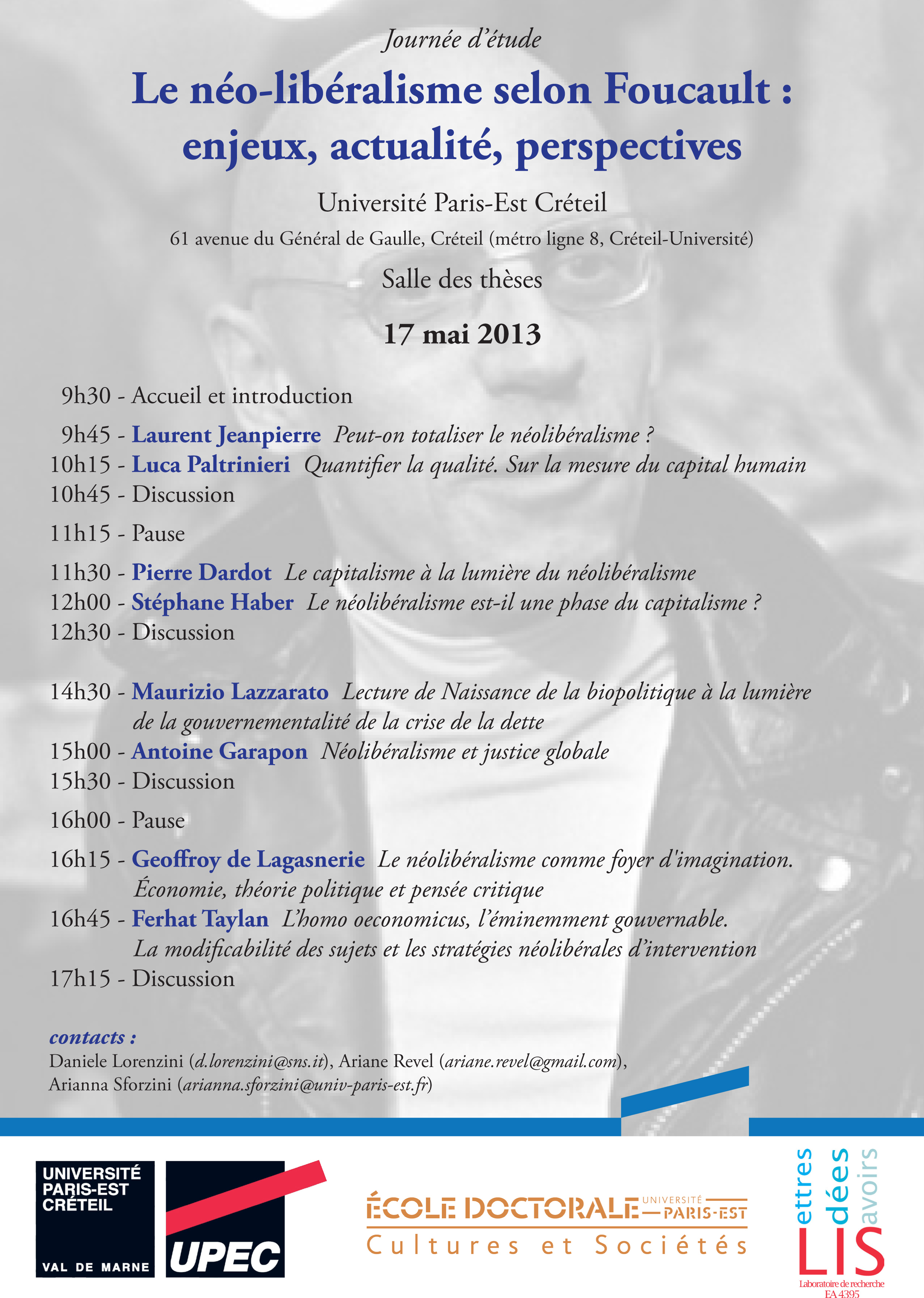
Foucault et le néolibéralisme

pdf flyer

murphySocial Theory and Education Research Understanding Foucault, Habermas,Bourdieu and Derrida. Edited by Mark Murphy, London: Routledge, April 2013

September 2025 update: Link above is to the second edition published in 2022.

Description
Although education researchers have drawn on the work of a wide diversity of theorists, a number of these have been of particular significance to education. While the likes of Karl Marx, Antonio Gramsci, John Dewey and Paulo Freire influenced previous generations of educational theorists, much of the more contemporary theory building has revolved around a quartet of well-known and much-debated thinkers – Michel Foucault, Jürgen Habermas, Pierre Bourdieu and Jacques Derrida. However, while the influence of these thinkers has grown considerably over the last number of years, both their original work and its application to education can prove challenging to the educational practitioner. The challenges they pose to educators are exacerbated by a lack of suitable reading material that can appeal to the advanced practitioner market, while also providing a sufficiently in-depth overview of the various theories and their applications in educational research.

This edited book expertly rectifies this omission in the educational literature, and delivers a text that is both advanced and accessible, offering the education practitioner/researcher a suitable guide to assist their acquisition and application of social theory. The chapters included in this collection are designed to illustrate the diverse ways in which continental theory of whatever stripe can be applied to educational issues. From school surveillance to curriculum, social theory is used to shed light on ‘practical’ issues facing the sector, helping to widen and deepen discussion around these areas when they are in danger of being over-simplified.

This book will be incredibly useful to post-graduate student teachers who wish to develop their capacity to engage with these debates at an advanced level. It will also prove of great interest to anyone involved in education policy and theory.

Additional – updated edition
Updated throughout and with new extended introductions to each theorist and a new chapter on the application of socio-theoretical concepts in education research methodologies and the how-to of research practice, this second edition assists education practitioners and researchers in their acquisition and application of social theory. This book contextualizes the various theories within the broader context of social philosophy and the historical development of different forms of thought.

Jiménez-Anca, J.J. Beyond power: Unbridging Foucault and Weber (2013) European Journal of Social Theory, 16 (1), pp. 36-50.
https://doi.org/10.1177/1368431012444919

Abstract
Today, very few would doubt that there are plenty of reasons to liken Weber’s and Foucault’s theories of power. Nevertheless, their respective works have divergent ethical and ontological preoccupations which should be reconsidered. This article explores Foucault’s account of a historical episode in Discipline and Punish and Weber’s theory of life spheres, uncovering evidence that there is a need to reassess the conceptual bridges which have been built so far. The exploration reveals a radical difference between a monological theory of power (Foucault) and a multidimensional approach to power (Weber). Yet by unbridging the two thinkers and focusing on other aspects of their theories along with their ideas about power, we also find that alternative links between the two frameworks may offer a more promising critical theory.

Author Keywords

ethics and religion; Foucault; power relations; theories of power; Weber

Kannen, V. (2013). These are not ‘regular places’: women and gender studies classrooms as heterotopias. Gender, Place & Culture, 21(1), 52–67.
https://doi.org/10.1080/0966369X.2012.759910

Abstract
This article questions the transformative potential of women and gender studies classrooms through a discussion of student experiences of privilege and oppression in these spaces. Using in-depth interviews with 22 undergraduate students from two contrasting Canadian universities, this article explores how women and gender studies classrooms function as heterotopias or ‘other places’ – sites that challenge ‘regular’ places outside of the academy. Critically analyzing student experiences illustrates to how the intersections of space/location, power, and identities inform notions of privilege and oppression within these classrooms. Analysis of the participants’ reflections points to how it is through these ‘other places’ that students are able to recognize identities that were once unknown to them, become conscious of their embodiments via feelings of worry and discomfort, and question their sense of place in the classroom. It is because of these findings that this research functions as a call to instructors regarding the need to prioritize student experiences, so as to be able to critically reflect upon the social and academic significance of women and gender studies classrooms.

Author Keywords
Canada; Foucault; heterotopia; identity; students; women and gender studies

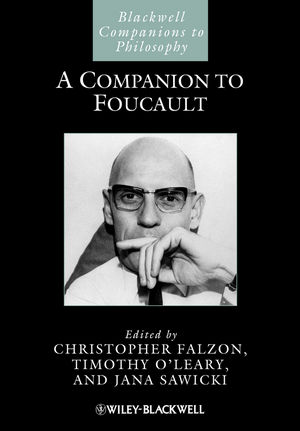
jw_blackwell_horzChristopher Falzon (Editor), Timothy O’Leary (Editor), Jana Sawicki (Editor) A Companion to Foucault, Wiley-Blackwell, March 2013.
ISBN: 978-1-4443-3406-7
Hardcover
626 pages

Description
A Companion to Foucault comprises a collection of essays from established and emerging scholars that represent the most extensive treatment of French philosopher Michel Foucault’s works currently available.

  • Comprises a comprehensive collection of authors and topics, with both established and emerging scholars represented
  • Includes chapters that survey Foucault’s major works and others that approach his work from a range of thematic angles
  • Engages extensively with Foucault’s recently published lecture courses from the Collège de France
  • Contains the first translation of the extensive ‘Chronology’ of Foucault’s life and works written by Foucault’s life-partner Daniel Defert
  • Includes a bibliography of Foucault’s shorter works in English, cross-referenced to the standard French edition Dits et Ecrits

Table of contents

Notes on the Editors and Contributors ix

List of Abbreviations xiv

Introduction 1

Part I Landmarks 9

1 Chronology 11
Daniel Defert

2 History of Madness 84
Colin Gordon

3 The Order of Things 104
Patrice Maniglier

4 On the Powers of the False: Foucault’s Engagements with the Arts 122
Joseph J. Tanke

5 Discipline and Punish 137
Alan D. Schrift

6 Reading The History of Sexuality, Volume 1 154
Richard A. Lynch

7 From Resistance to Government: Foucault’s Lectures 1976–1979 172
Paul Patton

8 Foucault’s Untimely Struggle 189
Paul Rabinow

Part II Knowledge and Critique 205

9 Foucault’s Normative Epistemology 207
Linda Martín Alcoff

10 Foucault and the Freudians 226
Wendy Grace

11 Foucault on Critical Agency in Painting and the Aesthetics of Existence 243
Michael Kelly

12 Foucault on Kant, Enlightenment, and Being Critical 264
Marc Djaballah

13 Making History 282
Christopher Falzon

Part III Power and Governmentality 299

14 Power, Resistance, and Freedom 301
Jon Simons

15 From Biopower to Governmentality 320
Johanna Oksala

16 Power and the Subject 337
Amy Allen

17 Power, Politics, Racism 353
Brad Elliott Stone

18 Foucault, Religion, and Pastoral Power 368
Jeremy Carrette

19 Space, Territory, Geography 384
Jeremy W. Crampton

Part IV Sexuality, Gender, and Race 401

20 Toward a Feminist “Politics of Ourselves” 403
Dianna Taylor

21 Infamous Men, Dangerous Individuals, and Violence against Women: Feminist Re-readings of Foucault 419
Chloë Taylor

22 Foucault’s Eros: For an Ethics of Living in Biopower 436
Lynne Huffer

23 The Missing Link: Homo Economicus (Reading Foucault and Bataille Together) 454
Shannon Winnubst

24 Genealogies of Race and Gender 472
David-Olivier Gougelet and Ellen K. Feder

Part V Ethics and Modernity 491

25 Foucault’s Ontology and Epistemology of Ethics 493
James D. Faubion

26 Foucault, Subjectivity, and Technologies of the Self 510
Mark G. E. Kelly

27 The Formation and Self-Transformation of the Subject in Foucault’s Ethics 526
Colin Koopman

28 Foucault, Nature, and the Environment 544
Paul Alberts

Appendix 562

Michel Foucault’s Shorter Works in English: Bibliography and Concordance 562
Richard A. Lynch

Index 593

Singh, N.M. The affective labor of growing forests and the becoming of environmental subjects: Rethinking environmentality in Odisha, India (2013) Geoforum
https://doi.org/10.1016/j.geoforum.2013.01.010

Abstract
How do humans come to care for their environment and what turns them into conservationists are central questions in environmental politics. Recent scholars have turned to Foucault’s ideas of “governmentality” to understand how technologies of power intersect with technologies of the self to create “environmental subjects,” that is, people who display a sense of commitment to the conservation of the environment. In this article, I argue that the applications of governmentality tend to privilege technologies of power and pay insufficient attention to the role of affect, emotions, and embodied practices in shaping human subjectivities. I draw on Spinoza’s framework of affects and Hardt and Negri’s idea of “affective labor” to bring attention to the processes through which human beings make themselves and the role of affect and environmental care practices in shaping subjectivity. Using the example of community-based forest conservation efforts in Odisha, India, I argue that we need to look beyond economic and political rationalities to explain human action and behavior. I suggest that villagers’ efforts to regenerate degraded forests involve affective labor in which mind and body, reason and passion, intellect and feeling are all employed together. Through the daily practices of caring for the forest and helping the forests grow, villagers not only transform natural landscapes but also transform their individual and collective subjectivities. I conclude by elaborating on the “biopower from below” of these environmental care practices.

Author Keywords
Affect theory; Affective labor; Biopower; Community forestry; Environmentality; Governmentality; Subjectivity

DOI: 10.1016/j.geoforum.2013.01.010

brossatLe racisme comme technologie de pouvoir
26 février 2013 par Alain Brossat

Ici et Ailleurs site

Plutôt que tenter de résumer mon livre, Autochtone imaginaire, étranger imaginé Retours sur la xénophobie ambiante, ce qui est évidemment l’exercice le plus douteux qui soit (ce qui se résume aisément ne vaut généralement pas grand chose), je vais m’essayer à en redéployer le motif central en repartant d’un des deux auteurs qui y occupent la place des saints patrons – Foucault (l’autre étant Benjamin).

Dans le cours du 17 mars 1976 (« Il faut défendre la société »), Foucault propose un développement tout à fait lumineux sur ce qu’il appelle « le racisme », sur sa fonction dans l’exercice des pouvoirs modernes. Il se pose une question toute simple : comment un pouvoir dont l’objet et l’objectif premier et dernier est « la vie », l’entretien de la vie des populations, la majoration, l’optimisation, la multiplication des chances de « la vie », comment un tel pouvoir peut-il se manifester encore en tuant, en réclamant la mort, en l’administrant, en exposant à la mort non seulement ses ennemis, mais aussi ses propres citoyens ou ressortissants ? Jusqu’ici, je paraphrase Foucault, mais maintenant, je vais le citer : « Comment peut-il laisser mourir, ce pouvoir qui a essentiellement pour objectif de faire vivre ? Comment exercer le pouvoir de la mort, comment exercer la fonction de la mort, dans un système politique centré sur le bio-pouvoir ? » – c’est-à-dire en rupture distincte avec le vieux régime de souveraineté, régime immémorial, dans lequel, pour Foucault, la puissance du souverain se manifeste en premier lieu par sa capacité de faire mourir ? Eh bien, dit Foucault, « c’est là (…) qu’intervient le racisme ». Bien sûr, précise-t-il tout de suite, le racisme (concept un peu « porte-manteau » ou « valise », en l’occurrence, mais peu importe), ne date pas d’hier et n’est pas l’invention des pouvoirs modernes. « Il existait depuis bien longtemps », note-t-il. Mais ce qui est nouveau, dans nos sociétés, c’est la façon dont il est entré dans les mécanismes de l’Etat dès lors qu’a émergé le bio-pouvoir. Il est, dans les sociétés modernes (les nôtres, du moins, en Occident), coextensif à l’exercice du pouvoir dont il est, dit Foucault, un « mécanisme fondamental ».

suite

Séminaire Actualités Foucault

Séminaire Actualités Foucault -pdf

Le séminaire “Actualités Foucault” tiendra sa première séance le vendredi 26 avril, de 14h à 17h, à l’Université Paris-Est Créteil, bâtiment i, 2e étage, salle 233 (métro ligne 8, Créteil-Université).

L’objectif de ce séminaire est de rassembler régulièrement tous ceux qui travaillent sur ou à partir de la pensée de Michel Foucault, et de créer un espace de débats et d’échanges autour d’une œuvre foisonnante dont la perception se renouvelle fortement et rapidement, grâce à des publications toujours plus nombreuses.

Il s’agira à chaque fois de présenter une actualité triple. Actualité académique : les étudiants travaillant actuellement sur ou à partir de Foucault (masters, doctorats, projets d’articles ou de livre) pourront exposer leur recherche. Actualité critique : on rendra compte des ouvrages ou articles importants parus dernièrement (parfois en présence de l’auteur). Actualité éditoriale : présentation à la fois des inédits de Foucault récemment publiés (conférences, articles, entretiens, cours au Collège de France), mais aussi présentation de travaux d’édition de nouveaux textes de Foucault à paraître. Nous profiterons de cet espace également pour annoncer les plus importantes manifestations foucaldiennes prévues.

Nous tâcherons enfin de mettre les concepts foucaldiens à l’épreuve des grandes mutations (techniques, politiques, éthiques) contemporaines, pour rester fidèles à l’injonction de diagnostic de notre présent.

Frédéric Gros, Daniele Lorenzini, Ariane Revel, Arianna Sforzini

Provided to YouTube by Frémeaux Librairie

A propos de l’histoire de la folie · Michel Foucault

Anthologie sonore de la pensée française du XXe siècle / Sartre, Merleau-Ponty, Lévinas, Jankélévitch, Foucault, Deleuze, Desanti, Corbin, Bergson, Aron, Althusser…