Foucault News

News and resources on French thinker Michel Foucault (1926-1984)

Review of two books inspired by Foucault:

Yves Citton, Renverser l’insoutenable, Paris: Seuil, 2012

Sous la direction de Fabienne Brugère et Guillaume le Blanc, Michaël Foessel, Marie Gaille, Judith Revel, Pierre Zaoui Dictionnaire politique à l’usage des gouvernés, Paris: Bayard, 2012

Dans le bel Avant-propos de leur livre écrit à quatre mains, Philippe Artières et Mathieu Potte-Bonneville nous apprennent qu’au début des années 1990 il n’allait pas de soi de s’intéresser à la pensée de Michel Foucault. “Foucault n’était pas seulement mort de manière brutale”, écrivent-ils, “on avait décidé d’enterrer avec lui sa pensée. Il fallait en finir avec ce trublion, avec cette figure inclassable et politiquement suspecte (…). L’Université pesait de tout son mutisme dans la balance de l’oubli”. Il fallait tirer par la manche tel professeur, ajoutent-ils, pour qu’il réponde du bout des lèvres : “Au fond, de Foucault, il ne restera pas grand-chose” .

Plus de vingt ans après sa mort, Michel Foucault est devenu l’un des auteurs de la French Theory le plus étudié et le plus commenté de par le monde. Et son influence est d’autant plus considérable qu’elle ne se laisse pas seulement mesurer – pour ainsi dire, quantitativement – au volume des publications qui lui sont consacrées et au nombre des notes en bas de page qui mentionnent expressément son nom, mais – de manière plus subtile et plus prégnante – à la façon dont il a su déplacer des lignes de réflexion en entraînant avec lui toute une génération de penseurs. La réussite de Foucault tient à ce que le geste par lequel il est parvenu à reformuler un certain nombre de problèmes a été partout reproduit silencieusement, au point d’organiser et de structurer en profondeur l’espace du discours contemporain.

suite

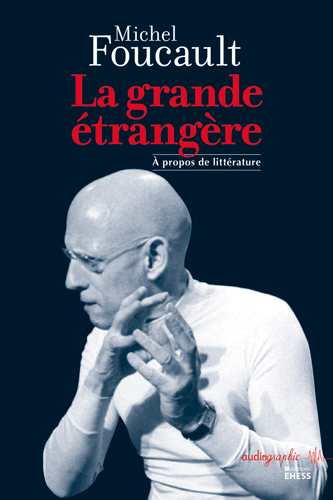
etrangereMichel Foucault, La grande étrangère: À propos de littérature. Édité et présenté par Philippe Artières, Jean-François Bert, Mathieu Potte-Bonneville et Judith Revel. Paris: Editions EHESS. mars 2013

Publisher’s page

Michel Foucault entretient avec la littérature une relation complexe, critique, stratégique. Les documents inédits qui composent le présent volume en témoignent magnifiquement.. Sade, Cervantes, Artaud, Shakespeare….Le philosophe se livre à une description de sa bibliothèque littéraire.

Ce recueil regroupe pour la première fois plusieurs de ces interventions : émission de radio, enseignements et conférences. Prononcés à l’oral sur une période de moins de dix ans — entre 1963 et 1971 — chacun entretient avec l’écrit et la langue un rapport particulier.

Les deux premiers documents sont la transcription intégrale de deux émissions de radio diffusées à a radio française en janvier 1963, consacrées à la représentation de la folie dans le langage. Foucault y fait entendre de nombreux extraits : Shakespeare, Cervantès, Diderot, Sade, Artaud, Leiris.

Le deuxième ensemble est formé de deux conférences successives sur Langage et littérature. À la faveur d’une analyse de l’étrange « triangulation » qu’il décèle entre le langage, l’œuvre et la littérature, Foucault reprend l’ensemble des thèmes qui traversent ses écrits sur la littérature de ce début des années 1960.

Enfin, ce volume livre un article en deux parties prononcé en 1971 à l’université de Buffalo aux Etats-Unis, résultat d’une expérimentation à l’oral d’une étude du Marquis de Sade dont les manuscrits ont été conservés. Pour le philosophe La Nouvelle Justine est intégralement écrit sous le signe de la vérité.

À lire ces prises de parole consacrées à la littérature, le souci de Michel Foucault prend l’allure d’un véritable redoublement de son propre discours, c’est-à-dire tentative, menée à l’extrême, de dire à la fois l’ordre du monde et de ses représentations à un moment donné.

SOMMAIRE
Introduction par Philippe Artières et Jean-François Bert, Mathieu Potte-Bonneville et Judith Revel
Avertissement
La Grande Étrangère. À propos de littérature
1. Le langage de la folie (1963)
« Le Silence des fous »
« Le Langage en folie »
2. Littérature et langage (1964)
3. Conférences sur Sade (1970)
Travaux et interventions de Michel Foucault sur la littérature
Michel Foucault (1926-1984)

Source m/f materiali foucautiani

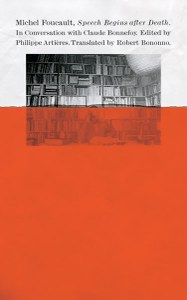
bonnefoy Michel Foucault (2013) Speech begins after death, University of Minnesota Press.

$24.95 cloth/jacket ISBN 978-0-8166-8320-8
96 pages, 5 x 8, March 2013

In 1968, Michel Foucault agreed to a series of interviews with critic Claude Bonnefoy, which were to be published in book form. Bonnefoy wanted a dialogue with Foucault about his relationship to writing rather than about the content of his books. The project was abandoned, but a transcript of the initial interview survived and is now being published for the first time in English. In this brief and lively exchange, Foucault reflects on how he approached the written word throughout his life, from his school days to his discovery of the pleasure of writing.

Wide ranging, characteristically insightful, and unexpectedly autobiographical, the discussion is revelatory of Foucault’s intellectual development, his aims as a writer, his clinical methodology (“let’s say I’m a diagnostician”), and his interest in other authors, including Raymond Roussel and Antonin Artaud. Foucault discloses, in ways he never had previously, details about his home life, his family history, and the profound sense of obligation he feels to the act of writing. In his Introduction, Philippe Artières investigates Foucault’s engagement in various forms of oral discourse—lectures, speeches, debates, press conferences, and interviews—and their place in his work.

Speech Begins after Death shows Foucault adopting a new language, an innovative autobiographical communication that is neither conversation nor monologue, and is one of his most personal statements about his life and writing.

Contents

Editor’s Note

Introduction: Foucault and Audiography
Philippe Artières

Interview between Michel Foucault and Claude Bonnefoy, 1968

Chronologies of Michel Foucault and Claude Bonnefoy

Via Stuart Elden at Progressive Geographies

stuartelden's avatarProgressive Geographies

419px-Triptych-Bosch-reconstructionMichael Bibby has produced a hybrid translation of the ‘Stultifera Navis’ chapter of Foucault’s History of Madness. It draws on both the existing English translations, and comes with various texts as an introduction and a selection of images.

View original post

Foucault et la psychanalyse : Histoire de la folie à l’âge classique, 50 ans après?

Samedi 24 novembre 2012, Amphi Buffon, Université Paris Diderot
15 rue Hélène Brion
75013 Paris
Métro, RER C et bus : arrêt : Bibliothèque François Mitterrand.

Université Paris-Diderot Paris 7 – UFR d’Etudes Psychanalytiques

Journée scientifique du CRPMS

Argument

En 1961 Foucault publie L’histoire de la folie à l’âge classique. Ce livre fait événement en déconstruisant l’histoire du positivisme psychiatrique à partir de la mise à nu d’un partage et d’un oubli qui le fondent. Contesté pour ses approximations historiques et sa méthode, encensé par les psychiatres, tenant de l’antipsychiatrie, ce livre n’a cessé de faire débat en traversant toutes les disciplines des sciences humaines : histoire, littérature, philosophie, psychologie, médecine, psychiatrie et psychanalyse.

50 ans après sa parution, que reste-t-il de ces débats passionnés ? Que reste-t-il de la pensée de la folie et de son traitement contemporain ?

Foucault esquisse dans ce livre une structure fondée sur l’exclusion qui traverse l’histoire. Chaque période historique (renaissance, âge classique, et modernité positiviste) met en acte, à sa manière, une forme de l’oubli de la folie. Les signifiants se modifient mais pas son altérité que le discours positiviste radicalise. Est-ce que notre (post) modernité organise cette structure de partage ? Comment épingle-elle l’altérité de la folie ? Quels sont ses opérateurs et les modalités de la constitution du savoir sur la folie ? Autrement dit, comment ce livre donne-t-il à penser les conditions de possibilité des discours et des pratiques (de pouvoir) contemporaines qui transforment l’expérience de la folie en une maladie mentale ?

L’histoire de la folie est-il aujourd’hui, 50 ans après sa parution, un livre politique ?

Nous posons également ce livre comme une matrice qui questionne le dialogue ou le débat entre la psychanalyse et la théorie foucaldienne. L’ambiguïté dans ce livre, repérée par Derrida, envers la psychanalyse et sa localisation, pointe un symptôme qu’il s’agit d’interroger. Quelles sont les pierres d’achoppement entre Foucault et la psychanalyse, les points de divergences irréductibles et quels sont leurs effets théoriques et éthiques ?

La référence de Foucault à la psychanalyse est récurrente et traverse, tantôt explicitement tantôt implicitement, l’ensemble de son oeuvre. Y- a-t-il une fonction de la psychanalyse à l’intérieur de l’économie discursive de Foucault ? Et qu’est-ce que cette fonction peut enseigner sur l’oeuvre de Foucault mais aussi sur la psychanalyse même ?

Inversement, se pose la question de savoir en quoi le discours de Foucault affecte la psychanalyse ? Comment sa déconstruction des notions comme « vérité », « identité » ou « liberté », ainsi que son historicisation de la notion de « sexualité » ont un effet sur la psychanalyse ? Sur quels points précisément l’oeuvre de Foucault vient mettre en travail la psychanalyse? Et comment peut-elle nous permettre de penser la clinique analytique ?

Programme

Matinée 9h-13h

Présidence et ouverture : Laurie Laufer

9h15 – 9h45 : Roland Gori « La néo-psychiatrie : une hygiène du corps social »

9h45 -10h15 : Jean-François Bert « L’histoire de la folie à l’âge classique, un livre à venir. Lectures et relectures de Michel Foucault »

10h15 -10h45 : Paul-Laurent Assoun « La production de la jouissance : pouvoir et sexuel chez Foucault et Lacan »

Pause

11h15 -11h45 : Jean Allouch « “L’analyse sera foucaldienne ou ne sera pas” »

11h45 -12h15 : Amos Squverer « L’architecture de l’Un et du multiple »

Discussion avec la salle

Après-midi 14h30-17h30

Présidence : Alain Vanier

14h30 -15h : Joël Birman « Le tragique et la finitude dans la psychanalyse »

15h – 15h30 : Thamy Ayouch « Foucault pour la psychanalyse : vérité, véridiction, pratiques de soi ».

Pause

Présidence : Claire Nahon

16h – 16h30 : Christian Hoffmann « Le bistouri de Michel Foucault »

16h30 – 17h00 : Elisabeth Roudinesco

Discussion avec la salle

Organisation : Laurie Laufer et Amos Squverer

Amphi Buffon, Université Paris Diderot 15 rue Hélène Brion 75013 Paris

Métro, RER C et bus : arrêt : Bibliothèque François Mitterrand. Entrée libre, places limitées.

Responsable : CRPMS, UFR Etudes psychanalytiques-Université Denis Diderot

Carolyn Hardin (2012). Finding the ‘Neo’ in Neoliberalism. Cultural Studies, 28(2), 199–221.
https://doi.org/10.1080/09502386.2012.748815

Abstract
‘Liberalism’ and ‘neoliberalism’ have become important shorthand terms in critical work that seeks to incorporate issues of economics into ideological and epochal analyses. Yet, these terms incorporate theoretical histories and refer to historical contexts so vast that they can seem ambiguous and boundaryless. This ambiguity threatens to reduce the analytical usefulness of the terms liberalism and neoliberalism. In this paper, I map the legacies and meanings of the terms liberalism and neoliberalism and diagram the complexity and specificity of what neoliberalism is today. First, I engage a small set of definitions and uses of these terms to try to make sense of liberalism and neoliberalism as historical-theoretical concepts. Second, I group current academic uses of the term neoliberalism into Foucauldian, Marxist and epochalist camps, explaining the limits of each. Third, drawing on a fourth minor strand of work on neoliberalism that opens a path to better defining and using the term, I present my own definition of neoliberalism that distinguishes between a theoretical mode and an articulation mode. I conclude by proposing that what is new in neoliberalism is what I call corporism, the privileging of the form and position of corporations.

La folie et la fête. Michel Foucault (1963)
Text from youtube

Premier temps d’une série de cinq émissions intitulée « L’usage de la parole : les langages de la folie ».
Pour l’interprétation des textes Michel Foucault est accompagné de Marguerite Cassan, Pierre Delpont, Abel Jacquin, Catherine Le Couey et de Claude Martin.
Émission radio, diffusée le 7 Janvier 1963 sur France III nationale (France culture).

Source: La Nuit rêvée de… Gérard Fromanger
Émission produite par Philippe Garbit et diffusée sur France culture le 16 septembre 2012.
Lien vers l’émission

With thanks to mmyii for this link

Text from youtube (edited)

From the European Graduate School.

François Noudelmann, contemporary philosopher, discussing the relation between, philosophy, truth and lying. During the seminar he refers to Nietzsche, Foucault, Freud and Marx. Noudelmann talks also about optimism, resilience, hope and compares the statements of Hegel, Socrates and Platon by reading passages from Nietzsche’s Human, All Too Human and Beyond Good and Evil. Seminar for the students and faculty of the European Graduate School EGS Media and Communication Studies department program Saas-Fee Switzerland Europe 2012 François Noudelmann.

François Noudelmann is a French philosopher, radio producer at the famous France Culture and professor. He is based in the French literature department at the University of Paris VIII, most famous as Université de Vincennes, which it is noteworthy to point out was founded a direct result of the famous May 1968 student protests. Additionally, he has also regularly taught in the United States at both Johns Hopkins University in Baltimore as well as New York University. As an author François Noudelmann has written several books on the fiction of time, which study genealogical representations through philosophical and literary essays. As a Jean-Paul Sartre specialist who wrote his dissertation on him, today still Noudelmann is inspired by Sartre.

François Noudelmann was from 2001 to 2004 the director of the Collège International de Philosophie (CIPh), an open philosophy university in Paris, which was founded in 1983, Jacques Derrida (1930 – 2004) himself was its first president. For 8 years, from 2002 through 2010 he would host a radio show Les Vendredis de la philosophie (“Philosophical Fridays”) as well as Macadam philo(“Philosophical Tarmac”), both on France Culture radio. Since September of 2010 Noudelmann has hosted a new show Je l’entends comme je l’aime (“I hear it as I like it”) also on France Culture but this show explores philosophy through the medium of music. The show has interviewed many critical thinkers including philosophers such as Alain Badiou (1937 – ) and Avital Ronell (1952 – ), but also writers like Georges-Olivier Châteaureynaud (1947 – ) and Catherine David.

Noudelmann has published over the years many more works, including: Samuel Beckett (2006), Dictionnaire Sartre (“Sartre Dictionary”) 2004, Politiques de la communauté (“Community Politics”) 2003, Scène et image (“Scene and Image”) (2000), Francis Ponge : matière, matériau, matérialisme (“Francis Ponge: Matter, Material, Materialism”) (2000), Avant-gardes et modernité (“Avant-gardes and Modernity”) (2000), Beckett ou la scène du pire (“Becket or the Scene of the Worse”) (1998), Suite, série, séquence (“Suite, Series, Sequence”) 1998, Image et absence: Essai sur le regard (“Image and Absence: Essay on Looking”) 1998,Sartre: L’incarnation imaginaire (“Sartre: Imaginary Embodiment”) 1996, La Culture et l’homme (“Man and Culture”) 1994, Huis clos et Les mouches de Jean-Paul Sartre (“Jean-Paul Sartre’s ‘No Exit’ and ‘The Flies'”) 1993, Le corps à découvert (“Uncovered Body”) 1992, L’incarnation imaginaire : l’image dans la pensée de Sartre (“Imaginary Embodiment: the Image in Sartre’s Thought”) – his Dissertation – 1992. La nature : de l’identité à la liberté (“Nature: from Identity to Freedom”) 1991.

With thanks to Dirk Felleman for this link

Lester K. Spence, The Neoliberal Turn in Black Politics, Souls: A Critical Journal of Black Politics, Culture, and Society, Volume 14, Issue 3-4, 2013, pages 139-159
http://dx.doi.org/10.1080/10999949.2012.763682

Abstract
The neoliberal turn arguably has a powerful effect on black political ideas, black political practices, and black life in general; the nature of this effect has gone under-examined. In this work I seek to rectify this gap by examining neoliberal governmentality as it appears in black communities. The result should deepen our understanding of class politics within racially subjugated communities, and should push us to consider a much wider range of phenomenon when examining the way resources are distributed within already resource-poor black communities.

Keywords
black politics,
governmentality,
neoliberalism

Seminar 10: Foucault and the critique of our present: reworking the Foucauldian tool-box, Goldsmiths College, University of London

Michael Dillon – “Foucault: Political Spirituality and the Courage of Truth”

Description:
“What is this present which I belong to?”. This was the question asked by Foucault recalling Kant’s writing on the Enlightenment. This is also the interrogation that a Foucaultian gaze on the present specific context/spaces should pose again. In Foucault’s view, the practice of a history of our present is primarily conceived as a critical attitude towards the configuration of power relations given at a certain time, that is as an effective challenge of the ways in which our lives are governed. Then, the history of the present and the critique are (in turn) grounded on a genealogical posture, aiming at making all evidence unacceptable. In this way, as Foucault remarked in 1978, the critique can be conceived as “the art of the voluntary disobedience, of the reasoned indocility. Therefore, the function of the critique would be the disassujettissement in the play of what could be named a politics of truth”.

Related to the couple critique-history of our present a broad Foucaultian vocabulary has emerged: governmentality, counter-conduct, and biopolitics are only some of the Foucaultian notions closely linked to the question of our present and to the will of “not to be governed in such a way”.

The aim of this seminar will be to trace out and to “update” this range of notions, reworking them in the light of postcolonial challenges, new practices of struggle and political technologies. Thus, the aim is neither to test the viability of the Foucaultian grid in our present, nor to undertake a philological route exploring Foucault’s concepts, but rather to put these notions at work in present and heterogeneous contexts. Secondly, it’s through the twofold axis of space and knowledge that we will try to highlight the spaces for critique that a Foucaultian vantage point could open and make visible today. However, in the place of a coherent Foucaultian grid/approach to take on, we also claim the ‘right’ to a partial and instrumental use of Foucault’s tool-box: consequently, the very concept of “use” needs to be rethought not in terms of an application of methods and concepts to our diagram of analysis but instead as a way of ‘playing with’ some of Foucault’s perspectives, also pushing them up to their geographical/historical/political limits and making them resound in different spaces.

Related to that, it’s the very meaning of critique which should be reframed: what does it signify today to put into practice an effective critique of the regime of knowledge and truth which shapes our conducts? If according to Foucault the first step consists in “making visible what is visible”, now perhaps we should ask whether this is enough or if the task of the critique becomes most of all the capacity to spur us to act, shaking what is given as unquestionable evidences.

Among the notions that we will tackle: Counter-conduct, Critique, Government and Governmentality, History of the present, Regime of truth, Subjectivation.
Event Information

Location: 250, Richard Hoggart Building
Cost: FREE
Department: Politics
Time: 26 March 2013, 16:00 – 18:00

Next events:

Emanuele Leonardi – May 17th – “Biopolitics as Method: The Biopolitical&Capitalist Nature of Contemporary Environmental Crisis”

Ottavio Marzocca – May 22nd

With thanks to Yari Lanci