
Foucault News

News and resources on French thinker Michel Foucault (1926-1984)

Mark B. N. Hansen, Foucault and Media: A Missed Encounter?, South Atlantic Quarterly 2012 Volume 111, Number 3: 497-528
http://dx.doi.org/10.1215/00382876-1596254

Abstract
This essay stages an encounter between Michel Foucault’s work—especially his final thought concerning biopolitics, security, and population—and contemporary theorization of media’s experiential impact. The essay argues that the opportunity for such an encounter has been obscured largely due to the role played by Gilles Deleuze (in particular by the concept of “control society”) in filtering Foucault’s work for media theory. The essay develops an approach to Foucault’s late work that centers on the population as a vehicle for rethinking individualization beyond substance; such an approach makes it possible to retain certain aspects of the category of the individual that are simply jettisoned in the contemporary embrace of Deleuze’s “dividual.” The essay concludes by exploring how this rethinking of Foucault’s work on individualization facilitates exploration of the impact of twenty-first-century “atmospheric” media on human individuation.

Mathieu Potte­‐Bonneville, Michel Foucault’s Bodies, Journal of the British Society for Phenomenology 43, 1 (2012) 1-32

Extract

The case seems settled: both in the field of the social sciences and in the discourses that accompany various contemporary political protests, Michel Foucault’s legacy is that of an eruption of bodies in at least two respects. Firstly, as an object of research, as is shown by the countless studies that borrow, more or less explicitly, from the programme announced in Discipline and Punish and developed in The Will to Knowledge, a programme whose categories are criticized only to better accept its fundamental horizon. This programme comprises a "political history of bodies" that carefully transfers their constitution from nature to history and that underlines how much the definition of their identity and reciprocal relations (whether of class, race or genre) is traversed by various forms of domination.

rest of article

Robert Castel, cinquante ans de pugnacité sociologique
Jean-François Laé
13 mars 2013 Site Mediapart

castel
Directeur d’études à l’Ecole des hautes études en sciences sociales (EHESS), Robert Castel, né à Brest en 1933, est mort à Paris, mardi 12 mars, des suites d’un cancer. A juste distance entre Michel Foucault et Pierre Bourdieu, dont il était l’ami, non sans bataille, son œuvre voulait être un diagnostic du temps présent.

Robert Castel, c’était d’abord une silhouette courbée sur sa cigarette, un regard caché sous ses longs sourcils, une présence discrète qui jaugeait longuement son interlocuteur. Il y avait chez lui quelque chose du vieux marin, légèrement méfiant, qui se manifestait par des silences, regard de travers, par une blague pour détendre le sérieux du milieu académique. Car ça le faisait rire, la pose des sociologues ou des historiens. Il devait alors penser à son certificat d’étude, passé à Brest, ou à sa mère lui disant : « A la maison, on manquera jamais de rien, il y aura toujours du vin. » Sous le manteau, il aimait brandir son diplôme d’ajusteur mécanicien, son orientation forcée dans une école technique, la rencontre d’un professeur de mathématique, surnommé Buchenwald, ancien rescapé du camp, qui le somma de quitter le collège pour faire de la philosophie à Rennes.

…..

La fréquentation de Michel Foucault marque alors ses analyses transversales, notamment par cette démarche généalogique que l’on peut suivre dans Le psychanalysme, l’ordre psychanalytique et le pouvoir (Maspero, 1973) ; L’ordre psychiatrique (Minuit, 1977) ; La société psychiatrique avancée : le modèle américain (avec Françoise Castel et Anne Lovell, Grasset, 1979) ; La gestion des risques (Minuit, 1981).  Le traitement et la prise en charge des malades mentaux sont violemment passés au crible de la critique. Du coup, il entretenait un rapport assez particulier avec la sociologie, réintroduisant le passé « avec ses problèmes qui ne sont jamais dépassés ».

suite

See also Le blog des livres

Update August 2025. For a retrospective in depth look at Google reader see:
David Pierce, Who killed Google Reader?, The Verge, 30 June 2023
I have since moved on to Feedly

Google reader, which is an rss reader or news aggregator, is one of the principal ways I gather news for Foucault News. A few days ago, Google announced that it was going to axe this software in July with vague excuses that it was no longer being used as much. This may be partially to do with the fact that google killed reader’s social media sharing capacities a while ago to bolster up their facebook competitor google+. This interesting article in Forbes by Alex Kantrowitz also makes the pertinent point:

The death of Google Reader reveals a problem of the modern Internet that many of us likely have in the back of our heads but are afraid to let surface: We are all participants in a user driven Internet, but we are still just the users, nothing more. No matter how much work we put in to optimize our online presences, our tools and our experiences, we are still at the mercy of big companies controlling the platforms we operate on. When they don’t like what’s happening, even if we do, they can make whatever call they want. And Wednesday night, Google made theirs.

There is an online petition to keep google reader running at change.org which I would encourage people to sign, even if ultimately this may be a futile gesture. The reality is that I am probably going to have to trawl through a number of software platforms in the hope of finding something that performs the same rss function as efficiently as google reader.

Nonetheless here is the text which I attached to my signature at change.org:

I run a very active academic news blog and need access in a fast and efficient format to keep up-to-date with multiple news sources, which include a wide variety of blogs, scholarly data bases, google alerts and other news feeds. Facebook, twitter and similar social networks, for all the carefully marketed myths that they have superseded rss readers as news platforms, are simply not up to the mark in terms of ease and efficiency of use and comprehensive coverage for high volume news consumers. I migrated to google reader after the demise of bloglines and am not looking forward to having to go through this whole process again.

Later… I have just come across (thanks Emma) a brilliant video on youtube which sums it up rather well – the latest contribution to the internet meme of resubtitling a section from the film Downfall: This one is titled ‘Hitler finds out that Google Reader is closing down’

Iliopoulos, J. Foucault’s notion of power and current psychiatric practice, Philosophy, Psychiatry and Psychology, Volume 19, Issue 1, March 2012, Pages 48-58
https://dx.doi.org/10.1353/ppp.2012.0006

Abstract
Underlying Foucault’s accounts of asylums, hospitals, prisons, and schools was a continuing concern with power and knowledge. In the field of mental health, his preoccupation with power relations and the construction of narratives of exclusion and repression in the History of Madness have led many scholars to consider Foucault an anti-psychiatrist (Freeman 1967; Laing 1967; Leach 1967; Shorter 1997, 274). They question the book’s historical data, which prioritize power relations and political analysis over the actual experience of doctors and patients, undermining its scientific worth. Even thinkers sympathetic to Foucault’s ideas argue that, despite the cultural discontinuities that he sought to foreground in his historical analysis, he nevertheless offered a continuous narrative of confinement and exclusion as a result of the oppressive powers of reason (Dreyfus and Rabinow 1983, 4). But for Foucault, power is not unilateral, dominant, and oppressive, but distributional. Power is not a substance or a property one can claim to possess. It is not a political structure, a government or a dominant social class. Power is mobile, unstable, and reversible and is not blind but is determined by an internal logic. There is a form of rationality behind the exercise of power, and when that form of rationality is undermined, power loses its foundations. This can be observed in current forms of psychiatric practice, where psychiatric power is in fact being undermined while apparently being ever more closely inscribed in social practices.

Author keywords
Community psychiatry; Dangerousness; Deinstitutionalization; Forms of rationality; Foucault; Governmentality; Power

Terry Flew, Six Theories of Neoliberalism, Paper presented to Emerging and Enduring Inequalities, the Annual Conference of The Australian Sociological Association (TASA) 2012, held at the University of Queensland, St Lucia, Brisbane, Australia, 26-29 November, 2012.

powerpoint slides

Abstract
This paper takes as its starting point the observation that neoliberalism is a concept that is ‘oft-invoked but ill-defined’ (Mudge 2008: 703). It provides a taxonomy of uses of the term neoliberalism to include: (1) an all-purpose denunciatory category; (2) ‘the way things are’; (3) a particular institutional framework characterizing Anglo-American forms of national capitalism; (4) a dominant ideology of global capitalism; (5) a form of governmentality and hegemony; and (6) a variant within the broad framework of liberalism as both theory and policy discourse. It is argued that this sprawling set of definitions are not mutually compatible, and that uses of the term need to be dramatically narrowed from its current association with anything and everything that a particular author may find objectionable. In particular, it is argued that the uses of the term by Michel Foucault in his 1978-79 lectures, found in The Birth of Biopolitics (Foucault, 2008) are not particularly compatible with its more recent status as a variant of dominant ideology or hegemony theories.

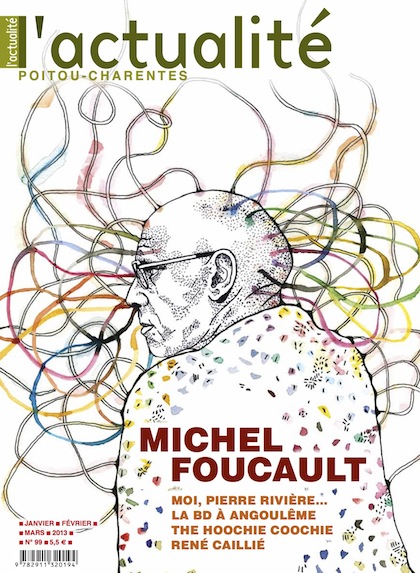
uneActu099L’Actualité Poitou-Charentes n°99 : Michel Foucault, Moi, Pierre Rivière…

Le numéro 99, janvier, février et mars 2013, de L’Actualité Poitou-Charentes, la revue trimestrielle éditée par l’Espace Mendès France, vient de paraître.

Édito

Si Michel Foucault est au cœur de cette édition de L’Actualité, ce n’est pas le fait du hasard. Deux dossiers ont déjà été consacrés, en 2001 et en 2006, à ce philosophe de notoriété mondiale, que sa ville natale, Poitiers, a mis du temps à reconnaître. en appui à la semaine organisée en mars à Poitiers, ces pages visent à mettre en évidence de multiples pistes de savoir et de réflexion autour et à partir de Michel Foucault. Pluridisciplinarité et transversalité ne sont plus envisagées comme une nouvelle sophistication de la pensée. La séparation entre sciences exactes et sciences humaines n’est plus valide. La «fabrique» de la connaissance est en pleine mutation. Dans ce processus, le cloisonnement qui sépare l’académie de la culture n’a plus lieu d’être, au contraire, l’académie a désormais besoin de la culture. Pour donner du sens.

C’est grâce à la culture que l’on peut créer «l’écosystème» dans lequel il est possible de relier, de mettre en relation aussi bien des approches que des thématiques, de créer des relations entre des choses qui, en apparence, sont séparées. De partager, par la confrontation, par la controverse, mais aussi avec le plaisir d’être ensemble. Il faut sortir de l’ordre naturel des choses, créer des interactions pour saisir mais aussi entraîner du mouvement. mais cela ne fonctionne plus en vase clos, cet équilibre dynamique interagit avec la société. au-delà du partage du savoir, il est nécessaire de questionner les conditions même de ce savoir. D’apprendre à «problématiser», dirait Michel Foucault. Ainsi il s’agit de créer les conditions d’échange avec les citoyens pour aller plus loin. La connaissance se construit collectivement, solidairement.

Didier Moreau

Sommaire

26 Dossier Michel Foucault

27 Subtile influence
Michelle Perrot évoque les relations du philosophe avec l’histoire et les historiens après la publication en 1975 de Surveiller et punir.

29  Le philosophe, la justice et la prison
Entretien avec Jean-Paul Jean, avocat général à la Cour de cassation, professeur associé à l’université de Poitiers, qui fut secrétaire général du syndicat de la magistrature de 1982 à 1986.

30  Le stimulant et le fédérateur
Avec le collectif F71, les textes de Michel Foucault se font théâtre, dans l’excitation et la joie de la pensée. À découvrir au TAP du 25 au 27 mars.

32 Le philosophe et la littérature
Michel Foucault a passé des étés à Vendeuvre-du-Poitou à écrire sur Raymond Roussel. Éclaircissements avec Jean-François Favreau.

34 Moi, Pierre Rivière
L’histoire d’un parricide, en 1835, de son mémoire rédigé en prison et de l’intérêt suscité par ce texte auprès de Michel Foucault.

36 Les paysans au cinéma
René Allio s’est emparé du dossier Pierre Rivière pour, cent cinquante ans après, en faire un film dans le pays du crime et avec les habitants. Un grand film, comme l’explique l’historienne Myriam Tsikounas.

40 Serrer la main de l’histoire
Gérard Mordillat se souvient des moments forts de l’expérience de Moi, Pierre Rivière… avec les gens du pays et le soutien de Michel Foucault.

42 Retour sur Allio
Pour dire ce qu’il doit à l’aventure de Moi, Pierre Rivière… avec les Normands et à René Allio, Nicolas Philibert a fait Retour en Normandie, qui est aussi un retour sur ses «propres fondations».

45  Carnets de René Allio
Des extraits des carnets de travail de René Allio lors de la préparation de son film Moi, Pierre Rivière…, transcrits par Annette Guillaumin.

46  À Saint-Stanislas avec Michel Foucault
Entretien sur l’atmosphère poitevine durant l’Occupation avec un camarade de classe de Michel Foucault, nommé Pierre Rivière.

47  Filmer la philosophie
Dans les années 1960, la télévision scolaire réalisait des programmes de philosophie avec les ténors de l’époque.

48  Culture scientifique

The Melbourne School of Continental Philosophy is proud to present the 2013 Semester 1 Evening School.

3 courses are on offer.  Considerable discounts are available when doing multiple courses.

When: March 21 – June 10, 2013

Where:  Law Building, Pelham St.
University of Melbourne

12 Thursdays 6.30-8.30pm March 21 – June 6 An Introduction to Deleuze’s Film-Philosophy: The Movement Image
Lecturer: Mairead Phillips
5 Mondays
6.30-8.30pm
March 25 – April 22
After Foucault: Maurizio Lazzarato and Contemporary Critiques of Capitalism
Lecturer: James Muldoon
6 Mondays 6.30-8.30pm May 6 – June 10 Deleuze Seminar Part Four: What is Philosophy?
Lecturer: Dr Jon Roffe

ABOUT THE MSCP

The Melbourne School of Continental Philosophy is an independent teaching and research organisation housed by the School of Historical and Philosophical Studies at the University of Melbourne. The MSCP teaches short courses during the summer and winter university holiday periods and evening courses during semester. We also run single day research workshops in autumn and spring, organise reading groups and work to encourage and support philosophical thinking in the community.

Everyone is welcome to attend our courses, and our teachers are free to teach on whatever subject they wish. The MSCP is a non-profit organisation.

EHESS 27 mars 2013

Journée d’études

Généalogies du dire-vrai

Michel Foucault, l’aveu, le gouvernement

27 mars 2013

Matinée – Président : Paolo Napoli (EHESS)

pdf of flyer
Program pdf
Organisé par m/f Materiali foucaultiani

9h30 Introduction à la Journée

10h00  Frédéric Gros (Université Paris-Est Créteil)

Préhistoire de l’aveu

10h45  Orazio Irrera (Université Paris Diderot-Paris 7)

La vérité en tant que force

11h30  Pause

11h45  Fabienne Brion (Université catholique de Louvain), Philosophie critique des véridictions et clinique philosophique du sujet

Après-midi – Président : Daniele Lorenzini (UPEC/Sapienza, Roma)

14h30  Michel Senellart (ENS de Lyon)

Métanoia et pénitence dans le cours de 1980

15h15  Gianvito Brindisi (Università degli Studi di Napoli SOB et Parthenope)

L’Œdipe roi entre gouvernement, juridiction et véridiction

16h00  Pause

16h15  Bernard Harcourt (University of Chicago)

Justice pénale et formes de vérité

17h00  Laura Cremonesi (Università di Pisa)

Véridiction antique et véridiction chrétienne

18h00  Cocktail offert par le Paris Center of the University of Chicago

EHESS

96 Boulevard Raspail, 75006 Paris

Salle Lombard

Continuum: Journal of Media & Cultural Studies welcomes proposal submissions for Volume 29 (for publication in 2015). The journal editors are interested in proposals across the range of cultural and media studies, such as: the relationship between media texts and wider questions of culture; contemporary issues in popular culture and consumption; publics and nations; and the politics of gender, class and race. A guest edited issue of Continuum normally consists of up to 12 articles with a word count of no more than 70,000 words.

To submit a proposal please include:

* Title
* Abstract (400-500 words)
* Bio of Editors and Track record
* List of Contributors and affiliations
* Where possible abstracts of papers
* Desired delivered date to Continuum

Proposal due: 30th April 2013.

Please note this is an annual call. The next review of proposal submissions will be in 2014.

Please email the proposal to p.allmark@ecu.edu.au Dr Panizza Allmark, General Editor, Continuum: Journal of Media & Cultural Studies