Foucault News

News and resources on French thinker Michel Foucault (1926-1984)

bucema7Michel Senellart, « Michel Foucault : une autre histoire du christianisme ? », Bulletin du centre d’études médiévales d’Auxerre | BUCEMA [En ligne], Hors-série n°7 | 2013, mis en ligne le 29 mars 2013, consulté le 24 avril 2013.
https://doi.org/10.4000/cem.12872

Extrait
La question du christianisme, à partir du milieu des années 70, occupe une place croissante dans le travail de Foucault. Elle est abordée de différents points de vue : celui des disciplines, tout d’abord, et du processus de normalisation sociale à l’âge classique, puis celui du pastorat, comme matrice de la gouvernementalité moderne, celui, enfin, de la véridiction, avec la comparaison des formes antique et chrétienne d’examen de conscience et de parrhesia. Si les angles d’approche varient, l’analyse foucaldienne, en revanche, suit un fil directeur assez constant, à travers la problématique générale de l’aveu, c’est-à-dire du rapport spécifique, dans la culture chrétienne, qui lie le sujet à sa propre vérité, en vue d’assurer son salut. Il est permis, dès lors, de considérer la recherche de Foucault comme les fragments successifs d’une « analytique » du christianisme visant à mettre en relief les formes originales de production de la subjectivité élaborées par ce dernier au cours des siècles : une étude, donc, du christianisme dans la perspective de l’histoire du sujet. C’est l’historicité du sujet, non celle du christianisme en tant que tel qui serait au centre de la réflexion de Foucault. Ce constat, sans doute, est indiscutable, mais demande néanmoins à être nuancé, voire corrigé, pour deux raisons : d’une part, parce que Foucault, tout au long de ces années, approfondit sa recherche selon une démarche régressive qui le fait remonter, par étapes, des XVIe-XVIIe siècles (Contre-réforme tridentine) aux IVe-VIIIe (organisation du pastorat, monachisme), puis aux Ier-IIIe (pratiques de véridiction) et, dans le dernier cours, au tout début du 1er (parrhesia) ; d’autre part, parce que ce parcours le conduit à poser avec insistance la question du « propre du christianisme » [1] par rapport aux autres formes de civilisation. Tout se passe donc, chez Foucault, comme si la mise en évidence d’une dimension particulière du christianisme disait en même temps quelque chose d’essentiel sur sa véritable nature en tant que phénomène historique. C’est pourquoi il nous paraît légitime de nous demander quelle histoire du christianisme découle de la problématique développée et sans cesse retravaillée par Foucault dans les dix dernières années de son enseignement.

suite

With thanks to Colin Gordon for this link
Affiche (A3)

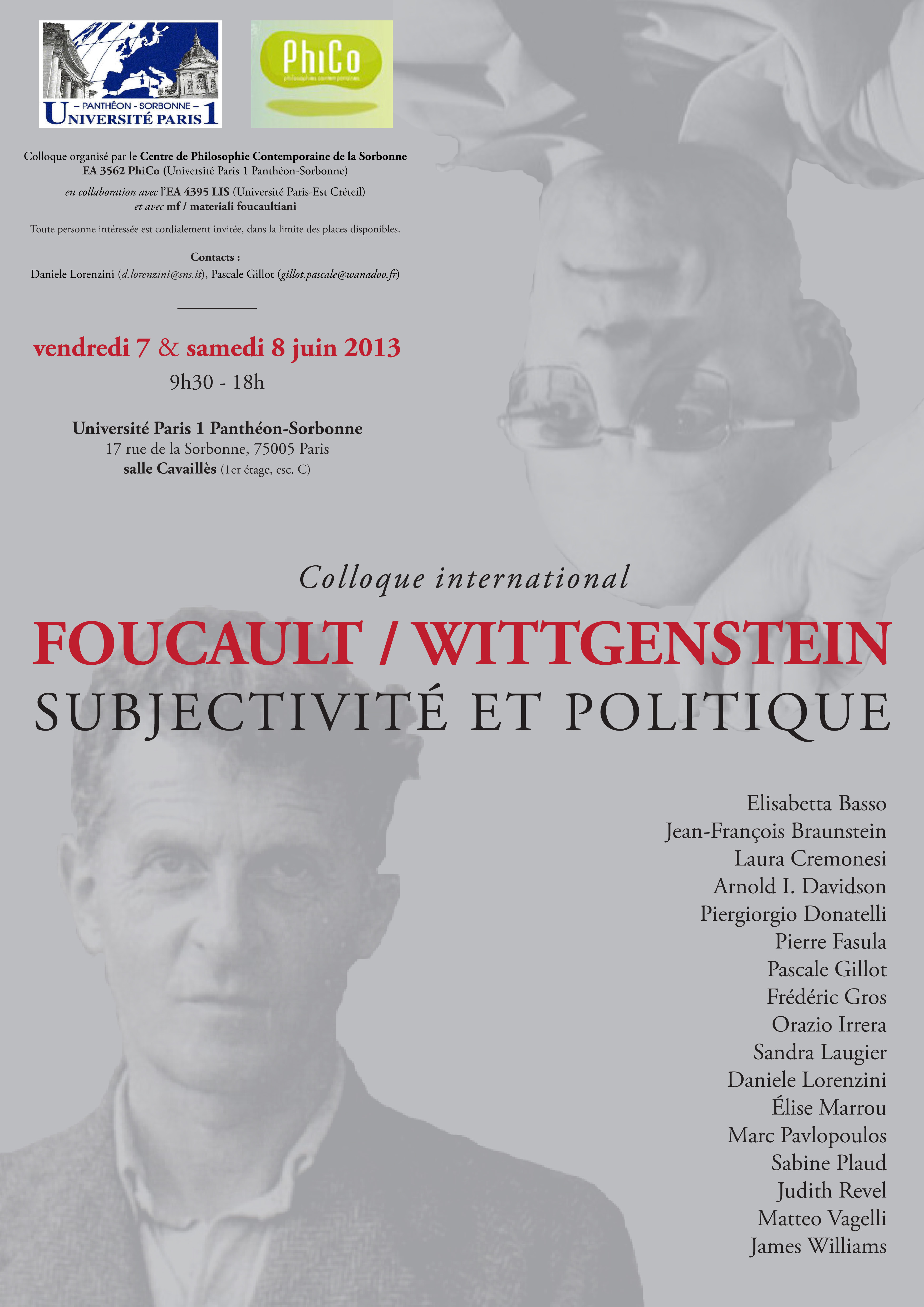
Colloque international

 Foucault / Wittgenstein : subjectivité et politique

vendredi 7 & samedi 8 juin 2013
9h30 – 18h

 Université Paris 1 Panthéon-Sorbonne
17 rue de la Sorbonne, 75005 Paris
salle Cavaillès (1er étage, esc. C)

Programme pdf

Argumentaire

À partir de deux traditions philosophiques distinctes, Michel Foucault et Ludwig Wittgenstein ont chacun proposé une critique radicale, non seulement du psychologisme, mais aussi de la notion classique d’une subjectivité souveraine comme du modèle afférent d’un sujet de l’action et du savoir transparent à soi-même. L’opposition de ces deux auteurs à une pensée d’obédience cartésienne-husserlienne offre ainsi une intersection entre philosophie dite « continentale » et philosophie analytique. Le combat engagé par Foucault (à la suite de Cavaillès et de Canguilhem) contre la « philosophie de l’expérience, du sens et du sujet » présente une analogie cruciale avec le projet wittgensteinien de dissolution de la mythologie des processus dits « mentaux », contre l’identification de l’esprit à une sphère privée, d’un genre spécifique.

Cette double critique du sujet souverain (et en particulier du « Je pense » cartésien entendu comme sujet de connaissance) n’invalide pourtant pas, chez les deux auteurs, l’impératif d’une enquête à propos des conditions de la subjectivité : une subjectivité inscrite dans le social et ses institutions, les rapports de pouvoir, les « formes de vie », les pratiques discursives, une communauté de langage. L’interrogation explicitement à l’œuvre, dans les derniers travaux de Foucault, à propos de l’expérience antique du « souci de soi » et de la parrêsia est à cet égard cruciale. Cet intérêt pour les techniques de soi et les processus de « subjectivation », dans la mesure où il ne renoue pas avec une philosophie de la conscience, peut en effet s’entendre en résonance avec l’effort toujours plus marqué, chez le dernier Wittgenstein, pour rendre compte d’une expérience en première personne aussi inéliminable qu’indescriptible au sens strict, dissociée comme telle de l’activité d’un sujet de la connaissance et de la représentation. Surtout, il fait signe vers une « insertion » possible de l’éthique dans la politique, précisément dans la mesure où le travail du sujet sur lui-même devient un point crucial de résistance et contre-conduite. Or cette dimension politique de la subjectivation n’est pas absente chez Wittgenstein : on peut songer tant au lien subjectivité-expressivité-communauté de langage qu’à la tâche (indissolublement éthique et politique) d’apprendre à voir ce qui est important mais qui, tout en étant sous nos yeux, n’est pas d’ordinaire remarqué.

Ce colloque a donc pour but, à travers la discussion et la confrontation des perspectives wittgensteinienne et foucaldienne, de mieux délimiter l’efficace persistante d’une pensée non psychologique et non « métaphysique » de la subjectivité, si décisive dans les débats contemporains autour de la reconnaissance et de la subjectivité constituée, ainsi que d’en mettre en lumière les conséquences sur les plans éthique et politique. Il ne saurait se réduire, toutefois, à un simple repérage des effets de résonance entre les approches de ces deux auteurs, mais s’attellera aussi à en explorer les divergences, dont l’analyse pourra se révéler féconde quant à la clarification des problèmes précédemment évoqués.

Pascale Gillot & Daniele Lorenzini

 Colloque organisé par le Centre de Philosophie Contemporaine de la Sorbonne – EA 3562 PhiCo (Université Paris 1 Panthéon-Sorbonne)
en collaboration avec l’EA 4395 LIS (Université Paris-Est Créteil) et avec mf / materiali foucaultiani

In case the embedded link doesn’t show up

With thanks to Dirk Felleman for this link

Workshop on ethics and norms in recent European philosophy

Monday, May 6, 2-5p.m.
Research Unit in European Philosophy
Caulfield Campus: Room A 1.34 (the Clayfield Room).
Faculty of Arts – Monash University
PO BOX 197, Melbourne, VIC 3145 Australia

Dr Sean Bowden (Deakin U):
“Normativity and Expressive Agency in Hegel, Nietzsche and Deleuze”

Associate Professor Daniel W Smith (Purdue U, U.S.A):
“Deleuze, Normativity, and Judgment”

Professor Paul Patton (UNSW):
“After Critique: Genealogy and Normativity in the work of Michel Foucault”

All welcome. Please rsvp to Alison.Ross@monash.edu for catering purposes.

Max Weber and Michel Foucault: possible convergences

International Conference
Universidade de São Paulo (USP) – São Paulo, Brazil
20th to 24th May 2013

Weber and Foucault 2013_Final Programme Pdf

May, 20th, Monday

10h-12h a.m.

Opening Session: Colin Gordon, “’Plato in Weimar: public philosophy in the last lectures of Weber and Foucault”. Coord.: Maria Helena Oliva Augusto (USP) and Fabiana A. A. Jardim (USP)

14h30-18h30

Roundtable – “Current interest on Max Weber and Michel Foucault: present, conduct of life and the government of self”

Sam Whimster (Global Policy Institute/ Käte Hamburger Kolleg)

Osvaldo López-Ruiz (CONICET – Argentina)

Maria Helena Oliva Augusto (USP)

Coord.: Daniel Pereira Andrade (FGV/SP)

May, 21, Tuesday

10h-12h a.m.

Intermediary Session: “Religious roots of modernity: moving beyond Weber and Foucault”. Coord.: Fabiana A. A. Jardim (USP)

14h30-18h30

Roundtable – “The religious origins of modernity in the works of Weber and Foucault”

Phillipe Chevallier (Bibliothèque Nationale de France)

Philippe Steiner (Université Paris – Sorbonne)

Mariana M. Côrtes (UFU)

Coord.: Ana Lúcia F. Teixeira (Unifesp)

May, 23, Thursday

14h-18h

Roundtable – “State: conduct of life and the government of others”

Colin Gordon (Royal Brompton & Harefield NHS Trust)

Susana Murillo (Universidad de Buenos Aires)

Daniel Pereira Andrade (FGV/SP)

Fabiana A. A. Jardim (USP)

Coordenação: Osvaldo López-Ruiz

May, 24, Friday

9h30-12h30 a.m.

Roundtable – “Intellectual Démarche: perspectives and uses of history”

Árpad Szakolczai (University College, Cork)

Márcio A. Fonseca (PUC-SP)

Ana Lucia F. Teixeira (Unifesp)

Coord.: Mariana M. Côrtes (UFU)

14h30-16h30

Closing Session: “Ascetisme, confession and hermeneutics of the self”.

Coord.: Maria Helena O. Augusto (USP)

Location: Av. Prof. Luciano Gualberto, nº 315, Cidade Universitária, São Paulo, Brazil.

Room 14 of  Philosophy and Social Sciences Building – FFLCH

Inscriptions will take place during the event. There will be simultaneous translation.

All the activities will be broadcasted by streaming.  Link will be available at the Post-Graduation Program on Sociology:  http://sociologia.fflch.usp.br/pos

 Promotion:

Programa de Pós-Graduação em Sociologia (PPGS/FFLCH-USP)

Research Group on Government, Ethics and Subjectivity (GES)

Support:

Fundação de Amparo à Pesquisa do Estado de São Paulo (FAPESP)

Programa de Pós-Graduação em Sociologia (FFLCH-USP)

Departamento de Sociologia (FFLCH-USP)

Faculdade de Educação (USP)

Departamento de Fundamentos Sociais e Jurídicos da Administração (FGV-EAESP)

Enquiries: Profa. Dra. Fabiana Jardim at fajardim@usp.br


Leffers, D., Ballamingie, P. Governmentality, environmental subjectivity, and urban intensification (2013) Local Environment: The International Journal of Justice and Sustainability, 18 (2), pp. 134-151.
https://doi.org/10.1080/13549839.2012.719016

Abstract
This article delineates concepts of eco-modernisation and urban sustainability (including its associated discourses), elucidating Foucault’s notion of governmentality and examining select moments of contested urban governance in the neighbourhood of Old Ottawa South, in Ottawa, Ontario, Canada. It shows how intensification – a “compact city approach” to urban sustainability – as both policy and practice, serves to both discipline and regulate by “conducting the conduct” of environmental and entrepreneurial subjects. It reveals that zoning has more explicitly become a political technology (albeit a flexible one) for achieving “highest and best use” of private property, privileging intensification projects proposed by developers, through a hierarchical exercise of state power that privileges market processes, while undermining community values and priorities.

Author Keywords
governmentality; urban governance; urban intensification; urban planning; urban sustainability

DOI: 10.1080/13549839.2012.719016

Hoffmann Pii, K., Villadsen, K. Protect the patient from whom? When patients contest governmentality and seek more expert guidance (2013) Social Theory and Health, 11 (1), pp. 19-39.
https://dx.doi.org/10.1057/sth.2012.19

Abstract
This article presents findings from an empirical study among patients and professionals involved in a preventive health program at a Danish hospital. It shows how patients enrolled in the program interact with health professionals in ways that challenge assumptions common to governmentality studies of prevention and health promotion. This literature has successfully explored how contemporary health promotion transgresses the public/private boundary by shaping the values of collectivities and individuals to fit better with public health objectives. By exploring the complex co-existence and intertwinements of discipline and biopolitics in preventive practices, this study eschews an interpretation that views the powers of the professional health system as invasive and one-directional. Perhaps surprisingly, the study demonstrates how patients in various ways defy a ‘patient-centered’ and empowering approach and demand to be treated medically and disciplined in a more traditional sense. The blurring of the public/private boundary, then, cannot be straightforwardly described as a result of a professional health system that, more or less subtly, reaches into the private lives of patients. A more complex picture emerges, as patients’ attitude reflect both traditional medicine and rationalities foreign to the health system.

Author Keywords
atherosclerosis; ethnography; Foucault; governmentality; preventive health; resistance

DOI: 10.1057/sth.2012.19

Spinozan Genealogies of Political Community

UNSW, Morven Brown 310, 9.30am July 25, 2013

An international workshop organised by the School of Humanities and Languages at the University of New South Wales
Supported by the School of Philosophical and Historical Inquiry at the University of Sydney

unsw

Spinoza’s idea that ‘the right of the individual is co-extensive with its determinate power’ has influenced important strains of contemporary political thought including Deleuze and Foucault, the Althusser School with Negri and Balibar, and socialist theology after Feuerbach. However, the assertion of equivalence between rights and powers confounds classic conceptions of sovereignty and political justice. How is the protection of fragile bodies able to be secured, if the right to persevere is linked with a power of endurance? If the indivisible power of a sovereign state is aligned with its right, then how are we to think about contested sovereignties in jurisdictions after empire? Participants in this workshop consider how Spinozist genealogies of political community may provide resources for new thinking about pluralism, the political economy of corporeal capacity, and transformative sociality.

* Professor Warren Montag (Occidental College, Los Angeles)*

* Dr Martin Saar (University of Frankfurt)*

With the participation of Professor Moira Gatens (University of Sydney),

Dr Aurelia Armstrong (University of Queensland),

Dr Knox Peden (University of Queensland), Dr Dimitris Vardoulakis (UWS),

Professor Miguel Vatter (UNSW), Professor Paul Patton (UNSW) and

Dr Simone Bignall (UNSW).

Admission is free, but booking is essential. To reserve a place, please RSVP to Simone.Bignall@unsw.edu.au by July 15 2013.

Ball, S.J., Olmedo, A. Care of the self, resistance and subjectivity under neoliberal governmentalities
(2013) Critical Studies in Education, 54 (1), pp. 85-96.

https://doi.org/10.1080/17508487.2013.740678

Abstract
Resistance is normally thought of as a collective exercise of public political activity. In this article, Ball and Olmedo approach the question of resistance in a different way, through Foucault’s notion of ‘the care of the self’. Neoliberal reforms in education are producing new kinds of teaching subjects, new forms of subjectivity. It makes sense then that subjectivity should be the terrain of struggle, the terrain of resistance. A set of e-mail exchanges with teachers, based around Ball’s work on performativity, enable the authors to access the work of power relations through the uncertainties, discomforts and refusals that these teachers bring to their everyday practice. By acting ‘irresponsibly’, these teachers take ‘responsibility’ for the care of their selves and in doing so make clear that social reality is not as inevitable as it may seem. This is not strategic action in the normal political sense. Rather it is a process of struggle against mundane, quotidian neoliberalisations, that creates the possibility of thinking about education and ourselves differently.

Author Keywords
educational policy; Foucault; neoconservatism/neoliberalism; resistance; subjectivity

kaldisClare O’Farrell, Foucault’s Thought, In Encyclopedia of Philosophy and the Social Sciences. Edited by Byron Kaldis. London: Sage, 2013, pp. 364-368.

Publisher’s page

First paragraph of entry
Michel Foucault was a French philosopher and historian of ideas who was born in Poitiers in France in 1926 and died in Paris in 1984. Since his death his work has had a steadily increasing impact across the social sciences and humanities, generating new research methodologies, new areas of empirical interest, and a whole panoply of theoretical concepts. Foucault produced some 11 books during his lifetime and a collection of 364 of his shorter writings was published in 1994. From 1970 to 1984, in his capacity as Professor of Systems of Thought at the research institution the Collège de France, he also produced an annual series of lectures reporting on his research. These lectures have gradually appeared in print since 1997. This entry provides an overview of Foucault’s overall philosophy and methodology, looks at key concepts in his work and provides descriptions of his best known books.

Description of Encyclopedia

This Encyclopedia is the first of its kind in bringing together philosophy and the social sciences. It is not only about the philosophy of the social sciences but, going beyond that, it is also about the relationship between philosophy and the social sciences.

The subject of this Encyclopedia is purposefully multi- and inter-disciplinary. Knowledge boundaries are both delineated and crossed over. The goal is to convey a clear sense of how philosophy looks at the social sciences and to mark out a detailed picture of how the two are interrelated: interwoven at certain times but also differentiated and contrasted at others. The Entries cover topics of central significance but also those that are both controversial and on the cutting-edge, underlining the unique mark of this Encyclopedia: the interrelationship between philosophy and the social sciences, especially as it is found in fresh ideas and unprecedented hybrid disciplinary areas.

The Encyclopedia serves a further dual purpose: it contributes to the renewal of the philosophy of the social sciences and helps to promote novel modes of thinking about some of its classic problems.