Foucault News

News and resources on French thinker Michel Foucault (1926-1984)

Natalie Depraz, De Husserl à Foucault : la restitution pratique de la phénoménologie, Les Études philosophiques, 2013/3 (n° 106), 333-344.
https://doi.org/10.3917/leph.133.0333

Resumé
Mon objectif dans cette contribution est d’explorer la pratique phénoménologique en jeu au sein même des descriptions de Michel Foucault. Un tel travail dépasse la portée d’un examen unique et ponctuel et supposerait de mobiliser les champs expérientiels multiples qu’a observés et traités Foucault de l’intérieur : la prison, la clinique, la sexualité. Il sera ici circonscrit à ce que je crois être le noyau de la pratique en jeu. Ce que Foucault nomme de son côté « le souci de soi », « la pratique de soi » ou encore « la technique de soi », et c’est ce qui permet de mettre au jour la conception foucaldienne du sujet comme soi. Pour ce faire, je vais parcourir le Cours de 1981-1982 en suivant le fil conducteur des occurrences du thème de l’attention. Pourquoi cela ? Je suis guidée, dans ce parcours, par l’hypothèse selon laquelle l’attention (plus que la réflexion qui est retour sur soi et clôture, donc en définitive objectivante) est, pour la phénoménologie, le nom concret, expérientiel, pratique de l’épochè, c’est-à-dire de la relation à soi du sujet comme présence à soi. Foucault ne parlant jamais d’épochè ou de réduction (ni d’ailleurs de réflexion), mais plutôt d’attention, en lien avec le souci de soi, la pratique de soi, ou encore l’exercice, il semble que les concepts méthodiques husserliens, ou toute philosophie réflexive résiduelle, ne peuvent que faire écran à l’intuition immédiate du sens de l’expérience et doivent être évités au profit de termes plus sobres et d’emblée intelligibles comme l’attention, le souci et le soin.

English
The main target of this article is to explore the phenomenological practice used by Michel Foucault in the very heart of his descriptions. Such a work would imply to call up the numerous fields of practice studied and developped from the inside by Foucault : such as prison, clinic, sexuality which goes beyond the scope of this article. By taking this path, we try to reach the very center of the practice, that Foucault calls “the Care of the Self” (“le souci de soi”) and “Practices of Self” (“la pratique de soi”) and “Technologies of the Self” (“la technique de soi”), in order to unveil the foucaldian conception of the subject as Self. I will therefore skim through the Lectures at the Collège de France, 1981-1982, following the many tokens of the concept of attention. In this journey, I’m suggesting the possibility that the concept of attention (more than the Reflexion which is a return on Self and Closure and finally a process of objectivation) is the pheno- menological equivalent of the practical and concrete Idea of Epoché as the link between the Subject and Itself concieved as the self-presence. Foucault never uses the words “Epoché” or “Reduction” (or even “Reflexion”). He prefers to employ the word “attention” which he links to “the Care of the Self”, “Practices of Self” or “Exercice”. Thus, it seems much more suitable to use plainer and easier to understand words as “attention” and “care” than the methodical concepts developped by Husserl or the one employed in any reflexive philosophy, which hide the immediate intuition of the meaning of experience.

PLAN DE L’ARTICLE

  • Introduction
  • I – L’attention comme souci de soi (Michel Foucault)
    • 1 – Les occurrences de l’attention
    • 2 – Les « mots » de l’attention
  • II – L’attention comme présence relationnelle à soi (E. Husserl)
  • III – L’espace de jeu entre Husserl et Foucault : la corporéité (a-)sexuée de l’attention
    • 1 – L’attention est un vécu gestuel distinct de sa nomination
    • 2 – L’attention, un processus
    • 3 – Y a-t-il un bémol à l’union parfaite ?
  • IV – Foucault avec Husserl : le noyau de la pratique
    • 1 – Husserl et la pratique
    • 2 – La phénoménologie de Michel Foucault
  • Conclusion : une éthique commune de l’ascèse

Sonja K. Pieck, “To be led differently”: Neoliberalism, road construction, and NGO counter-conducts in Peru (2013) Geoforum. Volume 64, 2015, Pages 304-313,
https://doi.org/10.1016/j.geoforum.2013.06.011

Abstract
This essay explores how neoliberal governance is being contested, adapted, and engaged by Peruvian NGOs responding to the Interoceanic Highway, a large infrastructure project in southern Peru. The road is an anchor project of a continent-wide regional integration effort called IIRSA (Initiative for the Integration of Regional Infrastructure in South America), begun in 2000 and spearheaded by Brazil. IIRSA is a result of Latin America’s neoliberal reorientations in the 1980s and 1990s and seeks to facilitate the extraction of resources and the movement of capital. IIRSA has been carried out with very little publicity, but in 2006, a group of non-governmental organizations (NGOs) formed a coalition named the Civil Society Working Group for the Interoceanic Highway, and began critiquing both the road’s massive ecological and social consequences as well as the Peruvian government’s poorly designed impact mitigation program. Following Foucault, this paper suggests that NGO critique of the IIRSA project represents a form of counter-conduct and at once co-constitutes and challenges neoliberal practices of rule in Peru. Through the lens of “counter-conducts” – defined by Foucault as “the will not to be governed thusly, like that, by these people, at this price” – this essay shows how the NGO working group largely acts within the political space of the state through neoliberal ideas of good governance, while its discourses and actions point to a more profound reworking of environmental politics in Peru, a call in Foucault’s words, “to be led differently… and towards other objectives.”

Author Keywords
Counter-conducts; Governance; Infrastructure; Neoliberalism; NGOs; Peru

DOI: 10.1016/j.geoforum.2013.06.011

Peter-Paul Verbeek, Resistance is futile: Toward a non-modern democratization of technology, (2013) Techne: Research in Philosophy and Technology, 17 (1), pp. 72-92.
https://doi.org/10.5840/techne20131715

Abstract
Andrew Feenberg’s political philosophy of technology uniquely connects the neo-Marxist tradition with phenomenological approaches to technology. This paper investigates how this connection shapes Feenberg’s analysis of power. Influenced by De Certeau and by classical positions in philosophy of technology, Feenberg focuses on a dialectical model of oppression versus liberation. A hermeneutic reading of power, though, inspired by the late Foucault, does not conceptualize power relations as external threats, but rather as the networks of relations in which subjects are constituted. Such a hermeneutic approach replaces De Certeau’s tactics of resistance with a critical and creative accompaniment of technological developments.

Author Keywords
Dialectics; Hermeneutics; Mediation theory; Political philosophy of technology; Power

DOI: 10.5840/techne20131715

Michalinos Zembylas, Derrida, Foucault and critical pedagogies of friendship in conflict-troubled societies (2013) Discourse. 36(1), 1–14.
https://doi.org/10.1080/01596306.2013.812341

Abstract
The aim of this paper is to place Derrida’s and Foucault’s ideas on friendship in conversation and then discuss how those ideas provide a pedagogical space in which critical educators in conflict-troubled societies can promote new modes of being and living with others. In particular, the notion of critical pedagogies of friendship is theorized and the pedagogical implications that follow are examined in the light of the emotional complexities of troubled knowledge in conflict-troubled societies. It is argued that critical pedagogies of friendship that take into consideration the emotional complexities of troubled knowledge help us interrupt the enemy-friend binary and revamp our sense of compassion and responsibility to others. Most importantly, critical pedagogies of friendship enable the creation of new spaces of political subjectification that nurture the invention of new relations of emancipation. © 2013 Taylor & Francis.

Author Keywords
conflict-troubled societies; critical pedagogy; Derrida; emotion; Foucault; friendship

Johan Hyrén, Självskapelseetik bortom Foucault: En rättviseteori för ett mångkulturellt, liberalt och demokratiskt samhälle

The English title:

An Ethics of Self-creation Beyond Foucault: A Theory of Justice for a Multicultural, Liberal and Democratic Society.

This recently submitted thesis is written in Swedish but includes an extensive English summary at the end and can be downloaded from this University of Gothenburg link

Abstract
This thesis develops a normative theory of justice centered on the concept of subjectivation. The concept originates from (late) Foucault and is connected to his writing on ethics. Foucault did not himself elaborate on the subject in any great detail. This thesis, however, does, creating a theory of justice for a multicultural, liberal, democratic, society on the basis of subjectivation.

The basic principle of the theory is that a just society is one in which everyone has equal opportunity to engage in active subjectivation. This is related, but not synonymous, to Foucault’s ethics, which is sometimes summarized in a clichéd manner by referring to his statement that we should turn our life into “a piece of art”. I argue that the opportunity to engage in active subjectivation is what ought to be equally distributed in society. Active subjectivation is best understood in relation to its opposite, passive subjectivation. The latter refers to an identity that is molded, subjugated and constituted by power relations external to the subject; the former to an identity-formation attained by the subject’s conscious and active work on itself.

The thesis is divided into three parts. The first part deals with the foucaultian ethic and how it is related to its archaic predecessors. This part also develops a critique of Foucault’s version of the ethic of self-creation. In the second part I surpass the foucaultian ethics, creating my own version of the ethic of self-creation. The third and last part is devoted to the questions of group-based rights and organization of education, and tries to explicate how these issues could be handled by a state that affirms the ethic of self-creation.

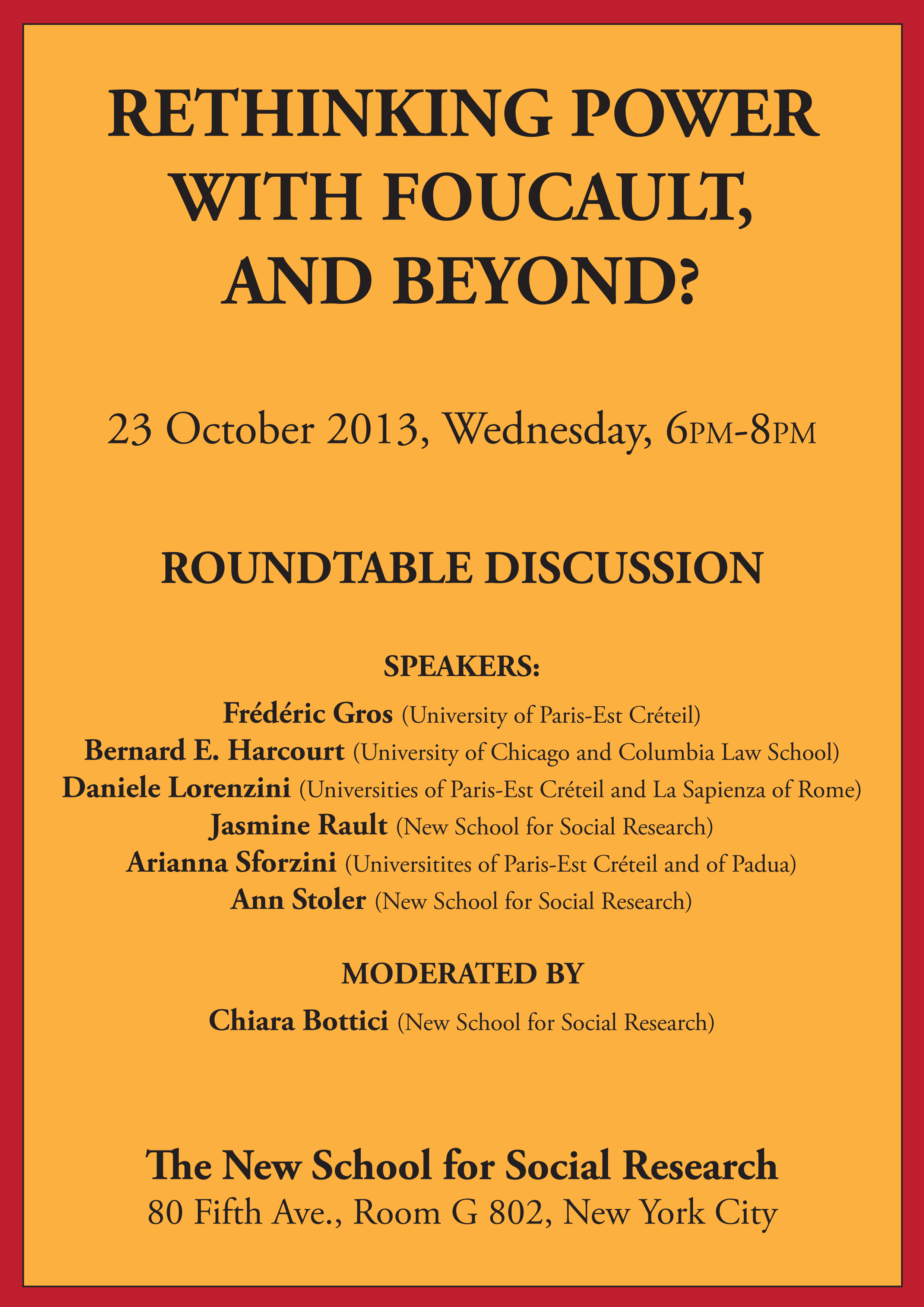
Dotan Leshem College de France lectures 10.25.13.indd

PDF flyer

Alessandra Renzi and Greg Elmer, The Biopolitics of Sacrifice: Securing Infrastructure at the G20 Summit (2013) Theory, Culture and Society, 30 (5), pp. 45-69.
https://doi.org/10.1177/0263276412474327

Abstract
This article investigates infrastructure spending from a biopolitical perspective and rethinks its connections to emerging regimes of (in)securitization. Starting with a study of the organization and contestation of the G8/G20 summits in Toronto in June 2010, the analysis moves through the shifty territory of a governmental logic that is reconfiguring the body politics of civic participation, as well as the ways in which discourses on economic growth, property and public safety intertwine in the aftermath of the 2008 global financial crisis. The case of Toronto shows significant changes to recent security practices, control techniques and funding arrangements. Rather than ‘war on terror’, ‘austerity and crisis’ are the new keywords sustaining current governmental rationality and the criminalization of dissent, which are no longer funded by defence budgets but by economic stimuli packages. This new rationality, while still relying on fear as an affective mode to mobilize masses, has exchanged a set of discourses on the clash of cultures or civilization for one on sacrifice. Following Foucault’s work on the government of populations and security, it is now possible to talk about ‘a sacrifice series’ to describe the series of elements that connect military or economic logics of (in)securitization.

Author Keywords
biopolitics; contemporary activism; crisis; Foucault; global city; militarization; neoliberalism

Poster Foucault New School

PDF Flyer

Audio of seminar

Saran Ghatak & Andrew Stuart Abel, Power/Faith: Governmentality, Religion, and Post-Secular Societies (2013) International Journal of Politics, Culture and Society, 26 (3), pp. 217-235.
https://doi.org/10.1007/s10767-013-9141-z

Abstract
Foucault’s concept of governmentality, and its attending modalities of biopower and disciplinary technologies, provides a useful conceptual schema for the analysis of the role of religious and quasi-religious institutions in contemporary society. This is particularly important in the study of those neoliberal democratic states where religious organizations constitute an important presence in the civil society. As religion is thoroughly involved in the reproduction of social structure in most societies, an appraisal of the social and political importance of religious institutions is needed to understand the articulation and exercise of governmentality. This is not just limited to partnerships between state agencies and faith-based organizations in providing for social services, but also in rituals and other religious group activities of these organizations that play a vital role in shaping and molding the social and political subjectivities of the adherents. We argue that synergy between the scholarship on governmentality, and sociology of religion would allow for a more nuanced understanding of the politics and culture of post-secular societies.

Author Keywords
Civil society; Faith-based initiatives; Foucault; Governmentality; Post-secularism; Religion; Rituals

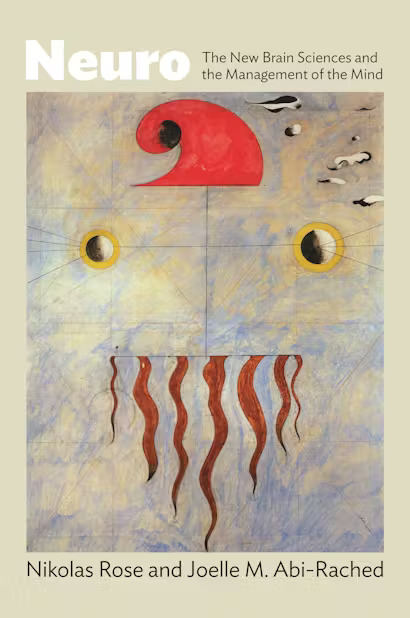
Nikolas Rose & Joelle M. Abi-Rached, Neuro:The New Brain Sciences and the Management of the Mind, Princeton University Press, 2013

The brain sciences are influencing our understanding of human behavior as never before, from neuropsychiatry and neuroeconomics to neurotheology and neuroaesthetics. Many now believe that the brain is what makes us human, and it seems that neuroscientists are poised to become the new experts in the management of human conduct. Neuro describes the key developments–theoretical, technological, economic, and biopolitical–that have enabled the neurosciences to gain such traction outside the laboratory. It explores the ways neurobiological conceptions of personhood are influencing everything from child rearing to criminal justice, and are transforming the ways we “know ourselves” as human beings. In this emerging neuro-ontology, we are not “determined” by our neurobiology: on the contrary, it appears that we can and should seek to improve ourselves by understanding and acting on our brains.

Neuro examines the implications of this emerging trend, weighing the promises against the perils, and evaluating some widely held concerns about a neurobiological “colonization” of the social and human sciences. Despite identifying many exaggerated claims and premature promises, Neuro argues that the openness provided by the new styles of thought taking shape in neuroscience, with its contemporary conceptions of the neuromolecular, plastic, and social brain, could make possible a new and productive engagement between the social and brain sciences.

Nikolas Rose is professor of sociology and head of the Department of Social Science, Health, and Medicine at King’s College London. His books include The Politics of Life Itself: Biomedicine, Power, and Subjectivity in the Twenty-First Century (Princeton). Joelle M. Abi-Rached is a PhD candidate in the history of science at Harvard University.

Review:

“Rose and Abi-Rached make a convincing argument for a more positive engagement between the social and brain sciences in their discussion of the effects of neuroscience on public understanding of the self.”–Wayne Hall, Lancet

“As the title implies, this book offers interesting thoughts and findings for any scholar with a connection to neuroscience.”–Choice

Endorsement:

“The ‘neurofication’ of the humanities, social sciences, public policy, and the law has attracted promoters and detractors. What we have lacked until now is a critical but open-minded look at ‘neuro.’ This is what Rose and Abi-Rached have given us in this thoughtful and well-researched book. They do not jump on the neuro bandwagon, but instead offer a clear accounting of its appeal, its precedents in psychology and genetics, its genuine importance, and ultimately its limitations. A fascinating and important book.”–Martha J. Farah, University of Pennsylvania

Neuro makes a significant and original contribution to our understanding of the impact of the brain sciences on social and cultural processes. The scholarship throughout is brilliant. This book gives us extremely perceptive, detailed, and illuminating analyses of what is actually being claimed in the various branches of the neurosciences. It will attract a great deal of interest and controversy.”–Emily Martin, author of Bipolar Expeditions: Mania and Depression in American Culture

“I enjoyed reading this book. It provides an interesting and comprehensive map of the many sciences and quasi-sciences that have embraced the ‘neuro’ prefix. I also appreciate how Rose and Abi-Rached manage to examine the explosion of ‘neuros’ with a critical eye, but without dismissing the genuine prospects that it may hold.”–Michael E. Lynch, Cornell University

TABLE OF CONTENTS:

Acknowledgments ix
Abbreviations xi
Introduction 1

  • Beyond Cartesianism? 3
  • Governing through the Brain 6
  • Our Argument 9
  • Human Science? 23

One The Neuromolecular Brain 25

  • How Should One Do the History of the Neurosciences? 28
  • Infrastructure 38
  • A Neuromolecular Style of Thought 41
  • Enter Plasticity 47
  • A Neuromolecular and Plastic Brain 51

Two The Visible Invisible 53

  • The Clinical Gaze 55
  • Inscribed on the Body Itself 56
  • Open Up a Few Brains 61
  • Seeing the Living Brain 65
  • The Epidemiology of Visualization 74
  • The New Engines of Brain Visualization 80

Three What’s Wrong with Their Mice? 82

  • Artificiality? 85
  • Models1, Models2, Models3, Models4 (and Possibly Models5) 92
  • The Specificity of the Human 102
  • Translation 104
  • Life as Creation 108

Four All in the Brain? 110

  • To Define True Madness 113
  • The Burden of Mental Disorder 125
  • All in the Brain? 130
  • Neuropsychiatry and the Dilemmas of Diagnosis 137

Five The Social Brain 141

  • The “Social Brain Hypothesis” 143
  • Pathologies of the Social Brain 148
  • Social Neuroscience 151
  • Social Neuroscience beyond Neuroscience 156
  • Governing Social Brains 160

Six The Antisocial Brain 164

  • Embodied Criminals 167
  • Inside the Living Brain 173
  • Neurolaw? 177
  • The Genetics of Control 180
  • Nipping Budding Psychopaths in the Bud 190
  • Sculpting the Brain in Those Incredible Years 192
  • Governing Antisocial Brains 196

Seven Personhood in a Neurobiological Age 199

  • The Challenged Self 202
  • From the Pathological to the Normal 204
  • The Self: From Soul to Brain 213
  • A Mutation in Ethics and Self-Technologies? 219
  • Caring for the Neurobiological Self 223

Conclusion Managing Brains, Minds, and Selves 225

  • A Neurobiological Complex 225
  • Brains In Situ? 227
  • Coda: The Human Sciences in a Neurobiological Age 232

Appendix How We Wrote This Book 235

With thanks to Matt Ball for this info