Foucault News

News and resources on French thinker Michel Foucault (1926-1984)

Verena Erlenbusch, The place of sovereignty: Mapping power with Agamben, Butler, and Foucault (2013) Critical Horizons, 14 (1), pp. 44-69.
https://doi.org/10.1179/15685160X13A.0000000003

Abstract
This article addresses the relationship between sovereignty, biopolitics and governmentality in the work of Giorgio Agamben, Judith Butler, and Michel Foucault. By unpacking Foucault’s genealogy of modern governmentality, it responds to a criticism leveled against Foucauldian accounts of power for their alleged abandonment of the traditional model of power in juridico-institutional terms in favor of an understanding of power as purely productive. This claim has most significantly been developed by Agamben in “Homo Sacer: Sovereign Power and Bare Life”. I argue that Judith Butler’s analysis of power, in particular in her essay “Indefinite Detention”, presents a more differentiated account of power that registers the significance of practices of sovereignty and resonates with Foucault’s lectures on “Security, Territory, Population”. © W. S. Maney & Son Ltd 2013.

Author Keywords
Agamben; Biopolitics; Butler; Foucault; Governmentality; Sovereignty

DOI: 10.1179/15685160X13A.0000000003

Lorenzini, Daniele. “What is a ‘Regime of Truth’?” Le foucaldien 1, no. 1 (2015): 1–5. DOI: https://doi.org/10.16995/lefou.2 [Note: In 2022, Le foucaldien relaunched as Genealogy+Critique.]

Originally published online 28 October 2013
Open access

Abstract
In this paper, I offer an overview of the ways in which Foucault defines and uses the concept of ‘regime of truth’ in his works between 1975 and 1980, focusing especially on his lectures at the Collège de France On the Government of the Living. There, I argue, a substantial shift takes place, which corresponds to the emergence of the dimension of subjectivity at the heart of the concept of regime of truth itself. This shift bears witness to Foucault’s elaboration of a new critical project, namely that of a genealogy of our contemporary regime of truth ‘indexed to subjectivity’.

Keywords: critique, government, regime, subjectivation, truth, Foucault

From the Critical Theory blog

Eugene Wolters, Listen to Foucault Lecture in English: The Culture of the Self, 27 September 2013

In the following audio recording, Michel Foucault lectures at UC Berkeley in 1983, a year before his death, on the subject “The Culture of the Self.”

Foucault starts with a story written by Greek satirist Lucian. In the story, Hermotimus, a Greek philosopher, walks mumbling in the street. A friend sees Hermotimus, approaches him, and asks him what he is mumbling about. “I’m trying to remember what I have to tell my master,” Hermotimus tells his friend.

Foucault explains that we learn that Hermotimus, to the point of financial ruin, has been paying for lessons with his master for 20 years. Hermotimus explains that he needs another 20 years of lessons before he can arrive at the end of his training. The point of these lessons, we learn, is for Hermotimus to learn how to best take care of himself.

“I am sure none of you is a modern Hermotimus,” Foucault continues, “but I hold a bet that most of you have met at least one of those guys who now-a-days regularly visit a kind of master who takes their money from them in order to teach them how to take care of themselves.” The crowd laughs. The name of these modern masters, Foucault continues, were called “philosophers” in antiquity.

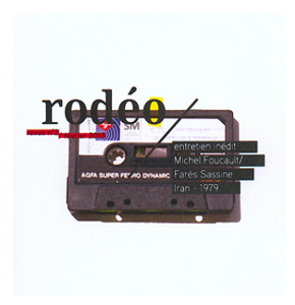
rodeo2 Source Variazioni foucaultiani

[Editor: 13 April 2026. Details and links updated.]

The translated article can be found here
Michel Foucault, “Political Spirituality as the Will for Alterity: An Interview with the Nouvel Observateur.” Critical Inquiry 47, no. 1 (2020): 121–34.
https://www.jstor.org/stable/48799742.

See also Sabina Vaccarino Bremner, “Introduction to Michel Foucault’s ‘Political Spirituality as the Will for Alterity.’” Critical Inquiry 47, no. 1 (2020): 115–20.
https://www.jstor.org/stable/48799741.

Sandra Iché, édito de la revue rodéo 2

Vous l’aurez noté en couverture : ce deuxième numéro de rodéo recèle en ses pages un document exceptionnel… Cadeau infiniment précieux, dont nous pourrions dire, en prenant au mot une pensée qui élabore une philosophie de l’événement, que nous le devons à un « accident » de l’Histoire : rien, évidemment, ne destinait rodéo à devenir l’éditeur même ponctuel d’un texte de Michel Foucault !

Et pourtant, sous forme de puzzle :
A. la vie de l’un des rédacteurs de rodéo, la mienne, à cheval entre la France et le Liban ;
B. dix ans plus tôt, diverses rencontres beyrouthines à l’occasion d’une étude universitaire sur une revue libanaise (« une revue revue : L’Orient-Express », rodéo n°1) ;
B’. parmi ces rencontres, des amitiés qui se tissent, avec notamment un philosophe/poète/éditeur, Farès Sassine ;
C. une conversation quotidienne, à Beyrouth, à laquelle participait aussi l’artiste Laure de Selys, présente dans ce numéro de rodéo, au cours de laquelle Farès nous apprend, sans aucun effet d’annonce, qu’en août 1979, aux lendemains de la révolution iranienne, alors qu’il venait d’achever sa thèse de philosophie à la Sorbonne et gagnait sa vie d’étudiant en proposant des articles aux journaux arabes paraissant à Paris, il a interviewé Michel Foucault… Et que la K7 est chez lui, sans personne pour l’écouter depuis 33 ans ;
D-1. 2010-2011 : Foucault si loin si proche, déjà nous le cherchions, et notre lanterne avait pris la forme d’après-midis de lecture collective, à Lyon, qui réunissaient certains des futurs fondateurs de rodéo ;
D. Dernier élément du puzzle : rodéo bien sûr, revue naissante, dont le geste serait de précipiter ensemble des territoires hétérogènes de sensations et de pensées.

Cadeau infiniment précieux puisqu’il nous offrait – après que nous avons réussi à dompter les peurs liées à nos capacités éditoriales de jeune revue – la possibilité d’accomplir ce geste avec une puissance… inédite : faire cohabiter cette parole philosophique avec d’autres langages, artistiques, photographiques, scientifiques, littéraires, politiques, picturaux, etc., et par là composer et orchestrer des chocs entre des champs de réflexions et de pratiques parfois cantonnés en tant que « catégories » dans des espaces-temps séparés : jeunes chercheurs, photographes militants, plasticiens géologues, avocats musiciens, écrivains cinéastes, philosophes artistes, universitaires poètes… une revue-vecteur.

Un très chaleureux merci à Farès Sassine donc, pour nous avoir remis cette archive à la fois personnelle et historique, et pour nous avoir fait confiance sur les choix, les décisions délicates qu’implique la publication posthume de propos inédits d’un homme dont la renommée est immense et qui nous laisse en héritage une pensée polémique dans le double sens qu’elle continue d’abord d’accompagner aujourd’hui nombre de combats, nombre de travaux, nombre d’hommes et de femmes qui cherchent à traquer les failles sous les représentations trop ordonnées du monde, et aussi de susciter des passions, des interprétations contradictoires, parfois à la défaveur de son auteur, qui, à trop jouer avec le feu, se serait « compromis ».

Le reportage iranien de Michel Foucault est parmi les chantiers les plus controversés du philosophe généalogiste. Il appartient aux spécialistes de sa pensée de juger si cet entretien invite à réouvrir le débat sur la place que les « textes iraniens » de Foucault occupent dans son corpus philosophique ainsi que sur la pertinence et l’effectivité de la méthode et des analyses qu’il développe à l’occasion de son reportage en Iran.

À tout le moins, les propos que Foucault tient ici sur les modalités, intellectuelles, sensibles, historiques, de surgissement d’abord et d’appréhension ensuite de l’« événement », dessinent pour nous – qui avions déjà tenté, dans le premier numéro de rodéo, de nous saisir de la « révolution » tunisienne – comme des repères pour continuer de nous construire, en tant qu’individus politiques, au contact de l’actualité des pays arabes.

Si les « révolutions » de 2011 ont réouvert l’avenir – prometteur et/ou sanglant –, c’est notamment, en rendant effectives, pour ceux qui se sont soulevés, leur capacité à le faire, et pour ceux qui ont assisté à ce soulèvement, notre capacité à le voir, à y porter crédit sans soupçon, déjà entaché d’une idée de l’avenir.

Seconde actualité : l’islam bien sûr. Non pas la foi comme moteur cette fois, du moins cela n’a pas été une lecture majoritaire, mais l’islam comme « lieu d’accueil » des lendemains des soulèvements. L’ancrage de certains imaginaires dans la dystopie a entraîné… le regret des dictatures anciennes qui avaient le mérite de contenir l’islamisme… l’effroi devant certaines de ces sociétés tribales incapables de s’unifier dans un projet politique national et démocratique… la crédibilité redoublée du soi-disant oxymore islam – modernité…

Comment se donner les moyens de penser autre chose ? Une attention portée aux usages de l’islam, intimes et collectifs, individuels et publics, ne nous aiderait-elle pas à renouveler le regard porté sur cette religion, ou sur la religion quand elle se mêle de politique, ou sur les grandes distinctions dont la modernité a tracé les frontières ?

Le chantier de Michel Foucault sur la « spiritualité politique », qui est au cœur de l’entretien publié ici, est à ce titre une invitation à rebattre les cartes. Corps, décision, géographie, individu, pouvoir, révolte, singularité, soulèvement, spiritualité, surréalisme, volonté : ce sont les termes qui traversent l’ensemble de ce rodéo n°2, sans que les matières présentées ici en dehors du « dossier Foucault » n’aient cherché à s’y référer.

Que les sensibilités propres à chacune des propositions réciproquement s’éclairent, s’instruisent, s’embrasent, tel est le pari de ce rodéo.

Séminaire de philosophie « Foucault, sexualité et vérité : relire La volonté de savoir (2) »
Responsable(s) scientifique(s) : Michel Senellart

Pratique

de 14h-17h30, en salle F 120 à l’ENS de Lyon (Site Descartes)

Programme

Andreas Kotsakis, ‘Change and Subjectivity in International Environmental Law: The Micro-Politics of the Transformation of Biodiversity into Genetic Gold’, Transnational Environmental Law 2013.
https://www.doi.org/10.1017/S204710251300054X

Abstract

There is no hope for international environmental law to be an engine for global social change when it can no longer provide a compelling account of itself. This article presents a theoretical framework, constructed from the works of Michel Foucault, capable of tracing this loss of descriptive capacity, as well as the resultant prescriptive confusion. The analysis examines the challenges posed by the triptych of biodiversity, biotechnology and neoliberalism housed under the idea of genetic gold, and calls for attention to micro-politics, in the shape of the apparatuses for the production of environmental subjectivity that operate outside the formal structures of the international legal sphere. The trope of genetic gold is revealed as an obsolete attempt to protect a fixed idea of biodiversity based on an outdated conception of environmental value. In response, the author argues for a mature confrontation with the end(s) of international environmental law.

Keywords
• Biodiversity;
• Methodology;
• Foucault;
• Subjectivity;
• Micro-Politics;
• Bioeconomy

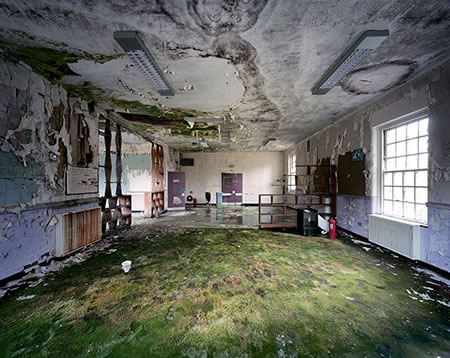
Heterotopia - La chute tragique - 2011 - Hétérotopie #AEEWI - 135 x 170 cm

Heterotopia – La chute tragique – 2011

Photographic Exhibitions by Vincent J. Stoker

Heterotopia, une brève introduction by Vincent J. Stoker

[Editor: Links updated 13 April 2026]

“Heterotopia, les grandes formes”
Exposition solo
29 mai – 13 septembre 2014
Orthez – Centre d’art Image/Imatge

Paris Photo
Stand Galerie Alain Gutharc
14 – 17 Novembre 2013
Paris 8e – Grand Palais

“Heterotopia, la fin de l’Histoire”
Exposition solo
24 oct. – 21 déc. 2013
Vernissage le 24 octobre, de 18h à 22h
Paris 3e – Galerie Alain Gutharc

Introduction from Vincent J. Stoker’s site
Heterotopia s’oppose en bloc à la morosité lancinante du ‘soleil noir de l’ennui’ quotidien. Il existe un lyrisme à la feuille blanche de papier, une poétique du banal que seul l’art peut révéler. En dehors, quand il se fait chair, le quotidien n’est qu’une souffrance sourde, déprimante. La photographie intervient comme outil de combat salvateur contre la réduction du vécu à une expérience morne et pauvre, contre la dépréciation d’un quotidien qui ne laisserait aucune trace objective et durable dans la mémoire. Son pouvoir héroïque est d’asseoir la course du présent hystérique et d’accroitre l’expérience du vécu en rendant le temps saisissable et communicable aux autres.

Heterotopia est une investigation phénoménologie du lieu autre qui utilise la photographie pour disséquer les corps architecturaux en leurs éléments fondamentaux et atteindre une compréhension plus éclairante du monde. L’approche objective et austère s’apparente à celle du scientifique qui saisit informatiquement les données de son expérience et doit permettre d’exhumer le caractère problématique du lieu et de la photographie.

Hetero : autre, l’altérité ; topos : le lieu. Les hétérotopies sont les autres lieux.

Les hétérotopies se définissent par ce qu’elles ne sont pas. Ici et nulle part, elles ne sont ni lieux réels, ni utopies mais les deux à la fois. Lieux hors de tout lieu mais pourtant répertoriés sur les cartes, elles sont des localisations physiques d’utopies. Principe fondamental de leur altérité, elles entretiennent un rapport ambigu à la réalité.

Ces espaces autres se défont de la relation communément établie du temps pour entrer dans une temporalité qui leur est propre. Au temps linéaire souverain de la montre se substitue celui de la lenteur molle du temps suspendu des ruines, le temps de l’accumulation humaniste des réserves du savoir ou encore celui de l’instant éternellement figé de la photographie.

suite

Source: Heterotopian Studies

Conflict, Revolt and Democracy in the Neoliberal World
Thursday, November 7 2013 BST – Friday, November 8 2013

Conference website

[Update 5 April 2026. Link above to the page archived on the Wayback Machine]

Centre for Applied Philosophy, Politics, and Ethics,
University of Brighton
Grand Parade
Brighton
United Kingdom

Keynote speakers:
Wendy Brown
University of California, Berkeley

Details

Neoliberal politics over the past four decades has linked democracy to the extension of markets and competition across the public, private and charitable sectors. These developments have been sustained through the extension of individual debt, ‘humanitarian’ wars and the normalisation of ‘exceptional’ acts of sovereign power including torture and illegal drones. Despite sustained economic crises, disastrous wars in Iraq and Afghanistan, and marked increased in inequalities both within nation states, and between nation states, neoliberal regimes have flourished. The collapse of the world financial system in 2008 was rearticulated as a crisis of the state. Debts incurred by global financial institutions became sovereign debts while citizens have borne the brunt of the risks generated by the confluence of debt, war and discipline.

These crises have increasingly put in to question the claim that the state is a bulwark of democratic politics, the last outpost for the expression of the sovereign will of the people against the incursion of market mechanisms. States function to regulate and protect actors in markets, extend the remit for markets, and limit the possibility for democratic revolt against the consequences of these freedoms. However, this recognition also opens the possibility of exploring other avenues, other directions and possibilities for the expression of democratic politics. These may involve political actors both below and above the state, as well as the possibility of reconfiguring parts of the state.

This conference investigates neoliberal rationalities, practices and regimes with particular attention to the current conjuncture. It also theorises the limits of the the different theoretical accounts of contemporary capitalist politics, while investigating the news sites and agents of democratic politics. Papers might address any one of these or related topics:

SPECIAL STRAND: Wendy Brown on neoliberal politics

  • Neoliberal ‘Democracies’
  • Marxist critiques of Neoliberalism
  • Critical Theories of Neoliberalism
  • The Politics of Debt
  • Neoliberal property regimes
  • Reconstruction after Invasion: Market and State in Afghanistan and Iraq
  • The Outsourced State
  • Foucault on Neoliberal Governmentality
  • Thinking Resistance: From Cairo to Wall Street
  • Democracy beyond the state

The conference fee is £160. This includes refreshments, lunch on Thursday and Friday and conference dinner on the Thursday evening

There are a limited number of places available for graduate students and for people who have no institutional affiliation at the reduced price of £80. If you wish to be considered for one of these places please contact Ian Sinclair i.sinclair1@uni.brighton.ac.uk. on as soon as possible.

Please note: the conference fee does not include accommodation and, unfortunately, we are unable to offer travel grants or other forms of financial assistance. If you have any questions about the conference or require further information please contact Ian Sinclair i.sinclair1@uni.brighton.ac.uk.

stuartelden's avatarProgressive Geographies

Foucault - Ceremonie, Thêatre et politiqueIn a previous post, I discussed the summary of a 1972 lecture Foucault gave in Minneapolis, entitled “Cérémonie, théâtre et politique au XVIIe siècle”. As far as I am aware the text of the lecture remains in Foucault’s own papers and was never published. It was published in a brief English summary, written by Stephen Davidson, in Acta: Proceedings of the fourth annual conference of XVIIth century French Literature, pp. 22-3. Given the text is so hard to find, I wanted to ask Davidson for permission to put this summary on this site, but sadly I heard he died some years ago. 

I’ve therefore gone ahead with make the summary available – in pdf. If anyone knows of a way of making this more legitimate please let me know.

Thanks to Kai Bosworth, Gerald Moore, Arun Saldanha and Garnet Kindervater for detective work.

Incidentally, the question was raised as…

View original post 91 more words

Crisis & Critique of the State
Interdisciplinary Goldsmiths Graduate Conference 2013

Friday, October 25 2013 – Saturday, October 26 2013

Goldsmiths, University of London
London
United Kingdom

Keynote speakers:
Sara Farris
Goldsmiths College, University of London

Massimiliano Tomba
University of Padua

Bob Jessop
Lancaster University

The conference is free and open to all.

If you have any questions, please contact goldsmithsgradconference@gmail.com

Conference Programme:

Friday, 25th of October
09.30 – 10.00 – Registration (New Academic Building – Lower Ground Floor)

10.00 – 11.00 am
Keynote I (Room NAB LG01)
Sara Farris, Goldsmiths: The State as ‘Space-Time’ of Convergences: Workfare, Migration and Feminism

11.15 – 13.00 pm – New Materialist Perspectives on the State I (Room NAB LG01)
Christopher Green, University of Oxford: State, space and self: Poulantzas and Foucault on governmentality
Peter Libbey, Duquesne University/Universität Heidelberg: The Truth of False Consciousness: Althusser on Ideology and the Limits of ‘Revolutionary’ Discourse
Aylin Zafer, Goethe-University, Frankfurt: Reading Gramsci with Foucault. Subjectivity between Consensus and Discipline
Respondent: Peter Thomas, Brunel University

– Lunch Break –

2.30 – 4.15 pm – Parallel Panels
Cultural and Political Economy of the Neoliberal State (Room RHB137)
Radman Selmic, Goldsmiths, University of London: State, Derivative Logic and Liquidity
Emma Mahony, National College of Art and Design, Dublin: Where do they Stand? Deviant Art Institutions and the Liberal Democratic State
Matthijs Krul, Brunel University: ‘Mainstream Political Economy and the State: The Conception of State Power and its Origins in the New Institutionalist Economic History
Respondent: tbc

Philosophies of the State I – Hegel and Marx (Room RHB256)
Ian Jakobi, Kingston University: The Eternal State of Temporal Crises: Hegel and Marx on political transformation
Nathanial Boyd, Brunel University: The socialisation of the political and the politicisation of the social: Hegel as a thinker of the problem of the modern state.
Danilo Scholz, EHESS Paris: The Rise of the World State: The Strange Encounter between French Hegelo-Marxists and German Conservatives in the 1950s and 1960s
Respondent: Sara Farris, Goldsmiths, University of London

– Coffee Break –

4.45 – 6.30 pm – Parallel Panels
Critiques of Democracy and Neoliberal Politics (Room RHB256)
Jonathan Baldwin, Royal Holloway, University of London: H. G. Wells’ Critique of the State: The Un-Utopianism of Democracy
Baraneh Emadian, University of Westminster: The Excrescences of Liberal-Democracy: Power of the People vs. Force of the State
JD Taylor, University of Roehampton: Are we post-political? Reading Spinoza on the civil state
Respondent: Saul Newman, Goldsmiths

Biopolitics of the State (Room RHB137)
Richard Morgan, University College London: “A Noxious Superstructure”: Peter Kropotkin, Degeneration and Bio-anti-statism
Zuleykha Mailzada, University of Glasgow: Human right to health after death of Soviet communism
Matthew Cole, London: Crisis, Proletarianization and the Limits of Real Subsumption or The Synthesis of the Biopolitical and the Biocapital
Respondent: Manfred Faßler, Goethe-Universität Frankfurt

6.45 – 7.45 pm
Keynote II (Room NAB LG01)
Bob Jessop, Lancaster University: Poulantzas on economic and political crises and the crisis of the state: historical lessons and contemporary relevance

Saturday, 26th of October
09.45 – 10.15 – Registration (RHB 342)

10.15-12.00 am – Parallel Panels
Creating Exceptions within State(s) of Emergency. On the notion of non-citizenship – refugee protests in Europe (and elsewhere) (Room RHB 342)
Sofia Bempeza, Academy of Fine Arts Vienna: Pro-testing democracy // The refusal to stay in one’s proper place
Jenny Kneis, Academy of Fine Arts Vienna: ‘REFUGEES ARE HUMAN BEINGS’, ‘WORLD HELP US’. Two Protest Banners.
Rachel Rye, Goldsmiths, University of London: ‘Unseeing’ Asylum Seekers: the sovereign state of Nauru and its Australian detention centre
Respondent: Stefan Nowotny, Goldsmiths

Philosophies of the State II – Politics of Community and Justice beyond the State (Room RHB 137)
Marita Vyrgioti, Goldsmiths, University of London: Community beyond identity: towards a rethinking of radical politics
Alison Hugill & Sami Khatib, Freie Universität Berlin: Community, Body Politics, and Profane Illumination. Reading Walter Benjamin with Jean-Luc Nancy
Mauro Farnesi Camellone, University of Padua: Leo Strauss and the Crisis of Liberal City. For a Non-Conservative Interpretation
Respondent: Massimiliano Tomba, University of Padua

– Lunch Break –
1.00-2.45 pm – Parallel Panels
The Sea, Shores, Islands – Territory, Sovereignty and the State (
Room RHB342)
Daniel Fernández Pascual, Goldsmiths, University of London: The Construction of the End
Léopold Lambert, New York: The Political Archipelago: For a New Paradigm of Territorial Sovereignty
Jérôme Seeburger, Leipzig: The Multitude of Rackets – A Critique of the ‘Utopia’ of Micronations, its Propagandists and its Theory
Respondent: Leila Whitley, Goldsmiths

Crisis and Protest (Room RHB137)
Sara Salem, The Institute of Social Studies, Den Haag: The Egyptian military and the 2011 uprising: re-alignments within the ruling class.
Alen Toplišek, Queen Mary, University of London: Why austerity is working
José Borges Reis, Goldsmiths, University of London: From theology to economics to moral tales: the winding paths of crisis
Respondent: Emma Dowling, Middlesex University

– Coffee Break –

3.15 – 5.00 pm – New Materialist Perspectives on the State II (Room RHB342)
Chris O’Kane, University of Sussex: Between Vulgar Marxism and Marxology: The State as ‘the force of value’ in Alfred Sohn-Rethel
Lukas Slothuus, Central Saint Martins: State, Capital, and Crisis: Toward a Theory of Neoliberal State Capitalism
Respondent: Bob Jessop, Lancaster University

5.00 – 6.00 pm
Keynote III (Room RHB342)
Massimiliano Tomba, University of Padua: Beyond Political Theology and its Temporality. Benjamin vs. Schmitt