
Foucault News

News and resources on French thinker Michel Foucault (1926-1984)

Arthur E. Walzer, Parrēsia, Foucault, and the Classical Rhetorical Tradition
(2013) Rhetoric Society Quarterly, 43 (1), pp. 1-21.

https://doi.org/10.1080/02773945.2012.740130

Abstract
In his last seminars, Michel Foucault analyzed parrēsia (frank speech) in classical Greece and Rome, a subject also addressed by classical rhetoricians. Foucault regards parrēsia as an idealized modality of truth telling-unartful, sincere, courageous speech that tells an unwelcome truth to power. Aligning rhetoric with flattery, Foucault excludes rhetorical parrēsia from his history of thought. This essay offers an alternative analysis of parrēsia from the perspective of classical rhetoric. Drawing especially on the comprehensive description in the Rhetorica Ad Herennium, this essay identifies within the classical tradition a feigned parrēsia as well as a sincere one and a rhetorically artful parrēsia as well as the unartful, bold one that Foucault favors. Furthermore, the essay traces a genealogy that highlights changes in the practice of parrēsia as the term is conceptualized in the context of friendship, at which point parrēsia takes on an unmistakably rhetorical character.

DOI: 10.1080/02773945.2012.740130
Appel à participation

Les samedi 26 et dimanche 27 octobre de 14h à 18h, le collectif F71 propose deux séances de travail avec des amateurs,
à l’occasion de sa résidence au Collectif 12 à Mantes la Jolie (78)

Pour en savoir plus, visitez cette page

[Editor: Update 14 April 2026. See video on YouTube posted 1 October 2019]

Prochain rendez-vous

Le 18 octobre à 17h, performance à partir du texte Le corps utopique de Michel Foucault,
dans le cadre du Laboratoire Eutopia, Savoir/pouvoir, Saline Royale d’Arc et Senans (25)

Pour en savoir plus, visitez cette page

Notre corps utopique

Le nouveau spectacle du collectif F71, Notre corps utopique,
à partir du texte de Michel Foucault, Le Corps Utopique, sera créé en décembre 2013.

Dans une conférence radiophonique donnée en 1966, Michel Foucault arpente le corps comme un territoire.
Espace a priori limité, personnel, imposé à chacun mais territoire que nous partageons en commun, sujet et objet de notre imaginaire. Comment s’emparer collectivement de ce corps utopique, lieu de tous les possibles ?

A venir en 2013-2014

Le 12 novembre à 19h30, Notre corps utopique – restitution d’atelier dans le cadre de TP-Travaux publics,
Le Carré, Scène Nationale, Château-Gontier (53)

Les 19 décembre à 14h30 et 20 décembre à 14h30 et 20h30, création de Notre corps utopique, Théâtre Eurydice, Plaisir (78)
avec le soutien de la Ferme de Bel Ebat, Guyancourt (78)

Du 7 au 22 janvier à 19h30, les Dimanche à 15h, Notre corps utopique, Théâtre de la Bastille, Paris (75)
(Relâche les 9, 13, 14 et 20 janvier)

Les 24 et 25 janvier à 20h30, Notre corps utopique, Collectif 12, Mantes la Jolie (78)

Les 27 et 29 mars à 19h00 et le 28 mars à 20h30, Foucault 71, Théâtre La Grange de Dorigny – Université de Lausanne (CH)

Contact

Mélanie Autier, 06 22 13 06 82, production.collectiff71@gmail.com

www.collectiff71.com

Paolo B. Vernaglione, Il bel rischio, Alfabeta2, Pubblicato il 30 settembre 2013

Update September 2025: Link above is to the archived page on the Wayback Machine

Scrivere è Il bel rischio perché è pericoloso. Essere nel linguaggio per l’animale umano comporta avere a che fare con il lato oscuro, il rovescio di sé, di cui oggi invero la superficie della prassi raramente rende conto. Nell’immensa opera di Foucault, scrivere significa confrontarsi con un’esteriorità, cioè riconoscere il mondo e l’insieme delle relazioni individuali, come effetto di un’azione comunque rischiosa in cui trovano corpo relazioni molteplici e intricate.

Nel 1968 il critico letterario della rivista “L’Art” Claude Bonnefoy, propone a Foucault una serie di interviste sul senso della scrittura come impresa personale. Leggere adesso quest’unica conversazione, interrotta e redatta da Philippe Artières, curatore dell’edizione francese del saggio, procura un piacere non dissimile da quello intenso e sfrangiato che si prova nello studiare Storia della follìa, Le parole e le cose, Il coraggio della verità. Con un supplemento, che emerge al vivo dalla puntuale traduzione di Antonella Moscati. Foucault infatti, incitato dalle domande di Bonnefoy, parla dello scrivere come “rovescio del ricamo”, cioè di quel modo in cui corpo e linguaggio tentano di aderire l’un l’altro nella radicale differenza che li separa.
[…]

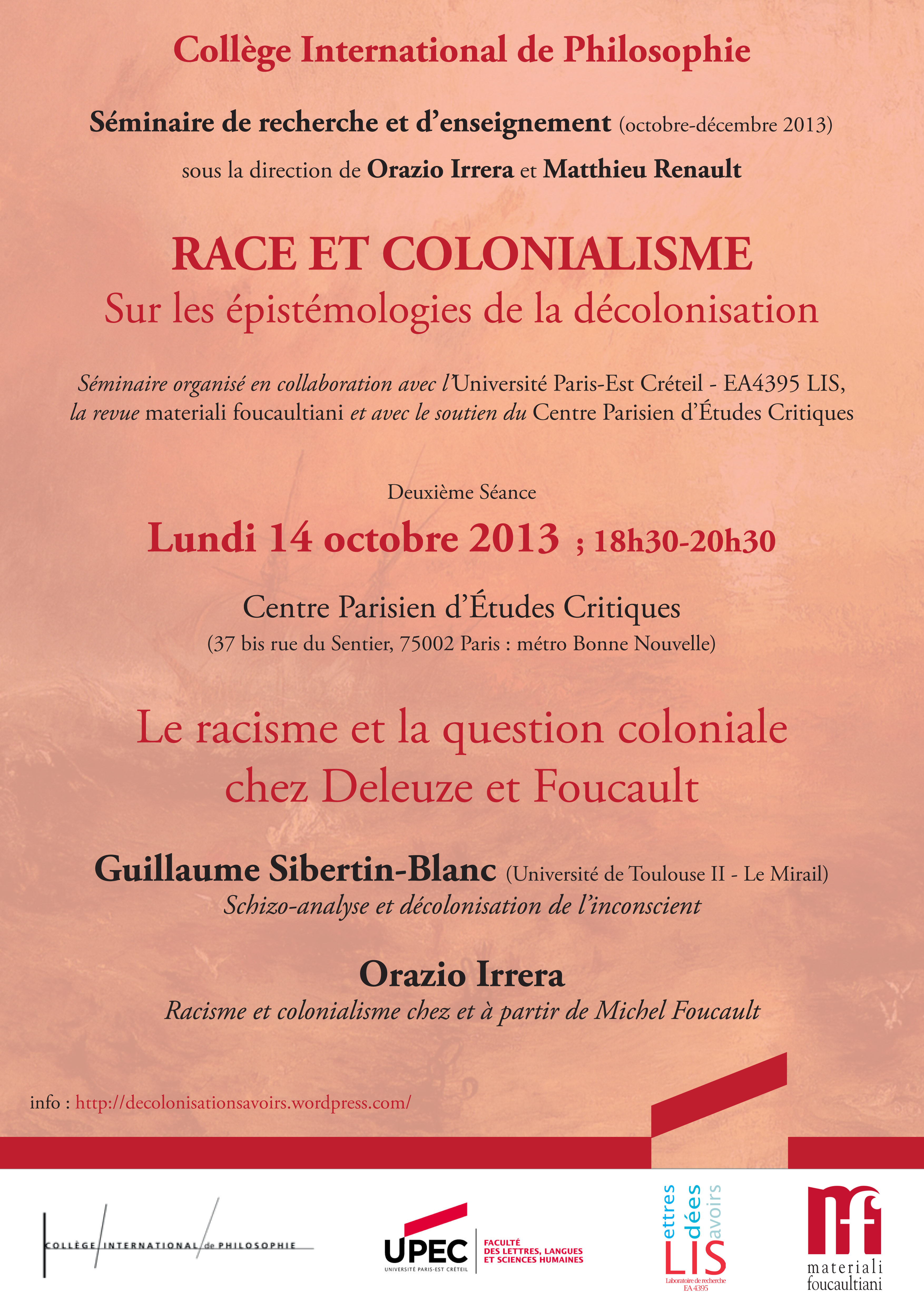
Affiche (S2)


Collège International de Philosophie
Séminaire de recherche et d’enseignement
sous la direction de Orazio Irrera et Matthieu Renault

Race et colonialisme. Sur les épistémologies de la décolonisation

[Editor: Update 14 April 2026. See list of seminars 2011-2017]

Séminaire organisé en collaboration avec l’Université Paris-Est Créteil – EA4395 LIS,
la revue materiali foucaultiani et avec le soutien du Centre Parisien d’Études Critiques

Deuxième Séance

Lundi 14 octobre 2013 ; 18h30-20h30
Centre Parisien d’Études Critiques
(37 bis rue du Sentier, 75002 Paris : métro Bonne Nouvelle)

Le racisme et la question coloniale chez Deleuze et Foucault
< b>Guillaume Sibertin-Blanc (Université de Toulouse II – Le Mirail)
Schizo-analyse et décolonisation de l’inconscient

Orazio Irrera
Racisme et colonialisme chez et à partir de Michel Foucault

Ondrej Ditrych, From discourse to dispositif: States and terrorism between Marseille and 9/11 (2013) Security Dialogue, 44 (3), pp. 223-240.
https://doi.org/10.1177/0967010613484076

Abstract
This article is a historical study of how states have articulated statements about terrorism since the 1930s; under what conditions these statements have been articulated; and what effects the discourses made up of these statements have had on global politics. This includes the constitutive role of the present discourse on what is posited as a terrorism dispositif. The inquiry is inspired by Foucault’s historical method, and comprises the descriptive archaeological analytic focused on the order of the discourse (including basic discourses in which the terrorist subject is constituted) and the genealogical power analysis of external conditions of emergence and variation of discursive series, whose treatment benefits also from Carl Schmitt’s concept of the nomos.

Author Keywords
discourse; Foucault; genealogy; nomos; Schmitt; terrorism

Carla Edgley, A genealogy of accounting materiality, Critical Perspectives on Accounting, Volume 25, Issue 3, 2014, Pages 255-271
https://doi.org/10.1016/j.cpa.2013.06.001

Abstract
This study explores the relevance of the historical dimensions of the materiality concept and its past role. Metaphors applied to materiality provide insights into conditions and traces of power that have shaped its discursive configuration. Rather than viewing materiality as the gradual development of a technical idea over time, metaphorical discourses suggest that it has been constituted as multiple categories of knowledge, with divergent roles, as: a moral responsibility; a solution to the problem of over-auditing; a solid epistemic foundation for financial reporting; a scientific technique; a quantitative rule of thumb; a risk management concept; and a mysterious shield. The malleable nature of the concept has allowed the profession to realign and reinvent it to meet shifting priorities and challenges. Divergence in the trajectories of materiality discourses is relative to certain conditions, events, actors and financial scandals. The paper draws on the metaphor of performance, to interpret materiality as a performative activity at the crux of truth games about making visible, controlling, taming, managing and hiding translation errors in accounting inscriptions. The extent to which a genealogical analysis identifies different styles of reasoning that have shaped its meaning over time has implications for debate about its future development.

Author Keywords
Critical; Foucault; Genealogy; Materiality; Social

Paul Veyne à propos de Michel Foucault

Emission
Le cercle de minuit France 2 (television), 22 juin 1994

Dans son émission consacrée au philosophe Michel FOUCAULT, Michel FIELD reçoit Paul VEYNE, professeur au Collège de France. L’historien parle de la vie de salon très agréable que Michel FOUCAULT avait recréée et de l’influence que le philosophe a eu sur lui.

James Lee, Ethopoiesis: Foucault’s late ethics and the sublime body (2013) New Literary History, 44 (1), pp. 179-198.
https://dx.doi.org/10.1353/nlh.2013.0005.

Abstract
This paper argues that Neil Hertz’s model of the sublime turn allows us to perceive the aesthetic, and specifically literary, consequences of Foucault’s late ethics reimagined as a sublime poetics. In doing so, the present analysis attempts to reanimate the concept of the sublime as a powerful ethical category reconceiving the subject in terms of the acts of writing that structure a constitutive aesthetic relationship to her own body. More generally, this account of Foucault proposes that his late ethics, and not necessarily the politics of his earlier work, holds the most interest for literary critics, since these ideas explicitly rethink ethics as a poetics, and thus foreground the frequently under recognized force of literary creation, and not simply cultural representation, in shaping subjects of power.

DOI: 10.1353/nlh.2013.0005

John Roberts, Testing the limits of structuration theory in accounting research (2013) Critical Perspectives on Accounting., Volume 25, Issue 2, Pages 135-141
https://doi.org/10.1016/j.cpa.2012.12.002

Abstract
In 1985 I published a paper in Accounting Organizations and Society with Bob Scapens titled ‘Accounting Systems and Systems of Accountability; understanding accounting practices in their organisational contexts’. The paper suggested the potential usefulness of Anthony Giddens’ structuration theory for efforts to understand accounting in its organisational contexts. Rather than engage in a further review of the use of structuration theory in accounting, this paper sets out to test our original proposition as to the usefulness of Giddens ideas for accounting research. I explore three points of possible criticism in the paper. That structuration theory does not take the ‘agency’ of accounting sufficiently seriously; that Foucault and Lacan allow us to get much closer to the ways in which accounting information works back upon human subjects; and that Giddens and accounting share a lack of ethics.

Author Keywords
Accountability; Actor network theory; Modalities of interaction; Structuration theory

Jason Schaub, Roger Dalrymple, Surveillance and silence: New considerations in assessing difficult social work placements (2013) Journal of Practice Teaching and Learning, 11 (3), pp. 79-97.
https://doi.org/10.1921/jpts.v11i3.279

Abstract
Studies to date have highlighted a number of key factors in the assessment of difficult social work placements including the need for adequate professional formation; communication; the changing social work education framework; and the influence of the wider social work context. Factors less widely examined are the perceptions of some practice educators that the assessment of placement students operates in a wider context of surveillance and scrutiny by a range of stakeholders. We argue that such perceptions of surveillance can cause a discursive anxiety for practice educators and can inhibit key developmental conversations between assessor and student. Drawing on interviews with ten practice educators, we examine the tendency of practice educators reflecting on a failed placement to rehearse or even enact those key developmental conversations post hoc, broaching previously unstated or tacit aspects of the placement experience. We argue for the need to create a safe discursive space for these conversations to take place in situ during the challenging placement and suggest that a diminution in perceptions of surveillance and enhanced outcomes for students and practice educators will result.

Author Keywords
anxiety; discursive spaces; failing students; Foucault; practice educators; surveillance