Key Thinkers: Michel Foucault by John Frow. Videos of lecture delivered in 2009 at the University of Melbourne. Posted 3 May 2013 by The Monthly

Key Thinkers: Michel Foucault by John Frow. Videos of lecture delivered in 2009 at the University of Melbourne. Posted 3 May 2013 by The Monthly
Raúl Sánchez García and Antonio Rivero Herraiz, ‘Governmentality’ in the origins of European female PE and sport: The Spanish case study (1883-1936) Sport, Education and Society, 18 (4), 2013, pp. 494-510.
https://doi.org/10.1080/13573322.2011.601735
Abstract
The purpose of the paper is twofold: (1) to contribute to the analysis of the origins of modern European female PE and sports from a power perspective, inspired by Foucault’s work; and (2) to present a detailed analysis of female PE and sport in Spain (1883-1936) as a specific European case study. It is argued that these physical activities could be conceived in the Spanish case as part of a specific kind of ‘governmentality’ with a dual nature. On the one hand they represented disciplinary ‘technologies of power’ over the female body. Selected physical activities-dictated mainly from the hygienic-moral position of the Regeneracionistas (‘Regenerationists’)-were exerted as a kind of ‘bio-power’ for the control of the female population. On the other hand, such kind of activities (especially sports) represented certain ‘technologies of the self’ for middle and upper class women. Through participation in sports, women gained a more active and public role in the Spanish society of the era, obtaining some degree of autonomy in self-governance over their bodies and their lives. © 2013 Copyright Taylor and Francis Group, LLC.
Author Keywords
Foucault; Governmentality; Physical Education; Power; Spain; Sports; Women
Jérôme Englebert
Some evidence for a psychopathological consideration on psychopathy: Part I [Quelques éléments en faveur d’une réflexion psychopathologique sur la psychopathie : Première partie]
(2013) Annales Medico-Psychologiques, 171 (3), pp. 141-146.
https://doi.org/10.1016/j.amp.2012.05.025
Jérôme Englebert
Some evidence for a psychopathological consideration on psychopathy: Part II [Quelques éléments en faveur d’une réflexion psychopathologique sur la psychopathie : Seconde partie]
(2013) Annales Medico-Psychologiques, 171 (3), pp. 147-153.
https://doi.org/10.1016/j.amp.2012.05.024
Abstract
Objectives: The objectives of this study are to offer some clinical and semiological considerations for a psychopathological conception of psychopathy. In the first part, the author provides a history of this diagnosis (see Introduction of this paper) and a description of the current trends in the international literature: the contributions of R.D. Hare and the PCL-R, D.J. Cooke and the Comprehensive Assessment of Psychopathic Personality (CAPP) and T.H. Pham for French-speaking validations (subtitle 2 of this paper). After that, the author proposes a definition of psychopathology in the sense of Minkowski and Jaspers proposals (i.e. these latter come from the principles of the continental phenomenology) (subtitle 3 of this paper). Patients and methods: This theoretical essay is improved by clinical situations. The psychopaths were interviewed in prison or in forensic centers.
The method used was a psychopathological analysis from the clinical material, as well as references to the phenomenological psychopathology (continental phenomenology) and the philosophy of J.-P. Sartre, M. Foucault and P. Ricœur. Results: This study shows that it is useful to consider a psychopathological reflection on psychopathy and this approach gives a framework for the clinical investigations. Regarding that, the author proposes a first comparison between the binswangerian conception of mania and the psychopathic functioning (subtitle 4 of this paper). By this way, we can understand why many studies show a positive correlation between the scoring in the PCL-R and the scale of the MMPI mania. The behavior is similar but the difference is about the dialectic between the ” ego” and the ” alter ego”.
The maniac has a fundamental crisis of the ” ego” , which the psychopath does not have. A second finding of our investigations concerns emotions and the dimension of the adaptive psychopathic disorder (subtitle 5 of this paper). An epistemological discussion of the concept of emotions allows us to say that the psychopath is competent in the management of emotional stimuli, which confers a psychological advantage to him. In addition, fundamental research on the management of the emotional stimuli in the psychopath seems to confirm our hypothesis of an adaptive dimension for the psychopathic disorder. The last point we discuss is about ” morality” and ” ethics” for the psychopath (these notions are from the concepts of empathy and sympathy). On the basis of Foucault’s distinction between these two concepts, it becomes possible to study these dimensions and integrate them in the practice of psychopathology. This proposal enables to introduce the concept of narrativity. This observation prompts the clinician to listen to the patient and to pay attention to how he has to tell himself.
Conclusions: Our contribution shows that it is possible to conduct a study about the psychopathology of psychopathy. Our study is not intended to be complete and irrefutable. Our goal is rather to give some evidence for a psychopathological consideration on psychopathy (as indicated by the title of this paper). Finally, we offered some thoughts on the practice of psychotherapy by integrating the adaptive dimension of this disorder which, when it is missed, can lead to a psychotherapeutic stalemate. © 2012 Elsevier Masson SAS.
Author Keywords
Adaptation; émotion; éthique; Emotion; Empathie; Empathy; Ethics; Mania; Manie; Morale; Morality; Psychopathie; Psychopathologie; Psychopathology; Psychopathy; Psychothérapie; Psychotherapy; Sympathie; Sympathy
DOI: 10.1016/j.amp.2012.05.025
DOI: 10.1016/j.amp.2012.05.024
 Johann Michel (2013), Ricœur et ses contemporains, Presses Universitaires de France
L’ouvrage se propose de confronter la philosophie de Ricœur avec certains de ses contemporains que l’on regroupent sous la bannière des « post-structuralistes
Si l’on connaît aujourd’hui le dialogue fructueux que Paul Ricœur a noué avec les penseurs structuralistes, on ignore largement son positionnement face à la mouvance poststructuraliste. Faut-il opposer la philosophie de Ricœur au poststructuralisme à la française ou au contraire doit-on montrer qu’elle en est une variante singulière ?
C’est la seconde option qui est ici défendue. Certes, le poststructuralisme ne doit pas être considéré comme une école de pensée mais comme une reconstruction qui relève de l’histoire de la philosophie. Dans la mesure où les horizons de dépassement du structuralisme ont été posés de manière chaque fois particulière, il est préférable de parler de poststructuralismes au pluriel. C’est la raison pour laquelle J. Michel propose des confrontations dyadiques entre Ricœur et certains de ses contemporains (Deleuze, Derrida, Foucault, Bourdieu…) que l’on regroupe habituellement dans cette mouvance.
Introduction
Chapitre I : L’habitus, le récit et la promesse
Habitus et Identité-idem. Identité narrative et illusion biographique. La promesse et ses dilemmes.
Chapitre II : Le sens de la démesure. Un hégélianisme avec réserves
Hégélianisme inversé et hégélianisme brisé. L’horizon kantien et l’ontologie heideggerienne. Le tiers et la question de la justice.
Chapitre III : Le hors-sujet et le devenir-sujet
La structure, l’intrigue et l’événement. Force, sens et désir. Le désir, la culpabilité, la loi.
Chapitre IV : Le souci de soi et le souci des autres
Devenir humain et adulte. L’anthropologie du soi et l’épistémologie des sciences humaines. Le souci des institutions justes.
Chapitre V : Les imaginaires et les institutions
La réhabilitation de l’imaginaire social. La leçon des « maîtres du soupçon » en débat : Marx vs Freud. La force des héritages et la création social-historique. L’utopie, concept mystificateur ou concept émancipateur ?
A propos des auteurs
Johann Michel est professeur des universités (Institut universitaire de France, université de Poitiers) et rattaché à l’EHESS. Membre du conseil scientifique du Fonds Ricœur, codirecteur de la revue internationale Études Ricœuriennes/Ricœur Studies (Pittsburgh University), il est notamment l’auteur de Gouverner les mémoires (Puf, 2010) et Sociologie du soi (PUR, « Sens social », 2012).
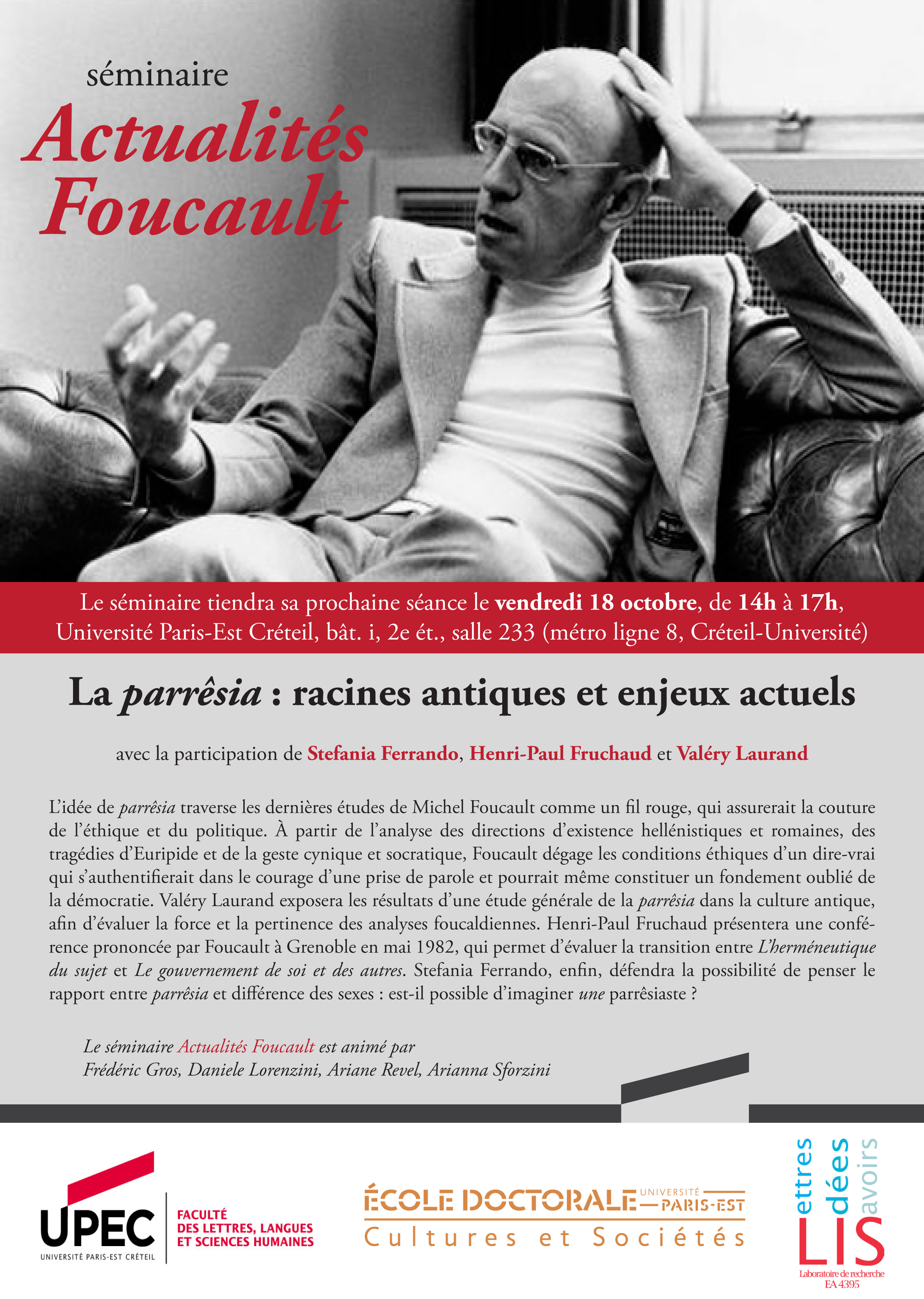
Séminaire « Actualités Foucault »
animé par Frédéric Gros, Daniele Lorenzini, Ariane Revel, Arianna Sforzini
Université Paris-Est Créteil, EA 4395 LIS « Lettres, Idées, Savoirs »
Présentation du séminaire :
L’objectif de ce séminaire est de rassembler régulièrement tous ceux qui travaillent sur ou à partir de la pensée de Michel Foucault, et de créer un espace de débats et d’échanges autour d’une œuvre foisonnante dont la perception se renouvelle fortement et rapidement, grâce à des publications toujours plus nombreuses.
Il s’agira à chaque fois de présenter une actualité triple. Actualité académique : les étudiants travaillant actuellement sur ou à partir de Foucault (masters, doctorats, projets d’articles ou de livre) pourront exposer leur recherche. Actualité critique : on rendra compte des ouvrages ou articles importants parus dernièrement (parfois en présence de l’auteur). Actualité éditoriale : présentation à la fois des inédits de Foucault récemment publiés (conférences, articles, entretiens, cours au Collège de France), mais aussi présentation de travaux d’édition de nouveaux textes de Foucault à paraître. Nous profiterons de cet espace également pour annoncer les plus importantes manifestations foucaldiennes prévues.
Nous tâcherons enfin de mettre les concepts foucaldiens à l’épreuve des grandes mutations (techniques, politiques, éthiques) contemporaines, pour rester fidèles à l’injonction de diagnostic de notre présent.
Prochaine séance :
« La parrêsia : racines antiques et enjeux actuels »
avec la participation de Stefania Ferrando, Henri-Paul Fruchaud et Valéry Laurand
Vendredi 18 octobre 2013, 14h-17h
Université Paris-Est Créteil, bâtiment i, 2e étage, salle 233 (métro ligne 8, Créteil-Université)
L’idée de parrêsia traverse les dernières études de Michel Foucault comme un fil rouge, qui assurerait la couture de l’éthique et du politique. À partir de l’analyse des directions d’existence hellénistiques et romaines, des tragédies d’Euripide et de la geste cynique et socratique, Foucault dégage les conditions éthiques d’un dire-vrai qui s’authentifierait dans le courage d’une prise de parole et pourrait même constituer un fondement oublié de la démocratie. Valéry Laurand exposera les résultats d’une étude générale de la parrêsia dans la culture antique, afin d’évaluer la force et la pertinence des analyses foucaldiennes. Henri-Paul Fruchaud présentera une conférence prononcée par Foucault à Grenoble en mai 1982, qui permet d’évaluer la transition entre L’herméneutique du sujet et Le gouvernement de soi et des autres. Stefania Ferrando, enfin, défendra la possibilité de penser le rapport entre parrêsia et différence des sexes : est-il possible d’imaginer une parrêsiaste ?
Calendrier du séminaire 2013-2014 :
Vendredi 18 octobre 2013
Vendredi 13 décembre 2013
Vendredi 24 janvier 2014
Mercredi 12 février 2014
Mercredi 5 mars 2014
Mercredi 2 avril 2014
Les séances se tiendront toujours à l’Université Paris-Est Créteil, de 14h à 17h.
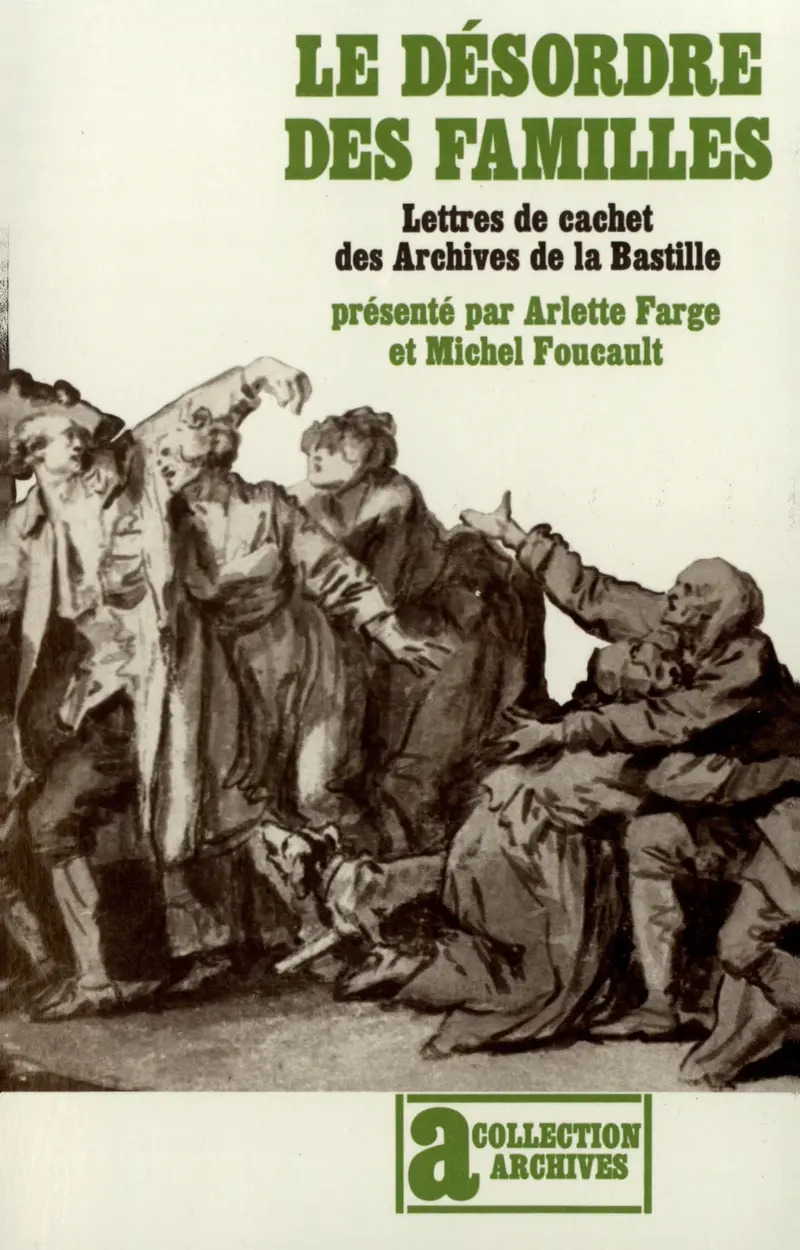 Arlette Farge, Michel Foucault, Le Désordre des familles. Lettres de cachet des Archives de la Bastille au XVIIIe siècle, Collection Archives (n° 91), Gallimard, Parution : 02-11-1982
A useful review by Jean-Yves Alt published 1 Septembre 2018 can be found at Culture et questions qui font débat
Gary S. Becker, François Ewald & Bernard E. Harcourt, Becker and Foucault on Crime and Punishment’: A Conversation with Gary Becker, François Ewald, and Bernard Harcourt: The Second Session (Coase- Sandor Institute for Law & Economics Working Paper No.654, 2013
[Editor: Update 15 March 2026. I have updated the links below to the archived pages held on The Wayback Machine as well as a page still available online]
This is an edited transcript of a conversation held at The University of Chicago on May 15, 2013, in Foster Hall 505, the seminar room of the Committee on Social Thought. The video recording of the open seminar can be viewed on-line at [this link]. It represents a continuation of a conversation begun the year before, titled “Becker on Ewald on Foucault on Becker”: American Neoliberalism & Michel Foucault’s 1979 Birth of Biopolitics Lectures. That first session can be viewed on-line as well at [this link], and the transcript of that first session can be read here. Professors Gary Becker and François Ewald have individually reviewed their portions of the conversation; Professor Bernard Harcourt has edited and annotated the text. We are extremely grateful to Eléonore Rimbault for transcribing the conversation.
In 1968, Gary Becker published a seminal article titled “Crime and Punishment: An Economic Approach” in the Journal of Political Economy, in which he set forth the contours of an economic perspective on the field of criminal law and punishment. Only a few years later, in his lectures on The Birth of Biopolitics at the Collège de France on March 21, 1979, Michel Foucault analyzed Gary Becker’s article in relationship to his own writings.
This seminar, featuring Gary Becker, François Ewald and Bernard Harcourt, seeks to engage the discursive repercussions of this textual exchange and the impact Becker’s work made on Foucault’s work, including his well-known work Discipline and Punish, published in 1975.
Gary Becker is a Nobel Laureate in economics and currently holds the position of University Professor in Economics, Booth School of Business, and Sociology at the University of Chicago and is the Chair of the Becker Friedman Institute for Research in Economics.
François Ewald is titular professor of the chair of insurance studies at the Conservatoire National des Arts et Métiers and director of the Ecole nationale d’assurances. Professor Ewald was Michel Foucault’s primary assistant and interlocutor at the the Collège de France from 1976 to 1984, and is the founder of the Michel Foucault Centre. He is in charge of publication of Foucault’s teaching works at the Collège de France.
Bernard E. Harcourt is the Julius Kreeger Professor and Chairman of the Department of Political Science at the University of Chicago. He is the author, most recently, of The Illusion of Free Markets: Punishment and the Myth of Natural Order (Harvard 2011).
Sponsored by the Department of Political Science, the France Chicago Center, the Computation Institute, and 3CT at The University of Chicago.
With thanks to Daniele Lorenzini for this information
Foucault Studies is pleased to announce the publication of issue 16
A Special Issue on Foucault and Feminism
guest edited by Cressida J. Heyes
Issue 16 also includes:
3 original articles on the topics of:
Foucault’s reading of Nietzsche’s notion of power
Foucault, Althusser and the Marxist tradition
Stultitia and patient education.
10 book reviews
a translation of Michel Senellart’s article “Machiavelli Facing the Challenge of Gouvernementalité.”

Foucault Studies is an electronic, open access, peer reviewed, international journal that provides a forum for scholarship engaging the intellectual legacy of Michel Foucault, interpreted in the broadest possible terms. We welcome submissions ranging from theoretical explications of Foucault’s work and texts to interdisciplinary engagements across various fields, to empirical studies of contemporary phenomena using Foucaultian.
All articles are freely available as open access on our website:
Please visit our website to sign up for E-alerts to receive news of CFP’s and new issues.
Number 16: September 2013: Foucault and Feminism
Table of Contents
Editorial
Sverre Raffnsøe, Alain Beaulieu, Sam Binkley, Patricia Clough, Sven Opitz, Jyoti Puri, Jens Erik Kristensen, Alan Rosenberg, Marius Gudmand-Høyer & Ditte Vilstrup Holm
____________________________________________
Special Issue on Foucault and Feminism
Foucault Studies Special Issue: Foucault and Feminism, September 2013
Cressida J. Heyes
Feminism, Foucault and the Critique of Reason: Re-reading the History of Madness
Amy Allen
Feminism and Neoliberal Governmentality
Johanna Oksala
Post-liberation Feminism and Practices of Freedom
Ladelle McWhorter
Queer Feminism: Cultivating Ethical Practices of Freedom
Jana Sawicki
Resisting the Subject: A Feminist-Foucauldian Approach to Cfountering Sexual Violence
Dianna Taylor
____________________________________________
Translations
Machiavelli Facing the Challenge of Gouvernementalité
Michel Senellart
___________________________________________
Articles
Force and Knowledge: Foucault’s Reading of Nietzsche
Kojiro Fujita
Foucault and Althusser: Epistemological Differences with Political Effects
Andrew Ryder
Stultitia and Type 2 Diabetes: The Madness of Not Wanting to Care for the Self
Anders Kruse Ljungdalh
_____________________________________________________
Reviews
Colin Koopman (ed.), “Special issue: Foucault across the disciplines,” History of Human Sciences, vol. 24. no. 4, October (2011)
Michael Solda
Éric Alliez and Andrew Goffey (eds.), The Guattari Effect (London & New York: Continuum, 2011)
Jonathan Fardy
Krzysztof Michalski, The Flame of Eternity: An Interpretation of Nietzsche’s Thought (Princeton: Princeton University Press, 2012)
Apple Zefelius Igrek
Philippe Chevalier, Michel Foucault et le christianisme (Lyon: ENS Éditions, 2011)
Michael Maidan
Saba Mahmood, Politics of Piety: The Islamic Revival and the Feminist Subject (Princeton: Princeton University Press, 2011)
Michele Spanò
David L. Hildebrand, Dewey: A Beginner’s Guide (Oxford: Oneworld Publications, 2008)
Kathleen Cole
Noam Chomsky and Michel Foucault, Human Nature: Justice vs Power, The Chomsky-Foucault Debate, edited by Fons Elders (London: Souvenir Press, 2011)
Asger Sørensen
Ian Marsh, Suicide: Foucault, History and Truth (Cambridge: Cambridge University Press, 2010)
Daniel R. Mistich
David Pettigrew & Francois Raffoul (eds.), French Interpretations of Heidegger: An Exceptional Reception (State University of New York Press, 2008) & Isabelle Garo, Foucault, Deleuze, Althusser et Marx – La politique dans la philosophie (Demopolis, 2011)
Andrew Ryder
John M. Cooper, Pursuits of Wisdom: Six Ways of Life in Ancient Philosophy from Socrates to Plotinus (Princeton: Princeton University Press, 2012)
Joel Alden Schlosser
Vincennes : roman noir pour une université rouge
Un documentaire de Yolande Robveille (2008), Zarafa Films
Résumé
Chronique de la communauté Vincennoise de 1968 à 1980. L’université de Vincennes ; un gouvernement l’a créé à l’été 1968, un autre l’a fait raser à l’été 1980. Le film débute par mai 1968, il se termine par la destruction des bâtiments. Des images d’archives restituent l’ambiance de l’époque, le quotidien du campus, des extraits de cours des philosophes, François Châtelet, Gilles Deleuze et J.F Lyotard, des interventions de Dario Fo et Michel Foucault. Des témoignages des acteurs de l’époque (Hélène Cixous, Bernard Cassen, Alain Badiou, Daniel Defert, Gérard Miller, et bien d’autres…) nous disent que Vincennes reste l’emblème, la démonstration ou l’exemple d’une liberté de l’Esprit authentiquement vécu.
Source: Variazioni Foucaultiane

 Foucault News