Foucault News

News and resources on French thinker Michel Foucault (1926-1984)

Passeport pour un autre monde…

Avec nos voyages en Afrique de l’Ouest, nous étions (trop) souvent confrontés à la négation de la liberté de circulation de nos partenaires, à la bêtise des corridors de sécurité, à la cécité des frontières. On s’était alors dit qu’on pourrait créer un pays dont nous serions tous citoyens, un pays de liberté, de fraternité, d’équité. Ce pays n’aurait pas de frontières : il serait constitué d’un ensemble de lieux écologiques et solidaires, conçus par des citoyen-ne-s pour répondre à leurs besoins, à ceux leurs proches et de leur communauté, dans le respect des personnes et de l’environnement.

Ce pays, nous l’avons appelé « Hétérotopia » en référence à une conférence de Michel Foucault qui parlait des « hétérotopies » pour désigner les utopies réalisées, ces projets concrets et ces lieux qui incarnent aujourd’hui ce qui était un rêve hier.

Hétérotopia, c’est donc un pays potentiel. Il n’existe sur aucune carte : il nous faut la construire. Ses citoyens n’ont pas de papiers, pas d’état civil : il leur faut conquérir leur identité. Il n’a pas d’expert pour le conduire, pas d’Etat pour le diriger, encore moins de monarque : il cherche sa voie, tâtonne, expérimente à travers la multiplicité des éléments qui le composent. Il est en perpétuel mouvement, en incessante (r)évolution.

A Via Brachy, on a décidé de lui créer un Passeport et de le diffuser afin de porter son message et ses valeurs, pour que chacun d’entre nous puisse s’y reconnaitre et puisse contribuer à son émergence.

Le Passeport Hétérotopia est une invitation au voyage. Il attire notre attention sur ce(ux) qui nous entoure. Il nous invite à chercher l’insolite dans notre quotidien et à entrer en contact avec les autres. C’est un passe-droit pour celles et ceux qui veulent voir dans le monde un peu plus que ce qu’il y a déjà. C’est une mémoire vive de ces lieux dans lesquels s’inventent la société de demain, un réservoir d’idées et de projets concrets. C’est aussi un prétexte pour se rencontrer, pour échanger des idées, pour apprendre à se connaître. C’est enfin un signe distinctif qui nous permet de nous retrouver et de nous fédérer.

Mais, nous direz-vous, si le monde se changeait avec des bouts de papiers, ça se saurait ! Et pourtant ! Pourtant, à Via Brachy, on est persuadé que ce Passeport fera son chemin. A condition que nous soyons nombreux à le faire vivre.

C’est donc à vous, simple citoyen-ne, que revient cette tâche. Comment procéder ? C’est très simple. Prenez votre Passeport avec vous, fourrez le dans votre sac : que vous l’ayez cherché ou non, vous rencontrerez certainement sur votre route des personnes dont les projets vous inspireront, vous vous arrêterez dans des lieux qui vous sembleront atypiques, exemplaires, prometteurs. A ce moment-là, vous sortirez votre Passeport de votre sacoche et vous demanderez à vos hôtes d’inscrire un petit mot pour vous souvenir de ce lieu et pour en parler autour de vous. Parallèlement, vous nous enverrez un petit message sur heterotopies@viabrachy.com pour nous raconter ce lieu et ces personnes. Si nous sommes d’accord pour qualifier ce lieu / ce projet d’Hétérotopie, nous l’inscrirons sur la carte que nous construisons ensemble. Et peu à peu, nous verrons se dessiner les contours de ce nouveau pays.

Hétérotopia sera-t-il le 196ème pays déclaré à l’ONU, juste après la Palestine ? Il est trop tôt pour le dire. Mais une chose est certaine : Il y a bien un autre monde, et il est dans celui-ci. A nous d’ouvrir l’œil !

suite

Source: Heterotopian Studies

Michel Foucault: Beyond Good and Evil, a documentary directed by David Stewart in 1993
42 mins
Broadcast as part of a BBC series called “The Late Show”.

Editor: 15 March 2026. Link above is to the archived page on the Wayback Machine.

Some of this documentary is rather speculative and sensationalised.

Sources of this link: Dangerous Minds
Critical Theory

The poststructural anarchist. Todd May interviewed by Richard Marshall. First published in 3:AM Magazine: Friday, July 12th, 2013.

Update September 2025. No longer held in the 3am magazine archives. Link above is to the archived page on the Wayback Machine

Todd May is the poststructuralist anarchist who thinks anarchism is more than just a critique of the state, that there is more than one struggle, that Foucault, Deleuze and Lyotard are important, that postructuralism is elusive, that anarchism is bottom-up and liberalism is top-down, that ‘how might one live?’ is the down and dirty question, that Foucault’s thought will remain standing when the dust is settled, that what it means to be human is a matter of practices, that Ranciere gets him emotionally, that friendship offers a different model from neo-liberalism and that his conception is about resistance not cohesion. High Five!

3:AM: What made you become a philosopher? Were you always aware of a kind of crisis?

Todd May: Many philosophers I talk with seem to get their start in philosophy from a teacher, often a college professor, that turns them on to the subject. For me, it was different. I went to a high school in New York City during the late 1960s and early 1970s, where ideas and crisis were in the air. It was the kind of place where Melville, Faulkner, and Dostoyevsky, along with the Vietnam War, were regular staples of conversation. So early on I became interested in both ideas and political resistance. In college I studied psychology, but was never far from philosophy: I read Being and Time with a philosophy grad student. Another friend of mine, also a grad student in philosophy, gave me Merleau-Ponty’s Phenomenology of Perception as a graduation present. In the few years I took off between college and grad school, I read most of Merleau-Ponty’s work. Eventually I decided I wanted to go to grad school in clinical psychology, but wanted a phenomenologically oriented one, and so chose Duquesne University. But, as it happens, at the end of my first year there I was introduced to the work of Foucault and Deleuze, who raised unsettling questions for me about the entire project of psychotherapy. I pressed these questions in my classes at Duquesne, admittedly with the passion of which a person committed to ideas is capable, and at the end of my second year was informed that my funding was going to be cut off. So I spent a few more years reading and thinking about what is often called “poststructuralism,” and finally applied to Penn State, where I had the chance to study these thinkers more rigorously. A friend of mine who is a radical lawyer once asked me why I wanted to study philosophy if I was so interested in politics. My response, to which he offered me a mocking stare, was that I felt somehow that in order to understand and solve political problems I needed to be able to grasp their ontological underpinnings.

read more

mf-3

materiali foucaultiani

Volume II, number 3 (January-June 2013)

ISSN 2239-5962

See site for full texts of articles

TABLE OF CONTENTS

Michel Foucault: un phénomène de bibliothèque? Spunti di riflessione a partire da un’installazione di Joseph Kosuth  (pp. 3-9)
Laura Cremonesi, Orazio Irrera, Daniele Lorenzini, Martina Tazzioli

Foucault e la letteratura

Introduzione. Sulle ragioni di una pubblicazione postuma  (pp. 11-24)
Miriam Iacomini

Nota alla traduzione  (pp. 25-26)
Miriam Iacomini

Linguaggio e letteratura  (pp. 27-67)
Michel Foucault

La distanza che ci separa dalla letteratura  (pp. 69-90)
Jean-François Favreau

Un mormorio infinito… Ontologia della letteratura e archeologia del sapere  (pp. 91-104)
Miguel Morey

La letteratura e il diritto alla follia. Blanchot, Foucault e la questione della letteratura  (pp. 105-125)
Bruno Moroncini

Saggi

Medicalizzazione e potere in Naissance de la clinique  (pp. 127-147)
Gianluca Vagnarelli

Forum: Foucault, migrazioni e confini

Nota introduttiva  (pp. 149-151)
Laura Cremonesi, Orazio Irrera, Daniele Lorenzini, Martina Tazzioli

Risposte di Nicholas De Genova  (pp. 153-177)
Risposte di Brett Neilson  (pp. 179-200)
Risposte di William Walters  (pp. 201-213)

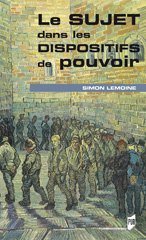
lemoine Simon Lemoine, Le sujet dans les dispositifs de pouvoir. Presses universitaires de Rennes, 2013

Domaine : Philosophie
Collection : Essais
Nombre de pages : 332 p.
ISBN : 978-2-7535-2741-6

Résumé :
Citons Surveiller et punir de Foucault : “Le pouvoir produit ; il produit du réel ; il produit des domaines d’objets et des rituels de vérité. L’individu et la connaissance qu’on peut en prendre relèvent de cette production.” L’individu et le savoir que l’on élabore à son sujet sont produits par des dispositifs de pouvoir (école, usine, prison, hôpital, caserne, etc.). Le pouvoir traversant ces dispositifs étant diffus, ceux-ci gouvernent les sujets insensiblement (on parlera alors d’assujettissement dans une “microphysique” du pouvoir).

Plus précisément, c’est un réseau d’aménagements discursifs, optiques et architecturaux, qui permet de “conduire les conduites”, dans un exercice du pouvoir à la fois insaisissable et profond (une “âme” est produite, nous dit Foucault).

Parce que nous assistons, de nos jours, comme Foucault l’avait annoncé, à une “grande montée des dispositifs de normalisation”, et parce que l’échelle du dispositif, peu étudié par la philosophie, permet d’adopter une perspective nouvelle sur la constitution du sujet, cet ouvrage entend montrer qu’il est nécessaire d’engager aujourd’hui une “philosophie des dispositifs”.

Sommaire :
■ Le dispositif chez Foucault
■ Les matrices
■ Recherches sur la réitération
■ Le sujet du cycle
■ Un homme est fait de l’homme
■ Maîtrise des sujets par la maîtrise des isotopies, des biotopes et du monde objectivé
■ La maîtrise des phénomènes par les dispositifs
■ La conscience comme lieu de lutte
■ Le sujet est sujet de dispositifs
■ L’identité comme invention tactique
■ La subjectivation détournée
■ Le « faire faire » comme principe premier
■ Le gouvernement invisible
■ Le sujet réfracté
■ La physique des discours charriés
■ L’économie de la vérité, et ses fins
■ Le passage du logos en êthos, répondre de soi
■ L’êthos régulier et le joug des discours
■ Le sujet microphysique

Simon Lemoine est enseignant en philosophie et chercheur postdoctoral au laboratoire de recherche Métaphysique allemande et philosophie pratique (MAPP, EA 2626, Poitiers).

stuartelden's avatarProgressive Geographies

The ‘Truth and Juridical Forms’ lectures

Between 21-25 May 1973, Foucault gave five lectures in Rio de Janeiro. These were under the collective title of ‘Truth and Juridical Forms’. They were published in Portuguese in 1974, in French in 1994 in Dits et écrits (text no 139); and in English in the ‘Power’ volume of Essential Works in 2000 (without the 23 page roundtable discussion that followed the fifth lecture). [Update: I translate a few bits of this here.]

The topics of the five lectures can be briefly summarised as

  1. Introduction and Nietzsche
  2. Oedipus – a variant of the ‘Oedipal Knowledge’ manuscript
  3. The Inquiry, Feudal law and the Carolingian Empire
  4. Panopticism
  5. Institutions

From the newly published and translated Lectures on the Will to Know (which includes ‘Oedipal Knowledge’ as an appendix), it’s clear that the overall framing of the lectures, and the content of the first two, were very…

View original post 797 more words

bioethicsJonathan Beever, Nicolae C. Morar (Editors), Perspectives in Bioethics, Science, and Public Policy, Purdue University Press, 2013

Book Description

In this book, nine thought-leaders engage with some of the hottest moral issues in science and ethics. Based on talks originally given at the annual “Purdue Lectures in Ethics, Policy, and Science,” the chapters explore interconnections between the three areas in an engaging and accessible way. Addressing a mixed public audience, the authors go beyond dry theory to explore some of the difficult moral questions that face scientists and policy-makers every day.

The introduction presents a theoretical framework for the book, defining the term “bioethics” as extending well beyond human well-being to wider relations between humans, nonhuman animals, the environment, and biotechnologies. Three sections then explore the complex relationship between moral value, scientific knowledge, and policy making. The first section starts with thoughts on nonhuman animal pain and moves to a discussion of animal understanding. The second section explores climate change and the impact of “green” nanotechnology on environmental concerns. The final section begins with dialog about ethical issues in nanotechnology, moves to an exploration of bio-banks (a technology with broad potential medical and environmental impact), and ends with a survey of the impact of biotechnologies on (synthetic) life itself.

Contents: Part 1: Animals: Moral agency, moral considerability, and consciousness (Daniel Kelly) and From minds to minding (Mark Bernstein); Animal Pain: What is it and why does it matter? (Bernard Rollin). Part 2: Environment: The future of environmental ethics (Holmes Rolston III); Climate change, human rights, and the trillionth ton of carbon (Henry Shue); Ethics, environment, and nanotechnology (Barbara Karn). Part 3: Biotechnologies: Nanotechnologies: Science and society (James Leary); Ethical issues in constructing and using bio-banks (Eric Meslin); Synthetic life: A new industrial revolution (Gregory Kaebnick).

About the Editor(s):

Jonathan Beever

Jonathan Beever co-founded the Purdue Lectures in Ethics, Policy, and Science at Purdue University. Beever receives his doctorate from Purdue in December 2012. His primary research in philosophy focuses on applied ethics, science, and bioethics, but also he works in continental philosophy, political and moral philosophy, and semiotics. Beever has published on several interrelated topics concerning semiotics, environmental value, biotechnological risk, and bioethics.

Nicolae C. Morar

Nicolae C. Morar is a 2011-2012 Faculty Fellow in the Department of Philosophy and in the Environmental Studies Program at the University of Oregon. He recently received his doctoral degree from Purdue University with a thesis analyzing the ways in which current biotechnologies are altering traditional conceptions of human nature. He is also coediting a book with V. Cisney on New Directions in Biopower: Ethics and Politics in the Twenty-First Century.

Background

Editor (Clare O’Farrell): I have been running a network on the Ning platform since 2008 with the title of Poststructural Theory, but most of the activity on it is currently related to Foucault and Education, so I have re-purposed the network and re-titled it Foucault and Education. [Update 14 March 2026. This network is no longer in existence]

The Ning platform allows for the creation of custom social networks. Further information about how the Ning platform works can be found on the Wikipedia page. I have found Ning to provide a far more satisfactory interface for supporting effective work and research collaboration than platforms such as Facebook, Twitter or dedicated blogging platforms.

Details

Foucault and Education is an international network for students and researchers applying the work of Foucault to Education. It incorporates the Poststructural Theory Special Interest Group (SIG) of the Australian Association for Research in Education (AARE).

Anybody engaged in research and study applying the ideas of Michel Foucault to the discipline of education is welcome to join this network.

Members can create their own profile pages and ‘friend’ each other, form private interest, work and reading groups, post status updates and post to the main forum or to the small private group forums. They can also post blog entries and notices of events. The network can be used to post notices of publications, calls for papers as well as for discussion of any other topics of general interest relating to Foucault and education. Members can in addition post documents, photos and videos, which is useful for those wishing to form work or reading groups.

The network also includes members of the Poststructural Theory Special Interest Group (SIG) of the AARE (Australian Association for Research in Education).

Foucault, Governmentality,Biopolitics – Analytical strategies for critique of power (PhD course, 11-13 December 2013)

Faculty
• Jeffrey Bussolini, Associate Professor, Staten Island, City University of New York, USA.
• Mitchell Dean, Professor of Public Governance, CBS/University of Newcastle, Denmark/Australia,
• Thomas Dumm, Professor, Department of Political Science, Amherst College, USA.
• Marius Gudmand-Høyer, Post.Doc, Dept. of Management, Politics & Philosophy, CBS, Denmark.
• Kaspar Villadsen, Associate Professor, Dept. of Management, Politics & Philosophy, CBS, Denmark.

Place: Department of Management, Politics & Philosophy, CBS, Copenhagen

Course Coordinators: Kaspar Villadsen & Mitchell Dean

Prerequisite/progression of the course:
Only PhD students can participate in the course.
It is a precondition for receiving the course diploma that the PhD student attends the whole course.

Aim of the course
The course will provide the participants with:

a) An updated introduction to key analytical concepts in the Governmentality literature, and the potentials and weaknesses of these concepts will be discussed.

b) Possibilities for supplementing the governmentality approach with other analytical sources will be discussed.

c) Furthermore, a detailed consideration of the current status of governmentality studies and post-Foucauldian studies will be given, in particular in light of recent claims for a crisis of critique.

d) Finally, suggestions will be presented on how to elaborate or move beyond the framework of governmentality by activating concepts of bio-power and sovereignty, reconsidering the social and notions of society, and focusing on international dimensions of governmentality.

In brief, the course aims to provide participants with a thorough understanding of the governmentality framework, that is, its analytical possibilities, its current status, and its possible directions of development.

Course content, structure and teaching
Over the last 20 years, post-Foucauldian “governmentality studies” have come to growing prominence. These studies have been effective in critically analyzing new types of liberal government, in particular by demonstrating ‘the active side of laissez faire’. They describe how the motto of ‘pulling back the state’ has been accompanied by a series of governmental strategies and technologies aimed at shaping institutions and subjects in particular ways. Perhaps most noticeably, they have presented a diagnosis of a proliferation of regimes of enterprise and accounting in new and surprising places. But a wide range of other domains have been subjected to governmentality analysis spanning from genetic screening and risk calculation, new crime prevention strategies, to health promotion by self-responsibilization. To be sure, the concepts in governmentality studies continue to constitute effective tools for critical social analysis.

Nevertheless, in recent years critical objections have been raised against the governmentality approach. It has been noted by some observers that the Foucauldian and post-structuralist language, originally used for critical academic purposes, seems to be increasingly appropriated by ‘the powers’ that were the object of such critique. Most notably, this point has been voiced (although in different versions) by Zizek, Boltanski, and Hardt & Negri.

These thinkers suggest that a post-structural ’politics of difference’ increasingly seems to be an integral part of the ways, in which institutions and companies organize themselves. If modern liberal government has begun to speak for the dissolution of binary essentials, the destabilization of rigid power structures, the creation of space for the subject’s self-transforming work upon itself, and so on. In light of this development, we need to think of ways to revitalize the Foucauldian concepts of critique/criticism or to push a critical perspective beyond Foucault.

A central theme of the PhD course is the search for effective analytical strategies for critique of power (some perhaps less noticed) in the works of Foucault and other writers within and outside the governmentality tradition. Of particular interest is Giorgio Agamben’s recent critique and extension of Foucault’s genealogy of government.

The course requires the submission of a paper that deals with conceptual problems or analytical designs in relation to Foucauldian inspired/governmentality studies. Furthermore, papers that apply Foucauldian concepts to empirical problems in a variety of domains are welcomed.

It is also possible to participate on the basis of an abstract stating the theme of the PhD project. An abstract should be approximately 1 page, whereas a paper should be approx. 5 pages. In both cases, the PhD student should state his main analytical challenge/concern at his/her current stage in the project.

Papers/abstracts
must be in English. DEADLINE is 2 December 2013.

Lecture plan

Wednesday 11th December.
10:00-12:30 Kaspar Villadsen Analytical approaches in governmentality studies
12:30-13:30 Lunch
13:30-16:00 Mitchell Dean Concepts of power:‘The signature of power’‘
16:00-17:00 Kaspar Villadsen & Mitchell Dean Papers from Ph.D. scholars

Thursday 12th December.
10.00-12.30 Thomas Dumm Foucault, Neo-liberalism and Freedom.
12:30-13:30 Lunch
13.30-15.00 Kaspar Villadsen Technologies and organisations in Foucault’s thinking
15.00-17.00 Kaspar Villadsen, Thomas Dumm & Mitchell Dean Papers from Ph.D. scholars

Friday 13th December
10:00-11:30 Jeffrey Bussolini Biopolitics: Foucault meets Agamben
11:00-12:30 Mitchell Dean Governmentality meets theology
12.30-13.30 Lunch
13:30-15:00 Marius Gudmand-Høyer Dispositive analysis: the key concept in Foucault?
15.00-16.00 Kaspar Villadsen, Jeffrey Bussolini & Mitchell Dean, Papers from Ph.D. scholars
16:00-17:00 Kaspar Villadsen & Mitchell Dean Concluding discussion and evaluation

Teaching methods
The course will use lectures given by specialists in the field, roundtable discussions, and presentation of papers from PhD students. Participation in the course requires a paper with an outline of PhD project or parts of the project.
See more details above.

Course literature

Agamben, G. (2011) The Kingdom and the Glory: a Theological Genealogy of Economy and Government. Stanford University Press, especially pages 109-114; Appendix.

Bussolini, J. (2010) ‘Critical encounter between Giorgio Agamben and Michel Foucault: Review of recent works by Giorgio Agamben’, Foucault Studies 10: 108-143.

Dean, M. (2012) ‘Governmentality meets theology: the king reigns but does not govern’, Theory, Culture and Society 29 (3):145-58.

Dean, M. (2012) ‘The signature of power’, Journal of Political Power 5 (1): 101-117.

Foucault, M. (2007) Security, Territory, Population. New York: Palgrave Macmillan (especially lecture 5)

Foucault, M. (2008) The Birth of Biopolitics. New York: Palgrave Macmillan (especially lecture 12).

Villadsen, K. & Karlsen, M.P. (2008) “Who Should Do the Talking? The proliferation of dialogue as governmental technology”, in: Culture & Organization, no. 14, vol. 4.

Villadsen, K. (2008) “Doing without the State and Civil Society as Universals: ‘Dispositifs’ of care across the classic sector divide”, Journal of Civil Society, no. 4, vol. 3.

ECTS awarded
3 ECTS

Language
English

Maximum and Minimum number of participants
Min: 19
Max:

Fee
DKK 3,900 (covers the course, coffee, tea, lunch and one dinner)

Enrol no later than 1 November 2013

dandysme
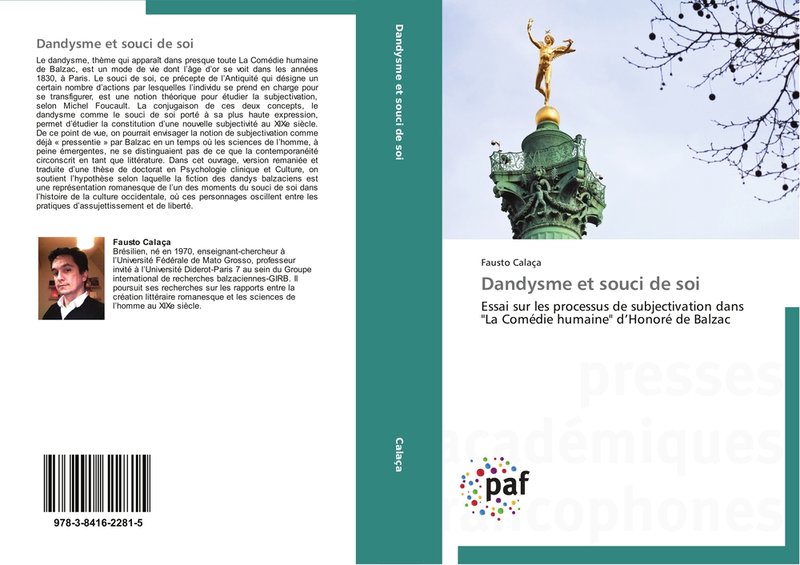
Fausto Calaça, Dandysme et souci de soi: Essai sur les processus de subjectivation dans “La Comédie humaine” d’Honoré de Balzac, Presses Académiques Francophones ( 28.08.2013 )

Cet ouvrage est la version remaniée et traduite d’une thèse de doctorat en « Psychologie clinique et Culture » soutenue dans sa version en langue portugaise, « Dandismo e cuidado de si : ensaios de subjetivação em Balzac », le 10 mars 2010 à l’Université de Brasilia (Brésil), par Fausto Calaça, sous les directions de Terezinha de Camargo-Viana et Olivier Bara. La recherche scientifique a été accomplie avec un stage doctoral à la Faculté des Lettres de l’Université Lumière Lyon 2 et dans l’UMR « Littérature, idéologies, représentations, XVIIIe-XIXe siècles-Lire » (CNRS), dans le cadre du Collège Doctoral Franco-Brésilien, financé par la Fondation Capes-Brésil.

Le dandysme, thème qui apparaît dans presque toute La Comédie humaine de Balzac, est un mode de vie dont l’âge d’or se voit dans les années 1830, à Paris. Le souci de soi, ce précepte de l’Antiquité qui désigne un certain nombre d’actions par lesquelles l’individu se prend en charge pour se transfigurer, est une notion théorique pour étudier la subjectivation, selon Michel Foucault. La conjugaison de ces deux concepts, le dandysme comme le souci de soi porté à sa plus haute expression, permet d’étudier la constitution d’une nouvelle subjectivité au XIXe siècle. De ce point de vue, on pourrait envisager la notion de subjectivation comme déjà « pressentie » par Balzac en un temps où les sciences de l’homme, à peine émergentes, ne se distinguaient pas de ce que la contemporanéité circonscrit en tant que littérature. Dans cet ouvrage, version remaniée et traduite d’une thèse de doctorat en Psychologie clinique et Culture, on soutient l’hypothèse selon laquelle la fiction des dandys balzaciens est une représentation romanesque de l’un des moments du souci de soi dans l’histoire de la culture occidentale, où ces personnages oscillent entre les pratiques d’assujettissement et de liberté.