Xavier Riondet ECS Forum 13/12/2013
À côté de Freinet : une enquête philosophico-historique d’allure foucaldienne
Education, Culture and Society Research Group Forum
KU Leuven

Xavier Riondet ECS Forum 13/12/2013
À côté de Freinet : une enquête philosophico-historique d’allure foucaldienne
Education, Culture and Society Research Group Forum
KU Leuven
Henrik Bang, Rethinking Michel Foucault: The Political Circle of Parrhesia and Democracy, 2014
As part of Sydney Democracy Network‘s seminar series, Professor Henrik Bang (University of Canberra) indicates perspectives on Michel Foucault that can inform our understanding of democracy.
Michel Foucault has become an exemplar in the disciplines of philosophy, sociology, history, linguistics and literary criticism. Ironically, he has never made much of an impact upon the political discipline, to which he first of all belongs, and in which he deserves a prominent position as one of the best political theorists and researchers of all time. In particular in his later strings of lectures from 1978 to 1984 he develops an empirical and normative approach to studying the political as governmentality.
Anthony Merino, Foucault for Dummies, Arts & Opinion. Arts, Culture, Analysis, Vol. 13, No. 3, 2014
Michel Foucault wrote anti-historical histories. He is most noted for his histories of four social domains: mental illness, crime and punishment, health systems, and sexuality. With a few exceptions, he does not talk much about art. He wrote a short book on René Magritte’s “Ceci n’est pas une pipe,” French for “This is not a pipe,” and in The Order of Things, Foucault wrote on Diego Velázquez’s painting “Las Meninas.” Foucault has been called a lot of things: historian, structuralist, Marxist, linguist, colonialist, nihilist and sociologist. He wrote two books on art, but these were not central to his work. So, why read Foucault? His influence on contemporary thought and society is profound. His thought seeps through academic disciplines into popular culture. Intellectual paranoia permeates his writing. For Foucault the most insidious forms of domination are those guised as given. Foucault was also a serial inverter who constantly switched cause and effect. Foucault’s writings say nothing about making a ceramic pot. The process of making a pot can however, illuminate many of the more difficult theories Foucault promoted.
Read more
Full article
Anthony Merino, independent art critic, has published over 70 reviews. He is a ceramic artist and has lectured internationally on contemporary ceramics.
Governmentality in the Age of Neoliberalism
Wendy Brown, University of California, Berkeley
Video of Professor Wendy Brown’s talk in March 2014 at the Pacific Centre for Technology and Culture at the University of Victoria in Canada on governmentality in the age of neoliberalism.
The Politics of Legality in a Neoliberal Age
1-2 August 2014
Staff Common Room, Level 2, Faculty of Law, University of New South Wales
Building F8. See map
Daniel McLoughlin and Ben Golder are organising a symposium in the Law School on 1-2 August 2014, under the umbrella of the ‘Public Law and Legal Theory Project’ at the Gilbert + Tobin Centre of Public Law. The event is supported both by the Centre and by the Faculty’s workshop support scheme.
The organisers would like to warmly invite all who are interested to attend the event. Registration is free but we do ask that people register their intention to attend by emailing an RSVP to gtcentre@unsw.edu.au with the subject line ‘Neoliberalism Symposium’. Please hurry as spaces are limited!
8.30-9.00: Registration and Collection of Name Badges
9.00-9.30 Welcome and Introduction
Daniel McLoughlin (University of New South Wales)
9.30-10.45 Panel 1: The Political Economy of Neoliberalism
Damien Cahill, ‘Embedded Neoliberalism and its Durability’ (University of Sydney)
Rob Nicholls, ‘And so to Bed: Regulatory Regimes as a Mechanism to Embed Neoliberalism’ (University of New South Wales)
10.45-11.15: Morning Tea
11.15-12.30: Panel 2: Neoliberalism and State Authority
Anna Yeatman, ‘Neoliberalism and the Question of Authority’ (University of Western Sydney)
Chris Butler, ‘State Power under Authoritarian Neoliberalism’ (Griffith University)
12.30-13.30: Lunch
13.30-15.15: Panel 3: Law and Economy in Neoliberal Thought
Jessica Whyte, ‘Governing homo œconomicus: Michel Foucault, Adam Ferguson, and the Providential Logic of Civil Society’ (University of Western Sydney)
Miguel Vatter, ‘Legal Systems and Economic Equilibrium: Hayek vs Becker’ (University of New South Wales)
Paul Patton, ‘Rights, Interests and the Basis of Government’ (University of New South Wales)
15.15-15.45: Afternoon Tea
15.45-17.00: Panel 4: Neoliberal Uses of the Rule of Law
Martin Krygier, ‘Trajectories of the Rule of Law: Pre-liberal, Liberal, Neo-, and Non-’ (University of New South Wales)
Melinda Cooper, ‘Postcolonial Family Law – Economic Liberalization, Rule of Law and the Reinvention of Tradition’ (University of Sydney)
Saturday 2 August 2014
Staff Common Room, Level 2, Faculty of Law, University of New South Wales
10.00-11.45: Panel 5: Law and Neoliberalism in the Global South
Fleur Johns, ‘Power Dispersal in the Work of Milton Friedman and in the Mekong River Basin: Nam Theun II and Xayaburi’ (University of New South Wales)
Javier Couso, ‘Constructing “Privatopia”: The Role of Constitutional Law and Courts in Chile’s Radical Neoliberal Experiment’ (Universidad Diego Portales)
Chepal Sherpa, ‘Theorizing Democratic Legality under Neoliberal Capitalism: India’s Neoliberal Project and the Maoist Alternative’ (Jawaharlal Nehru University)
11.45-12.15: Morning Tea
12.15-14.00: Panel 6: Neoliberal Legality Beyond the Nation State
Thomas Biebricher, ‘Understanding the Rise of Juridical Neoliberalism in Europe’ (Goethe-Universität Frankfurt)
Ntina Tzouvala, ‘Neo-liberalism as Legalism: The Rise of the Judiciary and International Trade Law’ (Durham University)
Jothie Rajah, ‘Neo-liberalism and the World Justice Project’s Rule of Law Index’ (American Bar Foundation)
14.00-15.00: Lunch
15.00-16.45: Panel 7: Strange Bedfellows? Human Rights and Neoliberalism
Samuel Moyn, ‘A Powerless Companion: Human Rights in the Age of Neoliberalism’ (Harvard)
Zeynep Kivilcim, ‘Articulating Human Rights Discourse in Local Struggles in a Neoliberal Age’ (Istanbul University)
Ben Golder, ‘The Neoliberal Question: Human Rights, Legal Form, and Political Strategy’ (University of New South Wales)
14.45: End
Call for papers
Workshop
Historicising Foucault: What does this mean?
6-8 November 2014
University of Zurich, Switzerland
Michel Foucault figures among the icons of today’s cultural and social sciences. The French philosopher and historian is productively read, quoted, discussed, refuted, and recycled in virtually every cultural and social scientific discipline. Voiced in 1975, Foucault’s invitation that people should help themselves to his works and concepts as if using a toolbox’ (‘make of it what you will’) was so widely taken up that the toolbox has since become standard equipment above all for the work of the cultural sciences. Indeed, the ‘toolbox’ contains an extraordinarily dazzling inventory of concepts, methods, models, sketches, and instruments, and last but not least still proves to be a treasure chest.
But today, thirty years after Foucault’s death, we — the group of editors of the ‘foucaultblog‘ — also face questions regarding the historicisation of this tool box with its instruments whose applicability seems independent of the context of their origins. How did this toolbox that we use actually come about? What does it mean for us today that it originated in the Cold War era in opposition to the ‘hyper-Marxism’ of the New Left, in a certain proximity to structuralism, in the struggle against the French prison system, that it was possibly shaped by commitments to Soviet dissidents, Spanish anarchists, Shiite revolutionaries, or Polish workers and undoubtedly by a fascination with the American counterculture and the Zen culture of Japan, but maybe even influenced by the New Age?? Do all of these ‘contexts’, ‘backgrounds’, and genealogies belong to the Foucauldian toolbox? It can be no other way: Foucault’s thought always and explicitly referred to his present and the poli tical context of his time. But does this not imbue his own concepts and analytical models with an ineluctable historicity? Undoubtedly, and today we should therefore set about writing the genealogy of the Foucauldian toolbox in order to understand it better, to be able to keep using it, but also to bring it up to date and adapt it to today’s scholarly and political situation. And perhaps also to discard some of it.
With such a project in mind, the ‘foucaultblog’ invites all interested scholars to attend a workshop at the University of Zurich on 6-8 November 2014 to discuss the question ‘Historicising Foucault: what does this mean?’ The initial objective will be to locate within a genuine historical context not only the life and work of the author Michel Foucault (1925-1984) but also ‘Foucault’ in his iconic nature and almost ubiquitous presence as a body of interrelated statements that for thirty years has been virulent in the cultural sciences throughout the world. This means interrogating this body of interrelated statements with regard to its specific conditions of possibility, theory formation processes, discursive strategies, and resonance chambers. But it also means taking the claim of historicisation seriously and filling this catchword with life, making the historicisation of Foucault (and ‘Foucault’) the object of one’s own research. We hold the view that such a venture does not by any means require an exclusively historiographical orientation but rather should proceed from all disciplines that work or deal with Foucault. For the new perspective that this can open up is always contemporary in nature: we believe that the historicisation of Foucault’s toolbox opens up new opportunities to think about how this intellectual tool kit can still be used today — or explains why it must perhaps be partially rejected. Work about Foucault is work on Foucault.
Organizational information:
The workshop will take place on 6-8 November 2014 at the University of Zurich.
All interested scholars are invited to send their proposals for papers (abstracts no longer than 500 words) by 30 June 2014 to foucaultblog@fsw.uzh.ch.
The costs of travel and accommodations will be covered for contributors.
The plan is to publish and comment on the workshop contributions on the foucaultblog. The contributors are therefore requested to post brief preliminary versions of their papers on the foucaultblog in advance of the workshops. These will then be provided with commentary, which the contributors can or should address during the workshops. After the conference, the presented papers can be published in full length on the foucaultblog.
Contact: foucaultblog@fsw.uzh.ch
Conference languages: German and English
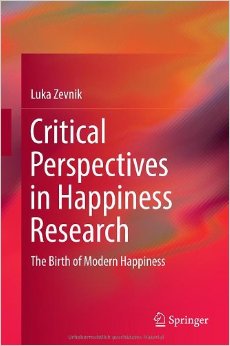 Zevnik, Luka, Critical Perspectives in Happiness Research: The Birth of Modern Happiness, Springer, 2014
Keywords »Anthropology of Well-Being – Art of Living – Basic Parameters of Happiness – Critical History of Happiness – Cultural Construction of Happiness – Cultural Neuroscience – Culture and Relations – Empirical Happiness Research – Ethnocentrism and Happiness – Eudaimonic Well-Being – Foucault and Happiness – Happiness Studies and Life Satisfaction – Happiness and Consumer Culture – Happiness and Culture – Happiness and Medieval Theology – Happiness and Pastoral Power – Interdisciplinary Approach to the Study of Happiness – Middle Ages and Happiness – Neoroscience of Happiness – Origins of Happiness in the Western Culture – Positive Timeless Universal Experience – Public and Communal Happiness – Pursuit of Happiness – Sin and Salvation – The Birth of Modern Happiness – Understanding of Happiness
Dr. Luka Zevnik is assistant professor at University of Ljubljana. He is interdisciplinary oriented and has presented conference papers and published on happiness and emotions, popular culture, consumer culture, experience, cultural studies and neuroscience.
Prospects for an Ethics of Self-Cultivation
Conference 1: ‘Hellenistic Ethics in Nietzsche and Foucault’
Date: 25-27 September, 2014
Location: The University of Warwick, UK
1st Call for Abstracts:
Philosophical interest in the ethical ideal of self-cultivation has increased in the nineteenth and twentieth centuries as philosophers have sought alternatives to deontological and utilitarian theories. This interest has been most evident in the widespread revival of virtue ethics, although contemporary virtue ethicists tend to focus on Aristotle’s account of character formation. Philosophers in the modern European tradition, however, have been influenced by other views on self-cultivation from the Hellenistic period. Nietzsche’s account of self-cultivation, for instance, is closer to Epicurus’s than Aristotle’s, while Foucault draws extensively on Stoicism and Cynicism for his account. The insights of these thinkers suggest that we may deepen and expand our understanding of self-cultivation by reassessing the merits of the Hellenistic tradition.
Confirmed Speakers
Prof. Keith Ansell-Pearson (Warwick)
Prof. Daniel Conway (Texas A&M)
Dr Edward Harcourt (Oxford)
Prof. Beatrice Han-Pile (Essex)
Dr John Sellars (Birkbeck)
Dr David Webb (Staffordshire)
We welcome papers suitable for 30 minute presentation on self-cultivation in Hellenistic ethics and modern European philosophy. Abstracts of around 500 words suitable for blind review should be sent to selfcultivation@warwick.ac.uk by June 30th 2014. Submissions from graduate students and early-career researchers are especially welcome.
This event will be followed by a second conference hosted by Monash University in 2015 with a separate registration and CFA. To find out more about the research project please visit our webpage: www2.warwick.ac.uk/selfcultivation, and to keep up with future news join our Facebook page at www.facebook.com/selfcultivation2014.
Marcella Milana and John Holford (Eds), Adult Education Policy and the European Union: Theoretical and Methodological Perspectives. Rotterdam, Sense Publishers, 2014
| Original language | English |
|---|---|
| Publication year | 2014 |
| Place of publication | Rotterdam |
|---|---|
| Publisher | Sense Publishers |
| Number of pages | 180 |
| ISBN (print) | 978-94-6209-546-5, 978-94-6209-547-2 |
| ISBN (electronic) | 978-94-6209-548-9 |
| State | In press |
| Name | Research on the Education and Learning of Adults |
|---|---|
| Volume | I |

Dates à venir
Vendredi 23 mai à 23h, dans le cadre de La Nuit des idées,
Notre corps utopique, Théâtre national Bordeaux Aquitaine (33)
Pour en savoir plus, visitez cette page ou cette page
Jeudi 19 juin à 19h, Le corps utopique, variation pour 2 comédiennes,
dans le cadre du Colloque International Foucault 1984 – 2014, Université Paris – Est Créteil (94)
Pour en savoir plus, téléchargez le programme
Jeudi 5 juin à 18h, restitution du travail avec les lycéens du lycée Jean Vilar, Plaisir (78), au Collectif 12
Pour en savoir plus, visitez cette page
Le petit corps utopique
Après Notre corps utopique,et librement inspiré du même texte de Foucault,
le collectif F71 prépare un spectacle pour tous à partir de 6 ans, Le petit corps utopique
Création prévue le 23 mars 2015 au Collectif 12, dans le cadre du festival Les Francos
Du 5 mai au 2 juin 2014, résidence de création à l’école Ferdinand Buisson de Mantes-la-Jolie (78) avec le Collectif 12
Lundi 2 juin à 18h, restitution du travail avec les classes de CP et de CM2 au Collectif 12
Pour en savoir plus, visitez cette page et cette page
Contact
Mélanie Autier, 06 22 13 06 82, production.collectiff71@gmail.com
Christelle Kongolo, 06 15 87 39 64, diffusion.collectiff71@gmail.com
Rejoignez-nous sur notre page facebook, ici
 Foucault News