Foucault News

News and resources on French thinker Michel Foucault (1926-1984)

Call For Papers:

Conduct and Counter-Conduct:
Critical Concepts for Old and New Times?

A special issue of Foucault Studies,
edited Barbara Cruikshank (University of Massachusetts at Amherst)
and Sam Binkley (Emerson College)

PDF of Call for papers

Update September 2025. The special issue in response to this call was published 28 June 2016, no. 21.

Recently, Arnold Davidson* distinguished Michel Foucault’s conceptions of conduct and counter-conduct as the most notable contribution of Foucault’s 1978 lectures. “It is astonishing,” he wrote, “and of profound significance, that the autonomous sphere of conduct has been more or less invisible in the history of modern (as opposed to ancient) moral and political philosophy.” Following Davidson’s lead, we invite contributions for a special issue of Foucault Studies on the theme of counter-conduct. We invite submissions, in particular, to take up the historical, conceptual, and political significance of conduct and counter-conduct either separately or in combination. These might include theoretical inquiries, empirical studies, comparative historical works, interpretive cultural studies or any other mode of intellectual engagement that addresses the theme of counter-conduct.

Questions and topics we aim to address in this volume include:

  • Given the immanent relation between conduct and counter-conduct, what is the critical difference between them? How can we distinguish between an instance of conduct and one of counter-conduct?
  • How should we understand the concepts of conduct and counter-conduct, articulated by Foucault in 1978, in relation to his previous and subsequent published works? Or, do these concepts stand apart in relation to a particular problematization?
  • Are these categories we can use across time, place, religions, institutions? If so, what forms do conduct and counter-conduct take today? If not, what demarcates their usage?
  • How can contemporary political movements, governmentalities, or moral and political philosophies be engaged through the concepts of conduct and counter-conduct?
  • Does counter-conduct help us understand new subjectivities and identities shaped by race, class, gender, sexuality, ability or other categories at the margins?
  • What value does the concept of counter-conduct hold for historical studies?
  • How is counter-conduct distinguishable from reform and reformation of the self, institutions, or of society? Foucault struggled in his lecture to distinguish counter-conduct as a category from resistance, revolt, and dissent, among other categories. Why does Foucault need to invent a new concept rather than use the vocabularies of pastoral struggles themselves?
  • What contribution can the concept of counter-conduct make to contemporary scholarship on governmentality?
  • What is the significance of counter-conduct in the context of contemporary neoliberalism or other formations of global capital, and to the many oppositional social movements that have emerged in their wake?
  • How can counter-conduct be understood alongside other theorizations of resistance, revolt, and transgression derived from Marxism, post-colonial theory, feminism, cultural studies or queer theory?
  • What is the relationship of counter-conduct to religion, spirituality and mysticism, either historically or in contemporary manifestations?
  • How does counter-conduct enable a bridge between the politics and ethics, either in Foucault’s researches or in other contexts?

This special issue of Foucault Studies will appear in Spring 2016. At this time the editors welcome abstracts for submission by October 1, 2014. Final essays will be due April 1, 2015. Please direct all questions and correspondence to both editors: Samuel_binkley@emerson.edu, and cruiksha@polsci.umass.edu.

Foucault Studies is an open-access, peer reviewed interdisciplinary online journal. Since 2004, Foucault Studies has covered the full influence of Foucauldian thought on such problematics and fields of study as power, politics, law, history, social and cultural theory, sexuality, race, religion, gender studies, psychoanalysis, philosophy, geography, architecture, education, health studies, management studies and media studies, as well as others. The Journal also publishes translations of shorter pieces from Foucault’s oeuvre, and carries book reviews, conference and seminar reports. Visit Foucault Studies at https://www.pennpress.org/journals/journal/foucault-studies/.

_________________________________

* Arnold I. Davidson, “In Praise of Counter-Conduct”, History of the Human Sciences October 2011 vol. 24 no. 4 25-41
Call for Papers
A HISTORY OF PENAL REGIMES IN GLOBAL PERSPECTIVE: 1800-2014

Harvard University
March 5-7th, 2015
Website

The rise of the prison has been an important historical development of the modern era. Over the past two hundred years, the growth of prisons has ticked upward. Confinement has come to dominate national penal regimes, increasingly replacing bodily harm as a primary form of punishment. Prisons now span the globe. While rates of incarceration have varied widely over the past two centuries across nations and over time, the last third of the twentieth-century witnessed an upward trend from the United States to Brazil and China. In the United States, prisons have become a pressing social problem with the highest number of its citizens behind bars of any country in the world.

On the occasion of the 40th anniversary of Michel Foucault’s Discipline and Punish: The Birth of the Prison (1975) the influential book that first opened a new line of inquiry into the study of the prison, the Weatherhead Initiative on Global History is planning a conference to spark a global conversation among researchers in the social sciences and humanities at work on the history of distinctive penal regimes. We are interested in exploring the diversity of regimes of punishment, and especially the prison as an institution within them, the paths along which they changed, and—most especially—the connections between these changes in different parts of the world.  The conference is open to papers that address a variety of themes from the philosophical underpinnings of systems of punishment, the character and function of regimes of incarceration and penality in colonial, liberal, neo-liberal and authoritarian state systems, and the distinctive cultures of confinement that have emerged within these varied systems. We hope to balance broadly comparative papers and revealing case studies. We are seeking proposals from scholars at all stages of their academic career, including graduate students. We are particularly interested in forging a global discussion of these topics, and therefore especially welcome contributions from outside North America and Europe.

The Weatherhead Initiative on Global History is a recently created center that responds to the growing interest at Harvard in the encompassing study of global history. The Initiative is committed to the systematic scrutiny of developments that have unfolded across national, regional, and continental boundaries as well as to analysis of the interconnections—cultural, economic, ecological and demographic—among world societies. For further information about WIGH and the conference, please consult our website at http://wigh.wcfia.harvard.edu.

Proposals should include an abstract of no more than 500 words and a brief curriculum vita. Please email your submissions to Jessica Barnard (jbarnard@wcfia.harvard.edu) by May 25, 2014 with the heading “Penal Regimes Conference.” Travel expenses (economy) as well as accommodation will be covered.

WIGH Chairs:
Sven Beckert, Laird Bell Professor of History, Harvard University
Charles S. Maier, Leverett Saltonstall Professor of History, Harvard University

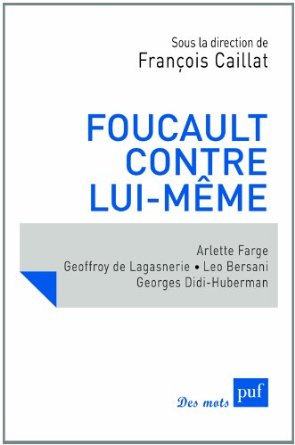
caillat François Caillat (dir.) Foucault contre lui-même , Paris: PUF, 2014

L’ouvrage
Dans sa vie privée, autant que dans son œuvre ou dans son rapport à la politique, Foucault n’a cessé de rompre avec lui-même.
Dans sa vie privée, Foucault quitte sa région natale très jeune, il change son patronyme et travaille dur pour intégrer l’ENS de Paris. Aussitôt entre les murs de la rue d’Ulm, il s’y sent mal et quitte la France, voyage à travers l’Europe, sans se fixer. Même quand il intègrera le Collège de France, il ne cessera de se définir contre l’institution. Dans son œuvre, il réécrit ses livres quand il les réédite, se dit « enfant de cœur du structuralisme » avant de dire qu’il n’a jamais été structuraliste, renie certains de ses livres. Il s’intéresse au marxisme puis, quelques années plus tard, au néolibéralisme et soutient des mouvements politiques (mouvements gays, maoïsme…), puis les critique, parfois très durement. Foucault, comme il l’a dit lui même, n’aura cessé de s’arracher à lui-même, de se « déprendre », de sans cesse se construire contre ce qu’il a été et ce qu’il a fait.

Ce livre montre comment la rupture est au centre du travail de Foucault et de sa vie, à travers des réflexions sur l’histoire, les mouvements homosexuels, la théorie, la domination, les institutions, l’Université, etc. Loin de se limiter toutefois à un commentaire académique de Foucault, il repense l’héritage de Foucault afin d’élaborer de nouveaux problèmes théoriques et de nouvelles politiques de lutte contre les mécanismes de la domination.

Table des matières

Se déprendre, François Caillat

Que signifie penser? Geoffroy de Lagasnerie

Percevoir l’intolérable, Arlette Farge

Apprendre à fuir (à propos des modes relationnels), Leo Bersani

Savoir trancher, Georges Didi-Huberman

François Caillat est réalisateur. Agrégé de philosophie, il a réalisé de nombreux documentaires et plusieurs films sur de grandes figures intellectuelles comme Le Clézio ou encore Julia Kristeva. Il a notamment réalisé Foucault contre lui-même, diffusé sur Arte en juin 2014.

Contributions d’Arlette Farge, Geoffroy de Lagasnerie, Leo Bersani, Georges Didi Huberman, Didier Eribon.

With thanks to Alexandre Klein for this news

‘Foucault contre lui-même’: un film de François Caillat (2014)

Cécile Mazin, Foucault contre lui-même : Arte dans la tête d’un philosophe
Un documentaire pour le trentième anniversaire de la mort, ActuaLitté, 15 avril 2014.

À l’occasion du trentième anniversaire de la disparation de Michel Foucault, arte diffuse le documentaire Foucault contre lui-même – ou comment un penseur majeur du 20e siècle a réussi à ne jamais donner une vision figée de lui-même et de ses travaux.

Disparu en juin 1984, Michel Foucault a laissé une œuvre traduite dans le monde entier, soumise à interprétation, source d’inspiration pour de nombreux penseurs. L’homme se montra à la mesure de son œuvre : complexe et contrasté. Il fut en même temps militant radical et professeur au collège de France, engagé politique et philosophe studieux, vivant volontiers aux marges et soucieux de tenir une place centrale dans l’institution. C’était un personnage brillant, incisif, iconoclaste.

Intervenant depuis sa chaire comme dans la rue, il a incarné la figure d’un intellectuel en prise avec son temps, tirant de son expérience personnelle la matière à des réflexions qui ont dépassé son époque et font autorité.

Le film présente le cheminement d’une pensée sujette à variations et souvent à des reniements, déplacée d’une discipline à l’autre, changeant de perspective et de centres d’intérêt, mais inscrite dans une grande cohérence. En trente ans, le travail de Michel Foucault construit un parcours multiple, pluriel, d’une originalité reconnue par tous et probablement inégalée.

Rendez-vous le 18 juin, à 22h20 sur Arte, donc.

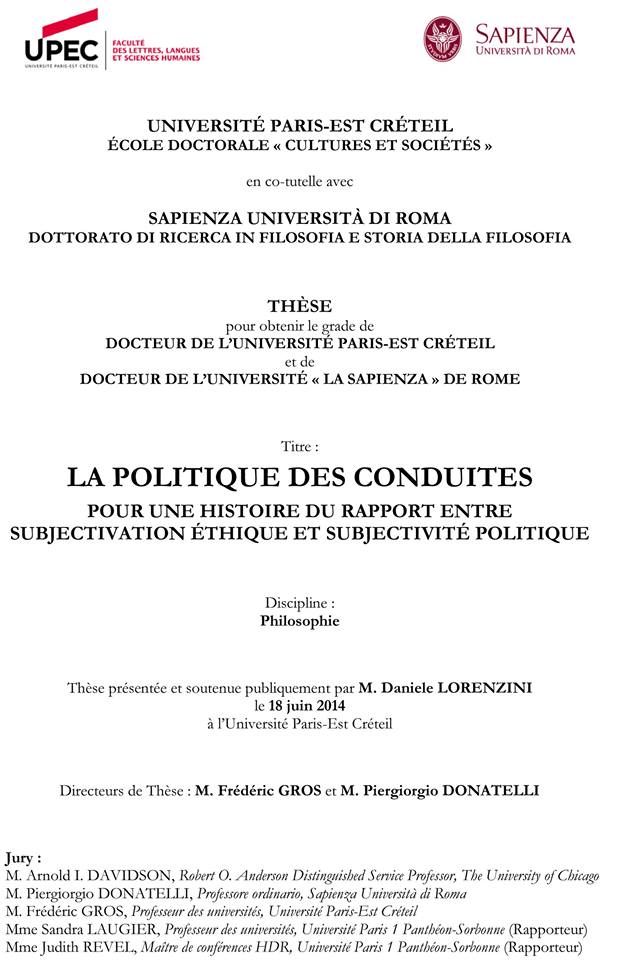
Daniele Lorenzini
“La politique des conduites. Pour une histoire du rapport entre subjectivation éthique et subjectivité politique”

Université Paris-Est Créteil, 61 avenue du Général de Gaulle, 94010 Créteil (métro Créteil-Université, ligne 8), salle des thèses

lorenzini-these

Résumé :
À partir de l’usage croisé des perspectives philosophiques de Michel Foucault, Pierre Hadot et Stanley Cavell, cette thèse vise à inaugurer un champ de recherche en éthique et en philosophie politique jusqu’à maintenant presque inexploré. Elle a trois objectifs principaux : (1) Explorer le rapport qui existe entre éthique et politique, ou plus précisément entre philosophie morale et philosophie politique, à travers la redéfinition de leurs objets, de leurs méthodes et de leurs buts respectifs par le biais d’un usage spécifique de la pensée de Michel Foucault et de Ludwig Wittgenstein. Élaborer par conséquent une « philosophie analytique de la politique » qui se propose de rendre visible l’existence et le fonctionnement concret du pouvoir dans ses ramifications ordinaires et son impact assujettissant-subjectivant sur la vie quotidienne des individus. (2) Mettre en lumière la valeur des techniques de soi et des exercices spirituels, ou mieux de ce que l’on suggère d’appeler « techniques de l’ordinaire », grâce à la comparaison, mais aussi à la mise « en tension », des travaux du dernier Michel Foucault, de Pierre Hadot et de Stanley Cavell (notamment ceux qui abordent le « perfectionnisme moral »), ainsi que, entre autres, de Ralph Waldo Emerson, John Stuart Mill, Henry David Thoreau, Iris Murdoch et Cora Diamond. (3) Poser le problème du statut de la vérité à l’intérieur d’une telle perspective éthico-politique, en défendant la nécessité d’élaborer une conception non-épistémologique de la vérité et en s’interrogeant sur le rôle que cette conception joue par rapport aux techniques de l’ordinaire.

“The Politics of Conduct. A History of the Relationship between Ethical Subjectivation and Political Subjectivity”

Abstract:
Starting from a crossed use of Michel Foucault, Pierre Hadot and Stanley Cavell’s philosophical perspectives, this dissertation aims to open a new field of research in ethics and political philosophy. It has three main objectives: (1) Exploring the relationship between ethics and politics, or more precisely between moral and political philosophy, through a redefinition of their objects, methods and goals via a specific use of Michel Foucault and Ludwig Wittgenstein’s thought. Developing, as a consequence, an “analytic philosophy of politics” aiming to make visible the existence and concrete functioning of power in its ordinary ramifications and its effects of subjection-subjectivation on the everyday life of the individuals. (2) Highlighting the value of the techniques of the self and the spiritual exercises, or better of what can be called the “techniques of the ordinary”, thanks to the comparison, but also the confrontation, between the works of Michel Foucault, Pierre Hadot and Stanley Cavell (especially his writings on “moral perfectionism”), as well as, among others, Ralph Waldo Emerson, John Stuart Mill, Henry David Thoreau, Iris Murdoch and Cora Diamond. (3) Raising the problem of the meaning of the notion of truth within such an ethico-political context, defending the necessity to elaborate a non-epistemological conception of truth and exploring its role in relation to the techniques of the ordinary.

Hammersley, M., Traianou, A.
Foucault and Research Ethics: On the Autonomy of the Researcher
(2014) Qualitative Inquiry, 20 (3), pp. 227-238.

Abstract
This article uses the later writings of Foucault as a means of reflecting on research ethics, and in particular on the notion of researcher autonomy. It is suggested that such autonomy is a precondition for ethical practice, and also for sound research, and it is noted that it is under threat today, not least from creeping ethical regulation. Foucault’s philosophical position is outlined, noting the shift that took place in his later writings. There have been only a few attempts to use his ideas in thinking about research ethics, but we examine how they have been applied in relation to the ethics of anthropology. This is followed by a discussion of some widely recognized, and quite serious, problems with Foucault’s position. Finally, a number of positive and negative lessons that can be learned from his work are presented.

Author Keywords
autonomy; Foucault; research ethics

DOI: 10.1177/1077800413489528

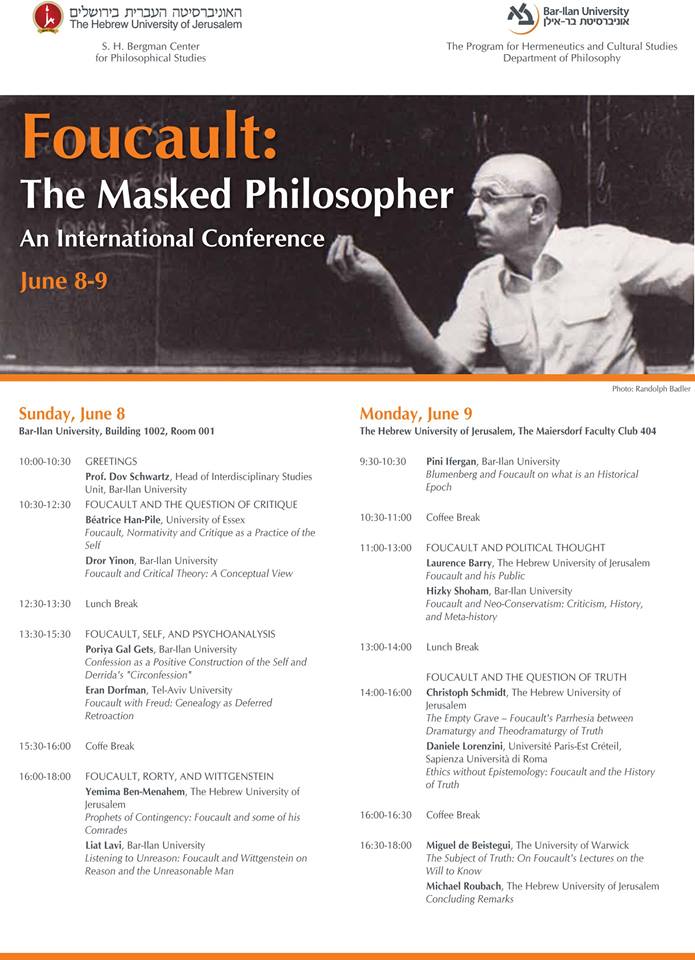
“Foucault: The Masked Philosopher”
An International Conference
June 8-9, 2014
Bar-Ilan University & The Hebrew University of Jerusalem

masked-philosopher

Semaine du 14 au 20 juin : Spécial Michel Foucault / Alain Juppé / Samuel Pisar / Michael Edwards…

SPECIAL MICHEL FOUCAULT (1926-1984)
> samedi 14 juin

16h-17h UNE VIE, UNE ŒUVRE

Michel Foucault par Christine Goémé

L’œuvre de Michel Foucault est surtout connue pour ses effets militants : elle a démystifié le pouvoir médical, l’enfermement des fous et des criminels ; elle est une vue critique archéologique de nos façons de voir, de savoir et de sentir. Mais on n’insistera jamais assez sur ce qui importait à travers tout cela. Une interrogation sur la nature et l’histoire du vrai. Comment des valeurs, des réalités, ou des discours deviennent-ils vrais ? C’est à saisir cette naissance de la vérité que Michel Foucault s’est consacré. Comment en effet Michel Foucault a-t-il travaillé à faire surgir la vérité, selon cette manière de cerner l’espace où se produisent des effets de vérité, par-delà le jeu entre le vrai et le faux ? Non pas système de pensée, mais méthode d’approche à travers la confrontation de plusieurs discours et de plusieurs réalités. Non pas réflexion sur des objets de savoir, mais à partir d’objets laissés de côté par le savoir, comme en creux. Que l’homme ait à se “dépendre de lui-même”, telle sera la démonstration de cette émission, en prise directe avec l’enseignement de Michel Foucault et sa déconstruction des systèmes. (1ère diff. 7/07/1988).

>  du samedi 14 au lundi 16 juin 15 juin, 2 nuits spéciales Foucault : archives et entretiens avec Frédéric Gros, philosophe, Eric Fassin, sociologue et Philippe Artières, philosophe.

Du 14 au 15 juin, 0h-6h30 LES NUITS par Philippe Garbit – Réalisation : Virginie Mourthé

Nuit spéciale Michel Foucault (1/2) avec Frédéric Gros et Eric Fassin

0h-0h30 Entretien avec Frédéric Gros

0h30-5h15 Michel Foucault : l’art de penser (1/2) par Christine Goémé (1ère diff. 3/08/1991)

Avec Raymond Bellour, Robert Castel, Daniel Defert, Bruno Karsenti, Jacques Lagrange, Gérard Lebrun, Anne-Marie Lecoq, Pierre Macherey, Jean-Claude Milner, Judith Revel et Severo Sarduy

5h15-5h45 Entretien avec Eric Fassin

A propos de la réédition de Herculine Barbin dite Alexina B.

5h45-6h25 L’usage de la parole – Langages de la folie (3)

La persécution par Michel Foucault (1ère diff. 21/01/1963)

Du 15 au 16 juin, 0h-6h30 LES NUITS par Philippe Garbit

Nuit spéciale Michel Foucault (2/2) avec Philippe Artières

0h-0h25 Entretien avec Philippe Artières

0h25-5h20 Michel Foucault : l’art de penser (2/2) par Christine Goémé (1ère diff. 4/08/1991)

Avec Daniel Defert, Myriam Revault d’Allonnes, Danielle Rancière, Michelle Perrot, Christian Jambet, Pierre Macherey, Jacques Lagrange, Arlette Farge, François Ewald, Jean-Pierre Vernant et Pierre Hadot

5h20-5h55 L’usage de la parole – Langages de la folie : Le langage en folie par Michel Foucault (1ère diff. 4/02/1963)

PPCspine22mmTony McHugh, Faces Inside and Outside the Clinic. A Foucauldian Perspective on Cosmetic Facial Modification. Routledge, 2017
[Originally published by Ashgate, 2013]

Drawing on studies of surface topography, image editing, and diagnostic and surgical experience, Faces Inside and Outside the Clinic addresses the notion of ‘truth’ in what are considered to be ‘right’ and ‘wrong’ faces, whether in clinical cosmetic procedures or in specific sociocultural contexts outside the clinic. With attention to the manner in which the human face – and often the individual herself or himself as a consequence – is physically defined, conceptually judged, numerically measured and clinically analysed, this book reveals that on closer inspection, supposedly objective and evidential ‘truths’ are in fact subjective and prescriptive.

Adopting a Foucauldian analysis of the ways in which ‘normalising technologies’ and ‘techniques’ ultimately preserve and expand upon an increasing array of ‘abnormal’ facial configurations, Faces Inside and Outside the Clinic shows that when determining ‘right’ and ‘wrong’ faces, what happens inside the clinic is inextricably linked to what happens outside the clinic – and vice versa. As such, it will be of interest to scholars and students of social, cultural and political theory, contemporary philosophy and the social scientific study of science, health and technology.

  • Contents: Foreword, Nikki Sullivan; Introduction: the human face is…; Surfaces and depths in and of the face; Re-visioning faces in time and space; Technologies and techniques of and for the face; The face of an-other as oneself; Conclusion; References; Index.
  • About the Author: Tony McHugh is a research associate in the Department of Media, Music, Communication, and Cultural Studies at Macquarie University, Australia, and has three decades of diagnostic and surgical teaching experience at the University of Sydney, Australia.
  • Reviews: ‘This book is excellent in every dimension: originality, significance, scope of argument…demonstrating that medical knowledge is always situated and showing the relevance of Foucault’s work to our understanding of the contemporary patient as medical subject.’
    Arthur Frank, University of Calgary, Canada

‘Much has been written from outside the clinic about the body and the technologies that are employed to refashion it. This remarkable volume however is written by a surgeon from inside the clinic. The result is an authoritative but compassionate study of the face, its ontological complexity and its diverse cultural meanings.’
Bryan S. Turner, The City University of New York, USA

‘This is a fascinating account of the face and its surgical modification by an oral plastic surgeon and scholar of Foucault. The angle of vision McHugh brings to the subject of cosmetic surgery is unique and imaginative; it is both theoretically sophisticated and grounded in the embodied experiences of patients and surgeons both inside and outside the clinic.‘
Victoria Pitts-Taylor, Queens College and Graduate Center, City University of New York, USA

becker Gary S. Becker, Nobel-winning scholar of economics and sociology, 1930-2014

Obituary by William Harms, UChicago News, May 4 2014

Nobel Laureate Gary S. Becker, AM’53, PhD’55, made historic changes to the study of economics and the social sciences, combining disciplines to understand decisions in everyday life, while spawning rich new questions for scholars in diverse fields to pursue.

Becker, 83, University Professor of Economics and of Sociology at the University of Chicago, died on May 3 following complications from a recent surgery. He won the Nobel Memorial Prize in Economic Sciences in 1992 [1] “for having extended the domain of microeconomic analysis to a wide range of human behavior and interaction, including non-market behavior.”

Becker pioneered study in the fields of human capital, economics of the family, and economic analysis of crime, discrimination, addiction, and population. University of Chicago President Robert J. Zimmer said Becker will be remembered as one of the foremost economics scholars of the 20th century.

“Gary was a transformational thinker of truly remarkable impact on the world and an extraordinary individual,” Zimmer said. “He was intellectually fearless. As a scholar and as a person, he represented the best of what the University of Chicago aspires to be.”

Read more