Foucault News

News and resources on French thinker Michel Foucault (1926-1984)

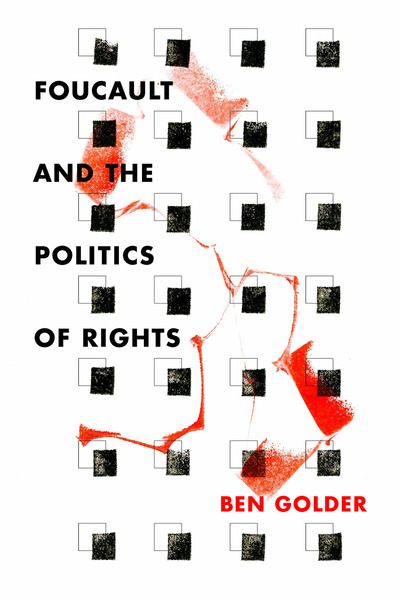
golder1 Ben Golder, Foucault and the Politics of Rights. Stanford University Press, forthcoming in October

This book focuses on Michel Foucault’s late work on rights in order to address broader questions about the politics of rights in the contemporary era. As several commentators have observed, something quite remarkable happens in this late work. In his early career, Foucault had been a great critic of the liberal discourse of rights. Suddenly, from about 1976 onward, he makes increasing appeals to rights in his philosophical writings, political statements, interviews, and journalism. He not only defends their importance; he argues for rights new and as-yet-unrecognized. Does Foucault simply revise his former positions and endorse a liberal politics of rights? Ben Golder proposes an answer to this puzzle, which is that Foucault approaches rights in a spirit of creative and critical appropriation. He uses rights strategically for a range of political purposes that cannot be reduced to a simple endorsement of political liberalism. Golder develops this interpretation of Foucault’s work while analyzing its shortcomings and relating it to the approaches taken by a series of current thinkers also engaged in considering the place of rights in contemporary politics, including Wendy Brown, Judith Butler, and Jacques Rancière.

About the author
Ben Golder is Senior Lecturer at the Faculty of Law at the University of New South Wales, Australia.
The Columbia Center for Contemporary Critical Thought​ and The Hispanic Institute for Latin American & Iberian Cultures are proud to invite you to the release of the last volume of Michel Foucault’s series of seminars at the Collège de France:

Foucault and May 68: Penal Theories and Institutions (Collège de France Lectures, 1971-1972) (Hautes Études, Gallimard and Seuil, 2015)

Participants include François Ewald (CNAM), general editor of the series, Bernard Harcourt (Columbia Law School, Columbia Center for Contemporary Critical Thought) the volume editor, and Jesús R. Velasco (LAIC Chair, Columbia University)

Casa Hispánica
Room 201
Wednesday, May 6, 7PM

Reception to follow

From the back cover:

Théories et Institutions pénales est le titre donné par Michel Foucault au cours qu’il prononce au Collège de France de novembre 1971 à mars 1972. Dans ces leçons, Michel Foucault théorise, pour la première fois, la question du pouvoir qui va l’occuper jusqu’à la rédaction de Surveiller et punir (1975) et au-delà, d’abord à travers la relation minutieuse de la répression par Richelieu de la révolte des Nu-pieds (1639-1640), puis en montrant comment le dispositif de pouvoir élaboré à cette occasion par la monarchie rompt avec l’économie des institutions juridiques et judiciaires du Moyen Âge et ouvre sur un «appareil judiciaire d’État», un «système répressif» dont la fonction va se centrer sur l’enfermement de ceux qui défient son ordre. Michel Foucault systématise l’approche d’une histoire de la vérité à partir de l’étude des «matrices juridico-politiques», étude qu’il avait commencée dans le cours de l’année précédente (Leçons sur la volonté de savoir), et qui est au coeur de la notion de «relation de savoir-pouvoir». Ce cours développe sa théorie de la justice et du droit pénal. La parution de ce volume marque la fin de la publication de la série des Cours de Michel Foucault au Collège de France (dont le premier volume a été publié en 1997).

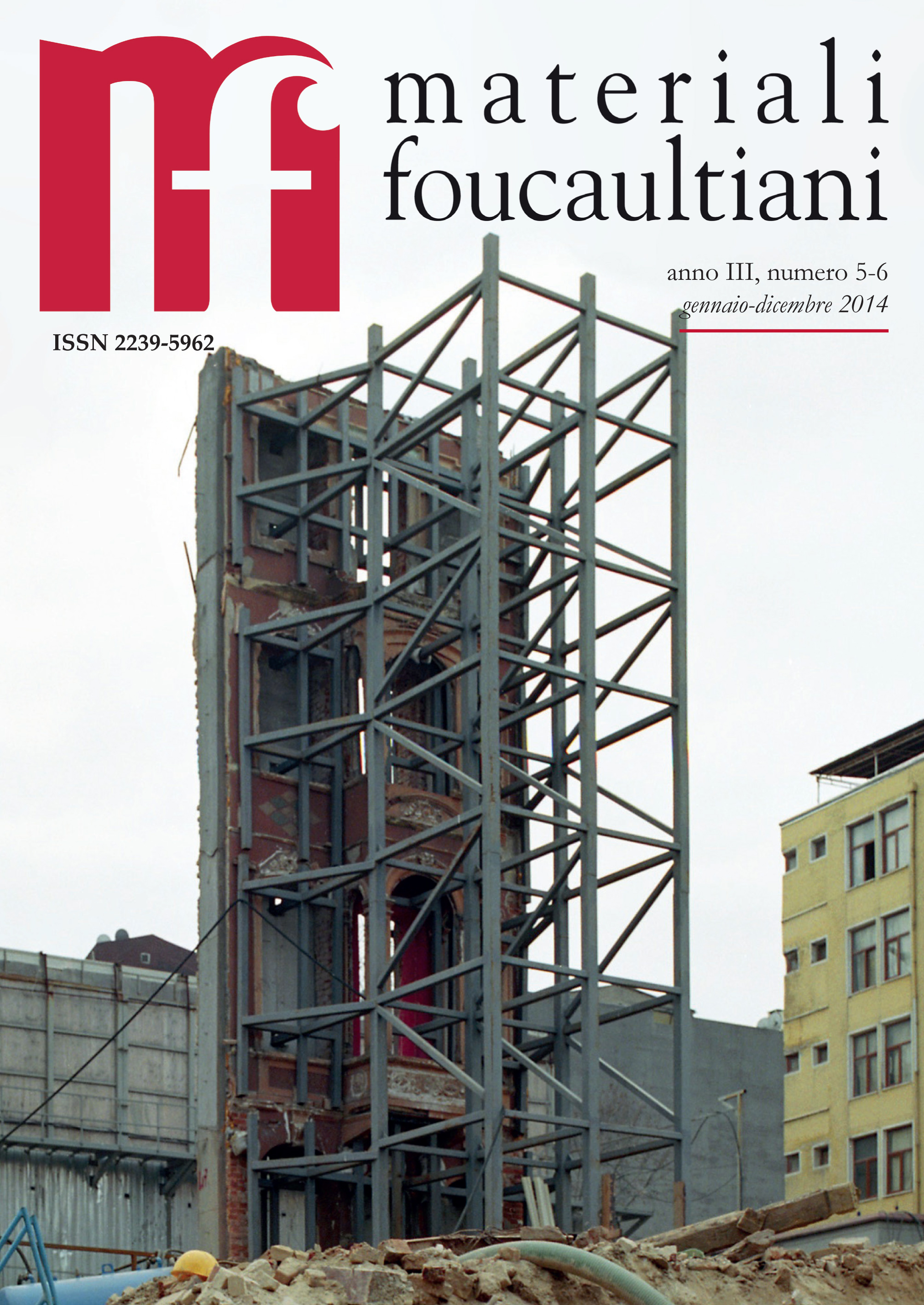
COPERTINA III,5-6

New issue of materiali foucaultiani

volume III, number 5-6 (January-December 2014)

TABLE OF CONTENTS

Il lavoro della sperimentazione  (pp. 4-7)

Laura Cremonesi, Orazio Irrera, Daniele Lorenzini, Martina Tazzioli

La parrhesia e l’attualità politica della critica

Introduzione  (pp. 9-13)

  Laura Cremonesi, Orazio Irrera, Daniele Lorenzini, Martina Tazzioli

Nota di lettura  (pp. 15-20)

  Laura Cremonesi, Orazio Irrera, Daniele Lorenzini, Martina Tazzioli

La parrhesia  (pp. 21-52)

Michel Foucault

Dalla parrhesia alle pratiche politiche nella postcolonia  (pp. 53-70)

Mariangela Milone

Authority, Interpretation and the Space of the Parrhesiastic Encounter  (pp. 71-90)

Nancy Luxon

What is Political Philosophy?  (pp. 91-112)

Johanna Oksala

Enunciazione e politica. Una lettura parallela della democrazia: Foucault e Rancière  (pp. 113-134)

Maurizio Lazzarato

Michel Foucault on Problematization, Parrhesia and Critique  (pp. 135-154)

  Giovanni Maria Mascaretti

Saggi

Foucault mitologo delle scienze. Per una rilettura de Le parole e le cose  (pp. 157-175)

 Ronan de Calan

Le parole, le cose ed altre inquisizioni  (pp. 177-196)

Marta Menghi

The Normative Immanence of Life and Death in Foucauldian Analysis of Biopolitics  (pp. 197-218)

  Marcos Nalli

Dal potere sulla vita al governo dell’ethos. Centralità genealogica della governamentalità  (pp. 219-240)

  Ottavio Marzocca

Sguardi foucaultiani

Il muro del silenzio  (pp. 243-245)

  Philippe Bazin

   Nascita della società punitiva

Nota introduttiva  (pp. 247-252)

  Laura Cremonesi, Orazio Irrera, Daniele Lorenzini, Martina Tazzioli

Foucault e la società punitiva  (pp. 253-262)

  Frédéric Gros

The Missing Link. An Inquiry into Michel Foucault’s Distinction from “Penal Evolution” Literature

between The Punitive Society and Discipline and Punish (1973-1975)  (pp. 263-282)

  Sacha Raoult

Per una sociologia morale delle traiettorie di controllo. Una lettura de La société punitive  (pp. 283-306)

  Corentin Durand

Dall’illegalismo alla gestione differenziale degli illegalismi: ritorno su un concetto  (pp. 307-322)

  Grégory Salle

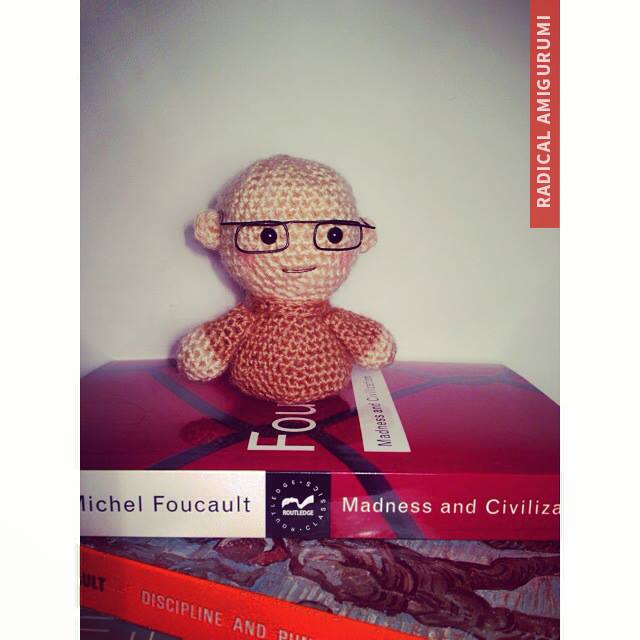
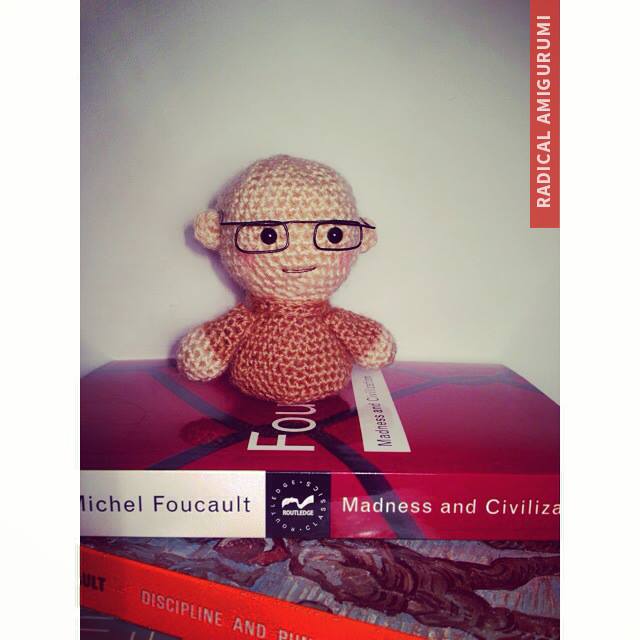
Amigurumi (編みぐるみ?, lit. crocheted or knitted stuffed toy) is the Japanese art of knitting or crocheting small stuffed animals and anthropomorphic creatures. The word is derived from a combination of the Japanese words ami, meaning crocheted or knitted, and nuigurumi, meaning stuffed doll (Wikipedia)

RadicalAmigurumi's avatarRadical Amigurumi

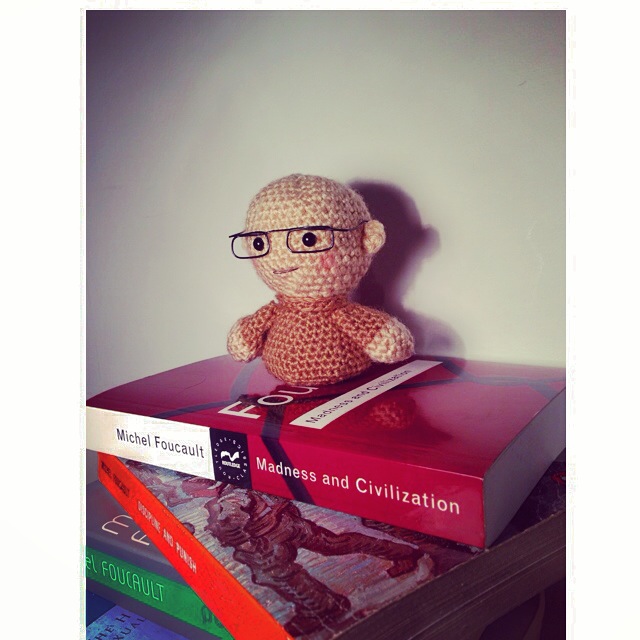
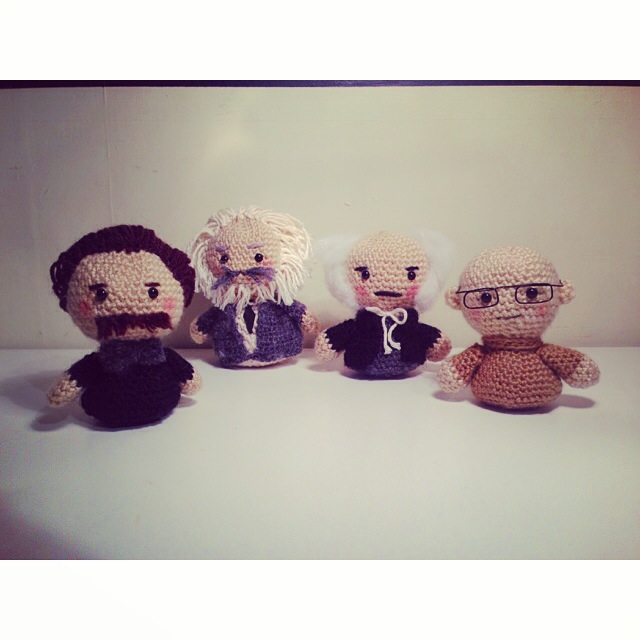
And a new member to the radical boy band, may I introduce Michel Amigurumi Foucault!!

My first ears and my first glasses, and enjoyed the bald look…

Michel Amigurumi Foucault says: “Where there is power, there is resistance.”

Foucault w CR

photo 2 (8)

photo 3 (5)

foucault irlphoto 4 (3)

View original post

Michel Foucault et la peinture

Peter Wall Institute for Advanced Studies Faculty Associate, Catherine Soussloff, will be giving a series of seminars on “Michel Foucault et la peinture” as Visiting Lecturer at the Collège de France in Paris on May 5, 12, 19 and 26 beginning at 2:30 pm.

About the speaker:

Catherine M. Soussloff’s research explores the historiography, theory, and philosophy of art in the European tradition from the Early Modern period (ca. 1400) to the present. She has published books and over forty essays and articles, and she has lectured extensively in Canada, Europe, the U.K., the U.S.A., and South America. Professor Soussloff has advised and supervised M.A. and Ph.D. graduates in Art History, Visual and Cultural Studies, History of Consciousness, Literature, and History. Known for her comparative and historical approaches to the central theoretical concerns of art history and aesthetics, Soussloff’s recent publications have focused on: Performance theory and visual culture, theories of painting from Leonardo da Vinci to contemporary post-structuralism, concepts of the Baroque, Viennese art and culture in the early 20th century, Jewish studies and art history, contemporary theories of the image, and curatorial practice.  She is presently preparing two books for publication: Michel Foucault and Painting and Theory for Art in the Late Twentieth Century.  Soussloff’s views on Foucault are featured in the Slovenian art mockumentary: MY NAME IS JANEZ JANŠA (dir. Janez Jansa). 

Before coming to UBC in 2010 as Head of the department, Professor Soussloff taught for twenty-four years at the University of California, Santa Cruz where she held a prestigious University of California Presidential Chair in Visual and Performance Studies and the first Patricia and Rowland Rebele Chair in the History of Art. For twelve years Soussloff was Director of Visual and Performance Studies, an international and multi-disciplinary faculty-graduate research initiative. In that capacity she programmed major conferences and an annual seminar series, funded by competitively awarded grants. She recently served as Chair of the Editorial Board of the Art Journal (College Art Association of America) and she was a founding editor of Images: Journal of Jewish Art and Visual Culture. For two years she was a member of the board of Live Vancouver, the city’s performance art biennale.

Professor Soussloff has been the recipient of grants and fellowships from the National Endowment for the Humanities, The Getty Research Institute, The Sterling and Francine Clark Art Institute, the University of California Humanities Research Institute, the College Art Association of America, the Herbert D. Katz Center for Advanced Judaic Studies, University of Pennsylvania and the Institute for the Humanities at New York University. In summer 2011 Soussloff was resident at the University of California, Irvine where she held a National Endowment for the Humanities Summer Seminar fellowship for the study of Walter Benjamin’s Later Writings. During the academic year 2013-14 Catherine M. Soussloff is a distinguished scholar in residence at the Peter Wall Institute for Advanced Studies.

Date: Tuesday, May 5, 2015
Time: 2:30 pm
Location: Collège de France, Salle 5 11, place Marcelin-Berthelot, 75005 Paris
Link: Read More

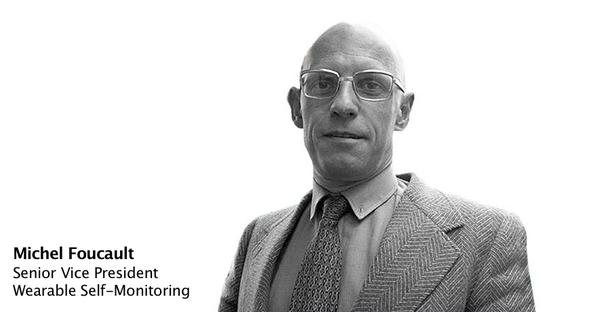
foucault-lol
Above picture can be found here

And on another site..(fastcodesign.com)

Note to Designers: Forget Wearables, Tackle Senseables

Ravi Sawney, CEO of RKS, calls on designers to think about the next stage of personal technology.

Let’s face it: the concept behind wearables—collecting data on oneself—is something people have sought for generations. French philosopher Michel Foucault, for instance, points to the ancient technological development of the hypomnema, a collection of writings one would keep on things one read, heard, saw, or thought throughout the day, which would then be reread in order to better connect to both the world and to, well, oneself. As Foucault explains, “There was a culture of what could be called personal writing…which must be reread from time to time so as to re-actualize their contents.”

So in the tradition of hypnomnema, wearables in their current form, creeping up our arms from wrist to elbow, are just the flavor of the month.

Read more

Les mots et les choses and beyond (2015)
Conference
FRIDAY, APRIL 17 2015
Harvard Colloquium for Intellectual History and
History and Theory

Editor: Unfortunately I found out about this conference late, but am posting it for information.

1:30-3:30 – Afternoon Session I

Introduction and Chair: Peter E. Gordon

Gary Gutting, The Politics of The Order of Things: Foucault, Sartre, and Deleuze

Nancy Partner, “The Reign of Leviathan and the Return of the Repressed Self”

Respondent: Samuel Moyn

3:30-4:00 – Coffee break

4:00-6:00 – History and Theory Keynote Lecture

Introduction and Chair: Ethan Kleinberg

Vincent Descombes, “The Order of Things: an archeology of what?”

Respondent: Warren Breckman

6:30 – Reception (for participants only)

SATURDAY, APRIL 18

9:00-9:30 – Coffee

9:45-11:45 – Morning session

Chair: Arthur Goldhammer

Jean-Claude Monod, “Les mots et les choses, history and diagnosis”

Béatrice Han-Pile, “Phenomenology and Anthropology in Foucault’s early work”

Respondent: Giuseppe Bianco

12:00-1:30 – Lunch break

1:30-3:30 – Afternoon Session I

Chair, Michèle Lamont

Laura Stark, “Human sciences, moral kinds, and the imposition of universal experience”

Ahmed Ragab, “Monsters, Fossils and Patients: An archeology of medieval medicine”

Respondent: Stefanos Geroulanos

3:30-4:00 – Coffee break

4:00-6:00 – Afternoon Session II

Chair: John Hamilton

Julian Bourg, “Nature and the Irruptive Violence of History in Foucault and Benjamin”

Frédéric Worms, “Unexpected (and vital) controversies: Foucault’s Les mots et les choses in its philosophical moment and today”

Respondent: Judith Surkis

Beckett, A. and Campbell, T. The social model of disability as an oppositional device (2015) Disability & Society, 2015 Vol. 30, No. 2, 270-283

DOI: 10.1080/09687599.2014.999912

Abstract
This article engages with debates about the UK Disabled People’s Movement’s ‘Big Idea’ – the social model of disability – positioning this as an ‘oppositional device’. This concept is adapted from the work of the art theorist and activist Brian Holmes, elaborated using insights from Foucault and others. The model’s primary operation is introducing contingency into the present, facilitating disabled people’s resistance-practices. We recognise, however, that the device can operate in a disciplinary manner when adopted by a machinery of government. Whilst our primary goal is to understand the character and operation of the social model, by providing a more general definition of an oppositional device as the concrete operation of technologies of power, we also propose a concept potentially useful for the analysis of the resistance-practices of activists involved in a wide variety of struggles. This concept may thus have implications for wider social and political analysis.

Terri Bourke, John Lidstone & Mary Ryan,
Schooling Teachers: Professionalism or disciplinary power?
(2015) Educational Philosophy and Theory, 47 (1), pp. 84-100.

https://doi.org/10.1080/00131857.2013.839374


Abstract

Since public schooling was introduced in the nineteenth century, teachers in many western countries have endeavoured to achieve professional recognition. For a short period in the latter part of the twentieth century, professionalism was seen as a discourse of resistance or the ‘enemy’ of economic rationalism and performativity. However, more recently, governments have responded by ‘colonizing’ professionalism and imposing ‘standards’ whereby the concept is redefined. In this study, we analyse transcripts of interviews with 20 Queensland teachers and conclude that teachers’ notions of professionalism in this second decade of the twenty-first century are effectively reiterations of nineteenth century disciplinary technologies (as proposed by Michel Foucault) yet are enacted in new ways.


Author Keywords

disciplinary power; Foucault; professionalism; teachers

Rajesh Venugopal, Neoliberalism as Concept, Economy and Society, Published online: 24 Apr 2015

DOI:10.1080/03085147.2015.1013356

Abstract
This paper is a critical exploration of the of the term neoliberalism. Drawing on a wide range of literature across the critical social sciences and with particular emphasis on the political economy of development, it evaluates the consequences of the term’s proliferation and expanded usage since the 1980s. It advances a case that neoliberalism has become a deeply problematic and incoherent term that has multiple and contradictory meanings, and thus has diminished analytical value. In addition, the paper also explores the one-sided, morally laden usage of the term by non-economists to describe economic phenomena, and the way that this serves to signify and reproduce the divide between economics and the rest of the social sciences.

Keywords

neoliberalism,
political economy,
market reform,
governmentality,
development studie