Foucault News

News and resources on French thinker Michel Foucault (1926-1984)

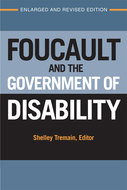
tremainShelley Tremain, Editor, Foucault and the Government of Disability, University of Michigan, 2015

Enlarged and Revised Edition
An up-to-date edition of a foundational collection

Foucault and the Government of Disability considers the continued relevance of Foucault to disability studies, as well as the growing significance of disability studies to understandings of Foucault. A decade ago, this international collection provocatively responded to Foucault’s call to question what is regarded as natural, inevitable, ethical, and liberating. The book’s contributors draw on Foucault to scrutinize a range of widely endorsed practices and ideas surrounding disability, including rehabilitation, community care, impairment, normality and abnormality, inclusion, prevention, accommodation, and special education. In this revised and expanded edition, four new essays extend and elaborate the lines of inquiry by problematizing (to use Foucault’s term) the epistemological, political, and ethical character of the supercrip, the racialized war on autism, the performativity of intellectual disability, and the potent mixture of neoliberalism and biopolitics in the context of physician-assisted suicide.

“A beautiful exploration of how Foucault’s analytics of power and genealogies of discursive knowledges can open up new avenues for thinking critically about phenomena that many of us take to be inevitable and thus new ways of resisting and possibly at times redirecting the forces that shape our lives. Every scholar, every person with an interest in Foucault or in political theory generally, needs to read this book.”

—Ladelle McWhorter, University of Richmond

“[A]n important, prescient, and necessary contribution…a kind of litmus test for the efficacy of Foucault’s concepts in the study of disability, concepts that lead to a refusal of the biological essentialism implied in the disability/impairment binary.”
Foucault Studies

“Tremain has done an exceptional job at organizing and procuring important, rigorously argued, and entertaining essays…. This book should be a mandatory read for anyone interested in contemporary philosophical debates surrounding the experience of disability.”
Essays in Philosophy

Shelley Tremain holds a Ph.D. in philosophy from York University (Canada), lectures on Foucault at the Ontario Institute of Studies in Education of the University of Toronto, and has published widely on philosophy of disability, Foucault, feminist philosophy, and bioethics.

L’Essai et la revue du jour
par Jacques Munier

France Culture, 9 June 2015
Audio

Michel Foucault : Théories et institutions pénales. Cours au Collège de France 1971-1972 (EHESS/Gallimard/Seuil)

« C’est un document exceptionnel » préviennent les éditeurs François Ewald et Bernard E. Harcourt dans le texte qu’ils consacrent à la Situation du cours, à la fois dans l’époque – l’immédiat après mai 68 et l’émergence de « nouveaux mouvements sociaux – mais aussi dans le parcours intellectuel de Foucault, dont c’est le deuxième cours prononcé au Collège de France. On voit dans ces treize leçons prendre forme la méthode généalogique qui sera sa « marque de fabrique », ainsi que sa théorie du pouvoir, saisi à travers la diversité de ses applications concrètes (police, justice, prison, folie, médecine, sexualité etc.) Il s’agit en l’occurrence de montrer la naissance au XVIIe siècle absolutiste de l’appareil répressif moderne et de l’État judiciaire à partir de l’analyse minutieuse d’une opération de « justice armée » destinée à mettre fin à la révolte antifiscale des Nu-pieds en Normandie. Mais l’actualité s’insinue dans l’histoire, comme toujours chez Foucault, et d’abord de la manière la plus directe. En cette fin d’année 1971 la répression est à l’ordre du jour, en particulier contre les militants de la « Gauche prolétarienne » emprisonnés. La présence policière reste très forte au Quartier Latin et lorsque Foucault commence ses cours il faut encore franchir plusieurs cordons de CRS pour entrer au Collège de France. Dès l’ouverture il pose la question de « la raison d’être de ce cours ». Réponse : « il suffit d’ouvrir les yeux »…

On le savait très engagé dans ces années 1971-72, notamment au sein du GIP, le « Groupe d’informations sur les prisons » et certains en ont déduit que cette activité militante avait fait passer au second plan le travail de la pensée. On voit avec ces cours qu’il n’en était rien, même si Surveiller et punir ne paraîtra que quatre ans plus tard. C’est même, insistent les éditeurs, « une des périodes les plus riches, les plus innovantes, sans doute les plus intenses » de sa vie. On assiste en effet dans ces leçons à la mise en œuvre de l’entreprise généalogique, d’inspiration nietzschéenne, comme méthode d’investigation philosophique. Dans le cours de 1975, Il faut défendre la société, il la définit ainsi : « Appelons, si vous voulez, généalogie, le couplage des connaissances érudites et des mémoires locales, couplage qui permet la constitution d’un savoir historique des luttes et l’utilisation de ce savoir dans les tactiques actuelles. » Immédiatement après Théories et institutions pénales, dans le cours de l’année suivante sur La société punitive, il élargit la focale à l’ensemble des sociétés à économie capitaliste, brassant un matériel historique jusque-là inédit concernant l’économie politique classique, les Quakers et « Dissenters » anglais, leur philanthropie, leur conception du pénitentiaire dans le pénal et de la moralisation du temps ouvrier.

Dans son cours précédent, le premier au Collège de France, sous l’intitulé La volonté de savoir, il était revenu aux institutions grecques de la justice (le serment, la juste mesure, la loi, les rituels de purification). La mesure, en particulier, y était décrite comme une forme de « pouvoir-savoir ». Ici, c’est l’enquête qui devient la forme judiciaire de référence, et le passage de la pratique accusatoire à la pratique inquisitoire, avec ce qu’elle emprunte à l’administration carolingienne, mais surtout au modèle de gestion et de contrôle ecclésiastique. On voit se déployer la remarquable cohérence de la démarche. Foucault embrasse d’un même regard à partir de positions dispersées dans le temps, la constitution progressive de l’État moderne, la fin du monde féodal qui conduira les seigneurs à abandonner leur privilège de justice à une instance royale centralisée, le moment où punir devient « enfermer », où l’on passe dans l’économie de la justice d’un prélèvement sur les biens, d’un supplice public et spectaculaire, à une ségrégation des hommes, par l’élimination – enrôlement, enfermement, travaux forcés – des chômeurs, vagabonds, brigands « qui servaient de cadre – je cite – de fer de lance, d’agents de communication des révoltes ». Et il ne lui suffit pas de voir dans la répression – orchestrée par Richelieu – d’une émeute antifiscale la naissance de l’État moderne, mais d’y lire le mouvement social dont il est contemporain comme devant s’inscrire dans cette réalité du « pouvoir ».

« Toutes les grandes phases d’évolution du système pénal sont des façons de répondre à des formes de luttes populaires » conclut Foucault, qui s’emploie à montrer dans ce cours que le droit pénal n’est pas une réaction à la délinquance ou à la criminalité, lesquelles sont plutôt produites par lui comme effet d’une lutte sociale.

Johansen, M.B.
Fall of the public teacher – discourse of intimacy and the teaching profession in Denmark
(2014) Research Papers in Education, 23 p. Article in Press.

DOI: 10.1080/02671522.2014.989176

Abstract
This article reports on a case study conducted in a Danish municipality with 22 teachers as participants, in the context of a project focused on well-being and key educational competencies. The final aim was that of discovering how their ideal of the good teacher was verbalised. What is it that they thematise? How are thematisations created and maintained? The study is theoretically based on Richard Sennett’s notions on the private–public divide and Michel Foucault’s definitions of power and discourse. It focuses on the manners in which Danish teachers articulate a discourse in which words and phrases otherwise seen in connection with intimate relationships (close friends, sweethearts, parents and children) are prevalent. This shall be defined as a discourse of intimacy, the assumption being that this discourse has become the predominant way in which to talk about the good teacher. Furthermore, the article provides (a) a discussion about the ontology of intimacy; (b) a threefold typology of intimacy, namely confessional, emotional and relational, a categorisation that stems from the teachers’ statements and exchanges when discussing good performance; and (c) a reflection on the concept of mode of intimacy, used in this research to refer to the manner in which teachers put to practice their idea of the good teacher, which is mainly through praise and recognition.

Author Keywords
case study; discourse analysis; forms of intimacy; schoolteachers

Raaper, R.
Academic perceptions of higher education assessment processes in neoliberal academia
(2015) Critical Studies in Education, 16 p. Article in Press.

DOI: 10.1080/17508487.2015.1019901

Abstract
Neoliberal higher education reforms in relation to quality assurance, managerialist practices, accountability and performativity are receiving increasing attention and criticism. In this article, I will address student assessment as part of the technologies that increasingly govern academics and their work in universities. I will draw on Foucault’s theories of governmentality and subjectification, and discourse analysis that have framed the research conducted with 16 academics in one university in the UK. While academics in the study expressed frustration with neoliberal reforms in general, and assessment policies in particular, they tended not to demonstrate overt resistance within their university systems. The reasons for this will be questioned and analysed in relation to a neoliberal mode of government where power relations shaping academic subjectivities are diffuse and pervasive. I will discuss the ways in which academics understand and act within these power relations, and I will also demonstrate a variety of covert practices that academics tend to apply when coping with the neoliberal technologies of government such as assessment.


Author Keywords

academic work; assessment; Foucault; governmentality; higher education; neoliberalism; resistance

Foucault au Collège de France : une aventure intellectuelle et éditoriale

DU JEUDI 11 JUIN (19 H) AU JEUDI 18 JUIN (14 H) 2015
(Colloque de 7 jours)

DIRECTION : Frédéric GROS, Luca PALTRINIERI

ARGUMENT :

Les leçons de Michel Foucault au Collège de France, prononcées entre 1971 et 1984, constituent une somme théorique indépassable qui a profondément renouvelé la connaissance et la réception d’un des plus importants penseurs du XXe siècle. Au mois de mai 2015 paraîtra, aux éditions du Seuil / Gallimard, le volume Théories et institutions pénales, correspondant à l’année universitaire 1971-1972. Avec cette parution, un point final sera mis à l’édition de ces cours mise en œuvre par François Ewald et Alessandro Fontana au milieu des années quatre-vingt-dix. Définitivement, avec cette entreprise éditoriale, une pensée de Foucault prise au vif de la parole s’est imposée sur la scène intellectuelle mondiale.

Le présent colloque entend revenir sur l’accomplissement de cette aventure intellectuelle, et surtout prendre la mesure de la diversité théorique et de l’intensité politique de ces leçons (de la pénalité à la psychiatrie, de la raison d’Etat au libéralisme, du souci de soi au courage de la vérité) en conviant un certain nombre de chercheurs, intellectuels, écrivains ou artistes à réfléchir sur ce qu’a pu représenter pour eux la redécouverte de cette parole.

CALENDRIER PROVISOIRE :

Jeudi 11 juin
Après-midi:
ACCUEIL DES PARTICIPANTS

Soirée:
Présentation du Centre, des colloques et des participants

Vendredi 12 juin
Matin:
Introduction générale
L’édition des cours au Collège de France: établissement du texte, traduction, réception. Une aventure intellectuelle, table ronde animée par Frédéric GROS, avec François EWALD, Colin GORDON (Les cours de Foucault: une mondialisation à diverses vitesses) et Márcio ALVES DA FONSECA (L’aventure de traduire la parole)

Après-midi:
Folie et psychiatrie
Table ronde animée par Roger FERRERI (Relire l’histoire de la folie en 1973), avec Julie MAZALEIGUE-LABASTE (Instinct, sexualité et fonction psy: une autre histoire des anormaux, à partir de et contre Foucault) et Elisabetta BASSO (Psychopathologie, psychiatrie, pouvoir psychiatrique. Le parcours de Michel Foucault de 1954 à 1974)

Samedi 13 juin
Droit / prison / justice
Matin:
Présentation générale et modération: Antoine GARAPON (Le tribunal comme centre de profit et la pénalité comme dette)
Christiane TAUBIRA: La philosophie de la loi relative à l’individualisation des peines (sous réserves)
Michele SPANÒ: Politique des moyens. Foucault et la normativité

Après-midi:
Claude-Olivier DORON: À propos de Théories et institutions pénales
Guillaume LE BLANC: Du pénal au carcéral. Une généalogie du droit

Soirée:
La voix de son maître, projection suivie d’un débat avec le réalisateur Gérard MORDILLAT, articulé dans la perspective du texte de Michel Foucault: “L’ordre du discours”

Dimanche 14 juin
Sexualités, éthique et normalisation
Matin:
Elsa DORLIN: Gouvernementalité, agentivité, subjectivité
Paul MENGAL: Dispositifs d’alliance et dispositifs de sexualité: les enseignements de l’éthologie et application à l’histoire de l’hystérie

Après-midi:
Philippe SABOT: Une généalogie de la question sexuelle dans les premiers cours de Michel Foucault
Sandra BOEHRINGER: Ce que les Grecs font à Michel Foucault: problèmes érotiques (des cours au Collège de France, 1980-1981, à l’Histoire de la sexualité, II et III, 1984)
Eric FASSIN: Histoire de la sexualité, ou du sexe? Le genre des hermaphrodites

Lundi 15 juin
Biopolitique et gouvernementalité
Matin:
Ferhat TAYLAN: Qu’est-ce que la mésopolitique?
Florence CAEYMAEX: Les postérités du cynisme: esthétiques, politiques, philosophiques?

Après-midi:
DÉTENTE

Mardi 16 juin
Matin:
Biopolitique et gouvernementalité
Martina TAZZIOLI: Generalizable singularites and temporary multiplicities: the production of the remnant and its excess
Christian LAVAL: “Naissance de la biopolitique”: contextes, lectures, réceptions, disputes

Après-midi:
Parrêsia / techniques de soi / éthique
Table ronde avec Arianna SFORZINI (Théâtres de vérité, théâtres des corps), Henri-Paul FRUCHAUD (Les dernières conférences sur la parrêsia), Daniele LORENZINI (La parrêsia et la force perlocutoire: Austin, Bourdieu, Foucault), Valéry LAURAND (Parrhêsia antique, véridiction foucaldienne) et Ariane REVEL (Politique du discours historique: à partir de l’idée d’actualité)

Mercredi 17 juin
Généalogie / histoire / vérité
Matin:
Judith REVEL: “Une histoire de la vérité sans idée fixée de la vérité”: de Nietzsche à l’”histoire des systèmes de pensée”, et retour
Orazio IRRERA: Les deux faces de l’alèthurgie: force du vrai et subjectivation dans les Cours au Collège de France

Après-midi:
Jérôme LAMY: Foucault, historien des sciences? Les cours au Collège de France et le remaniement de l’épistémologie historique
François HARTOG

Soirée:
Ciné-concert d’anthologie, avec le Collectif F71

Jeudi 18 juin
Matin:
Pierre MACHEREY: Lire Foucault

Conclusions

Après-midi:
DÉPARTS

Phillips, M., Woodham, A., Hooper-Greenhill, E.
Foucault and museum geographies: a case study of the English ‘Renaissance in the Regions’
(2015) Social and Cultural Geography, 34 p. Article in Press.

DOI: 10.1080/14649365.2015.1009854

Abstract
This paper explores the subject of museum geographies, focusing particularly on the development of museum policies in a changing political context. The empirical focus is the emergence and transformation of the museum programme Renaissance in the Region, which is linked to the concepts of primary, secondary and tertiary spatialisations presented by Michel Foucault. The paper discusses the development of the programme and how it transformed aspects of the primary, secondary and tertiary spatialisations of museums in England, before focusing attention on the geography of school visits to museums. The results of two extensive studies of school visits to museums in the programme suggest that large numbers of visits come from schools located in areas with high indices of multiple deprivation and income deprivation affecting children. It is argued that this social geography reflects the tertiary spatialisation of museums linked to their emergence in areas of past industrial development, although practices linked to reconfigurations of the primary and secondary spatialisation as part of the Renaissance in the Regions programme may also have played some role. The paper concludes by discussing recent changes in government policy and the degree to which the ‘New Renaissance’ policy may signify reductions in the social reach of museums into areas of social deprivation and exclusion.

Author Keywords
deprivation; Foucault; museum geographies; Renaissance in the Regions; social inclusion; spatialisations

Kavoura, A., Ryba, T.V., Chroni, S.
Negotiating female judoka identities in Greece: A Foucauldian discourse analysis
(2015) Psychology of Sport and Exercise, 17, pp. 88-98.

DOI: 10.1016/j.psychsport.2014.09.011

Abstract
Objectives: The objectives of this paper are to trace the discourses through which female Greek judokas articulate their sporting experiences and to explore how they construct their identities through the negotiation of sociocultural beliefs and gender stereotypes. Design: This article is based on interview data from a larger ethnographic research with women judo athletes, grounded in a cultural praxis framework. Method: Ten semi-structured interviews were conducted during fieldwork in Greece. Interview data were analyzed drawing on a Foucauldian approach to discourse analysis. Results: We identified four concepts-biology, gender, femininity, and judo/sport-that were central to unearthing the discourses in which female Greek judokas constructed their identities. Female athletes (strategically) negotiated multiple identities, each serving different purposes. Conclusion: The gender power dynamics in Greek society at large are reproduced in the sporting experience of Greek female judokas. Although women have agency to negotiate their identity, they tend to accept the “given” subject positions within dominant discourses of gender relations. By doing so, female athletes become agents in the reproduction of patriarchal power.

Author Keywords
Cultural praxis; Discourse analysis; Ethnography; Gender; Martial arts

entitlecollective's avatarENTITLE blog - a collaborative writing project on Political Ecology

Uses and abuses of historical contextualization in Critiquer Foucault. Les années 1980 et la tentation néolibérale, edited by Daniel Zamora. Part I. 

* by Emanuele Leonardi

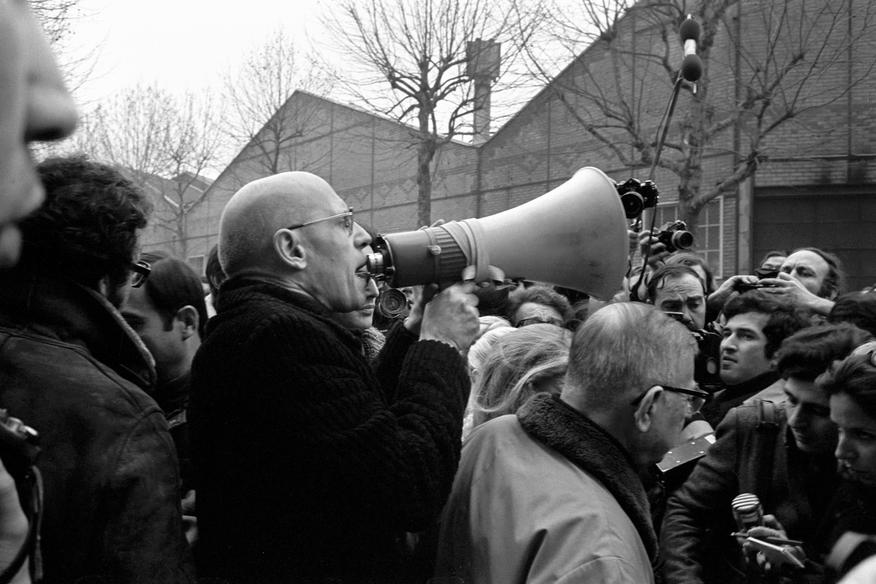
Foucault participating in a demonstration. Source: http://www.teatrovalleoccupato.it/

Reviewing Critquer Foucaultis not an easy task, for at least two reasons. The first – which will be discussed in this post – is related to its dishomogeneity, both in terms of its argumentations and of Foucault’s texts analyzed. In the six essays included in the collection Foucault is criticized from the Left and from the Right, at times in relation to a specific problematic issue, at times because of a certain authorial posture or philosophical attitude. Similarly, the works discussed vary: from the biopolitical lectures (1976-1979) to a 1977 journalistic review for Le Nouvel Observateur, from Discipline and Punish (1975) to the Foucaultian corpus as a whole – it is curious to know…

View original post 1,125 more words

Cox, B.D., Pringle, R.
‘Muscles for Motherhood’: A Genealogical Analysis of Medicalised Ways of Knowing Female Footballers in New Zealand, 1921 and 1973–1975
(2015) International Journal of the History of Sport, 15 p. Article in Press.

DOI: 10.1080/09523367.2014.989497

Abstract
Michel Foucault argued that females gradually became integrated into the sphere of medical practices through a process which he termed as a ‘hysterization of women’s bodies’ (Foucault, The History of Sexuality, Volume One: An Introduction, New York: Pantheon Books, 1978, 104). In this article, we draw on Foucault to examine how women’s bodies, exercise and motherhood impacted on the historical development of female football in New Zealand within two time periods (1921 and 1973–1975). Employing his genealogical framework, we analyse newspaper reports, historical documents and conducted in-depth interviews to demonstrate how medical/scientific discourses both constrained and enabled the participation of women in football. We conclude that while medical knowledge was used to publicly disqualify the legitimacy of the female footballer in 1921, and hence her abrupt disappearance from the sporting realm, the absence of such medical knowledge in the early 1970s, combined with societal changes associated with second wave feminism, paved the way for the eventual ‘normalization’ of female football in New Zealand.

Author Keywords
Foucault; genealogy; health; medicalization of bodies; women’s football

Kristjánsdóttir, S.
Becoming Christian: A Matter of Everyday Resistance and Negotiation
(2015) Norwegian Archaeological Review, 19 p. Article in Press.

DOI: 10.1080/00293652.2015.1015602

Abstract
The diverse appearances of church buildings, iconography and altered burial practices have commonly been used to exemplify the expansion of Christianity in early medieval Europe. Less emphasis has been placed on how the common European dealt with the Christian transformation in daily life, perhaps because of the tendency in research to distinguish ritual actions from secular. To become Christian did not necessarily entail greater religiousness or deeper religious devotion but centred rather on how people synchronized their everyday lives, both religious and secular, in accordance with Christian doctrine and the laws imposed by the Roman Church. However, social transformations do not emerge exclusively from political or administrative institutions, such as the Church or other ruling authority; they also emerge interactively, through the general public, who are equally capable of exercising power by taking part in societal discourse. With reference to examples from early medieval Iceland, this article argues for the application of Foucault’s theory of power relations and everyday resistance to research on the adoption of Christianity, beyond time and space.

Author Keywords
dualism, Christianization; Foucault; post-colonialism; power relations