Foucault News

News and resources on French thinker Michel Foucault (1926-1984)


Foucault and May 1968

Published on 18 Jun 2015

François Ewald (CNAM), Bernard Harcourt (Columbia Law School, Columbia Center for Contemporary Critical Thought), and Jesús R. Velasco (LAIC Chair, Columbia University) delve into the influences and effects of Michel Foucault’s lectures at the College de France, Penal Theories and Institutions (1971-1972). The panelists explore how the social unrest of 1968 influenced Foucault as he began to work out theories on repressive disciplinary penal systems that he would develop fully in one of his most important works, Discipline and Punish.

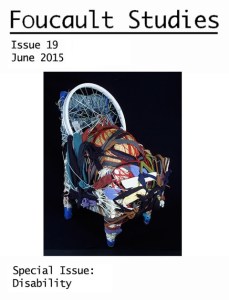
fs-19New issue
Foucault Studies
Number 19: Disability

Foucault Studies is an open access journal and full PDFs of the articles can be found on the website.

Table of Contents

Editorial
Sverre Raffnsøe, Alain Beaulieu, Sam Binkley, Barbara Cruikshank, Knut Ove Eliassen, Marius Gudmand-Høyer, Johanna Oksala, Sven Opitz, Jyoti Puri, Jens Erik Kristensen, Alan Rosenberg, Jeppe Groot

This issue includes:

Special Issue: New Work on Foucault and Disability

New Work on Foucault and Disability: An Introductory Note
Shelley Tremain 4-6

This Is What a Historicist and Relativist Feminist Philosophy of Disability Looks Like
Shelley Tremain 7-42

Desiring Disability Differently: Neoliberalism, Heterotopic Imagination and Intra-corporeal Reconfigurations
Kelly Fritsch 43-66

Genealogies of Disability in Global Governance: A Foucauldian Critique of Disability and Development
Xuan-Thuy Nguyen 67-83

Neoliberalism and Disability: The Possibilities and Limitations of a Foucauldian Critique
Scott Yates 84-107

Historical Epistemology as Disability Studies Methodology: From the Models Framework to Foucault’s Archaeology of Cure
Aimi Hamraie 108-134

Articles

Foucault on Ethics and Subjectivity: ‘Care of the Self’ and ‘Aesthetics of Existence’
Daniel Smith 135-150

State Racism and the Paradox of Biopower
Elisa Fiaccadori 151-171

Political Technique, the Conflict of Umori, and Foucault’s Reading of Machiavelli in Sécurité, Territoire, Population
Sean Erwin 172-190

Alea Capta Est: Foucault’s Dispositif and Capturing Chance
Nick Hardy 191-216

Translations

Standing Vigil for the Day to Come
Elise Woodard, Robert Harvey 217-223

Reviews

Barry Stocker's avatarStockerblog

Serialising a paper I wrote a while back that has ideas on Foucault I am still working on, but which is going to be absorbed into different parts of that work, so I’d like to put it here as a way of setting up some part of  what I think is important in Foucault

Foucault’s approach to antique ethics is often seen as advocating a style of living, in which the individual engages in self-invention unrestrained by inner nature or external reality.  However, Foucault’s references to style of living have an ontology in the sense that individual living, and self creation, is discussed in the context of physical nature and social relations.   Individual pleasure is only well formed where it is also care of the self, a care of the self that refers to the nature of the body, and to relations with others.  Foucault refers to an active…

View original post 880 more words

Disney, T.
Complex spaces of orphan care – a Russian therapeutic children’s community
(2015) Children’s Geographies, 13 (1), pp. 30-43.

DOI: 10.1080/14733285.2013.827874

Abstract

Institutions of orphan care are immensely complex spaces imbued with social and cultural norms, and can exhibit intricate power relations and particularly severe examples of surveillance. While there have been numerous excellent quantitative studies of these institutions, they reveal little of the complexity and heterogeneity of the spaces, and there remains a need for more qualitative and particularly ethnographic studies of spaces of orphan care to reveal their nuances. Drawing upon the author’s reflections on a highly unusual space of orphan care, this article makes two major contributions to Children’s Geographies: (1) it employs a sorely neglected aspect of Foucault’s work in Children’s Geographies, Mettray, in analysing surveillance and discipline in an institution providing care to orphaned children and (2) It highlights the heterogeneity of these spaces and provides an example of best practice in spaces of orphan care.

Author Keywords
care; Children’s Geographies; Foucault; Mettray; orphan; Russia

Carey, J.L.W.
Taking Responsibility for Cloning: Discourses of Care and Knowledge in Biotechnological Approaches to Nonhuman Life
(2015) Journal of Agricultural and Environmental Ethics, 11 p. Article in Press.

DOI: 10.1007/s10806-015-9544-0

Abstract
This article examines the practice of animal cloning in relation to discourses of care and responsibility, in particular a common cultural interpretation of care theorized by Michel Foucault. This interpretation figures care as a “pastoral” relation premised in essential differences between carers and objects of care, and its interspecies implications are increasingly drawing the attention of theorists in animal studies. This article argues that, perhaps despite appearances, animal welfare in the form of pastoral care and abstract conceptualizations of animals that are dominant in discourses of animal biotechnology are not mutually exclusive, but rather in practice may be operating in conjunction with each other, discursively working together to naturalize ethics of biotechnology and animal welfare that reinforce rather than question human dominance and superiority. Specifically, mapping the normative framework of pastoral care onto the existing scientific orientation to acquiring knowledge of animal bodies produces a definition of care that is presumed to be both finite and perfectible. Ultimately, critical analysis of biotechnological manifestations of care and responsibility enables both a theorization of the industry’s performance of responsibility independently of its care-related claims about its own practices, and the elucidation of an alternative framework for assessing interspecies ethics that maintains a critical distance from the supposed “naturalness” or “unnaturalness” of interspecies relationships such as cloning. © 2015 Springer Science+Business Media Dordrecht

Author Keywords
Animal ethics; Biopolitics; Biotechnology; Cloning; Ethics of care; Foucault

Bullen, J.
Governing Homelessness: The Discursive and Institutional Construction of Homelessness in Australia
(2015) Housing, Theory and Society, 22 p. Article in Press.

DOI: 10.1080/14036096.2015.1024886

Abstract
This paper analyses changes in the conceptualization of “homelessness” in Australian policies, programmes and services from the 1970s to 2006. Research and commentary confirm a shift away from an understanding of homelessness in terms of “structural”, social and economic factors to an understanding in terms of “individual” issues. Research reflects this dichotomy, but attempts to reconcile the two explanations have failed in practice. Using Foucault’s work on governmentality, historical official statements and in-depth interviews, I show how changing policies and programmes, involving an extension and reconfiguration of political power beyond the state, had a constructive role in shaping “homelessness”. This “welfare reform” characterized homelessness as dependency, and programmes increasingly focussed on producing a managed form of self-reliance, shifting the conceptualization of homelessness towards individual explanations.

Wrench, A., Garrett, R.
Gender encounters: becoming teachers of physical education
(2015) Sport, Education and Society, 17 p. Article in Press.

DOI: 10.1080/13573322.2015.1032922

Abstract
Pre-service teachers of physical education (PE) bring understandings about gender and bodies to their university studies. These understandings are partially informed by biographies and experiences and bear potential to mediate learning and processes of becoming teachers. In this paper we explore technologies of power/knowledge and technologies of self that inform understandings of gender and the constitution of PE teacher subjectivities. Data were drawn from semi-structured interviews conducted with pre-service teachers studying at an Australian university. Foucault’s theoretical perspectives around the constitution of subjects were drawn on to analyse data. Findings reveal that discursive practices frame particular ‘truths’ around gender and, hence, possibilities for being teachers of PE. Discourses of sport were significant in establishing a male norm for bodies and subjectivities. This was problematic for female participants who also turned to discourses of nurturing in constituting their subjectivities. Implications are raised for PE teacher educators with regard to disrupting hegemonic discourses as means for developing pedagogies for greater justice.

Author Keywords
Foucault; Gender; Pre-service teachers of physical education; Subjectivities; Technologies of self

Ailon, G.
From superstars to devils: The ethical discourse on managerial figures involved in a corporate scandal
(2015) Organization, 22 (1), pp. 78-99.

DOI: 10.1177/1350508413501937

Abstract
This article draws upon a growing body of Foucauldian-inspired literature on business ethics. Looking at the media as a prime site of dynamic discursive production in contemporary times, it offers an analysis of the underlying moral sensitivities and ethical frameworks characteristic of reports about the two top managerial figures involved in the Enron scandal: Jeffrey Skilling and Kenneth L. Lay. Analysing Forbes and BusinessWeek articles, the article examines the sudden appearance of these managers as a heightened moral threat, asking what constellations of knowledge and meaning were expressed through the demonization of these once idealized managerial superstars. It shows that while speaking in the name of ethics, the examined discourse also undermines ethics in that it promulgates a largely paradoxical and ethically incapacitating concept of self and logic of action.

Author Keywords
business ethics; discourse; Enron; Foucault; Lay; self; Skilling

Rencontre doctorale du Centre Michel Foucault

14/15/16 octobre 2015. IMEC. Caen

L’Association pour le Centre Michel Foucault propose pour la sixième année une école doctorale visant à réunir les doctorants travaillant sur, avec et autour de la pensée de Michel Foucault. L’objectif est comme les années précédentes de mettre en relation, le plus agréablement possible et de manière assez informelle, les jeunes chercheurs afin de constituer un réseau de travail national et international, et de leur donner l’occasion de présenter leurs travaux.

Cette rencontre aura lieu le 14, 15 et 16 octobre 2015 à l’Abbaye d’Ardenne à Caen (avec un départ de Paris le mercredi 14 octobre en milieu de journée et un retour le vendredi 16 octobre en fin de journée). Les frais de séjour sur place et les billets de train à partir de Paris (Paris-Caen-Paris) seront offerts aux intervenants par l’Association pour le Centre Michel Foucault.

Pour que les échanges puissent être les plus féconds possibles – et compte tenu des capacités d’accueil de l’Abbaye – nous limitons le nombre de participants, ce qui impliquera nécessairement un choix de notre part. Les doctorants ayant participé les années passées aux rencontres pourront décider d’y assister, mais la priorité sera donnée aux nouveaux intervenants et aux doctorants en 2ème et 3ème année de thèse.

Les propositions d’intervention (une page maximum), portant soit sur une question particulière du travail de thèse, soit sur un problème méthodologique précis, devront nous être envoyées, avec un CV (indiquant obligatoirement l’année et le titre de la thèse, le nom du directeur, de l’université et de l’ED de rattachement) avant le 30 juin 2015. En fonction des demandes, nous établirons et diffuserons un programme après le 15 juillet.

Ces rencontres doctorales sont ouvertes à tous les étudiant(e)s sans distinction de nationalité, mais la langue de travail sera le français.

N’hésitez pas à nous contacter pour toute question. Très cordialement,
L’Association pour le Centre Michel Foucault

Contacts : Judith Revel : jrevel@u-paris10.fr ; Arianna Sforzini : arianna.sforzini@univ-paris-est.fr

The “International Congress of Critical Applied Linguistics” will take place in Brasília, Brazil, at the University of Brasília, from Monday, October 19th, 2015, to Wednesday, October 21st, 2015. The event is organized by research groups from the University of Brasília and the State University of Londrina.

Contributions on the following themes are welcome: (i) Language and Politics; (ii) Language and Ethics; (iii) Language and Identity; (iv) Language and Agency; (v) Language and Practice(s); (vi) Language, Epistemology, and Ontology; (vii) Language and Discourse; and (viii) Language and Structure.

Presentation proposals are due June 30th, 2015, and should be 300 to 350 words long, written in Times New Roman 11, in single line spacing; title in upper case letters, and subtitle in lower case. The author’s last name should also be in capitals.

Participation is encouraged for both undergraduate and graduate students, university professors and researchers, as well as school teachers. Conference fees are as follows for the 2nd tier, which ends on June 30th: 80R$ – Undergraduate students; 150R$ – Graduate students; 200R$ – University professors and researchers. The event is free for state school teachers. Payment procedures, as well as prices for the upcoming tiers, can be found here.

The conference will include thematic presentations, poster sessions, round tables, and plenary lectures by Alistair Pennycook (University of Technology, Sydney, Australia), Bill Cope and Mary Kalantzis (University of Illinois, USA), Bonny Norton (University of British Columbia, Canada) and Kanavilil Rajagopalan (University of Campinas, Brazil).