Foucault News

News and resources on French thinker Michel Foucault (1926-1984)

Julian Vigo, Biopower and Security, Counterpunch, May 05, 2015

Full text online

In The History of Sexuality: The Will to Knowledge (L’histoire de la sexualité, La volonté de savoir), Michel Foucault defines biopower as the practices engaged by the modern state to effect an “an explosion of numerous and diverse techniques for achieving the subjugations of bodies and the control of populations” (184). Developing his notion of biopower through the many exegeses of disciplinary power he studies throughout his career, Foucault focuses his interpretations of biopower on various styles of governments which have historically devised myriad controls of the body—be it in the areas of public health creation and regulation, heath crises and quarantine, military education, the creation of the mental hospital, the structure of the modern prison or the public policies which evolve discourses of the body and discourses of power onto the body:

[I]t is focused on the species body, the body imbued with the mechanics of life and serving as the basis of the biological processes: propagation, births and mortality, the level of health, life expectancy and longevity, with all the conditions that can cause these to vary. Their supervision was effected through an entire series of interventions and regulatory controls: a biopolitics of the population. (1976, 183)

Foucault suggests that the somatic, the individual body, is controlled as a means to dominating the general population. Maintaining that biopolitics were developed in the second half of the 18th century and were centered entirely on the body—its health, mortality and continuance—Foucault details this newly born power which has not replaced disciplinary power, but that was instead simply grafted onto disciplinary power, as he writes in “Society Must Be Defended” (Il faut défendre la société):

These are the phenomena that begin to be taken into account at the end of the eighteenth century, and they result in the development of a medicine whose main function will now be public hygiene, with institutions to coordinate medical care, centralize power, and normalize knowledge. And which also takes the form of campaigns to teach hygiene and to medicalize the population (1997,217).

This distinction between biopower and disciplinary power is imperative to understand in moving forward through his various readings of power: Foucault reads disciplinary power as that which focusses upon people as individuals—subjects to train, teach, punish, surveil and utilize—whereas bio-power focuses on individuals as people—as a “species” to conglomerate, regulate, characterize, and ultimately forecast. Where disciplinary power focuses on particular individuals, Foucault sees biopower as that which focuses upon an extrapolated individual who can be serialized to the point of being interchangeable, repeatable and disappearable.

read more

Gourlay, L.
Open education as a ‘heterotopia of desire’
(2015) Learning, Media and Technology, 18 p. Article in Press.

DOI: 10.1080/17439884.2015.1029941

Abstract
The movement towards ‘openness’ in education has tended to position itself as inherently democratising, radical, egalitarian and critical of powerful gatekeepers to learning. While ‘openness’ is often positioned as a critique, I will argue that its mainstream discourses – while appearing to oppose large-scale operations of power – in fact reinforce a fantasy of an all-powerful, panoptic institutional apparatus. The human subject is idealised as capable of generating higher order knowledge without recourse to expertise, a canon of knowledge or scaffolded development. This highlights an inherent contradiction between this movement and critical educational theory which opposes narratives of potential utopian futures, offering theoretical counterpositions and data which reveal diversity and complexity and resisting attempts at definition, typology and fixity. This argument will be advanced by referring to a one-year longitudinal qualitative multimodal journaling and interview study of student day-to-day entanglements with technologies in higher education, which was combined with a shorter study focused on academic staff engagement [Gourlay, L., and M. Oliver. 2013. “Beyond ‘The Social’: Digital Literacies as Sociomaterial Practice.” In Literacy in the Digital University: Learning as Social Practice in a Digital World, edited by M. Lea and R. Goodfellow. London: Routledge/SRHE]. Drawing on sociomaterial perspectives [e.g., Fenwick, T., R. Edwards, and P. Sawchuck. 2011. Emerging Approaches to Educational Research: Tracing the Sociomaterial. London: Routledge], I will conclude that allegedly ‘radical’ claims of the ‘openness’ movement in education may in fact serve to reinforce rather than challenge utopic thinking, fantasies of the human, and monolithic social categories, fixity and power, and as such may be seen as indicative of a ‘heterotopia of desire’. © 2015 Taylor & Francis

Author Keywords
Foucault; heterotopias; Latour; OERs; sociomateriality

stuartelden's avatarProgressive Geographies

unnamedThis has been the period between submitting the Foucault’s Last Decade manuscript and waiting for reader reports. I’ve largely been doing other things – talks on terrain and urban territory; editing a Lefebvre translation and writing its introduction; writing a response to a review forum on The Birth of Territory; a review of David Farrell Krell’s The Phantom of the Other for Derrida Today; short pieces on ‘Theory and Other Languages’ and ‘Writing by Accumulation’ (a little more here) – and not fully embarking on Foucault: The Birth of Power just yet. But this isn’t to say I haven’t done anything concerning Foucault.

I became particularly interested in Foucault’s 1983 seminar at Berkeley, which ran alongside the parrēsia lectures that became Fearless Speech. I’ve previously shared a “who’s who” of the people in the well-known ‘cowboy hat’ photograph. As a result I spoke to Keith Gandal…

View original post 632 more words

O’Neill, A.-M.
The New Zealand experiment: assessment-driven curriculum – managing standards, competition and performance to strengthen governmentality
(2015) Journal of Education Policy, 24 p. Article in Press.

DOI: 10.1080/02680939.2015.1033766

Abstract
Following the Tomorrow’s Schools administrative restructuring, a second wave of educational change installed globalised discourses as governmentality policies in Aotearoa New Zealand. Drawing on Foucault’s ‘toolkit’, this genealogical policy chronology traces the transformation of curriculum and assessment into a specific political rationality, unsupported by national standards (NS) or testing. Its inscription into students and teachers through technical-managerial and business-market discourses, sought to remake them as enterprising, industrious and governable within an Enterprise Culture. The paper traces the microphysics of the institution of this rationality, through the fusion of curriculum, assessment and economic policy, and the imposition of a NS accountability framework onto curriculum. Learning discourses encouraged teachers to locally breakdown objectives and activate them as NS to initiate governance by outcomes, targets and results. Reinforcing market relations, this installed the basis of performativity and measurement. By 1995, the failure to attain reliable, comparable data, calculate productivity gains and leverage standards, resulted in the government’s review and audit agency declaring standards non-existent and the framework unworkable. This paper demonstrates the centrality of curriculum assessment, even with ostensibly failing purposes, to the construction of malleable human capital and the embedding of a calculative governmentality for future population knowledge, management and control. © 2015 Taylor & Francis

Author Keywords

curriculum assessment; economisation; education policy; governmentality; rationality; standards

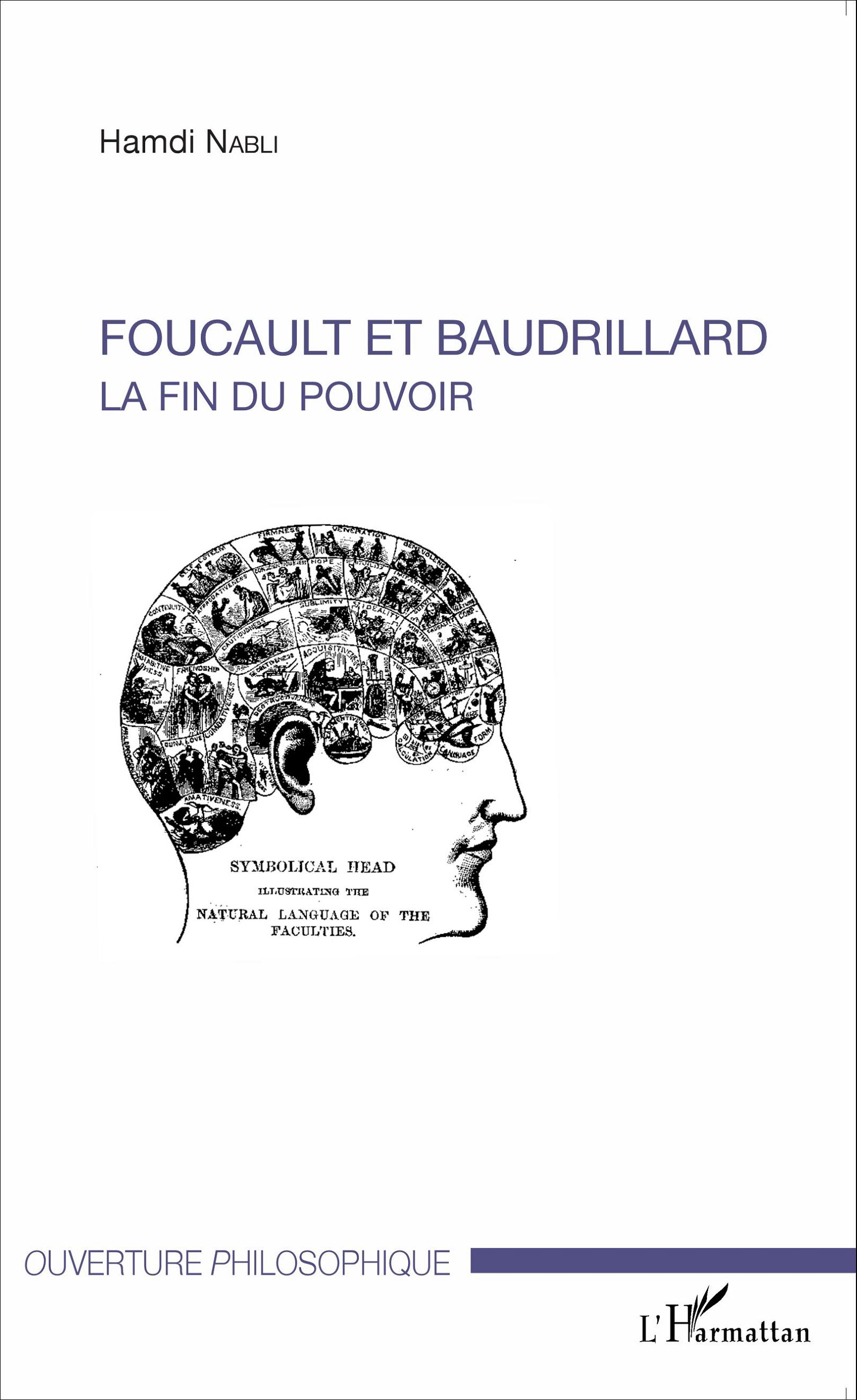
nabliHamdi Nabli, Foucault et Baudrillard: La fin du pouvoir, L’Harmattan, 2015
ISBN : 978-2-343-05754-5 • 1 juin 2015 • 214 pages

Foucault, dans son Histoire de la sexualité, esquissa une anthropologie du plaisir dans l’Antiquité gréco-romaine. Ce travail avait constitué un virage, car depuis Mai 68, l’intellectuel avait fait de l’engagement le vecteur des résistances modernes. Dans son Oublier Foucault, Baudrillard reprochait au philosophe de garder intacte l’instance du pouvoir comme grille d’intelligibilité ultime. Dès lors, la façon dont Foucault a orienté sa recherche, en se focalisant sur la subjectivité, l’éthique de soi, l’esthétique de l’existence et le style de vie, ne serait-elle pas une manière de concéder à la critique de Baudrillard une part de vérité ?

Les mouvements de libération avaient provoqué chez Foucault l’espoir d’un agencement fructueux entre une sexualité renouvelée et une nouvelle culture. Or, l’évolution des sociétés a montré une adéquation entre cette nouvelle culture socio-sexuelle et la société de consommation. Cette culture n’est-elle pas devenue un modèle d’intégration à la société postmoderne, une matrice du « nouvel esprit du capitalisme », et le garant d’un nouvel ordre établi ?

HAMDI NABLI est né à Paris, en 1981. Diplômé de sciences politiques à La Sorbonne, il est enseignant chargé de cours à l’université Paris-3 Sorbonne Nouvelle et consultant chargé de mission au Collège des Bernardins. Il a publié La Fraternité aryenne. L’esprit du terrorisme au cœur de l’Amérique blanche (Connaissances et Savoirs, 2012) et L’inégalité politique en démocratie (Fondation Jean-Jaurès, 2013).

Table des matières
Introduction : Traiter des passions en histoire des idées

PREMIÈRE PARTIE : OUBLIS ET RÉMINISCENCES

L’oubli de soi. De la folie au savoir : la connaissance tragique.
Le pouvoir et son contraire
Le souci de soi. La subjectivité, l’absence de moi

DEUXIÈME PARTIE : GÉNÉALOGIES ET NÉCROLOGIES
Vers la singularité.
Les rapports ambigus à Nietzsche
Traditionalisme et postmodernisme

TROISIÈME PARTIE : SOUCIS DES AUTRES ET FAUSSES SINGULARITÉS

Les ambivalences du souci.
L’homosexualisme : de la communauté contreculturelle au ‘‘pouvoir’’ gay
L’idéologie du care contre le souci de soi.
L’éthique du souci et l’esprit du néocapitalisme
Échapper à la règle (du jeu)
Bibliographie

Paul Patton, Government, rights and legitimacy: Foucault and liberal political normativity, European Journal of Political Theory May 5, 2015

doi: 10.1177/1474885115582077

Abstract
One way to characterise the difference between analytic and Continental political philosophy concerns the different roles played by normative and descriptive analysis in each case. This article argues that, even though Michel Foucault’s genealogy of liberal and neoliberal governmentality and John Rawls’s political liberalism involve different articulations of normative and descriptive concerns, they are complementary rather than antithetical to one another. The argument is developed in three stages: first, by suggesting that Foucault offers a way to conceive of public reason as a historical phenomenon. Second, it is suggested that both Rawls and Foucault allow us to consider rights as historical and particular rather than a-historical and universal. Third, it is argued that Foucault’s genealogy of modern liberal government illuminates some of the tensions and some of the alternatives within the liberal tradition in relation to the concept of political legitimacy.

Foucault
governmentality
homo juridicus
homo oeconomicus
legitimacy
neoliberalism
public reason
Rawls
rights

Hamdi Nabli : “Le discours radical offre une binarisation du monde, il faut un discours alternatif”, Bondy Blog en partenariat avec Liberation, mardi 27 janvier 2015

Par Mathieu Blard

Influencé par les théories de Foucault et Baudrillard, Hamdi Nabli, politologue, livre son regard sur la radicalisation, le traitement médiatique et ses conséquences. Rencontre.

Vendredi 23 janvier, 10h Collège des Bernardins, dans le Ve arrondissement parisien, rendez vous avec Hamdi Nabli, politologue, auteur de La fraternité aryenne, l’esprit du terrorisme au cœur de l’Amérique blanche, et co-auteur de L’inégalité politique en démocratie.

Est-il possible de dégager les causes de radicalisation ?

Hamdi Nabli : Les causes sont plus ou moins connues. Les policiers et les criminologues en ont conscience, ce sont les inégalités économiques et sociales. C’est aussi la prison au cœur de la société française, autour de laquelle il y a une vraie hypocrisie. Il est dit que c’est un problème, alors que c’est un système fonctionnel. Comme le souligne Michel Foucault dans Surveiller et punir, on utilise la prison pour créer cette figure du délinquant qu’on va pouvoir ensuite attaquer dès qu’il va se passer quelque chose. La prison est l’institution phare de la société occidentale moderne. C’est elle qui fonde une société qui exclut, régie par le principe selon lequel celui qui enfreint la loi doit être hors la société. Ce n’est pas un problème de cas sociaux, c’est un problème de civilisation. L’exclusion est un problème central qui se voit aussi au niveau des territoires. Il existe une forme de ségrégation au cœur même de l’inclusion sociale.

suite

Prospects for an Ethics of Self-Cultivation

Introduction

Videos of this conference

‘Prospects for an Ethics of Self-Cultivation’ is a two-year research project investigating the revival of ethical self-cultivation within the European philosophical tradition.

The project will host two international conferences and workshops. The first, entitled ‘Hellenistic Ethics from Nietzsche to Foucault’, took place at the University of Warwick, UK in September 2014. The second, entitled ‘Modern Appraisals of the Hellenistic Legacy’, will be at Monash University’s campus in Prato, Italy in June 2015.

Theatre, Performance, Foucault!

 One-day symposium hosted by the Theatre, Performance and Philosophy working group of the Theatre and Performance Research Association (TaPRA)

 Saturday, 4th July 2015
King’s College London

K0.31 Small Committee Room, Strand London UK WC2R 2LS

Registration site

Welcome

9:30-10am Welcome, registration and tea/coffee

Session 1: Theatre/Foucault/Theatre
10am – 11:30am

Mark Robson (University of Dundee), “Foucault and Theatre: Playing Placeless Place”

Stuart Elden (University of Warwick), “Foucault and Shakespeare: Ceremony, Theatre and Politics”

Aline Wiame (Université Libre de Bruxelles), “Foucault’s Genealogical Theatre of Truth and its Impact on Performance Philosophy”

break

Interruption/Provocation 1: ‘Murmurs of Resemblance’
11:45am –12:15pm

P.A. Skantze (University of Roehampton), “The Table that Says Its Name”

Eleni Kolliopoulou (independent artist, Turin), “Dead can dance” and “8-9”

Lunch

12:15 – 1:30pm Please join us for lunch at Fernandez & Wells, in the Somerset House courtyard

Session 2: Forms, Methods and Methodologies
1:30pm – 3pm

Magnolia Pauker (Emily Carr University of Art and Design, University of British Columbia and European Graduate School), “Foucault Live! ‘A voice that still eludes the tomb of the text’”

Mischa Twitchin (Queen Mary, University of London), “Animating Masks”

Fay Brauer (University of East London and University of New South Wales), “Performing Biopouvoir: Body Culture, Scientia Sexualis and Eugenics”

break

Interruptions/Provocations 2: Time and the ‘Conduct of Souls’
3:15 – 3:30pm

Steve Potter (Goldsmiths, University of London / Cornell University), “Doing Time Together: Music, Chance, and the Security State”

Tea & coffee break
3:30 – 4pm

Session 3: Critical Historiography / Theatre and Performance Genealogies in the dix-neuvième
4pm – 5:15pm

Eve Katsouraki (University of East London), Chair “On the Interstices of Knowledge and Theatre Historiography: a Provocation”

Tony Fisher (Central School of Speech and Drama), “A Night at the Riot: the struggle against monopoly and the governmentalisation of the stage”

Kélina Gotman (King’s College London), “Archaeology, Genealogy, Choreography: Imagining Dance Histories in Motion”

Response
5:15 – 5:30pm

Sanja Perovic (King’s College London)

Symposium dinner and drinks

5:30pm Please join us for dinner and drinks at the India Club, upstairs from the Hotel Strand Continental, 143 Strand WC2R 1JA

Please note all attendees must register on our Eventbrite page:https://www.eventbrite.com/e/theatre-performance-foucault-tickets-17398034991. Registration is free for TaPRA members, and £10 for non-members. Spaces are limited, so advance registration is strongly advised.

Estudos Nietzsche: Special Issue on Foucault and Nietzsche, vol.5, no.1, jan./jun. 2014

Estudos Nietzsche is an open access journal. Full PDFs are available. All articles are in Portuguese

SUMÁRIO

Editorial

1. Editorial v. 5, n. 1 (jan./jun. 2014)
Ernani Chaves.

Artigos

1. Filosofia da cultura e escrita da história: Notas sobre as relações entre os projetos de uma genealogia da cultura em Foucault e Nietzsche

Philosophy of culture and writing of history: Notes on the relationship between the projects of a genealogy of culture in Foucault and Nietzsche
Oswaldo Giacoia Júnior.

2. Retesamentos discursivos: um olhar foucaultiano do estilo antidogmático de Nietzsche

Discursive stiffness: A Foucauldian approach of the antidogmatic style of Nietzsche
Carlos Eduardo Ribeiro, Alexandre Filordi de Carvalho.

3. O Nietzsche de Foucault, o Foucault de Nietzsche

The Nietzsche of Foucault, the Foucault of Nietzsche
Thiago Fortes Ribas.

4. O sol negro da linguagem: Nietzsche, Foucault e a questão do sentido

The dark sun of language: Nietzsche, Foucault and the question of meaning
Fabiano Lemos.

5. Por uma injustiça, dois Platões: tempo e genealogia em F. Nietzsche e M. Foucault

For one injustice, two Platos: time and genealogy in F. Nietzsche and M. Foucault
Felipe Figueiredo de Campos Ribeiro.

6. Prazer, sexualidade e normalização do real

Pleasure, sexuality and normalization of real
Giovana Carmo Temple, Malcom Guimarães Rodrigues.

7. Foucault, Nietzsche: teoria do conhecimento, teologia e crítica da modernidade

Foucault, Nietzsche: theory of knowledge, theology and modernity critique
Ricardo Bazilio Dalla Vecchia.

Resenhas

1. Nietzsche contra Darwin
Oscar Augusto Rocha Santos.