
Foucault News

News and resources on French thinker Michel Foucault (1926-1984)

Kaveh Dastooreh, Vers une sociologie foucaldienne. Réunir l’objectivation et la subjectivation, L’Harmattan, 2015

L’œuvre foucaldienne est aussi une œuvre sociologique. Sa pensée conduit à une pratique autoréflexive de la sociologie. Ce qui rapproche Foucault des sociologues, c’est sa compréhension du sujet à travers un social devenu historique ; cette Histoire nous revient en tant que forme culturelle. La question centrale est ce social primordial dans la constitution de l’individu. Sa sociologie met en lumière la question “qui sommes-nous en train de devenir ?” pour construire un diagnostic sociologique à la fois moderne et paradoxal.

The study proposes a reading of the sociological representation of Foucault’s oeuvre: Foucault’s work can be described as sociology, and it can certainly also be said that there is a sociological program underlying his work. The discussion of his work offers an ideal opportunity to trace back the contours of a social criticism and also that of a sociological auto-reflection. Analysis of the related economies of objectivity/subjectivity and their combinations in Foucault’s work provide a better understanding of the originality of his sociology.
Re-reading Foucault: On Law, Power and Rights
Ben Golder, Editor
(New York: Routledge, 2013. 264 pages.)

Reviewed by—Irina Ceric, (Criminology Faculty member, Kwantlen Polytechnic University),
Vancouver, October 2014

Re-reading Foucault is an ambitious and mostly successful attempt to answer the question “Where is the law in Foucault and what has he done with it?” and the contributors’ creative responses demonstrate the breadth of the interdisciplinary analyses emerging in the wake of the translation of Foucault’s later lectures into English. The collection is dedicated to the “interpretive work of re-imagining law in, and through, Foucault’s work” but the key themes—the politics of rights, surveillance, biopolitics and Foucault’s gestures towards the juridical in his lectures on history, knowledge and power—reflect a broader orientation of likely interest to readers in disciplines other than law. To some extent, however, this potential is belied by the book’s initial focus on the so-called expulsion thesis, the notion that “Foucault had expelled law from any significant role in modernity.” Initially straying into the minutiae of the existing literature, the authors taking up the expulsion thesis ultimately succeed in locating this debate within the context of Foucault’s broader political and theoretical development.

read more

Perret, S.
In the name of the nation? The National Award in Narrative Literature, and the democratization of art in Spain (1977–2013)
(2015) Journal of Spanish Cultural Studies, 17 p. Article in Press.

Abstract
This article looks at the history of the National Award in Narrative Literature (El Premio Nacional de Literatura, Modalidad Narrativa) – a governmental prize issued by the Spanish Ministry of Education, Culture and Sports – to examine how the award has contributed to the formation of a particular idea of Spanish literature in the democratic period (1977–2013). On the one hand, drawing from the theories of Rancière and Foucault, I argue that the conferring of the prize represents a specific technique of power that has allowed the Spanish state to attach itself to individual citizens/artists of diverse linguistic and cultural backgrounds and to appropriate their works as “national.” In so doing, I claim that the issuing of the National Award has served the state well in its attempts throughout the democratic period to market Spain as a multicultural, yet cohesive nation state. On the other hand, I discuss how the issuing of the National Award also serves as a platform from which to discuss a wide variety of social issues, paradoxically including ideas that challenge the state’s legitimacy.

Author Keywords
Alfredo Conde; Bernardo Atxaga; biopolitics; Javier Marías; literary prizes; nationalism

Launch of The Funambulist Magazine by Léopold Lambert

Full PDF of announcement which includes links

Editor: Léopold Lambert has written fairly extensively on Foucault on his Funambulist blog. Many of these writings have been collected together as a book The Funambulist Pamphlets, vol.2 Foucault published by Punctum Books in collaboration with the Center for Transformative Media at Parsons The New School.

Last week in New York City, I was thrilled to launch my new project, The Funambulist Magazine at the offices of e-flux. Helping me to introduce the magazine were three of its brilliant contributors, Sadia Shirazi, Olivia Ahn, and Minh-Ha T. Pham (see photos and recording of the event). This new 62-page publication will now be published once every two months in both digital and printed versions. This magazine continues alongside and in parallel with the open-access platforms that constitute the blog and podcast (Archipelago), which both aim at proposing a political discourse about design, territories and the city, as well as to create an international community of thinkers and creators around these questions since 2010.

read more

Gilles Deleuze, The Intellectual and Politics. Foucault and the prison, Interview with Paul Rabinow and Keith Gandal, 25 May 1985, History of the Present, Spring 1986.

PDF of interview

Update on the 13/13 series of seminars from the website

The first seminar will take place  on September 14, 2015.

Thank you very much for your interest in the series Foucault 13/13. The seminar has received an overwhelmingly good response, and we have more applications than available seats. Please accept our apologies. The application process is now officially closed.

However, we will be live streaming the seminars and also arranging to have an overflow room where you could watch the ongoing seminars by audio-visual projection. We are doing everything possible to make this seminar conversation accessible nonetheless.

First, we will be streaming the seminar live on the multimedia page of the new website of the Foucault 13/13 series here: Multimedia.

Second, we will also have an overflow room if you would like to watch the live stream with others in the overflow room while the seminar is going on, and we will try to promote discussion in the overflow room with the help of our teaching assistants.  The overflow room will be located at the Columbia Law School, 435 West 116th Street, NY, and the exact room location will be posted on the blog page of the new website for Foucault 13/13.  The location for the first seminar on September 14, 2015, will be Room 105 at the Columbia Law School, Jerome Greene Hall.

Third, we will also be blogging on issues related to the seminar on the blog page of the new website for Foucault 13/13, and archiving prior recordings of the seminars. Our blog will be open and moderated for comments and you can find it here: http://blogs.law.columbia.edu/foucault1313/ Please do join us in that conversation as well.

We do hope that this will make it possible for you to follow the seminar series closely, even though you will not be able to be in the seminar room in person.  Again, we will do everything possible to make this seminar series accessible to you in overflow and virtually.

Thank you again for your interest.

Please do follow any news and developments regarding the Foucault 13/13 series either on the new website at Microsite or on our FB and/or Twitter pages.

Warm regards,

Bernard E. Harcourt and Jesus R. Velasco

– See more at: http://blogs.law.columbia.edu/foucault1313/2015/09/03/applications-closed-but-live-stream-live/#sthash.diG1j4Df.dpuf

Why Do We Take Selfies? – 8-Bit Philosophy
by Wisecrack

“Wisecrack is a Los Angeles-based media collective run by comedians, academics, filmmakers and artists who are endlessly curious about the world around us. Their channel explores great topics in ways that make them fun, engaging and unexpected.”

This video is essentially about Foucault’s work.

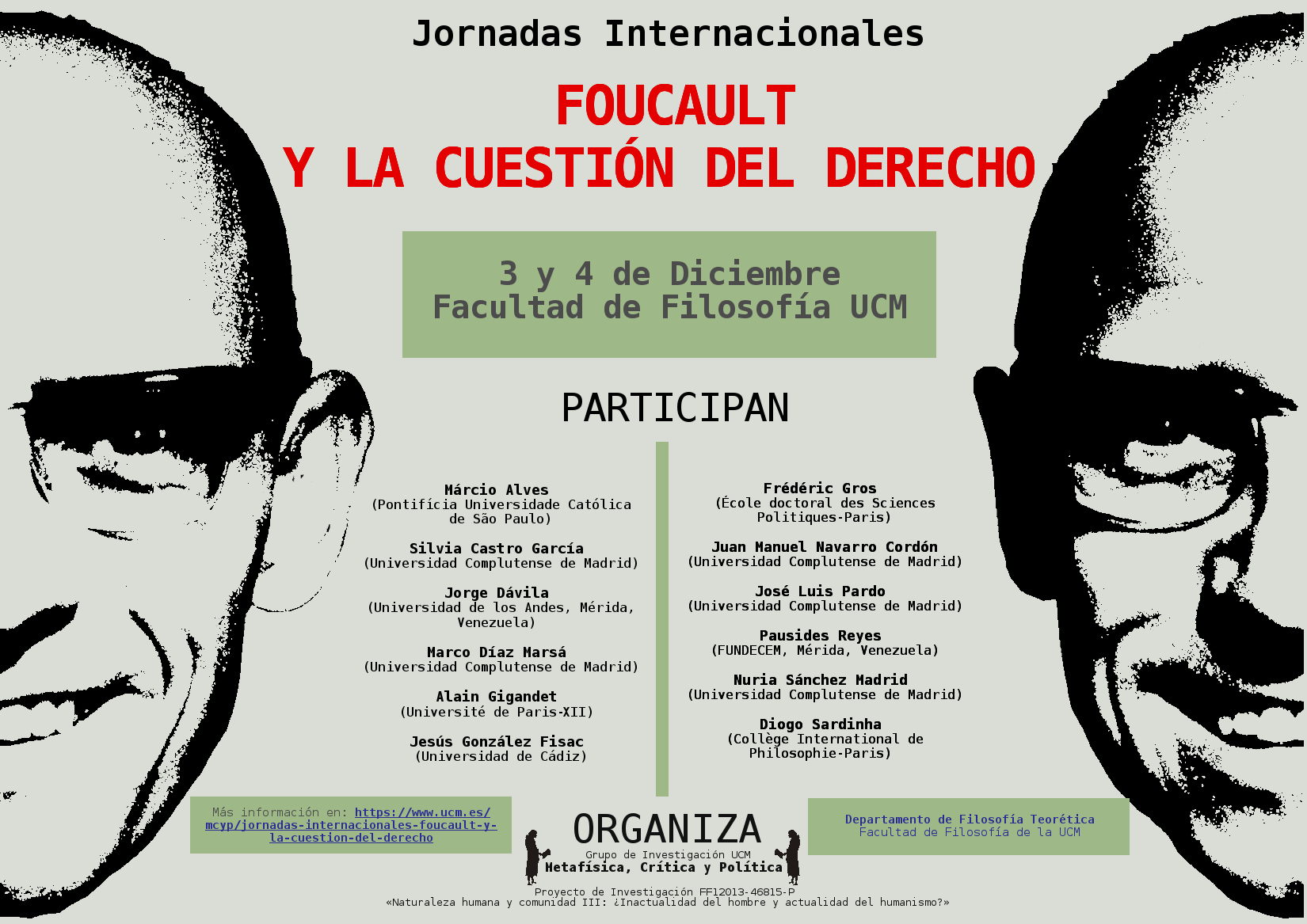
CARTEL_Foucault_y_la_cuestion_del_derecho

Jornadas Internacionales “Foucault y la cuestión del derecho”

Faculty of Philosophy
Complutense University of Madrid
3-4 December 2015.

RESÚMENES

Márcio Alves: “Direito e análise da política em Foucault”
Silvia Castro García: “Breve arqueología del derecho a la última palabra”
Jorge Dávila: “Foucault y la problematización de la relación Ética – Derecho”
MarcoDíaz Marsá: “Sobre “Derecho y Ontología” en Foucault (1978-1984)”
Alain Gigandet
Jesús González Fisac: “El pueblo como sujeto de lo universal. De la gubernamentalidad a la Aufklärung”
Frédéric Gros
Juan Manuel Navarro Cordón
José Luis Pardo
Pausides Reyes
Nuria Sánchez Madrid: “El eclipse del “homo criticus” en la sociedad neoliberal: el diálogo de Wendy Brown con Michel Foucault”
Diogo Sardinha:”Une minorité qui ne fait pas loi. Le Kant des Lumières relu par Foucault”

For the archives on the early history of the reception of Foucault’s work in English. This appears to be a roneotype with original illustrations.

David Brown, “A Note on Michel Foucault’s Discipline and Punish [1981] AltCrimJl 17; (1981) 4(1) Alternative Criminology Journal 116

With thanks to Brendon Murphy for this news

aids6n-8-web

Keri Blakinger, On Freddie Mercury’s birthday, 11 other HIV-related deaths, New York Daily News, September 5, 2015

Michel Foucault
An acclaimed French philosopher, Michel Foucault was best known for works like “Discipline and Punish” and “The History of Sexuality.”He died in 1984 of AIDS-related illness.