Foucault News

News and resources on French thinker Michel Foucault (1926-1984)

The Analytics of Power Today: A Masterclass with Mitchell Dean

Date: Monday, Dec. 14th, 2015
Time: 8:45am—6:00pm
Place: TBA, University of Queensland, St Lucia, Australia

PDF of flyer

About the Masterclass
Over the last thirty years, we have witnessed three broad movements regarding power. The first is the displacement of the state from the centre of political analysis in favour of governance, networks and the energies found in civil society. The second is the rejection of sovereignty and its models, and notions of social structure, to stress the local, heterogeneous and contingent nature of power (Foucault and Deleuze). The third emphasizes the agency of the non-human, material and vital forces and actors (from Latour to Karen Barad). These three movements deconstruct the idea of power in different ways, denying that it has a source or can be possessed, and even depriving it of any explanatory value at all. In his recent book, The Signa-ture of Power, Mitchell Dean argues that such analyses only capture one pole of that which marks power relations. He proposes ways to analyse both governing and reigning, governmentality and sovereignty, different forms of life and the orders and laws of life, and how we can understand biopolitics, through four different analytical approaches. These might be called an analytics of government, a genealogy of order, an archaeology of glory, and an analytics of sovereignty. The challenge is to convert these into analytical frameworks capable of addressing empirical materials.

Mitchell Dean is Professor of Public Governance at the Copenhagen Business School. He is author of eight books, including Governmentality: Power and Rule in Modern Society, The Constitution of Poverty: Towards a Genealogy of Liberal Governance, The Signature of Power and State Phobia and Civil Society: the Political Legacy of Michel Foucault (forthcoming) He describes his work as at the nexus between political and historical sociology

No Cost: This masterclass has been fully supported by the ARC Governing Performance Project and the School of Social Science, University of Queensland.

RSVP: Alison Gable (a.gable@uq.edu.au) by Thurs, 15th October 2015 to register your interest to attend

Participation in the Masterclass
This Masterclass will dialogically engage with questions of analyzing power today in conversation with Professor Dean and other senior academics. A small number of preparatory readings will be made available prior to the day. The masterclass is of course open to anyone. As the event is limited to 25 participants, it is essential to register your interest early. Preference is given to PhD students and early career academics who are invited to present their own work for collegial discussion and feedback.

Participants who wish to present should submit up to two pages outlining their research, their theoretical approach to power, and their main analytical or conceptual challenges. Twelve papers will be selected and circulated to all participants in anticipation of their presentation and discussion at the Masterclass.
The Neoliberalism Controversy and Saint Foucault
Professor Mitchell Dean

Copenhagen Business School

PDF flyer

WHEN
Tues 15 December 2015
3pm – 5pm

WHERE
Room 116
Sir Llew Edwards Building (14)
The University of Queensland
St Lucia campus

There is currently something of a controversy concerning Michel Foucault and neoliberalism, sparked by a book of that title, edited by Daniel Zamora and Michael Behrent (Polity, 2015). The book has already achieved notoriety in its earlier French form, but it chimed with the recent claim by François Ewald, that Foucault had made an “apology of neoliberalism” in the late 1970s. Here I argue that this controversy signals the end to a rather de-contextualized and ahistorical view of Foucault as a felicitous combination of activist and radical critic of mainstream knowledge and institutions who somehow became the most influential figure in the humanities and social sciences. I offer some reflections both on the habitus and persona of high-status intellectuals and on the social and political contexts in France during a moment of historic rupture with the post-war settlement. I argue that it is possible to identify Foucault’s affirmative views on neoliberalism as an ideal set of principles of social organization, as a language of critique of the welfare state, and as an element of actual political forces within the French Left of the 1970s. I conclude by suggesting that the current discussion might signal a change of Foucault’s status today from “unsurpassable horizon” of critical thought to acknowledged classical thinker, with strengths and limitations, and a series of problems that might not be our own.

Mitchell Dean is Professor of Public Governance at the Copenhagen Business School. He is author of, among others, Governmentality: Power and Rule in Modern Society (Sage, 1999/2010), The Signature of Power (Sage, 2013), and, with Kaspar Villadsen, State Phobia and Civil Society: the Political Legacy of Michel Foucault (Stanford University Press, 2015). He has published extensively in international journals and describes his work as at the nexus between political and historical sociology and political theory and philosophy.

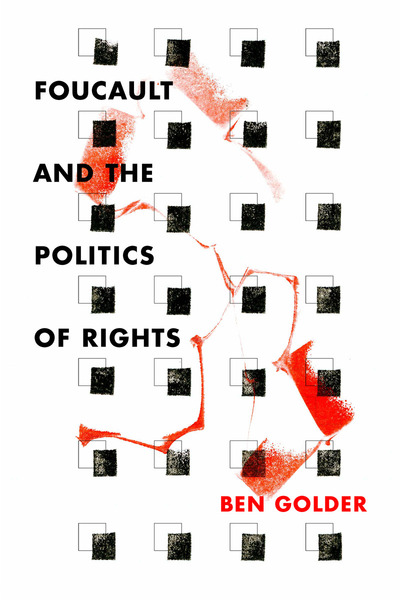
golder2Ben Golder, Foucault and the Politics of Rights, Stanford University Press, 2015, Now available.
Publisher’s page

This book focuses on Michel Foucault’s late work on rights in order to address broader questions about the politics of rights in the contemporary era. As several commentators have observed, something quite remarkable happens in this late work. In his early career, Foucault had been a great critic of the liberal discourse of rights. Suddenly, from about 1976 onward, he makes increasing appeals to rights in his philosophical writings, political statements, interviews, and journalism. He not only defends their importance; he argues for rights new and as-yet-unrecognized. Does Foucault simply revise his former positions and endorse a liberal politics of rights? Ben Golder proposes an answer to this puzzle, which is that Foucault approaches rights in a spirit of creative and critical appropriation. He uses rights strategically for a range of political purposes that cannot be reduced to a simple endorsement of political liberalism. Golder develops this interpretation of Foucault’s work while analyzing its shortcomings and relating it to the approaches taken by a series of current thinkers also engaged in considering the place of rights in contemporary politics, including Wendy Brown, Judith Butler, and Jacques Rancière.

About the author

Ben Golder is Senior Lecturer at the Faculty of Law at the University of New South Wales, Australia.

Editor: Reblogged from Stuart Elden’s site Progressive Geographies

Foucault was interviewed in 1975 for a Brazilian paper:

Q: In your work, the State seems to occupy a privileged place. And the State represents a privileged instance for understanding historical-cultural formations. Could you specify the conditions of possibility which underpin the State?

A: It is true that the State interests me, but it only interests me differentially [différentiellement]. I do not believe that the entirety [ensemble] of the powers which are exercised within a society – and which assure the hegemony of a class, an elite, or a caste in that society – are entirely contained in the State system. The State, with its grand judicial, military and other apparatuses [appareils], only represents a guarantee, the reinforcement of a network of powers which come through different channels, different from these main routes. My problem is to attempt a differential analysis of the different levels of power in society. As a consequence, the State occupies an important place in this, but not a preeminent one (DE no 163, II 812).

“El filósofo responde’, Jornal da Tarde, 1 Nov 1975, pp. 12-13; translated by Plinio-Walder Prado Jr as “Michel Foucault: Les réponses du philosophie”, Dits et écrits text no 163, Vol II, p. 812 (1994 Four Volume edition).

This passage does not appear in the recent reprint of the Portuguese translation of the interview. I guess it must be in the original Portuguese version (which I have been unable to locate) because if not, what is the source for the translation in Dits et écrits? [Update 26 May 2015: the question does appear in the 1975 original – thanks to Andrea Teti for tracking down a copy.]

read more

La bibliothèque de Foucault : Guide des papiers de travail de Michel Foucault.
Inventaire EAD réalisé par l’EHESS et l’ENS Lyon

Foucault’s working manuscript for Les mots et les choses

With thanks to Stuart Elden at Progressive Geographies for this news

Fitzpatrick , P. and P. Kender. 2015 . Foucault, Surveillance and the Law of the Outside, Surveillance & Society 13( 2 ): 314 – 318.

Full PDF

Introduction
The inside as an operation of the outside: in all his work Foucault seems haunted by this theme of an inside which is merely the fold of the outside, as if the ship were a folding of the sea. – Gilles Deleuze, Foucault (2006: 81) This note could be even shorter than it has to be if a prevalent perspective on our brief were adopted. Broadly, that brief evokes the relation between law and surveillance in Foucault’s work. The standard perspective would render that relation in terms of law’s abjection. A compendious instance comes with the “expulsion thesis” (see Golder and Fitzpatrick 2009: chapter 1). This thesis has it that Foucault expelled law from a modernity formed by and in a conglomerate of disciplinary powers and a biopower made operative through the managed governing of whole populations. More precisely, with the expulsion thesis law is entirely if functionally subsumed within this conglomerate. It has no autonomous existence. Foucault did say as much (e.g. 1981:89 — all unnamed references will be to Foucault). And this does pose an obvious problem for what will be our contrary argument, and especially so in relation to surveillance since Foucault does vividly instance surveillance as subsuming the juridical (2001a:73)

read more

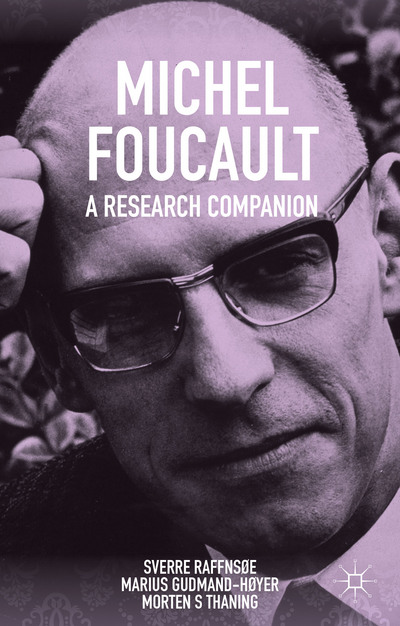
raffnsoeSverre Raffnsøe, Morten S Thaning, Marius Gudmand-Hoyer, Michel Foucault: A Research Companion. Palgrave Macmillan, 2015

Publication Date: November 2015

Michel Foucault continues to be hugely influential. His diagnoses challenge us to rethink crucial phenomena such as madness, discipline, the human sciences, the state, neoliberalism, sexuality and subject formation. Based on his work in its entirety, and with special emphasis on his many recently published lecture series, this book provides an updated, comprehensive and original account of his thought. By reading Foucault as a philosopher, it offers an extensive systematic assessment and discussion of his unique conception of philosophical practice and brings a unifying trajectory in his work to light.

Comment lire L’Archéologie du savoir de Michel Foucault ?, Les Études philosophiques, 2015/3 (N° 153)

English version

Sommaire
Baptiste Mélès
Page 323 à 326 Présentation

Michel Foucault, Texte établi et introduit par Martin Rueff
Page 327 à 352 « Introduction » à L’Archéologie du savoir

Luca Paltrinieri
Page 353 à 376 L’archive comme objet : quel modèle d’histoire pour l’archéologie ?

Jean-François Courtine
Page 377 à 390 Michel Foucault et le partage nietzschéen : Vérité/Mensonge

Baptiste Mélès
Page 391 à 412 Les « règles de formation » comme catégories foucaldiennes

David Rabouin
Page 413 à 430 L’exception mathématique

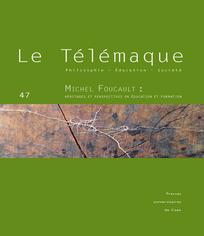
telemaqueMichel Foucault : héritages et perspectives en éducation et formation. Le Télémaque, 2015/1 (n° 47)

Sommaire
Brigitte Frelat-Kahn, Dominique Ottavi, Alain Vergnioux
Page 7 à 8 Ouverture

Chronique morale
Alain Vergnioux
Page 9 à 15 La philosophie de François Châtelet

Notion
Valentina Crispi
Page 17 à 30 L’interculturalité

Dossier – Michel Foucault : héritages et perspectives en éducation et formation
Hubert Vincent
Page 31 à 37 Présentation

Francois Jacquet-Francillon
Page 39 à 57 Un autre regard sur les disciplines scolaires

Nicolas Guirimand
Page 59 à 70 De la “pédagogisation” des soins des malades chroniques aux dispositifs d’éducation thérapeutique

Hubert Vincent
Page 71 à 86 Foucault éducateur : un art de l’écriture et un modèle d’autoformation

Sílvio Gallo
Page 87 à 95 La production des hétérotopies à l’école : souci de soi et subjectivation

Annie Hourcade Sciou
Page 97 à 108 La question de l’écoute chez Michel Foucault

Edouardo Machado
Page 109 à 120 Foucault, lecteur de Plutarque : de la notion de savoir « éthopoétique » à la construction d’une « esthétique de l’existence »

Étude
Sébastien Urbanski
Page 121 à 138 L’expression de croyances dans les manuels d’histoire pour l’école publique : le cas de la Pologne avant et après 1989

Compte rendu
Alain Vergnioux
Page 139 à 144 Raymond Bénévent, Claude Mouchet, L’école, le désir et la loi. Fernand Oury et la pédagogie institutionnelle. Histoire, concepts pratiques, Nîmes, Éditions Champ Social – Matrice, 2014, 493 p.

With thanks to Sam Matuszewski for this news

American Comparative Literature Association (ACLA) Conference
March 17-20, 2016 — Harvard University
Panel: The New Security State: Surveillance, Counter-Surveillance, and Strategies of Resistance
Organizers: Carlos Rojas (Duke University) and Belinda Kong (Bowdoin College)

Full panel description and submission guidelines can be found here: Deadline for paper submissions is Sept 23 2015

Papers with a foucauldian approach are welcome

Literature has long been closely imbricated with practices of surveillance. Not only does literary production necessarily rely on practices of observation (either at the level of the individual or a broader collectives, as with the close synergy between the rise of the modern novel and Western imperial projects), literature itself has often been the object of close scrutiny by the state and other corporate entities. In this respect, literary representation anticipates—and is symptomatic of—a broader array of technologically-based surveillance practices that have emerged in the modern period. As technological advances continue to enhance the ability of states and corporations to surveil the public, even as the public is also increasingly able to deploy similar technologies to its own ends—including efforts to surveil the operation of the surveillance apparatus itself. This latter practice of counter-surveillance is particularly evident in the ways that citizen videos (and the public circulation of videos originally produced by the state) have helped precipitate a national debate in the US over police brutality, but it also has much broader ramifications.

Our panel will examine some of the implications of these developments as they pertain to the new security state. We are interested not only in how issues of surveillance and counter-surveillance are addressed in literary works, but also how some of the discourses and visual archives generated by these surveillance practices may be approached as virtual literary works in their own right. Potential topics include examinations of state censorship regimes, social media and practices of collective authorship, surveillance video and found footage as a form of textual production, digital archives and shifting loci of identity, practices of exhibitionism and impersonation, selfies and confessional discourses, as well as advances in wearable technologies and cybernetic states.

Full panel description and submission guidelines can be found here: Deadline for paper submissions is Sept. 23 2015