Ciclo de conferencias de Nikolas Rose (2015)
Nuevo horario conferencia de Nikolas Rose . Martes 17/11, 18 horas. Quebec 415, Providencia.
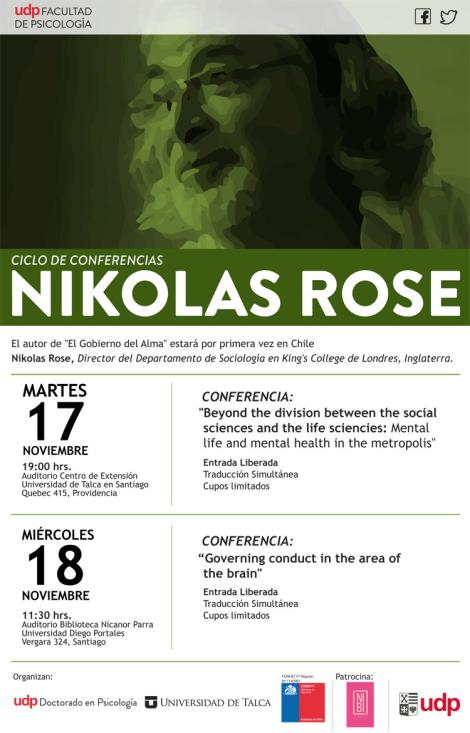

Ciclo de conferencias de Nikolas Rose (2015)
Nuevo horario conferencia de Nikolas Rose . Martes 17/11, 18 horas. Quebec 415, Providencia.
International Workshop Program
November 19th, 2015
Room “auditorio DEC”,
Faculty of Engineering Diego Portales University (Vergara # 432, Santiago)
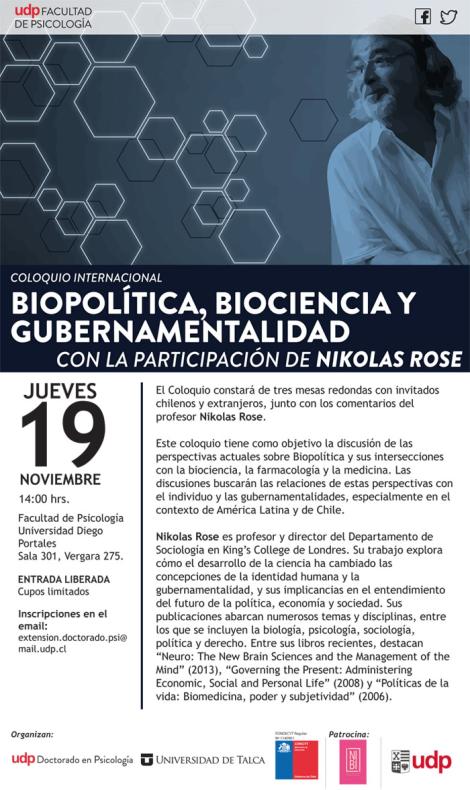
Panel 1 (14:00 a 15:45 hrs):
Claudio Maino and Álvaro Jiménez (Universidad Paris 5 (Descartes)): The challenges to think mental health in democratic societies: What can the biopolitical approaches offer?
Mauricio Sepúlveda, Sebastían de la Fuente and Jorge Lucero (Universidad de Chile): The poppers as technology of the body in the sexual (counter) practices: Pleasure, counter-pratice and somatic fiction
Jimena Carrasco (Universidad Austral de Chile) and Arthur Arruda (Universidade Federale Rio de Janeiro): Brazilian and Chilean psychiatric reforms and management for freedom – a history of the modes of governance in mental health practices.
Coffee Break
Panel 2 (16:00 a 17: 45):
Jorge Castillo (Universidad de Santiago de Chile): Bio-governmentality: regimes of subjectification, embodiment and biosociality in GES: approach to expert repertoires
Sebastián Rojas (King’s College London): A biomedical hybridization of childhood? Modes of agency and flashes of will according to an ethnographic experience in a Chilean school of Santiago
Ricardo Camargo (Universidad de Talca) and Nicolás Ried (Universidad de Chile):
Biopolitics and Truth in the Chilean judicial apparatus: the case of the Marchiafava Bignami disease
Coffee Break
Final: 18:00
Nikolas Rose: “Biopolitics in the Twenty First Century”
Open University December philosophy seminar
Dr Luca Sciortino (Visiting Research Fellow, University of Leeds)
‘Styles of Thinking and Epistemic Relativism’
2pm December 2nd 2015
Meeting Room 5, Walton Hall, Milton Keynes
Abstract
In the 1980s Ian Hacking put forward the ‘styles project’, as he called it, whose central idea is that there exist distinct styles of thinking which have emerged in the course of the history of science. This paper points at a potential tension between Hacking’s entity realism and his styles project. I argue that realism about unobservable entities is a case in which a scientific claim is justified for a community that adopts a certain style and unjustified for a community that adopts another style. I conclude that Hacking’s styles project implies epistemic relativism.
Michel Foucault: The rights and duties of international citizenship (2015)
The front page of the Open Democracy Site, 14 November 2015
Also includes links to the following items:
Michel Foucault “The refugee problem is a presage of the great migrations of the twenty first century”, 1979. Translated by Colin Gordon.
Colin Gordon, The drowned and the saved: Foucault’s texts on migration and solidarity, 13 November 2015
Engin Isin, Michel Foucault as an activist intellectual, 13 November 2015
Jen Bagelman, Foucault and the ‘current’ refugee crisis, 13 November 2015
“Face aux gouvernements, les droits de l’homme”, Liberation no 967, 30 June /1 July 1984, p. 22. Dits et ecrits IV pp. 707-8 (355), Gallimard 1994.
This statement was read by Foucault at a press conference on June 19th 1981, organized in association with the organizations Médecins du monde and Terre des hommes, in the presence of Yves Montand, André Glucksmann and Bernard Kouchner. The press conference, according to the newspaper Libération when it published Foucault’s text for the first time just after his death in 1984, was to have marked the public announcement of the formation of an International Committee against Piracy. Another account states that this Committee was set up in Lausanne on April 30 that year. The Libération editor’s note states that Foucault wrote this statement “minutes” before he read it. The title of the piece as published by Libération, “Confronting governments, human rights” seems to have been provided by them, not by Foucault. Given the public profile of the event and those present, it is unclear why the text appears not to have been published at the time.
“We are here only as private individuals and with no other claim to speak, and to speak together, except a certain difficulty we share in enduring what is taking place.
I know very well, and one must defer to this evident truth: we can do little about the reasons which make men and women prefer to leave their country rather than remain and live in it. It is not in our power to change these facts.
So who asked us to speak? No one, and that is exactly our entitlement. It seems to me that we need to keep in mind three principles which, I believe, guide this initiative, like several others that have preceded it: Ile-de-Lumière, Cap Anamour, A Plane for El Salvador, but also Terre des Hommes and Amnesty International.[1]
1) There exists an international citizenship which as such has its rights and duties, and which is obliged to stand up against all forms of abuse of power, no matter who commits them, no matter who are their victims. After all, we are all governed, and, by that fact, joined in solidarity.
2) Because of their claim to care for the wellbeing of societies, governments arrogate to themselves the right to treat in terms of profit and loss the human suffering which their decisions cause and their negligence allows. It is a duty of this international citizenship to always confront the eyes and ears of governments with the human suffering for which it cannot truthfully be denied that they bear responsibility. People’s suffering must never be allowed to remain the silent residue of politics. It grounds an absolute right to stand up and to challenge those who hold power.
3) We must refuse the division of labour which is so often proposed to us: individuals are allowed to be indignant and to talk, while it falls to governments to deliberate and to act. It is true that well-intentioned governments appreciate the sacred indignation of the governed, providing that it remains merely lyrical. But I think we must be aware that it is very often those who govern who talk, are only able to talk, or only want to talk. Experience shows that we can and must refuse the histrionic role of pure protest which governments would like to offer us. Amnesty International, Terre des Hommes, Médecins du Monde are initiatives which have created this new right: the right of private individuals to intervene actively and materially in the order of international politics and strategy. The will of individuals must be present and expressed in the order of reality which governments have sought to monopolise. Step by step and day by day, their purported monopoly must be rolled back.“
Translated by Colin Gordon, October 2015
[1] Ile-de-Lumière was a French hospital and rescue ship organized by Bernard Kouchner and others which conducted a series of missions in the South China Sea in 1979. Cap Anamour was another rescue ship organised by the German humanitarian activists Christel and Rupert Neudeck and others.
Editor: My thoughts are with those of you reading Foucault News from Paris in the wake of Friday night’s terrible events.
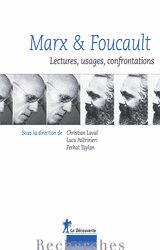 Christian LAVAL, Luca PALTRINIERI, Ferhat TAYLAN, Marx & Foucault: Lectures, usages, confrontations, Éditions La Découverte, 2015
Marx et Foucault : deux œuvres, deux pensées sans lesquelles on ne peut saisir le sens de notre présent. Pas de théorie critique qui puisse se passer de leurs concepts et de leurs analyses. Et pas de luttes qui ne renvoient à tel moment ou à tel aspect de leur héritage. Pourtant, de l’un à l’autre le passage ne va pas de soi. Les époques, les intentions, les philosophies même ne sont pas superposables. Hétérogènes donc, ces pensées font, l’une et l’autre, obstacle à tout « foucaldo-marxisme ».
L’ouvrage vise à montrer des rapports mobiles et complexes, non des identités profondes ou des incompatibilités d’essence. Rapports de Foucault à Marx : il prend appui sur lui pour le déborder, l’envelopper, et parfois l’opposer à lui-même. Rapports de Foucault aux marxismes, sous leurs variantes les plus diverses, humaniste, existentialiste, althussérienne, qui n’ont cessé de composer les actualités changeantes de Foucault. Rapports des marxistes, d’hier et d’aujourd’hui, à Foucault : comment l’ont-ils lu ? Que lui ont-ils reproché, que lui ont-ils emprunté ? Qu’en font-ils aujourd’hui de neuf ?
C’est donc l’actualité d’une lecture croisée de Marx et Foucault qui est au centre des contributions de cet ouvrage et qui ouvre sur un espace fécond pour l’avenir de la pensée critique.
“An Archaeology of Adam Smith’s Epistemic Context”
Iara Vigo de Lima and Danielle Guizzo
Review of Political Economy, Published online: 26 Oct 2015
(DOI:10.1080/09538259.2015.1082819)
Abstract:
Adam Smith played a key role in Foucault’s archaeology of political economy. This archaeology, which Foucault accomplished in The Order of Things, is the focus of this article. Foucault may have disagreed with the writings of the classical political economists but he widens our perspective through new possibilities of understanding. It is very illuminating to understand Smith’s thinking as following a discursive practice that economic thought shared with the knowledge of living beings (natural history) and language (grammar). Foucault’s archaeology highlights some ontological and epistemological conditions that shed light on some of the pillars of Smith’s thinking: the centrality of exchange, the division of labour and the labour theory of value. The proximity between Newton and Smith is also examined in ontological and epistemological terms which can be understood through an investigation of that interdiscursivity practice. Beyond testing Foucault’s considerations, our aim is to demonstrate their potential for the current scholarship of Smith’s works. Foucault’s archaeology of knowledge offers a range of elements that warrants greater analysis by historians of economic thought.
Key Words:
Adam Smith, archaeology, Foucault, interdiscursive practice, Newtonian method, ontological and epistemological conditions.
Deleuze ABECEDAIRE, Fidélité Amitié, seconda parte: Foucault
Deleuze describes his friendship with Michel Foucault
With thanks to Colin Gordon for this link
CALL FOR PAPERS
The sixteenth annual meeting of the Foucault Circle
Sydney, Australia
June 29-July 2, 2016
(hosted by the University of New South Wales)
We invite individual papers and roundtable proposals (4-5 panelists) on any aspect of Foucault’s work. Studies, critiques, and applications of Foucauldian thinking are all welcome. We will aim for a diversity of topics and perspectives.
Abstracts should be prepared for anonymous review, and are to be submitted to the program committee chair, Richard A. Lynch, by email (lynchricharda@sau.edu) on/before Friday, Nov. 20, 2015. Please indicate “Foucault Circle submission” in the subject heading, and include the abstract as a “.docx” attachment.
Individual paper submissions require an abstract of no more than 750 words; roundtable submissions require a 500-word abstract describing the theme and 150-word summaries of each panelist’s talking points.
Program decisions will be announced in December.
Each speaker will have approximately 35 minutes for paper presentation and discussion combined—papers should be a maximum of 3000 words (15-20 minutes reading time). Roundtables will have approximately 50 minutes total for presentation and discussion combined; individual panelists should plan to speak for no more than 5-7 minutes. In addition to paper and roundtable sessions, the conference will also feature a “reading group” discussion session (texts TBA) open to all participants.
Logistical information about lodging, transportation, and other arrangements will be available after the program has been announced.
For more information about the Foucault Circle, please see our website:
The Foucault Circle at UNSW will be held immediately before the Australasian Association of Philosophy Conference which in 2016 is being hosted by Monash University at the Caulfield campus. AAP
Dates are: Sunday 3rd July – Thursday 7th July 2016. Scholars planning to attend the Foucault Circle may also wish to attend the AAP.
Plateau Simone Signoret, Michel Foucault
06 oct. 1982, Antenne 2, Site l’Institut national de l’audiovisuel
présentateur
Christine Ockrent
Christine OCKRENT interviewe l’actrice Simone SIGNORET et le philosophe Michel FOUCAULT sur la situation en Pologne, où le syndicat Solidarité vient d’être interdit par le gouvernement.
– Simone SIGNORET, qui porte un badge du syndicat polonais “Solidarité”, explique pourquoi elle est allée en Pologne, notamment avec Médecins du Monde. Elle raconte qu’elle n’a pas eu le courage de porter ce badge là-bas. Elle estime que tout le pays est en dissidence ; elle parle de la situation économique et du fait que les Polonais sont surveillés en permanence : “on ne parle pas car il y a des micros partout”. Elle a vu des acteurs polonais “boycotter” leur travail, à savoir leur participation à des émissions de télévision qui leur apporte un revenu fixe. Cette décission n’est pas une consigne donnée par un syndicat, mais elle est prise individuellement.
– Michel FOUCAULT étudie la notion de normalisation en Pologne, parle du régime totalitaire dans les pays socialistes. Il engage les français à se rendre dans ce pays. Il pose le problème de l’engagement nécessaire de l’Europe, explique ce que ressentent les Polonais a propos des français.
With thanks to Colin Gordon for this news
 Foucault News