
Foucault News

News and resources on French thinker Michel Foucault (1926-1984)

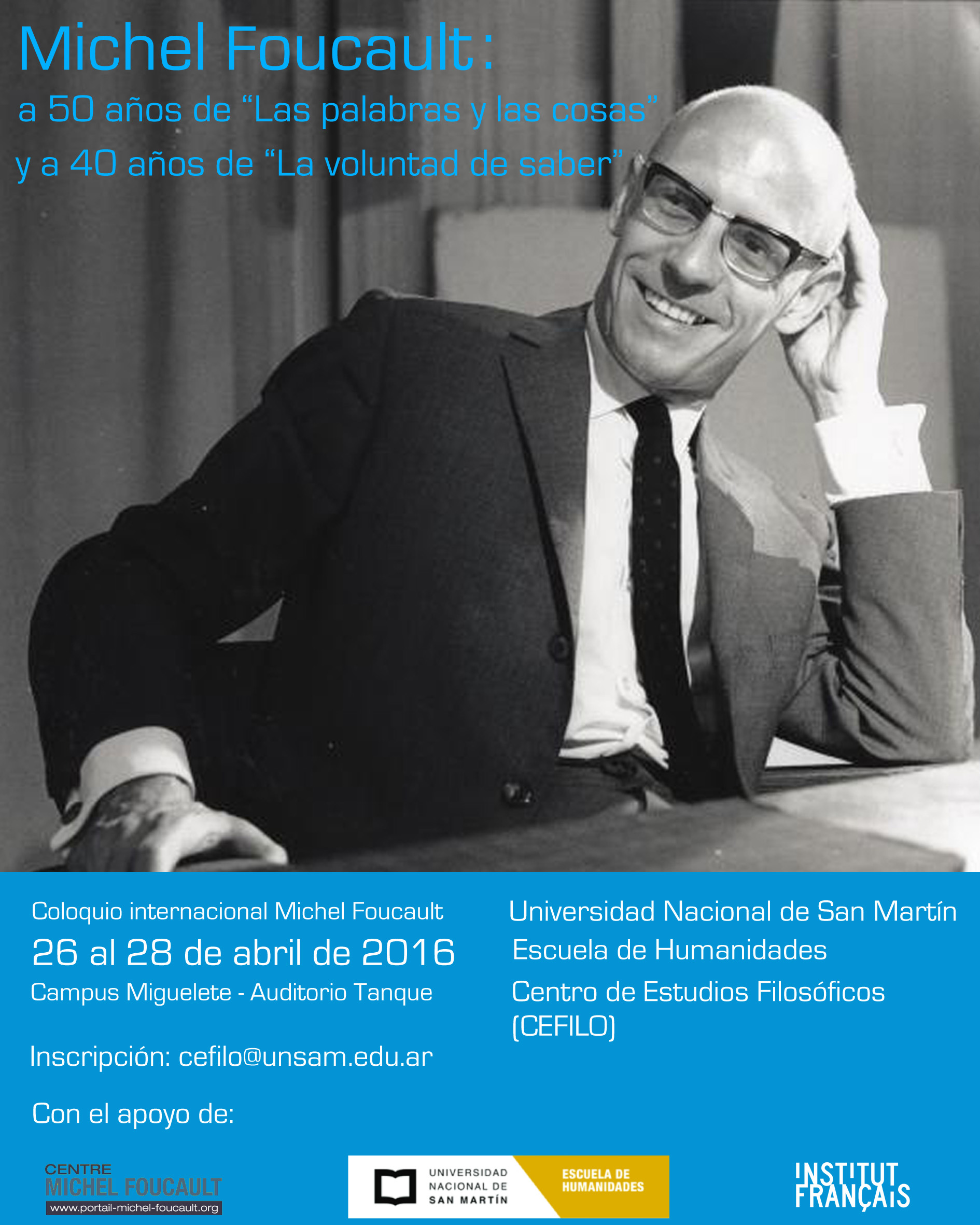
Flyer Foucault UNSAM 1

UNIVERSIDAD NACIONAL DE SAN MARTÍN

Escuela de Humanidades

Centro de Estudios Filosóficos (CEFILO)
Coloquio Internacional Michel Foucault:
a cincuenta años de “Las palabras y las cosas
y a cuarenta años de “La voluntad de saber

26 al 28 de abril de 2016 – Campus Miguelete – Auditorio Tanque

Programa de Exposiciones

Programa de Exposiciones

Martes 26 de abril

Mesa 1: Los desafíos filosóficos de Las palabras y las cosas

Coordina: Marcelo Raffin.

14:00 hs.: Cristina López (Humanidades–Unsam)El desafío filosófico del libro sobre los signos”.

14:30 hs.: Cesar Candioto (Pontifícia Universidade Católica do Paraná) “La finitud en Las Palabras y las cosas”.

15:00 hs.: Philippe Sabot (Université Lille 3) “Aux sources des Mots et les choses: l’archéologie et ses archives”.

15:30 hs.: Debate.

16:00 hs.: Pausa café.

Mesa 2. Los desafíos filosóficos y políticos de Historia de la sexualidad 1

Coordina: Cristina López.

16:30 hs.: Arianna Sforzini (BNF) “Histoire de la sexualité: première version”.

17:00 hs.: Orazio Irrera (Université Paris 1 Panthéon-Sorbonne) “La bête d’aveu et l’animal idéologique, ou comment sortir de l’humanisme?”.

17:30 hs.: Edgardo Castro (Conicet-Unsam) “Michel Foucault, una filosofía de la voluntad”.

18:00 hs. Debate.

18:30 hs. Fin primera jornada.

Miércoles 27 de abril

Mesa 3. Los desafíos genealógicos de La palabras y las cosas a Historia de la sexualidad 1

Coordina: Beatriz Podestá.

14:00 hs.: Daniel Verginelli Galantin (Universidade Federal do Parana) “Do ser da linguagem à insurreição: Michel Foucault e Georges Bataille”.

14:30 hs.: André de Macedo Duarte (Universidade Federal do Parana) “Foucault y Butler en torno a Herculine o ¿qué significa resistir al dispositivo de la sexualidad?”.

15:00 hs.: Agustín Colombo (Paris 8-Uba) “De la carne como punto de emergencia del dispositivo de sexualidad a la carne como modo de subjetivación”.

15:30 hs.: Debate.

16:00 hs.: Pausa café.

Mesa 4: Las postrimerías filosóficas de Las palabras y las cosas

Coordina: Agustín Colombo.

16;30 hs.: Tuillang Yuing (Instituto de Asuntos públicos-Universidad de Chile) “De Foucault a Foucault, pasando por Rancière”.

17:00 hs.: Beatriz Podestá (Facultad de Filosofía/UNSJ)“En torno a Las palabras y las cosas“.

17:30 hs.: Thiago Fortes Ribas (Universidad Positivo) “Foucault, el “a priori histórico” y la productividad del discurso”.

18:00 hs.: Luca Paltrinieri (Université de Paris 8, CNRS-Collège International de Philosophie.) “Discours philosophique et ethnologie. Après les Mots et les choses“.

18:30 hs.: Debate.

19: 00 hs.: Fin segunda jornada.

Jueves 28 de abril

Mesa 5: Las incidencias teóricas y políticas de Las palabras y las cosas

Coordina: Luis Blengino.

14:00 hs.: Senda Sferco (Conicet-IIGG de la Uba)El retiro del origen y las temporalidades de la experiencia”.

14:30 hs.: Luciano Nosetto (Gino Germani, Uba / CONICET) “Retroceso y retorno del origen en el discurso político”.

15:00 hs.: Ariane Revel (UPEC) “De l’histoire naturelle des régimes à l’analyse historique du politique: le savoir politique classique à l’épreuve de la contingence”.

15:30 hs.: Debate.

16:00 hs.: Pausa café.

Mesa 6: Filosofía y política en Historia de la sexualidad 1

Coordina: Senda Sferco.

16:30 hs.: Luis Blengino (UnLaM)  “La política como pregunta. A propósito de la hipótesis de 1976 en relación con las de 1979”.

17:00 hs.: Marcelo Raffin (Conicet/UBA) Historia de la sexualidad”: entre el dispositivo de sexualidad y la gubernamentalidad”.

17:30 hs.: Frédéric Gros (Science Po–Paris) “Sexualidad y obediencia”.

18:00 hs.: Debate.

18:30 hs.: Fin del Coloquio.

Contacto
cefilo@unsam.edu.ar

 Con el patrocinio del Centre Michel Foucault y el Institut Français

The Art of Thought


Sam Kaprielov, Foucault 2016

Press release PDF

April 13th – May 6th 2016

Exhibition at The Cob Gallery
205 Royal College Street
London NW1 0SG

All artworks are available for purchase.

The Cob Gallery is delighted to present celebrated Russian artist Sam Kaprielov’s new exhibition ‘The Art of Thought’ on 14th April.

The show is a series of 40 oil on canvas portraits depicting renowned thinkers. They range from history’s founding Philosophers to modern day Royalty and Rock Stars.

Kaprielov suggests that the mind is the most potent tool known to mankind. Its used by the philosopher to ponder metaphysics and by the artist to create images that lead to thought and inspiration. With ‘The Art Of Thought’ he has brought these two fields of human endeavour together as friendly bedfellows.

His extraordinarily agile and, yet, very precise brushwork has conjured up on canvas a collection of some of the most influential thinkers of centuries past so that we may retain a modicum of cognition, lest we forget the contribution that these fellows have made to the development of humanity throughout history, leading us to where we are now.

Amongst the portraits of more traditional philosophers such as Plato and Socrates, Kaprielov has included a few of what he describes as ‘red herrings’, such as Ian ‘Lemmy’ Kilmister, Prince Philip and Roberto Cavalli, to name a few.

The works are straightforward painterly interpretations of likenesses found on Google, and not an attempt to visually represent philosophical concepts of the thinkers. The mono coloured canvases represent those personalities in the history of philosophy whom we know nothing about.

In most of the paintings the ice-cold precision of the philosopher’s outlook is nicely balanced out with the warmth of palette. During his formative years, Kaprielov spent countless hours in Leningrad’s Hermitage Museum contemplating somewhat yellowish old master works and came to firmly believe that a truly good oil painting should be yellow.

Torrano, A.
Werewolves in the immunitary paradigm
(2016) Philosophy Today, 60 (1), pp. 153-173.

DOI: 10.5840/philtoday2016113102

Abstract
This article problematizes the political category of the monster in Hobbes’s thought from a biopolitical perspective. Even though political thought has been tra-ditionally focused on Leviathan’s figure as a political monster, here we pay particular attention to the maxim homo homini lupus, which can be identified with the wereWolf. This figure allows us on the one hand, to show how the Wolf becomes man with the creation of the State, and on the other hand, to show how there is a constant threat of man becoming Wolf, of the lupification of man. Hobbes’s discourse of sovereignty aims to neutralize the wereWolf. This neutralization can be seen as immunization. In this sense, the wereWolf operates both as poison and as antidote-pharmakon-within the State. The wereWolf produces an inoculation with a therapeutical function: it is a dose of the same poison from which the State seeks to protect itself. © 2016. Philosophy Today.

Author Keywords
Biopolitics; Immunization; Monstrosity; Sovereignty; Werewolf

Marianne Fenech and Jennifer Sumsion, Early Childhood Teachers and Regulation: Complicating Power Relations Using a Foucauldian Lens, Contemporary Issues in Early Childhood, June 2007 vol. 8 no. 2 109-122

doi: 10.2304/ciec.2007.8.2.109

Abstract
This article both supports and complicates the positioning of reconceptualists who frame the regulation of early childhood services as repressive. Drawing on Foucault’s construction of power and, in particular, his notion of an ‘analytics of power’, the authors analyse findings from an Australian study investigating university-qualified early childhood teachers’ perceptions of regulation. The authors contend that whilst most participants in this study experienced regulation as constraining, they resisted perceived threats to themselves and quality practices in ways that problematize a reconceptualist repressive construction of regulation. The authors show, firstly, that teachers strategically positioned regulation as an ally so as to resist perceived threats to themselves and to children; and secondly, that they strategically positioned themselves to resist perceived adversarial aspects of regulation. Exercising agency in these ways meant that regulation was experienced as enabling and its constraining potential somewhat mitigated. After highlighting the role critical thinking plays in early childhood teachers’ exercising of agency through resistance, the authors conclude by urging early childhood teachers to contest not only the elements of regulation they perceive to be constraining, but also the contextual factors that can influence how early childhood teachers view regulation.

Gray, E.M., Harris, A., Jones, T.
Australian LGBTQ teachers, exclusionary spaces and points of interruption
(2016) Sexualities, 19 (3), pp. 286-303.

DOI: 10.1177/1363460715583602

Abstract
Lesbian, gay, bisexual, transgender and queer (LGBTQ) teachers are a marginalised group that historically have been absent from research on sexuality and schooling. Rather, much research in the field has focused upon the experiences of same sex attracted and increasingly, gender diverse young people in schools, as well as the delivery of sexuality education. Up until recently, very little research has been carried out that explicitly addresses the experiences of LGBTQ teachers, particularly within the Australian context. This article focuses upon key issues arising from the semi-structured interviews that the Out/In Front team carried out as part of a pilot study that took place between April and July 2013 in the state of Victoria, Australia. We interviewed nine current or former teachers working within primary and secondary education across the public, Catholic and private sectors. This paper focuses upon the notion that LGBTQ teachers exist within a ‘space of exclusion’ that is dominated by discursive mechanisms that (re)produce heteronormativity. We also argue that the Victorian policy context – as well as increasing socio-political tolerance for LGBTQ people within Australia – enables LGBT teachers to interrupt the discursive frameworks within which their professional lives are situated. © The Author(s) 2016.

Author Keywords
Foucault; heteronormativity; homophobia; queer teachers

Index Keywords
Australia, bisexuality, Catholic, education, homosexual female, human, human experiment, pilot study, semi structured interview, teacher, transgender

Aggerholm, K.
On practising in sport: towards an ascetological understanding of sport
(2016) Journal of the Philosophy of Sport, pp. 1-15. Article in Press.

DOI: 10.1080/00948705.2016.1159917

Abstract
Within the philosophy of sport, the phenomenon of practising (askēsis) has received very little attention, whereas other related aspects of sport such as excellence (aretē) and competition (agon) have been subjected to many and thorough studies. This essay will attempt to clarify this particular phenomenon of practising through the notion of athletic ascetics, which will be analysed as a special variant of askēsis. Drawing especially on Foucault’s lectures on ascetics in ancient philosophy and Sloterdijk’s anthropology of the practising life, the essay outlines and interrogates the potential relevance of an ascetological understanding of sport. Through both descriptive and normative analysis, it is argued that athletic ascetics can refine our understanding of performance in sport and comprise an embodied account of the formative aspect of ethics, with implications for ethical considerations related to performance enhancement. © 2016 IAPS

Author Keywords
Askēsis; ethics; Practising; resilience; Stoicism; testing

Foucault, Political Life and History – Workshop 5
Friday April 22nd 2015 11.00 – 16.00

London School of Economics
Room CLM.1.02 , first floor,
Clement House, The Aldwych

We are very happy to confirm the programme for the next workshop.

[10:15 approx] Dr Egle Rindzeviciute (Kingston University) : “System-Cybernetic Governmentality: Depoliticisation of Scientific Governance During the Cold War”

Dr Rindzeviciute’s new book, with the preliminary title “The Power of Systems: How Policy Sciences Opened Up the Cold War World”, is forthcoming with Cornell University Press in 2016. Focusing on the history of the International Institute of Applied Systems Analysis (IIASA), the first international think tank in the world, established by the Soviet Union and USA in Luxemburg, Austria, in 1972, she examines how East-West scientists used transnational social networks and computer technologies to create an intellectual and institutional framework for global governance.

[13:45 approx] Dr S M Amadae (MIT and University of Helsinki) : “The challenges of appreciating and resisting neoliberalism” .
(Dr Amadae writes: “The idea is to capture the need to be charitable to the core intellectual and institutional basis of neoliberalism as the best means to critique and resist it. Recommended reading: Chapter 1, “Neoliberalism” in Prisoners of Reason, pp. 3-23 ; the concluding chapter of Rationalizing Capitalist Democracy, “From the Panopticon to the Prisoners Dilemma,” 291-96.

Please also note that Dr Amadae will also be speaking during her UK visit at Goldsmiths College on Monday April 25th at 4pm in room RHB 150, on: “From Panopticon to Prisoner’s Dilemma: Neoliberal Subjects as Prisoners of Reason”. The topic is intended to compliment her talk at FPLH. This event is open to all.

In this talk, S. M. Amadae (MIT and University of Helsinki) will explore how the pedagogy of game theory and practice of institutional design generates neoliberal subjects and neoliberal governance. This analytic approach enables us to understand the legitimation of a reactionary interventionist security state as well as the neopaternalism of ‘nudge’. Neoliberalism is staunchly counter-Enlightenment in reducing agency to consumptive preference satisfaction. It anticipates the further step toward algorithmic governance and mindless rationality consistent with treating information as signals sustaining rational choice rather than elementary ingredients to be vetted and shared to jointly create horizons of meaning and institutions based on shared expectations.

OPEN TO ALL – SPACE IS LIMITED – TO ATTEND PLEASE REGISTER ASAP BY EMAIL TO colinngordon@aol.com

Waitt, G., Roggeveen, K., Gordon, R., Butler, K., Cooper, P.
Tyrannies of thrift: Governmentality and older, low-income people’s energy efficiency narratives in the Illawarra, Australia
(2016) Energy Policy, 90, pp. 37-45.

DOI: 10.1016/j.enpol.2015.11.033

Abstract
Social scientists are arguing that energy policies should pay more attention to everyday life to address energy efficiency. Scholars are now positing that energy policy needs to move beyond essentialised understandings of people positioned as the problem and seek to involve household members as part of the solution. Joining this conversation, we explore the energy narratives of low-income people aged 60 years and over, living in private sector housing. Participants shared their energy efficiency stories during focus groups conducted in the Illawarra, Australia. The paper explores how Foucault’s concept of governmentality may help inform energy efficiency programs by paying close attention to the way in which individual energy choices made under certain circumstances create who an individual becomes. Learning from participants, our governmentality analysis revealed the tyrannies of thrifty domestic energy conduct. We illustrate our argument drawing on the examples of practices relating to clothing and lighting. We outline how governmentality analysis can be used by researchers, policy makers and practitioners to assist people to safely negotiate energy efficiency in their domestic lives. © 2015 Elsevier Ltd.

Author Keywords
Domestic energy use; Energy efficiency; Foucault; Policy; Programs; Qualitative research; Social marketing; Social Practice Theory

Index Keywords
Computer software, Energy policy, Energy utilization, Marketing, Public policy, Social sciences; Domestic energy use, Foucault, Qualitative research, Social marketings, Social practice theories; Energy efficiency; Armeria

Eduardo Rivera Vicencio, Monetary conformation of the corporate governmentality III Description of the monetary system, Eurasian Journal of Economics and Finance, 4(2), 2016, 18-41

DOI: 10.15604/ejef.2016.04.02.003

Full PDF available

Abstract
This paper describes the current monetary system, identifying different components and the relationship between them. It is part of the Foucaultian approach of power relations and forms part of a body of work on the monetary conformation of corporate governmentality. It also forms part of the theoretical framework: the general monetary theory and, in particular, the quantity theory of money and the theory of business cycles. It describes four major components such as international organizations with effects on the money supply, states from dominant or dominated economies, the economy of large financial and non-financial companies and the real economy, made up of families and small and medium size companies. Within these four main components, there are different levels of action and influence in the money supply. The relationships, that are addressed, are the relationships which occur within each one of the components and the relationships between the different components. In these relationships between components of the monetary system, the creation of excess money supply is explained which produced the economic crisis as a result of the structure of the monetary system and its historical conformation. This document also describes the conformation of rent appropriation and yields, together with the process of the concentration of wealth, where the monetary system acts as an essential tool for achieving these purposes by large companies.

Keywords:
Monetary System, Rent Appropriation, Concentration of Wealth, Corporate Governmentality, Monetary Theory, Quantity Theory of Money, Money Supply and Crisis.

Eduardo Rivera Vicencio, Monetary conformation of the corporate governmentality I From the new art of governing to the beginning of neoliberal governmentality, Eurasian Journal of Economics and Finance, 4(2), 2016, 72-90

DOI: 10.15604/ejef.2016.04.02.006

Full PDF available

Abstract
From the perspective of the Foucaultian approach and using the archaeological and genealogical methodology, this paper describes the origins of the first monetary institutions which are those that have the greatest impact on the development of the monetary system that took shape over time. The origin of the first central Banks, the gold standard system, the origins of the FED (Federal Reserve) and the birth of neoliberal governmentality, institutions whose conformation gave rise to the origins to, from a monetary standpoint, corporate governmentality. This document, of a historical, philosophical and economic character, describes relationships of power which shaped and defined the lines of development of a monetary system in conformation and is based on the concentration of wealth and the appropriation of income and their yields. The crisis, monetary shocks or monetary imbalances began to be more frequent and linked to the monetary conformation of institutions that give rise to the rising monetary system.

Keywords:
Governmentality, Monetary Conformation, Foucault, Archaeological and Genealogical Methodology, Relationship of Power, Gold Standard Crisis, Concentration of Wealth and Income Appropriation