Foucault News

News and resources on French thinker Michel Foucault (1926-1984)

Ojalammi, S., Blomley, N.
Dancing with wolves: Making legal territory in a more-than-human world
(2015) Geoforum, 62, pp. 51-60.

DOI: 10.1016/j.geoforum.2015.03.022

Abstract
As human codings of animals are often simultaneously legal and spatial, it may be useful to bring together the animal geographies literature and scholarship on legal geography. Through a case study set in southwest Finland, we explore the emergent and fraught entanglements of wolves, humans and sheep, characterizing the attempts at the regulation of the wolf as entailing tense biopolitical calculations between the contradictory legal imperatives of biodiversity and biosecurity. Under the former, the wolf must be made to live; under the latter, it may need to die. These are worked out in and productive of two territorial configurations: the everyday spaces of encounter (real or imagined) between wolf and human, and the propertied territories of sheep farming. While human imperatives and anxieties are clearly central to these spatializations, we also seek to give the wolf its due, noting its important role in the making of legal territories. The coproduction of law and space, we conclude, offers important ethical lessons for humans in their relations to the wolf, as well as directing us to the need for more capacious thinking regarding territory. © 2015 The Authors.

Author Keywords
Animal geography; Finland; Legal geography; Property; Territory; Wolf/human interactions

Index Keywords
anthropogenic effect, biodiversity, nature-society relations, territory; Finland; Animalia, Canidae, Ovis aries

Nicholas Heron, What Is a Minister? Toward a Theory of the Instrumental Cause, CR: The New Centennial Review, Vol. 15, No. 3, 2015, pp. 135–166

Full text on Academia.edu

First few lines

The problem of the relationship between politics and religion in modernity, Michel Foucault once suggested, is not the problem of the relationship between the emperor and the pope (the political-theological problem of Caesaropapism); it is the problem of that ambiguous figure who, significantly enough, retains the same name across both spheres: the figure of the minister (Foucault 2007, 191-2). Within the context of Foucault’s own oeuvre, this curious remark, which seems to present almost the key to his reflections on “pastoral power” (and hence, by extension, to the larger genealogy of “governmentality,” of which the former is but a part), remained entirely without continuation.

VALDEZ, I.
Nondomination or Practices of Freedom? French Muslim Women, Foucault, and The Full Veil Ban
(2016) American Political Science Review, pp. 1-13. Article in Press.

DOI: 10.1017/S0003055415000647

Abstract
This article proposes a conception of freedom understood as practices. Based on Michel Foucault’s work on the ethics of the self, I develop a conception of freedom that exceeds liberation and distinguishes between genuine practices of freedom and practices of the self that are unreflective responses to systems of government. I develop and illustrate this conception through an engagement with the recent French ban on full veils in public spaces and the ethnographic literature on European Muslim revival movements. I reconstruct how Muslim women relate to alternative discourses through specific practices of the self. These practices reveal that French Muslim women actively contest discourses of secularism and liberation that construct them as inherently passive and in need of tutelage. The conception I develop sheds light on some shortcomings of Philip Pettit’s notion of freedom as nondomination. I argue that the proposed account is useful to, first, criticize the centrality of the opposition between arbitrary and nonarbitrary power in the definition of freedom. Second, I show that the predominant engagement with the external dimension of freedom in Pettit makes it difficult to capture the particular subjective practices that make up freedom and its development in the presence of power and/or attempts at domination. Copyright © American Political Science Association 2016

Applications are now open for the July intake of the MA in Continental Philosophy at Western Sydney University.

Our MA is an 18-month program that is designed primarily as a degree program for those excellent and promising students who would like to continue in a doctoral program. To that end, we will actively support students who wish to continue their studies in a doctoral program elsewhere.

The MA is housed in the Philosophy Research Initiative of Western Sydney University, which is an active group of philosophers and graduate students who also share in the lively intellectual and cultural life of other universities and of Sydney, Australia.

We have two stipends ($2000) to support international students and we also have professional travel funding ($2000) available to all MA students. Details can be found here:

Please do not hesitate to direct any queries to either of us directly or to the departmental email address

Best regards,
Dennis Schmidt (Chair of Philosophy)
Dimitris Vardoulakis (Director of Graduate Studies)

Foucault and Contemporary Theory in Education Special Interest Group SIG 45

Part of the AARE. The American Educational Research Association (AERA), founded in 1916, is concerned with improving the educational process by encouraging scholarly inquiry related to education and evaluation and by promoting the dissemination and practical application of research results.

SIG Purpose
The Foucault and Contemporary Theory in Education SIG provides a forum for scholars and researchers interested in postmodern approaches to educational research. We are dedicated to historical and philosophical studies of education that engage the writings of Michel Foucault and the work of related/sympathetic contemporary theorists. We are interested in work that aims to identify and push the boundaries of Foucault’s and these other theortists’ thought and that which plays in the interstices between Foucault and these other theorists.

Further info

Anders Fogh Jensen, Foucault – Systems of Thought – Systems of Management and Governance (2013)

Foucault – Systems of Thought: Systems of Management and Governance.
Danish philosopher Anders Fogh Jensen guides us through some of the primary issues in the philosophy of Michel Foucault (1926-84). Anders demonstrates that, to Foucault, the history of the systems of thought and the systems of governance – the history of how we think and how we think about governance – are one and the same. He also shows how Foucault is an extension of both Kant and Nietzsche in a history of how the categories of the sciences and thought change throughout time, and how knowledge, built on the categories of a certain time, is also always entangled in power. This explanation is about how punitive discipline functions, and finally also a suggestion of how the post-disciplinary society can be understood as a Project Society.
This lecture is based on Anders Fogh Jensen’s book “Mellem ting – Foucaults filosofi” (“In Between Things – The Philosophy of Foucault”). You can read the first chapters here:

PDF programme
Website

Affiche A3 S&P - mai 2016

Programme SP - mai 2016 (LD)_Page_2

PDF programme
Website

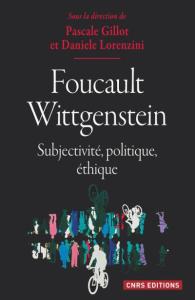
foucault-wittgenstein Foucault / Wittgenstein. Subjectivité, politique, éthique
Sous la direction de Pascale Gillot et Daniele Lorenzini
CNRS Editions, 2016

Les œuvres de Foucault et de Wittgenstein, qui relèvent de traditions philosophiques fort éloignées, peuvent toutefois entrer en résonance et se relancer mutuellement : cette mise en perspective permet alors de cerner les points aveugles comme l’insistance contemporaine du questionnement philosophique propres à chacune d’elles.

Ces deux auteurs ont en effet proposé une critique radicale de la notion classique d’une subjectivité souveraine, contre une compréhension traditionnelle d’un sujet de l’action et du savoir transparent à soi-même.

Quelles sont dès lors les conséquences éthiques et politiques d’une telle conception – non psychologique et non métaphysique – de la subjectivité ?

En explorant, hors de tout clivage institué, des thèmes tels que le « rapport à soi », la conscience et ses illusions, l’identité subjective dans sa dimension institutionnelle et politique, les rapports entre le Je et le Nous, il s’agit de faire émerger de la confrontation Foucault/ Wittgenstein un « style de pensée » qui nous pousse à repenser radicalement la forme de nos intérêts et de nos préoccupations éthiques et politiques.

Introduction : La subjectivité à l’épreuve
Pascale Gillot et Daniele Lorenzini

Première Partie. La question de l’anti-psychologisme

Chapitre I : La psychologie comme « champ des décisions ». Déclinaisons et enjeux de l’antipsychologisme chez Foucault
Elisabetta Basso

Chapitre II : Foucault / Wittgenstein : une « subjectivité sans sujet » ?
Pascale Gillot

Chapitre III : Wittgenstein après Foucault. Le sujet à la limite entre archéologie et littérature
Matteo Vagelli

Deuxième Partie. Langage, histoire et politique

Chapitre IV : Du conventionnalisme linguistique à l’historicisation radicale : Foucault avec Wittgenstein ?
Judith Revel

Chapitre V : Foucault, Wittgenstein et la philosophie analytique de la politique
Daniele Lorenzini

Chapitre VI : Le gouvernement, les savants et la tribu sans âme. Peut-on penser une forme de vie pour des automates ?
Sabine Plaud

Troisième Partie. Le Je et le Nous

Chapitre VII : Le sujet hors d’action
Marc Pavlopoulos

Chapitre VIII : Moi et les autres : une critique wittgensteinienne de Foucault
Pierre Fasula

Chapitre IX : Retour au sol raboteux des pratiques. Le statut de la déviance de Foucault à Wittgenstein
Élise Marrou

Quatrième Partie. L’éthique du rapport à soi

Chapitre X : « Work on philosophy is really more a work on oneself ». Le travail de soi sur soi chez Foucault et Wittgenstein
Orazio Irrera

Chapitre XI : Infléchir le cours de nos vies. Foucault et Wittgenstein à propos de l’éthique et de la subjectivité
Piergiorgio Donatelli

Despard, E.
Diagram of a love for plants gone bad
(2016) Environment and Planning D: Society and Space, 34 (2), pp. 337-354.

DOI: 10.1177/0263775815615124

Abstract
This article uses a surprising horticultural event—an unplanned, collective ‘theft’ of plants from the Montreal Botanical Garden in 1981—as impetus to interrogate the contribution of garden plants to public life in so-called ‘green’ cities of the late twentieth century. As sites of both social nature and material culture that are perceived as socially and environmentally beneficial and frequently designed to appear more-or-less natural, gardens are normally quite difficult to see or think in politically differentiated terms. Taking a historical ‘eventalization’ of civic horticulture as a means to enable critical perception, I develop the diagram (as introduced by Foucault and interpreted by Deleuze) as an analytical tool conducive to identifying and historicizing the perceptual and socio-spatial effects produced by the use of garden plants in urban public spaces. I outline the local historical context of the theft at the Botanical Garden and analyze the functioning of a program of horticultural beautification coincident with it as a means of establishing the theft’s more general intelligibility. This illuminates, not only a change in the functioning of plants in Montreal’s urban landscape, but also a means of recognizing the historical specificity of relations between people and plants, and socio-cultural change as more-than-human. © 2015, © The Author(s) 2015.

Author Keywords
civic horticulture; Diagram; plants; public gardens; social nature; urban environmental history

Robert Shaw, Nuit Debout as Heterotopia: Some Early Thoughts, Blog post (2016)

Since March 31st, protestors in the Place de La République in Paris have been convening every evening, staying in place the full night as part of the ‘Nuit Debout’ protests. The protests, which began in opposition to the ‘Loi Travail’ labour laws, form part of the wider series of anti-austerity, anti-neoliberalist protests by young people in Europe that date back to the Occupy movement. Indeed, ‘Nuit Debout’ translates roughly as ‘here all night’ and this implies a strength and permanence that the term occupy also sought.

[…]

These protestors are making several interesting uses of ‘night’. Spending time with people in darkness is more intimate than daylight, as we can’t as clearly distinguish between people, objects and the environment. Ideas, sounds and sensations thus more easily flow between people, generating a closeness. Added to this, the protests have incorporated impromptu concerts, debates and other events, more easily held in night as a time associated with leisure. This intimacy in combination with a relaxed atmosphere creates a moment, space-time for discussion and conversation among strangers. Michel Foucault describes such places as ‘heterotopias’, moments which operate outside of the normal rules of hegemony. For Nuit Debout, the night is key to making this a heterotopia.

Read more