
Foucault News

News and resources on French thinker Michel Foucault (1926-1984)

Political Science Department and the The France Chicago Center present “Reflections on Foucault’s Lessons on the Will to Know”, with Daniel Defert, Moderated by Bernard E. Harcourt Julius Kreeger Professor and, Chairman of the Political Science Department.

Daniel Defert edited the French edition of Foucault’s Leçons sur la volonté de savoir. Cours au Collège de France 1970-1971 (Gallimard/Seuil 2011), which is being released in English in May 2013 under the supervision of Professor Arnold Davidson of the University of Chicago.

Daniel Defert is a prominent French AIDS activist and the founding president (1984-1991) of the first AIDS awareness organization in France, AIDES. He started the organization after the death of his partner, the French philosopher Michel Foucault.

He is an alumnus of the École normale supérieure de Saint-Cloud. A professor of sociology, Daniel Defert has been Assistant (1969-1970), Maître-assistant (1971-1985), then Maître de Conférence (from 1985) at the Centre Universitaire of Vincennes, which became in 1972, Université de Paris VIII Vincennes.

Daniel Defert is author of numerous articles in the domain of ethno-iconography and public health. He also co-edited with François Ewald the Dits et Ecrits of Michel Foucault (1994), a posthumous collection of Foucault’s interviews and writings.
Creagh, S.
‘Language Background Other Than English’: a problem NAPLaN test category for Australian students of refugee background
(2016) Race Ethnicity and Education, 19 (2), pp. 252-273.

DOI: 10.1080/13613324.2013.843521

Abstract
Since 2008 Australia has held the National Assessment Program: Literacy and Numeracy (known as NAPLAN) for all students in years 3, 5, 7 and 9. Despite the multilingual character of the Australian population, these standardized literacy and numeracy tests are built on an assumption of English as a first language competency. The capacity for monitoring the performance of students who speak languages other than English is achieved through the disaggregation of test data using a category labelled Language Background Other than English (LBOTE). A student is classified as LBOTE if they or their parents speak a language other than English at home. The category definition is so broad that the disaggregated national data suggest that LBOTE students are outperforming English speaking students, on most test domains, though the LBOTE category shows greater variance of results. Drawing on Foucault’s theory of governmentality, this article explores the possible implications of LBOTE categorisation for English as a Second Language (ESL) students of refugee background. The article uses a quantitative research project, carried out in Queensland, Australia, to demonstrate the potential inequities resultant from such a poorly constructed data category. © 2013 Taylor & Francis.

Author Keywords
categorization; English as a Second Language; governmentality; Language Background Other Than English; NAPLAN; refugees

Philippe Sabot, « De Foucault à Macherey, penser les normes », Methodos [En ligne], 16 | 2016
https://doi.org/10.4000/methodos.4652

Texte intégral

Penser avec Pierre Macherey – avec Foucault. Tel est l’objet des lignes qui vont suivre. Penser avec, ce n’est pas simplement penser (à) quelque chose, ce qui revient à circonscrire un objet pour en faire justement un ob-jet pour la pensée, disponible pour une pensée compréhensive ou conceptuelle qui s’en empare. Ce n’est pas non plus, lorsque l’on s’applique à penser une autre pensée, celle d’un autre que soi, chercher à en restituer seulement le sens général ou les arguments particuliers, en vue d’en cerner les contours, d’en faire le tour, d’en rendre raison dans la cohérence (pourquoi pas systématique ?) d’un discours. Penser avec, cela s’entend plutôt comme la prise de contact avec sa propre pensée à travers celle d’un autre qui en déclenche la possibilité, qui en impulse le mouvement, sans que ce mouvement soit nécessairement finalisé, pré-orienté par son point d’appui initial. Penser avec peut même conduire à une certaine désorientation lorsque l’on en vient à penser autrement, à réviser ses certitudes (voire à les abandonner) au moment même où on cherche à les formuler pour soi-même. En ce sens, penser avec Foucault, comme nous y invite Pierre Macherey dans les ouvrages qui vont nous occuper, c’est moins chercher à dire ce qu’a ou ce qu’aurait pensé Foucault (sur le sujet, la vérité, le discours, le pouvoir) que s’exercer à reprendre dans sa propre pensée le mouvement même de cette pensée – qui est aussi, dans son ordre propre, une pensée avec – pour en éprouver la dynamique transformatrice.

suite

Orazio Irrera, « Michel Foucault et les critiques de l’idéologie. Dialogue avec Pierre Macherey », Methodos [En ligne], 16 | 2016;
https://doi.org/10.4000/methodos.4667

Texte intégral

Orazio Irrera – On a l’habitude un peu hâtive de dire que lorsque Foucault critique l’idéologie, il s’adresse surtout à la conception althussérienne de l’idéologie. Mais en suivant votre argumentation, il semble plutôt que Foucault et Althusser ont tenté tous les deux d’échapper à une conception représentationnelle et seulement négative (donc non productive) de l’idéologie. Pour cette raison, à votre avis, serait-il utile de distinguer parmi les critiques de Foucault entre celles qui sont adressées à l’idéologie comme système de représentation, donc comme « reflet et transposition », ou encore comme rationalisation (Althusser lui aussi semble critiquer cette conception de l’idéologie) et celles qui sont plutôt adressées à la manière dont Althusser cherche, pour sa part, à surmonter cette idée représentationnelle de l’idéologie à travers une conception positive de l’idéologie, entendue comme agent effectif du processus de reproduction sociale ? Pourquoi, face aux efforts déployés par Althusser pour sauver la notion d’idéologie, Foucault tient-il, au contraire, cette notion comme étant non-amendable – ce qui revient à jeter le bébé avec l’eau du bain ? Est-ce que toutes les critiques que Foucault adresse à l’idéologie ont pour lui le même poids, ou est-ce qu’il y en a une qui, à un certain moment, se révèle plus importante ou plus décisive que les autres et qui aurait enfin persuadé Foucault qu’il n’est pas possible de se servir de cette notion ?

Pierre Macherey – Il me semble, c’est une hypothèse que je propose à la discussion, que la manière tranchante utilisée par Foucault pour aborder la question de l’idéologie est le symptôme d’un embarras.

Mots-clés : Foucault, Althusser Louis, idéologie, Macherey Pierre

suite

Ben Mylius, “Towards the Unthinkable: Earth Jurisprudence and an Ecocentric Episteme” (2013) 38 Australian Journal of Legal Philosophy 102-122

Full text available

Abstract
This paper argues that Earth Jurisprudence aims to bring about a change in episteme, using the law, from our current anthropocentric episteme to a new ecocentric one: a process that requires a critique of current epistemic objects and methods, and a gradual articulation of alternative objects and methods for new legal and governance systems to draw upon.

The Prologue and Epilogue are literary reflections on Foucault’s concept of ‘the erasure of the human’, and its two readings: ‘the end of the human as species’, and ‘the end of the human as episteme. The Preliminaries section lays conceptual groundwork for subsequent sections, characterising the concept of episteme (1) as a priori configuration of mind; (2) as epoch in time; (3) as configured around ‘objects’ (all the ‘things’ that can be known) and ‘methods’ (all the ways of knowing them). It also characterises epistemic change (1) as abrupt and all-encompassing; (2) as positioned outside epistemology; (3) as involving the introduction of new objects and methods in a two-phase process. The section on Earth Jurisprudence’s Project discusses Earth Jurisprudence’s role in theorising and implementing potential new objects and methods using a critique of the existing episteme.

The final section begins such a critique. It proposes that current epistemic objects are configured by a dichotomy between Human and World, and critiques (1) the way this establishes and maintains false divisions and perpetuates hierarchies; (2) the way it stifles creative new approaches to interpreting the world, by confining the possible loci for meaning; (3) the way it valorises spatiality at the expense of the temporal. The critique also considers current epistemic methods as variations of the ‘Research Ideal’, examining (1) the way their push for ever-increasing specialisation hinders generalism and transdisciplinary work; (2) the way it leads to ‘knowledge of knowledge’ and insular, self-referential discourse; and (3) the way it valorises an unrealistic, unsustainable static model of a future world. Both critiques conclude with brief reflections on potential alternative objects and methods for a new episteme.

Michel Foucault, France Culture radio, Émissions • Hors-champs • Michel Foucault,
5 émissions, mars 2016

A l’occasion de la sortie dans la Pléiade de l’œuvre de Foucault, toute une semaine avec Michel Foucault, il s’agira de penser avec Michel Foucault, grâce à Michel Foucault et d’envisager Michel Foucault demain. Comprendre l’ampleur à la fois intellectuelle, politique, historique et philosophique de son œuvre, sans faire œuvre testamentaire, ni patrimoniale, en tentant de se projeter dans ce présent intense.

L’énigme Foucault: Daniel Defert et Fréderic Gros

Les enjeux théoriques de l’oeuvre de Foucault: Jean Birnbaum et Philippe Artières

Foucault, la société punitive et l’Amérique avec Bernard Harcourt

Didier Eribon: Michel Foucault, du philosophe au militant

La trajectoire philosophique et politique de Michel Foucault
Pour cette dernière émission consacrée au philosophe Michel Foucault, l’historien Patrick Boucheron, le militant anti-sida Daniel Defert et le philosophe Fréderic Gros explorent la trajectoire philosophique et politique de Michel Foucault aux côtés de Laure Adler.

With thanks to Colin Gordon for this news

Hannigan, David, (1998) From aboriginality to governmentality: the meaning of section 35(1) and the power of legal discourse, Master of Laws thesis, University of British Columbia

Full text available

This thesis examines recent doctrinal developments regarding the aboriginal and treaty rights which are recognised and affirmed in s.35(l) of the Constitution Act, 1982. Specifically, it explores how the meaning of such rights is being constituted by diverse relations of power operating within specific ‘cites’ of struggle.

Chapter I is a brief introduction to recent transformations in the legal discourse of the Supreme Court and an overview of the methodologies being employed in this thesis. In this regard, the author undertakes an interdisciplinary approach to discourse analysis.

Chapter II draws upon the writings of Michel Foucault to make the argument for the analytical framework being utilised; namely, the study of ‘law’ within a ‘sovereign- discipline-government’ society.

Chapter III examines the relationship between the productive power of the disciplines and the legal discourse constituting the content of aboriginal rights; the purpose being to explore to what extent law ‘operates as a norm’ within this area. Additionally, it provides a lead into the discussion of ‘government’ by outlining the rationality underpinning the test for the justified governmental infringement of aboriginal and treaty rights.

Chapter IV, examines the relationship between the regulatory power of ‘government’ and the legal discourse around current treaty negotiations. Specifically, it explores the inter-dependency between rationalities of self-government and the governmental technologies associated with ‘advanced’ liberalism. In doing so, it focuses on an emerging treaty from British Columbia to assess the extent to which law is being used as ‘a tactic of government’.

Chapter V, examines the relationship between the deductive power of ‘sovereignty’ and the legal discourse constituting the content of Aboriginal title. It argues that recent developments require the Court to deal with the issue of legal pluralism. And to do so, in a way that lays a more successful foundation in law for the legitimate reconciling of the pre-existence of First Nations societies and the sovereignty of the Crown.

Chapter VI provides some concluding comments about the insights gained from the proceeding analysis. In doing so, it offers a brief discussion of how the proceeding specific analysis may relate to some recent work in post-colonial studies.

Vaahtera, E.
Biopolitics and the repressive hypothesis of the body: the case of swimming training in Finland
(2016) Scandinavian Journal of Disability Research, 18 (2), pp. 142-153.

DOI: 10.1080/15017419.2015.1063538

Abstract
Iris Marion Young, a feminist theoretician, argued that patriarchal society inhibits women to cultivate capable bodies. In contrast, Foucauldian arguments have stressed that to view a certain historical situation as a consequence of repression, overlooks how the idea of repression is already a product of power. This article explores this nexus between Foucault and Young, and investigates how bio/thanatopolitical projects saturate the notion of the repressed body. The article investigates how the inability to swim has been connected with inhibition in Finland in the twentieth and early twenty-first century. It argues that the repressive hypothesis of the body generates the identification with able-bodiedness in the ways in which eventually favour athletic or otherwise capable bodies. Moreover, the assumption that incapability is an inhibited way of being makes able-bodiedness appear to be primary and original. Thus, the exploration of the repressive hypothesis helps us to understand the intricate mechanisms of ableism. © 2015 Taylor & Francis.

Author Keywords
ableism; biopolitics; Iris Marion Young; thanatopolitics; The repressive hypothesis

William Davies, From Jurisdiction to Translation: Elite Power Under Advanced Neoliberalism, Pre-print of article to appear in Theory Culture & Society

Abstract
The financial crisis, and associated scandals, created a sense of a juridical deficit with regard to the financial sector. Forms of independent judgement within the sector appeared compromised, while judgement over the sector seemed unattainable. Elites, in the classical Millsian sense of those taking tacitly coordinated, ‘big decisions’ over the rest of the public, seem absent. This article argues that the eradication of jurisdictional elites is an effect of neoliberalism, as articulated most coherently by Hayek. It characterises the neoliberal project as an effort to elevate ‘unconscious’ processes over ‘conscious’ ones, which in practice means elevating cybernetic, non-human systems and processes over discursive spheres of politics and judgement. Yet such a system still produces its own types of elite power, which come to consist in acts of translation, rather than judgment. Firstly, there are ‘cyborg intermediaries’: elites which operate largely within the system of codes, data, screens and prices. Secondly, there are ‘diplomatic intermediaries’: elites who come to narrate and justify what markets (and associated technologies and bodies) are ‘saying’. The paper draws on Lazzarato’s work on signifying vs asignifying semiotics in order to articulate this, and concludes by considering the types of elite crisis which these forms of power tend to produce.

Keywords
elites, neoliberalism, finance, Hayek, capitalism, Lazzarato

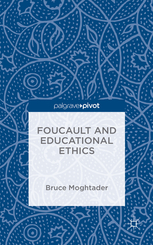
9781137574954.inddBruce Moghtader, Foucault and Educational Ethics, Palgrave Macmillan, 2016

Publisher’s site

About this book
In his works on ethics, Foucault turned towards an examination of one’s relationship with oneself and others. This differs from the modern approaches that explore the relationship between and the responsibilities of actors to each other by adopting criteria. Ethical criteria engender assumptions about the actors by focusing on their responsibilities. Instead of relying on criteria, Foucault’s writing and lectures contributed to an awareness of the activities we take upon ourselves as ethical subjects. His reconstruction of the Greco-Roman ethics seeks to examine the possibilities of the reconstitution and transformation of subjectivity. Through this, he offers an avenue of understanding the formation of ethical subjects in their educational interrelationships.