Foucault News

News and resources on French thinker Michel Foucault (1926-1984)

Borg, Kurt, Conducting critique : reconsidering Foucault’s engagement with the question of the subject, Symposia Melitensia (SymMel) 2015, Volume 11

Full PDF

Abstract:
A common criticism of Michel Foucault’s works is that his writings on power relations over-emphasized the effects that technologies of power have upon the subjection of humans, rendering any attempt of resistance futile and reducing the subject to a mere passive effect of power. This criticism treats Foucault’s consideration of ethics in his later works as a break from his earlier views. In this paper, by reading Foucault’s books alongside his lectures and interviews, two ways will be proposed through which the question of the subject can be productively raised and located throughout Foucault’s works, even within his concerns with power relations. The first way is through the relation between assujettisement and critique, and the second way is through the notions of government and conduct.

Re-posted with updated links and youtube videos

For full story see the Foundation for Art and Public Domain site. (Now only available on wayback machine). See Harmut Wilkening’s website as well.
Vrij-Geestig

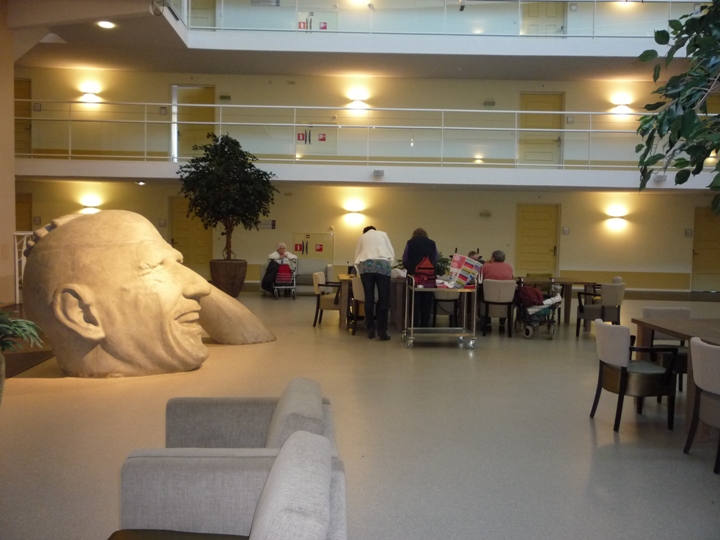
On Thursday 24 June 2010, a piece of sculpture by Harmut Wilkening was placed on the first floor of the De Burcht nursing home in Hoogezand. It is a head weighing more than seven tons and is titled Vrij geestig (Quite witty). Just before a start was made with laying the roof in 2009, the sculpture was installed with the aid of an enormous crane. Prior to the installation, a programme was held in the carcass of the building with a presentation by the artist and an introduction by Douwe Draaisma, titled ‘Wisdom comes with the years, but is preceded by forgetfulness’. Douwe Draaisma is Professor in the History of Psychology at the University of Groningen.

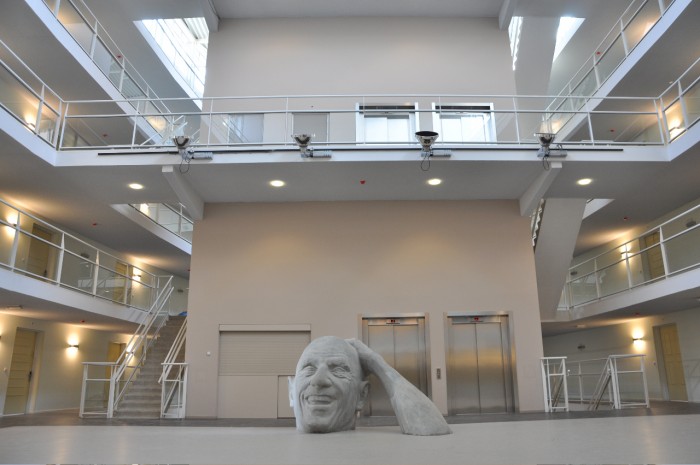
The building of the De Burcht residential nursing home has the form of a panopticon. From the open well on the first floor there is an all-round view of the galleries on the upper floors where the entrance doors of the apartments are located. Inspired by the idea of a central point in the building from which everything can be seen in a single glance, and which can itself be seen from all angles, Harmut Wilkening proposed to make a large sculpture depicting the head of Michel Foucault, the theoretician of ‘panopticism’. The concrete portrait of the French philosopher sports a broad smile, his arm emerges from the floor and his hand is resting on his bald head.
vrij-geestig-2

As its first inhabitant, Wilkening’s sculpture is being incorporated into the construction process, as a built-in part of the building. Before the placing of the roof, the sculpture was hoisted in with a crane, under the watchful eyes of the future residents and other invited guests. After that the building work has been completed, during which time the sculpture was protected in a wooden crate. At the festive moment on June 24, 2010, when the building comes into service, Foucault’s head will be unveiled again. A large panel with a photographic account of the making of the work of art will hang next to the building’s entrance. The story of Foucault as the ‘first inhabitant’ can then be told to visitors and newcomers.

For the residents of De Burcht, Wilkening’s sculpture will be a fixed component of their changing entourage. The central open well will be used in diverse ways: as a reading room, theatre and party room. The sculpture refers further to the philosopher’s ideas and to the fact that the human head is the storeroom of memory – that essential mental function, particularly for the people who live here. Wilkening compares the building with a library, as a great collection of the knowledge and experience of all the residents together. He also sees the library as a translation of the social order. For him, the piece is about panopticism: the form in which knowledge is generated, ordered, disseminated and guarded. In De Burcht, Foucault’s head – with a wink – occupies the place of the globe that was also centrally displayed in old libraries, symbolising the all-seeing world.

Antipode Editorial Office's avatarAntipodeFoundation.org

Introduction: The Making Visible of Carceral Politics

Marijn Nieuwenhuis, University of Warwick

This symposium contains a rich collection of contributions based on the screening of the French documentary film Sur les Toits (“On the Roofs”). On a Wednesday in May 2016 I invited the film’s independent maker, Nicolas Drolc, and a number of academics from across Warwick’s humanities and social sciences to the screening of the movie. The result was a friendly and productive discussion on an important, but sometimes forgotten, episode in the history of incarceration (see, however, Zurn and Dilts 2016). The essays presented here comprise an interview with the director and a series of original reflections (from Dominique Moran, Sophie Fuggle, Anastasia Chamberlen, Oliver Davis and Stuart Elden) on both the film and its subject of investigation.

Sur les Toits (a title taken from a protest song of the French punk band…

View original post 1,584 more words

[Editor] A note to say how much I enjoyed attending the Foucault @ 90 conference in Ayr in Scotland over the last two days and listening to all the interesting work being done. Thank you to Professor Donald Gillies and to Caroline Sisi for all their hard work organising the conference.

Note from the editor

I will be taking a break from Foucault News for about a month while I attend the Foucault @ 90 conference in Scotland and take a short holiday. Posts will be sporadic until mid to late July.

You might be interested to know that the volume of Foucault related activity is always increasing and that there is considerably more material now than when I initially started this blog in September 2010. I currently already have quite a large backlog of material ready to post when I return.

Please don’t hesitate to send news on to me in the meantime. I will post it up as I can. Could I also take the opportunity to ask you to send me messages to my email address rather than via Facebook as I tend not to check Facebook as often.

Clare O’Farrell

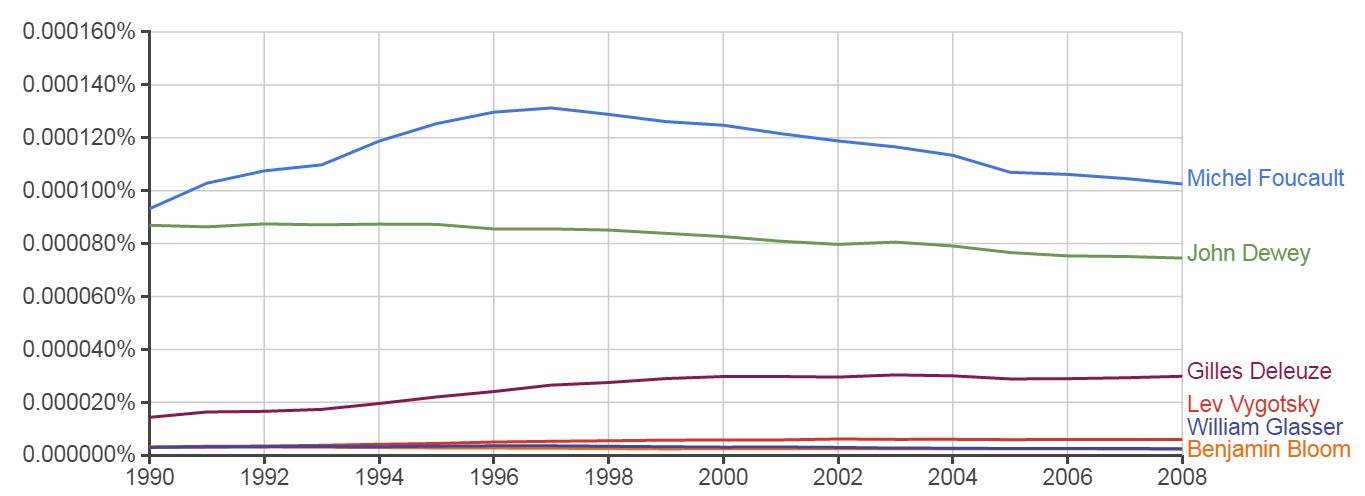
This is a Google ngram which even if it only measures up to 2008, demonstrates the rate of citation of Foucault’s work against a number of other thinkers who are popular in the discipline of education.

foucault-ngram

postmortemPascal Hintermeyer (ed.) Foucault post mortem en Europe, Presses universitaires de Strasbourg, 2015

Michel Foucault continue à marquer des pans entiers de la pensée contemporaine en apparaissant comme un penseur à multiples facettes, qui se joue des frontières, bouscule les clivages établis, évolue sans cesse, surgit là où on ne l’attendait pas, ouvrant ainsi de nouvelles perspectives.

Depuis sa mort, en 1984, son influence épistémologique, géographique et culturelle n’a cessé de croître. Pour expliquer son rayonnement international, on insiste souvent sur son succès aux États-Unis. Nous nous intéressons ici à sa réception dans plusieurs aires culturelles européennes et au positionnement de son œuvre par rapport à divers auteurs (Lacan, Habermas, Weber, etc.).

L’influence exercée par Foucault post mortem à travers la diffusion de toute une terminologie issue de ses travaux est un signe de cette empreinte durable: assujettissement, panoptisme, dispositifs, biopolitique.

Ainsi se dessine un portrait de Foucault à la fois cohérent et divers. Cohérent dans son refus des essentialismes et des téléologies, dans sa volonté de transcender les divisions instituées. Divers dans ses talents, ses combats, ses initiatives.

What are you rebelling against, Johnny ?

initié par le collectif F71 et le Centre Pénitentiaire de Fresnes – SPIP 94.

Cette présentation est l’aboutissement d’ateliers menés par le collectif F71 avec un groupe de détenus du Centre Pénitentiaire de Fresnes et des élèves de théâtre du Conservatoire Municipal – Gabriel Fauré. Sur scène, ils évoquent ensemble la naissance du Rock’n’roll aux
Etats-Unis, dans le climat ségrégationniste des années 50.

Après une date en détention et une au Conservatoire du 5e arrondissement de Paris, la dernière restitution publique aura lieu :

le mercredi 15 juin 2016 à 19h à La Maison des Métallos dans le cadre de “Fin de Chantier”

94 rue Jean-Pierre Timbaud – Paris – 11e arr.

L’entrée est libre mais la réservation est conseillée, merci donc de nous informer de votre présence par retour de mail ou par téléphone au 06 22 13 06 82 ou directement auprès de la Maison des Métallos les après midi au 01 47 00 25 20 ou par mail à reservation@maisondesmetallos.org

What are you rebelling against, Johnny ?
Texte : Stéphanie Farison et Lucie Nicolas
Intervenants : Stéphanie Farison, Jane Joyet, Siegfried Mandacé et Lucie Nicolas.
Régie Générale : Frank Condat

Production : Le collectif F71 – La concordance des temps, avec le soutien de la Permanence Artistique et Culturelle de la Région Ile-de-France et la DRAC Île de France dans le cadre du dispositif “Culture et Justice” – Le Centre Pénitentiaire de Fresnes – Le Service Pénitentiaire d’Insertion et de Probation du Val-de-Marne (SPIP 94) et son coordinateur culturel (Romain Dutter) – Le CMA 5 de Paris, Hacène Larbi – directeur et le BEAPA ainsi que la Maison des Métallos, Etablissement culturel de la Ville de Paris.

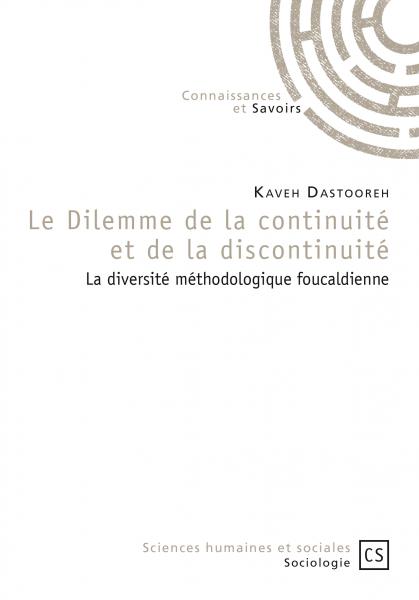
dastoorehKaveh Dastooreh, Le dilemme de la continuite et de la discontinuite. La diversite methodologique foucaldienne, Connaissances et savoirs, 2016

Sociologie – 62 pages – 140×200
ISBN : 9782753903319

La pensée de Michel Foucault est souvent présentée comme une pensée discontinuitiviste, comme si la discontinuité était le seul thème administrant son travail. En étudiant ce que Foucault, lui-même, pouvait commenter à ce propos et en examinant de près son travail, nous pouvons constater que la discontinuité n’est pas le seul thème administrateur de son travail, et nous pouvons y trouver en abondance des images de continuité temporelle. Bien que, parfois, Foucault accorde un privilège à la discontinuité temporelle, ces images ne reflètent en aucun cas une quelconque opposition aux continuités, qui se trouvent par ailleurs de manière récurrente dans son entreprise. Cette recherche montre donc en premier lieu que ces deux thèmes relèvent d’une complexité méthodologique dans la pensée de Foucault. Nous montrons comment ces thèmes sont engagés par Foucault, dans un rapport loin d’être négatif ou paradoxal mais qui instaure leur complémentarité et qui les amène à cohabiter dans son œuvre. Pour ce faire, et dans un second temps, nous revenons alors sur la conception foucaldienne de l’histoire au sein de laquelle nous contextualisons ces deux thèmes dans leurs propres places théoriques et méthodologiques. Au final, nous verrons que ces conceptions de continuité, de discontinuité et ainsi sa définition de l’histoire ne sont pas possibles que par une lecture que Foucault a faite de Nietzsche pour bâtir une pensée de « singularité » et éviter à tout prix ne pas fonder ces recherches sur une théorie de la connaissance.

L’AUTEUR
Kaveh Dastooreh a obtenu en 2011 son diplôme de doctorat en sociologie à l’Université Paris V – René Descartes – Sorbonne. Il a des expériences d’enseignements dans des universités françaises comme Université de Paris Descartes et Université d’Évry Val d’Essonne, ainsi qu’à l’étranger. Il a publié un ouvrage en 2015 chez L’Harmattan intitulé : “Vers une sociologie foucaldienne”. Il a également traduit la série de livres de “L’Histoire de la sexualité de Michel Foucault”, du français au kurde. Il est membre de l’Association internationale des sociologues.

Foucauldian Genealogy and Maoism

Concerning the origin and foundation of the method of genealogy in Foucault’s work, there is an astonishingly unanimous “interpretative consensus” among Foucault scholars.[1] While there is great disagreement about a vast range or many aspects of Foucault’s thought and practice, it seems that there is an almost harmonious agreement regarding the emergence of genealogy in his work. The secondary literature on Foucauldian genealogy feels obliged to repeat reverently and respectfully: in the beginning was the word of Nietzsche.

Foucault himself made no secret of his intellectual affinity to Nietzsche’s genealogical method. On the backcover of the French edition of Discipline and Punish in 1975 he posed the main question of his book in explicit Nietzschean terms by asking “could we do the genealogy of modern morality starting from a political history of the body?” [peut-on faire la généalogie de la morale moderne à partir d’une histoire politique des corps?] resonating deeply and sonorously Nietzsche’s groundbreaking Genealogy of Morality of 1887. Moreover, he confessed in what was meant to be his final interview: “I am simply Nietzschean, and I try to see, on a number of points, and to the extent that it is possible, with the aid of Nietzsche’s texts – but also with anti-Nietzschean theses (which are nevertheless Nietzschean!) – what can be done in this or that domain.”[2]

read more at the Foucault blog

leshemDotan Leshem, The Origins of Neoliberalism: Modeling the Economy from Jesus to Foucault, Columbia University Press, 2016

Dotan Leshem recasts the history of the West from an economic perspective, bringing politics, philosophy, and economics closer together and revealing the significant role of Christian theology in shaping economic and political thought. He begins with early Christianity’s engagement with economic knowledge and the influence of this interaction on politics and philosophy. He then follows the secularization of economics in liberal and neoliberal theory, showing it to be a perversion of earlier communitarian tradition. Only by radically relocating the origins of modernity in late antiquity, Leshem argues, can we confront neoliberalism.

Introduction: Economy Before Christ
1. From Oikos to Ecclesia
2. Modeling the Economy
3. Economy and Philosophy
4. Economy and Politics
5. Economy and the Legal Framework
6. From Ecclesiastical to Market Economy

ABOUT THE AUTHOR
Dotan Leshem is senior lecturer in the department of government and political theory at the School of Political Sciences, University of Haifa.