
Foucault News

News and resources on French thinker Michel Foucault (1926-1984)

The 16th annual meetings of the Foucault Circle
June 29-July 2, 2016

University of New South Wales
Sydney, Australia

All sessions in Lecture Room G02 in the Law School Building.
Registration is on-site only. On the first morning, registration will be open in the foyer of the Ground Floor of the Law Building, adjacent to Room G02.
Registration Fee: $30.00 AUD (cash only), payable on the morning of the first day.
This schedule allows 40 minutes total per paper, inclusive of reading and discussion.
It is expected that roundtable participants’ opening remarks will be brief (5-8 min.)

Program Overview

Wednesday, June 29

10:00-10:40 Morning Tea and Registration

10:40-12:00 SESSION #1 (2 papers)

12:00-13:30 Lunch

13:30-15:30 SESSION #2 (3 papers)

15:30-16:00 Afternoon Tea

16:00-17:20 SESSION #3 (2 papers)

17:30- Drinks reception

Thursday, June 30

08:30-09:50 SESSION #4 (2 papers)

09:50-10:20 Morning Tea

10:20-12:00 ROUNDTABLE #1

12:00-13:30 Lunch

13:30-15:30 SESSION #5 (3 papers)

15:30-15:45 Afternoon Tea

15:45-17:05 SESSION #6 (2 papers)

17:15-18:00 BUSINESS MEETING

Evening Local dinner
Friday, July 1

08:30-09:50 SESSION #7 (2 papers)

9:50-10.20: Morning Tea

10:20-12:00 ROUNDTABLE #2

12:00-13:30 Lunch

13:30-15:30 SESSION #8 (3 papers)

15:30-16:00 Afternoon Tea

16:00-18:00 WORKSHOP/SEMINAR

Evening Local dinner

Saturday, July 2

09:00-10:20 SESSION #9 (2 papers)

10:30-12:30 SESSION #10 (3 papers)

Program Detail

Wednesday, June 29

10:00-10:40 Registration and Morning Tea

10:40-12:00 SESSION #1: ANATOMICAL ABNORMALITIES

Moderated by Ben Golder (University of New South Wales, Australia)

Benjamin Kunkler (University of Melbourne, Australia)

The Archaeology of Anatomical Knowledge

Matthew Chrulew (Curtin University, Australia)

Abnormal Animals: The Problematisation of Captivity in Hediger and Meyer-Holzapfel

12:00-13:30 Lunch

13:30-15:30 SESSION #2: CYNICAL GOVERNMENTALITY

Moderated by Daniel McLoughlin (University of New South Wales, Australia)

Miguel Vatter (University of New South Wales, Australia)

Foucault and Strauss on Socratic Natural Right

Özge Yalta Yandaş, (Independent Researcher, Turkey)

Constructing a Neoliberal Art of Government: Urban Regeneration Processes of Istanbul in 2000s

Terry Flew (Queensland University of Technology, Australia)

Weberian Themes in Michel Foucault’s The Birth of Biopolitics lectures

15:30-16:00 Afternoon Tea

16:00-17:20 SESSION #3: DIALOGUES WITH AGAMBEN

Moderated by Paul Patton (University of New South Wales, Australia)

Vanessa Lemm (University of New South Wales, Australia)

Agamben as a Reader of Foucault

Daniel McLoughlin (University of New South Wales, Australia)

Killing in the Name of Life: Foucault and Agamben on Nazism and Biopolitical Sovereignty
17:30- Drinks Reception

Thursday, June 30

08:30-09:50 SESSION #4: FOUCAULDIAN APPROACHES TO SOCIAL WORK

Moderated by Ben Golder (University of New South Wales, Australia)

Sharon Alexander (Monash University, Melbourne, Australia)

What does Theorising with Foucault Contribute to Social Worker’s Understanding of Perinatal Mental Health?

Uschi Bay (Monash University, Melbourne, Australia)

Working with Foucault’s theorising to elaborate on reflexivity in social work practice

10:20-12:00 ROUNDTABLE #1: FOUCAULT’S CRITIQUE OF NEOLIBERALISM?

Moderated by Mark G E Kelly (Western Sydney University, Australia)

Organized by Paul Patton

Ben Golder (University of New South Wales, Australia)

Paul Patton (University of New South Wales, Australia)

Miguel Vatter (University of New South Wales, Australia)

Terry Flew (Queensland University of Technology, Australia)

12:00-13:30 Lunch

13:30-15:30 SESSION #5: ANCIENT ENGAGEMENTS

Moderated by Miguel Vatter (University of New South Wales, Australia)

Michael Ure (Monash University, Australia)

Foucault and Nietzsche: Two Philosophical Physicians?

Federico Testa (Monash University, Australia)

Is There a Politics of the Care of the Self in Michel Foucault?

Charles Barbour (Western Sydney University, Australia)

Dismantling the City State: Foucault, Classicism, and Politics in the Ancient World

15:45-17:05 SESSION #6: UNFOLDING EVENTUALITIES

Moderated by Lynne Huffer (Emory, USA)

Farzaneh Haghighi (University of Auckland, New Zealand)

Eventualisation: Multiplying the faces of a polyhedron

Elliot Patsoura (The University of Melbourne, Australia)

Buggering the Fold: Deleuze reads The Order of Things

17:15-18:00 BUSINESS MEETING

Friday, July 1

08:30-09:50 SESSION #7: EPISTEMOLOGICAL AUTONOMY

Moderated by Ben Golder (University of New South Wales, Australia)

Chari Larsson (University of Queensland, Australia)

The Archaeological Art Historian: Didi-Huberman’s Epistemological Debt

Katherine Filbert (Villanova University, USA)

De-Spatializing Critical Agency: Freedom without Autonomy in Foucault and Benjamin

10:20-12:00 ROUNDTABLE #2: FOUCAULT AS A CRITICAL THEORIST: THE ‘CARE OF THE SELF’ AND THE POLITICISATION OF LIFE

Moderated by Charles Barbour (Western Sydney University, Australia)

Organized by Michael Ure (Monash University, Australia)

Michael Ure (Monash University, Australia)

Irene Dal Poz (Monash University, Australia)

Sam O’Brien (Monash University, Australia)

Federico Testa (Monash University, Australia)

12:00-13:30 Lunch

13:30-15:30 SESSION #8: INJUSTICE IN THE STREETS

Moderated by Michael Cowen (Alliance Manchester Business School, UAE)

Sylvain Lafleur (Université de Montréal, Montréal, Canada)

Foucault’s justice fonctionnelle and its relationship to legislators and popular illegalism

Joanna Crosby (Morgan State University, USA)

The 2015 Baltimore Protests: A Neoliberal Love Child

Falguni A. Sheth (Emory University, USA)

State Racism, Biopower, and the Mass Migration Problem

16:00-18:00 WORKSHOP ON FOUCAULT AND THE ANTHROPOCENE: reading a new translation of “The Situation of Cuvier in the History of Biology” (DE#077, 1970)

Group discussion facilitated by Lynne Huffer (Emory University, USA)

An English translation of this text will be distributed by PDF in early June.

Saturday, July 2

09:00-10:20 SESSION #9: HETEROTOPIAS

Moderated by Steven Ogden (Charles Sturt University, Australia)

Margaret A. McLaren (Rollins College, USA)

Harems (Brothels) and Hammams as Heterotopias

Charles Villet (Monash South Africa, Johannesburg, South Africa)

Oscar Pistorius and the white heterotopia: The suburban laager in post-Apartheid South Africa

10:30-12:30 SESSION #10: POLITICS OF THE NORMATIVE

Moderated by Ben Golder (University of New South Wales, Australia)

Erik Zimmerman (The New School for Social Research, USA)

Resistance and Rupture: Foucault and the Cynicism of Otherness

Mark G E Kelly (Western Sydney University, Australia)

A Sketch for a Genealogy of Normativity

Dianna Taylor (John Carroll University, USA)

The Self-relation, Anti-normalization, and Prospects for Enduring Peace: The Case of Northern Ireland

obs-capPubblicato online l’e.book:
Moneta, rivoluzione e filosofia dell’avvenire. Nietzsche e la politica accelerazionista in Deleuze, Foucault, Klossowski, Guattari (Obsolete Capitalism Free Press – Rizosfera, 2016).
Link at Variazioni foucaultiane

L’antologia a cura di Obsolete Capitalism è scaricabile online gratuitamente.

Autori e autrici: Algorithmic Committee, Sara Baranzoni, Edmund Berger, Lapo Berti, Paolo Davoli, Network Ensemble, Letizia Rustichelli, Obsolete Capitalism, Obsolete Capitalism Sound System, Francesco Tacchini, Paolo Vignola.

Moneta, rivoluzione e filosofia dell’avvenire
a cura di Obsolete Capitalism

Siamo proiettati a velocità fotonica nella comunicazione istantanea e nel controllo continuo mentre le forme di dominio rapido appaiono inarrestabili. Il museo delle ideologie si riempie di concetti in via di esaurimento quali capitalismo, neoliberismo, marxismo, keynesismo. Ora, con più esattezza, il sistema modula i vari flussi che innervano il pianeta: Moneta, Ricerca, Controllo, Informazione, Circuito sono i vecchi nomi che attraverso una nuova velocità producono potere. Maggiore è l’immanenza del Mercato, maggiore è la probabilità che al conflitto si sostituisca l’interruzione, il virus, la fuga di notizie, l’invisibilità, il fuori-circuito, la biforcazione. Uno squarcio nella «zona grigia» dell’egemonia.

Gli autori del libro Moneta, rivoluzione e filosofia dell’avvenire indagano alcune aree poco battute di politica accelerazionista attraverso linee teoriche contagiate dalle filosofie più visionarie: Nietzsche, Klossowski, Deleuze, Guattari, Foucault. Più che analizzare la grande trasformazione culturale in atto, la presente antologia evidenzia i pericoli in cui incorre il pensiero del futuro quando ancora mantiene pratiche, schemi e linguaggi di un’epoca industriale e post-industriale che mostra in tutti i suoi aspetti una crisi perpetua. Siamo tutti coinvolti nel duro intreccio di liberazioni insperate e nuovi asservimenti che ci prospetta la presentificazione del futuro da parte della tecnologia a linguaggio numerico, ma – come afferma Deleuze – «non è il caso né di avere paura, né di sperare, bisogna cercare nuove armi». Sperimentare è dunque il primo impegno politico e filosofico per un futuro differente.

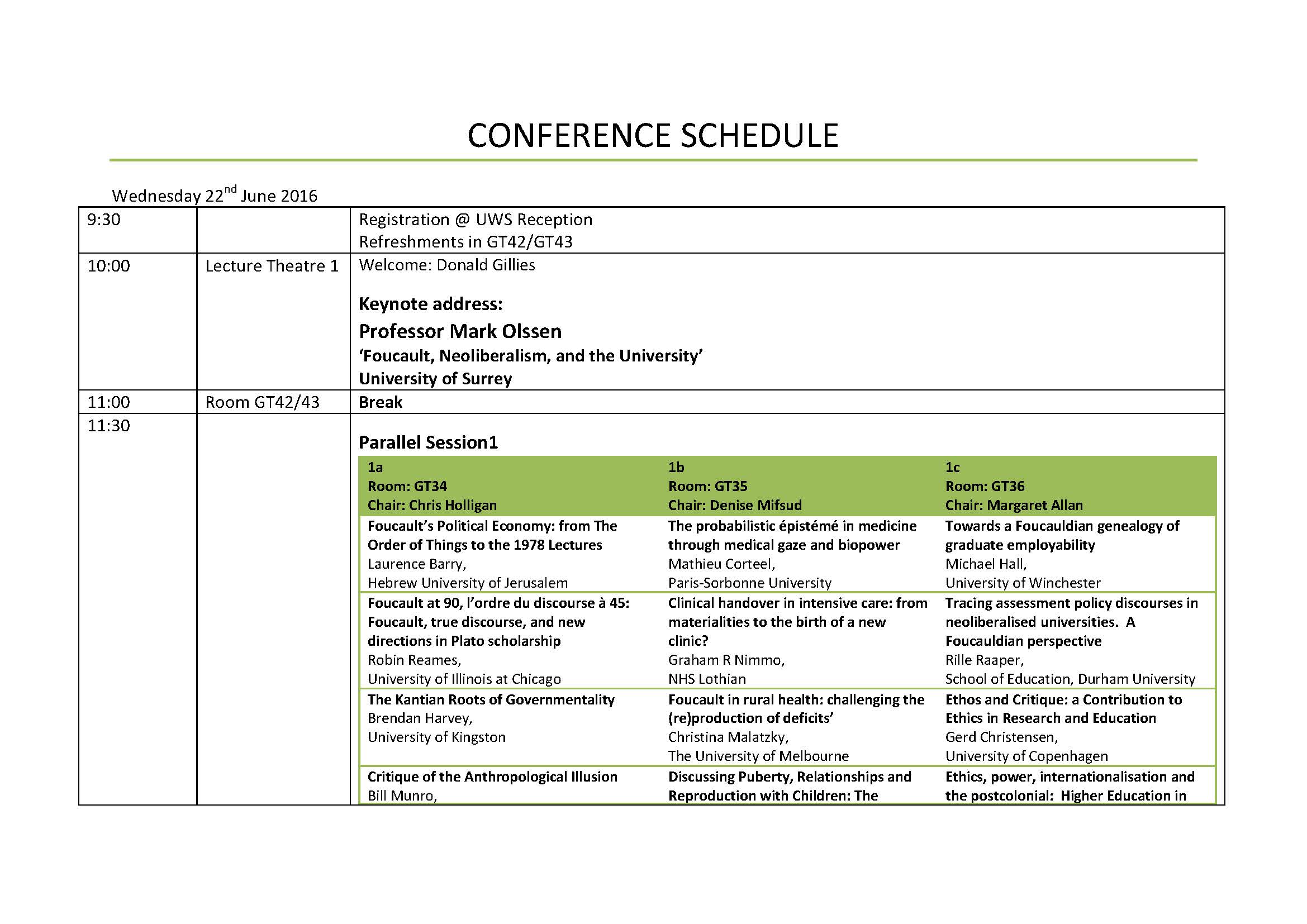
Conference program (PDF) for the Foucault @ 90 conference 22-23 June 2016, in Ayr, University of West Scotland.
CONFERENCE SCHEDULE 1.6.16_Page_1
CONFERENCE SCHEDULE 1.6.16_Page_2
CONFERENCE SCHEDULE 1.6.16_Page_3CONFERENCE SCHEDULE 1.6.16_Page_4CONFERENCE SCHEDULE 1.6.16_Page_5

Kelvin T. Knight, Placeless places: resolving the paradox of Foucault’s heterotopia (2016) Textual Practice, 31(1), 141–158.
https://doi.org/10.1080/0950236X.2016.1156151

ABSTRACT
This article looks to restore Michel Foucault’s concept of the heterotopia to its literary origins, and to thereby resolve the paradox that exists between Foucault’s various definitions of the term. Described by Foucault as both an unimaginable space, representable only in language, and as a kind of semi-mythical real site, examples of which include the mirror, the prison, the library, the garden and the brothel, the heterotopia seems inherently contradictory. However, through a reading of an often overlooked radio broadcast given by Foucault as part of a series on literature and utopia, this article demonstrates that the concept was never intended to refer to real urban sites, but rather pertains exclusively to textual representations of these sites. Subsequently, it looks to draw parallels between Foucault’s remarks about the heterotopia and several examples of his literary criticism, on writers including Sade, Flaubert and Borges. In particular it draws attention to the similarities between Foucault’s definitions of the heterotopia and the language he uses to describe the ‘placeless places’ of Blanchot’s fiction, and to posit the heterotopia as an example of Blanchot’s notion of literary contestation.

Special Issue: Foucault Meets EU Studies
Global Society (2016), Vol. 30, No. 3, pp. 387-506.

Table of contents:

Introduction: Foucault Meets EU Studies Lucie Chamlian & Dirk Nabers

The Colonisation of the Future: Power, Knowledge and Preparedness in CSDP Lucie Chamlian
Exploring the Security/Facilitation Nexus: Foucault at the `Smart´ Border Matthias Leese
Knots, Port Authorities and Governance: Knotting Together the Port of Hamburg Luis Lobo-Guerrero & Anna Stobbe
The Sight of Migration: Governmentality, Visibility and Europe´s Contested Borders Martina Tazzioli & William Walters
Conducting Government: Governmentality, Monitoring and EU Counter-Terrorism Stef Wittendorp
Local Practices of Immigration: The “Right of Death and Power over Life” in German Asylum Discourses Dirk Nabers

Thanasis Lagios, Foucauldian Genealogy and Maoism
20th March 2015 | 12:00 – 12:45

Conference paper, audio podcast on The Voice Republic site

Thanasis Lagios studied Philosophy, Pedagogy & Psychology (specialization: Philosophy), at the National and Kapodistrian University of Athens, Greece (1998 – 2003). Having completed his postgraduate studies (MA) in Political Philosophy at the University of York (UK, 2004-5), he successfully defended his doctoral thesis at the National and Kapodistrian University of Athens on “Stirner, Nietzsche, Foucault: The death of God and the end of Man” (2009), which was published by futura in 2012. He has published a Greek translation of Foucault’s 1978 interview “Considérations sur le marxisme, la phénoménelogie et le pouvoir” (futura, 2013). He has published several articles on the history of philosophy, epistemology and political philosophy. Since 2010, he has been teaching in the postgraduate program on Ethics at the Department of Philosophy, at the National and Kapodistrian University of Athens, Greece. Since 2013, he also teaches philosophy (epistemology/political philosophy) in the EU-sponsored program at the National and Kapodistrian University of Athens, “Plato’s Academy”.

McMahon, J., Barker-Ruchti, N.
The media’s role in transmitting a cultural ideology and the effect on the general public
(2016) Qualitiative Research in Sport, Exercise and Health, 8 (2), pp. 131-146.

DOI: 10.1080/2159676X.2015.1121912

Abstract
Previous research investigating Australian swimming culture revealed a deeply entrenched ‘slim to win’ ideology, a notion that is centred on the swimmer body needing to be lean in order to achieve competitive performance. While previous research revealed that ‘slim to win’ was occurring in situ, this study examines how media representations might come to be possible contributors to this ideology being proliferated to outsiders of the culture. Specifically, three professional sports photographs are examined for materiality criteria. Further, an affect perspective is employed through Foucault’s idea of ‘dispositive’ to consider how the messages provided by the images, their captions and the titles of the news items they were included in, were consumed. We argue that the media representations included in this investigation are highly problematic because they reinforce the ‘slim to win’ ideology. Further, we argue that many people who contributed to the online forums relating to these media representations reproduced and to a certain extent negotiated ‘slim to win’ through their comments. This latter point occurred via the representations which provided a platform for critical interpretation. © 2016 Taylor & Francis.

Author Keywords
affect; body; dispositive; Foucault; Materiality; media; online forum comments; photographs; slim to win; swimming

Des jardins autres, L’Harmattan ,
Sous la direction de Alexandre Néné et Sarah Carmo
Archives Karéline
ENVIRONNEMENT, NATURE, ÉCOLOGIE PHILOSOPHIEURBANISME, AMÉNAGEMENT, SOCIOLOGIE URBAINE

ISBN : 978-2-35748-111-4 • mai 2015 • 324 pages

L’extension des villes, la dissolution de leur espace et le phénomène de périurbanisation font du jardin une composante du paysage urbain de plus en plus convoitée. Perçu très souvent comme une bouffée d’air permettant d’échapper à des espaces citadins de plus en plus violents, il est une donnée relationnelle importante à partir de laquelle on pense les villes de demain. Les jardins jouent également sur un effet de sortie : ils sont un espace déviant dans la logique du monde…

See also

PDF programme

Reprenant ainsi la formule consacrée par Michel Foucault, la journée d’étude « Des Jardins Autres » vise à interroger, dans une approche pluridisciplinaire, l’altérité caractéristique du jardin. Les études de cas seront privilégiées bien que les approches théoriques soient aussi acceptées. Nous proposons ainsi plusieurs axes de recherches :

See also this silent video of photos from the conference and gardens

Elise Hunkin, Deploying Foucauldian genealogy: Critiquing ‘quality’ reform in early childhood policy in Australia, Power and Education March 1, 2016 8: 35-53

doi: 10.1177/1757743815624114

Abstract
The last two decades have seen the emergence of a global education paradigm that has reimagined education through the lens of neo-liberal ideology. Education policy agendas and discourses in current times are globally governed through transnational networks, which have increased the opaqueness of education policymaking. For critical policy researchers, the challenge is to respond with new methodologies that can capture and critique the increasingly diffuse, fractured nature of contemporary policy processes. This article presents one such methodology, where Foucauldian genealogy is used to construct a history of the discourse of ‘quality’ in early childhood reform policy in Australia. The genealogical approach is combined with ‘network ethnography’, which uses interviews with policy actors and the construction of policy network and mobility maps to undertake a governmentality analysis of discourse production. The preliminary findings emphasize the global spread of a positivist discourse of quality, and discuss its neo-liberal ideological ties and policy uses in Australian early childhood policy. The tactical use of human capital theory in the Australian Early Years Learning Framework is uncovered, wherein government discourse control resulted in the creation of learning outcomes for children, intended for use as a performativity structure.

Keywords
Early childhood education quality critical policy analysis genealogy discourse Australia

Ole B. Jensen, New ‘Foucauldian Boomerangs’: Drones and Urban Surveillance, Surveillance and Society, Vol 14, No 1 (2016)

Full PDF

Abstract
This paper uses the metaphor of ‘boomerangs’ articulated by Michel Foucault to discuss the potential for drones to become the ‘next layer’ of urban surveillance in our cities. Like earlier Western technologies and techniques of government that were ‘tested out’ in foreign warzones and then ‘brought back’ to urban centres (the helicopter and its utilization in Vietnam and its return to urban police forces is a clear illustration hereof), contemporary unmanned aerial vehicles hold the potential to act as proverbial ‘Foucauldian boomerangs’ and return from warzones in Afghanistan, Iraq, and Pakistan to Western cities. The paper explores how a nexus of Surveillance Studies and mobilities research may be a fruitful way into comprehending this new phenomenon. En route the practical applications of drones as well as the historical importance of aerial power are connected to a situational understanding of mobilities. The paper points at a number of challenges for the future and should be understood as a first tentative attempt to set this on the research agenda.

Keywords
Mobilties; Situational Mobilities; Urban Studies