Foucault News

News and resources on French thinker Michel Foucault (1926-1984)

nettletonSarah Nettleton, Power, Pain and Dentistry, Open University Press, May 1992

[Editor: This book appears to be out of print at present, but an interesting and worthwhile read if you can get hold of it]

This text presents a genealogy of dentistry. It is about relations between dental power and dental knowledge. Drawing on the work of Michel Foucault, the central concept on which the book is based is that of disciplinary power and the associated notions of surveillance, monitoring and normalization. The routine practices of the profession of dentistry provide a tangible example of these ideas. Furthermore, it is aruged that “prevention” forms the conceptual and practical base of dentistry and as such it has much in common with public health. The book should be of interest to medical sociologists, health educators, historians and dentists.

Katherine Bischoping, Selom Chapman-Nyaho, Rebecca Raby, Linking Visuality to Justice through International Cover Designs for Discipline and Punish, Annual Review of Interdisciplinary Justice Research, Visualizing Justice (IJR) Volume 5: Winter 2016, pp. 180-214

Full PDF

Abstract:
Discipline and Punish revolves around the demise of a brief impulse to develop a juridical subject. We employ cover designs of this book from around the world as lenses through which to focus on how Foucault links visuality to justice. From examining covers showing the envisioning of “model men” that justify the inspection of others, we move to covers drawing attention to the measured rationalities and restless irrationalities of such inspection, and to the ubiquity of the resulting “carceral complex” across interconnected institutions. We turn next to cover images that spur our attention to the contemporary significance of torture, either when consumed in spectacular forms of “dark tourism” or when perpetrated secretly under state sponsorship – a possibility that Discipline and Punish appears not to anticipate. In response, we develop an understanding of how torture may nonetheless cohere with Foucault’s conception of discipline. Finally, we discuss how cover designs remind us that we, like Foucault, are caught up in disciplinary gazes, and ask where the possibilities of resistance and hope might lie.

ecologies
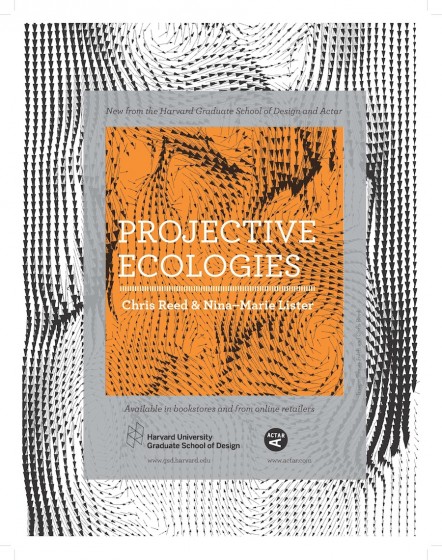
A review of Projective Ecologies, edited by Chris Reed and Nina-Marie Lister. 2014. Second edition 2020. ISBN: 1940291127. ACTAR, Harvard Graduate School of Design. 314 pages.

Review by Anne Trumble

Several months ago, I reviewed Landscape Imagination, a collection of essays by James Corner, a professor at University of Pennsylvania and the landscape architect who designed New York City’s celebrated High Line. Composed over twenty years, his essays examine the many factors hindering the advancement of the cultural medium of landscape. One factor Corner repeatedly addresses is the hoary old dichotomy between nature and culture still pervasive in landscape architecture—the belief in a pristine nature separate from humans.

[…]

Projective Ecologies aims to recover a critical sense of ecology for the design professions because they operate at the intersection of nature and culture—particularly landscape architecture, since its medium holds unique environmental, social, and existential opportunities and responsibilities. Emerging from a multi-year research initiative at Harvard’s Graduate School of Design, Reed and Lister drew on Foucault’s The Archaeology of Knowledge to present three “parallel genealogies,” or intellectual traditions, dealing with the concept of ecology: natural sciences, the humanities, and design.

read more

Helena Ostrowicka, On the Reception of Foucauldian Ideas in Pedagogical Research, European Educational Research Journal, September 2011 vol. 10 no. 3 433-444

doi: 10.2304/eerj.2011.10.3.433
Full text

Abstract
The article is devoted to the presentation of the reception of Foucauldian ideas in Polish pedagogical research over the past twenty years. This movement of thought is described as an oscillation between heterotopia and utopia, autonomy and heteronomy, emancipation and repression. As results of this analysis indicate, Polish pedagogues are most interested in those of Foucault’s analyses which undertake an inquiry into the problems of discursive power or reveal the generative conditions shaping particular discursive formations. The concepts of disciplinary and pastoral power are adopted and utilised for analysing power relations inscribed in discourses of gender, market, childhood, youth, disability, homelessness and subjectivity. Apart from this, the article discusses the Polish reception of Foucauldian texts devoted to the critique of the autonomous subject and to his project of heterotopology. In conclusion, the author points to the inspirations issuing from the works of the French philosopher which encourage us to depart from a dualistic mode of reasoning.

McGowan, Deirdre (2015) The Normalising Power of Marriage Law: An Irish Genealogy, 1945 – 2010. PhD thesis, National University of Ireland Maynooth.

Abstract

Marriage law is often conceptualised as an instrument of power that illegitimately imposes the will of the State on its citizens. Paradoxically, marriage law is also offered as a route to liberation. In this thesis, I question the efficacy of this type of analysis by investigating the actual power effects of marriage law. Using Michel Foucault’s concepts of bio-power and government, and his genealogical approach to history, I identify the role played by marriage law in governing the social domain over a discrete period of Irish history. Drawing on this analysis, I suggest that marriage law is part of a dense network of power relationships that cannot be reduced to a binary relationship of oppression and liberation. Rather, marriage law acts, in conjunction with other techniques of government, to conduct conformity in social behaviour.

Until the 1960s, marriage was considered a fully social matter outside the jurisdiction of politics. With the adoption of a Keynesian economic model at the end of the 1950s the welfare of the population became a matter of political concern. In the 1970s, the vulnerable dependent wife emerged as an object of regulation and marriage law was enacted to protect her through enforcement of the obligations of morally bound, gendered, lifetime marriage. The need to protect this form of marriage drove further reform of marriage law in the 1980s and divorce legislation enacted in 1997. An increasingly rationalised, economic approach to government, adopted following ratification of the Maastricht treaty, required the deployment of social scientific knowledge by government. Within the domain of family life, science connected social stability to relationship stability. Marriage law reform in the 2000s, therefore aimed to promote stability in relationship behaviour by acknowledging, regulating, and promoting relationship practices that performed lifetime marriage. Over the research period, marriage law operated as one among many techniques of government that installed a detailed apparatus of surveillance and control around individual lives, with the objective and effect of conducting conformity in relationship behaviour.

Deirdre McGowan, “Governed by marriage law: An Irish genealogy” (2016) 25 Social and Legal Studies 311.

doi: 10.1177/0964663915614110

Abstract:
Marriage law links the private and the political, connecting the aspirations of individuals to the regulatory ambitions of the state. Marriage has significant social and cultural importance, but the assumptions of stability and care it entails are also useful to government. As a result, marriage law has, both historically and in the present, been offered as the solution to a range of social problems. Using Ireland as a case study example, this essay focuses on the problems that marriage law reform has attempted to address and the political frameworks within which reform took place. It suggests that marriage law is a technique of government that aims to encourage marriage performance in the interests of economic and social stability.

Afiche VII JORNADAS DATPC

VII Jornadas Debates Actuales de la Teoría Política Contemporánea
El neoliberalismo a debate: hacia una genealogía del presente

17 y 18 de noviembre de 2016
Facultad de Ciencias Sociales, Campus Miguelete, Universidad Nacional de San Martín

Presentación:
¿Cómo interpretar el neoliberalismo? Más allá de cualquier salida fácil que lo reduzca a una doctrina económica o a una ideología política, el neoliberalismo se ha vuelto un objeto elusivo, ya casi indistinguible por la forma que ha ido tomando: la de una suerte de gobierno de los vivos a través de la configuración de un ‘ethos’ empresarial. Por eso, nos proponemos pensar y debatir acerca de los discursos, las experiencias de lo común y de su negación, los dispositivos de control y gobierno, las formas de subjetivación, los procesos tecnológicos y las geografías que el neoliberalismo, como racionalidad gubernamental dominante, establece en la actualidad. En ese marco nos preguntamos por las modalidades con las cuales esta lógica transversal que gobierna la vida en un mundo globalizado establece sus dispositivos en los distintos campos que proponemos como ejes temáticos de estas Jornadas.

En ese sentido invitamos a encarar la cuestión del neoliberalismo desde distintas perspectivas temáticas y enfoques teóricos. La propuesta es pensar colectivamente al neoliberalismo y sus implicaciones desde distintos planteos, experiencias, y trabajos teóricos en el tema.

En Debates Actuales de la Teoría Política Contemporánea proponemos pensar “más allá del diagnóstico”, dar un paso más respecto a la reducción del fenómeno a la identificación de sus síntomas. Por el contrario, proponemos utilizar estos planteos teóricos para contribuir de manera concreta para transformar las formas y prácticas de saber que configuran las lógicas de poder de nuestro tiempo.

Ejes Temáticos:

Eje 1:“Teorías y políticas de lo común en la era neoliberal”. Coordinador: Matías Saidel (CONICET/UCSF, UNER)

Eje 2: “Territorios y espacios en el ensamblaje neoliberal”. Coordinador: Adrián Velázquez (IDAES/EH-UNSAM, CONICET)

Eje 3: “Artefactos y artificios neoliberales: técnicay tecnología en tiempos del gobierno de la(s) existencia(s)”. Coordinadores: Camilo Rios (UBA, IDAES/CONICET) y Jimmy Ortiz (UBA, IIGG/CONICET)

Eje 4: “Nuevas formas de gubernamentalidad: Neoliberalismo, Empresa y Deuda”. Coordinador: Emiliano Sacchi (CONICET/CEFC Comahue)

Eje 5: “Discurso, política y neoliberalismo”. Coordinador: Ricky Esteves (UBA/UNA)

El encuentro:

En las Jornadas proponemos una dinámica colectiva de trabajo que comienza compartiendo grupalmente las ideas principales de los textos presentados —lo que implica una dosis importante de protagonismo del participante—, y de registro de los trabajos escritos.

Las Jornadas Debates Actuales de la Teoría Política Contemporánea son un encuentro en el que la discusión grupal –basada en la lectura previa de los textos enviados– es la actividad principal del evento. La dinámica de las jornadas exige la participación a lo largo de dos días de discusiones grupales en los ejes temáticos y un debate plenario entre todos los participantes junto a los coordinadores.

El proceso de las Jornadas comienza un mes antes del encuentro con la publicación y distribución de los trabajos presentados por los participantes de cada eje temático (en nuestra web: teoriapoliticacontemporanea.org, con ISSN 2313-9609), para su lectura y posterior discusión en grupo, y finaliza con la selección y publicación de los trabajos destacados en formato digital como eBook con ISBN. Por esta razón, se especifican las características de formato que el texto debe cumplir para ser incluido en la publicación digital.

Las jornadas proponen una modalidad de participación y discusión grupal diferente a la de la mayoría de los encuentros académicos, que da lugar a los participantes a difundir su texto entre otros participantes –y el público en general con la posterior publicación de las actas–, discutir con ellos, y con los demás participantes de los distintos ejes, presentando diferentes miradas sobre la misma problemática: el neoliberalismo.

Las Jornadas se realizarán los días jueves 17 y viernes 18 del mes de noviembre de 2016 en la Facultad de Ciencias Sociales de la Universidad Nacional de San Martín, Provincia de Buenos Aires, Argentina (toda la información será publicada oportunamente en nuestra web).

Fechas Importantes:

• Envío de resúmenes (ver especificaciones, más abajo): 16 de septiembre de 2016.
• Envío de textos (ver especificaciones, más abajo): 21 de octubre de 2016.
• Día del encuentro: jueves 17 y viernes 18 del mes de noviembre de 2016

Formatos y estilos para el envío de textos:

• Resúmenes:
o Archivo WORD (*.doc // *.docx)
o Hoja A4.
o Título del trabajo, nombre de autor(es), y adscripción institucional.
o Eje propuesto.
o CV del autor de hasta 200 palabras por cada autor.
o Resumen hasta 250 palabras.
o Hasta 5 palabras clave separadas por comas.
o Nombre del archivo: “Eje#_Apellido_RES” (Ej. “Eje4_Perez_RES.doc”

Textos:
o Archivo WORD (*.doc // *.docx)
o Hoja A4.
o Letra Times New Roman, 12pts.
o Interlineado 1,5.
o Título del trabajo, nombre de autor(es), y adscripción institucional.
o Eje propuesto.
o Cuerpo del texto hasta de 8000 palabras (incluyendo pies de página, bibliografía, anexos, tablas, etc.).
o Sistema de citación y referencias APA.
o Citas textuales de más de 4 líneas, en párrafo aparte, entre comillas, y sangría a ambos lados.
o Nombre del archivo: “Eje#_Apellido_TEX” (Ej. “Eje4_Perez_TEX.doc”

Enfatizamos que se deben respetar los formatos propuestos para poder ser publicados. Todos los resúmenes y textos deben ser enviados tanto al correo del coordinador del eje propuesto y al correo de Debates Actuales (debatesactuales@gmail.com).

Hospedaje:
En la circular del año pasado figura una lista de hospedaje en Buenos Aires.

Inscripción:

Los participantes y asistentes podrán inscribirse el día de las jornadas.

Aranceles:
Participantes $300.- Asistentes $150.-
Incluye materiales, certificado, bebidas y café.
Otorgamos factura de pago.

Para Mayor Información:
debatesactuales@gmail.com
http://teoriapoliticacontemporanea.org/

Las Jornadas Debates Actuales de la Teoría Política Cuentan con la Adhesión Institucional de la Facultad de Ciencias Sociales de la UBA y del Instituto de Altos Estudios Sociales de la UNSAM .

Eduardo Rivera Vicencio, Monetary Conformation of the Corporate Governmentality II The Monetary System and the Privatization Process, Journal of Governance and Regulation, Volume 5, Issue 2, 2016, 75-90

Abstract
The global governance of large corporations or corporate governmentality changed over time through the penetration of the economy in all aspects of society but which has shaped the monetary system as an integral part of corporate governmentality and which gave it a big push in the last forty years. The conformation of the monetary system and the introduction of the neoliberal model which brought about the private process and which started from the late seventies of the twentieth century and marked the turning point in the acceleration of wealth will be discussed in this document. The shaping of this accelerated private process would not have been possible without the establishment of the monetary system. These conformations are described through Foucault’s approach to power relations and its manifestations such as discourse, discipline, ethics and governmentality. This document uses the archaeological and genealogical method Foucaultian approach and therefore looks at historical, philosophical and economic aspects. The period covered in this document corresponds from the interwar period to the beginning of the 21st century in terms of monetary aspects that have influenced the formation of the monetary in the privatisation process and the effects of both on the economy.

Keywords: Monetary System, Private Process, IMF (International Monetary Fund), the Gold Standard, Corporate Governmentality, Rent Appropriation, Concentration of Wealth and Monetary Disturbances

Colin Koopman, Historicizing the Critique of Power
20th March 2015 | 14:15 – 15:00

Conference paper, audio podcast on the Voice Republic site

Colin Koopman is Associate Professor of Philosophy at the University of Oregon, where he is also 2014-15 Humanities Research Fellow and 2015-16 Wulf Professor of Humanities. He has published widely on genealogy, pragmatism, and political theory. His works on genealogy include his 2013 book Genealogy as Critique: Foucault and the Problems of Modernity (Indiana University Press, 2013) and articles in Critical Inquiry, Constellations, Foucault Studies, and James Faubion’s recent Foucault Now (Polity, 2014) collection.

Michel Foucault’s Death Valley Trip
Heather Dundas
20th March 2015 | 17:30 – 18:15

Conference Paper, audio and podcast on Voice Republic

Heather Dundas is a Russell Fellow and a candidate for the Ph.D. in Literature and Creative Writing at the University of Southern California, where she is writing her dissertation on the intersection of American landscape and culture and Foucault’s later work. In addition to her critical work, Dundas is a playwright and fiction writer. Her story “House Menu” has been nominated for a 2015 Pushcart Prize, and her play Cannibals, described as “a comic reverie” by The New York Times, has received dozens of productions and is published by Faber and Faber. Other stories and essays have been published in PMSpoemmemoirstory, Brain, Child, The Los Angeles Times, among others.