Foucault News

News and resources on French thinker Michel Foucault (1926-1984)

Kordela, A.K.
Monsters of biopower: Terror(ism) and horror in the era of affect
(2016) Philosophy Today, 60 (1), pp. 193-205.

DOI: 10.5840/philtoday2016113104

Abstract
This paper argues that today the true source of terror in the economico-bio-politically advanced countries of global capitalism lies in biopower’s own constitution as a normative field (the protection of life) that presupposes its exception (the superfluity of life) as its own precondition. At the two extreme poles of this exception we find “terrorism,” and particularly suicide bombing, and unmanned aerial vehicles (UAVs or drones), as the pair revealing the core of biopower. However, of the two only “terrorism” is discursively constructed in the “West” as a monstrous act that should incite horror. Linking horror to the psychoanalytic concepts of repression and foreclosure, I argue that the biopolitical function of horror lies in rendering unreadable the message of such “monstrous” acts. Furthermore, insofar as horror’s experience is an affective state of being that can, nevertheless, be incited discursively, affect shifts to the center of the political domain. The affect of horror in particular becomes instrumental to politics as it can provide the criterion for determining the bio-racial break between, in Foucault’s words, “what must live and what must die “. © 2016. Philosophy Today.

Author Keywords
Affect; Biopolitics; Psychoanalysis; Racism; Terrorism

Sokhi-Bulley, B.
Re-reading the Riots: Counter-Conduct in London 2011
(2016) Global Society, pp. 1-20. Article in Press.

DOI: 10.1080/13600826.2016.1143348

Abstract
The riots that took place in England in August 2011 have widely been described as destructive, senseless and without purpose. This article, taking inspiration from Michel Foucault’s later work on revolt as counter-conduct, argues for a new understanding of how to read political expression and thereby calls for the riots to be thought differently, as a form of counter-conduct. This demands a new appreciation for the possibilities of revolt where spontaneous, impulsive, mundane and non-spectacular events like riots can be construed as political rather than purely criminal. It also opens up possibilities for how we might understand the ethos of the “revolting subject”.

Foucault: The Birth of Power Update 15 – revision and resubmission of the manuscript, and table of contents

17 May 2016


stuartelden's avatarProgressive Geographies

While I had made some changes to the manuscript after submission, and again after receiving the reports, on Sunday evening I finished four long days of thoroughly revising the text and resubmitted it to the publisher.

Just as I was beginning the review process for the second book I received a very nice letter from Daniel Defert, Foucault’s long-term partner, saying how much he’d liked Foucault’s Last Decade. This was obviously a wonderful thing to receive, and gave me a great motivation to finish up this second study.

The key changes are to the Introduction, which is restructured and some parts extensively revised. I wrote a bit about the work here and here. I think the Introduction now more clearly sets up the argument, approach and sources of the work. I also made lots of changes through the text, and added some sentences to the Conclusion. While the reports…

View original post 771 more words

Berthold Molden,
Resistant pasts versus mnemonic hegemony: On the power relations of collective memory
(2016) Memory Studies, 9 (2), pp. 125-142.

https://doi.org/10.1177/1750698015596014

Abstract
The politics of history and memory in any society are determined by the relations of forces between hegemonic master narratives, defiant counter-memories, and silent majorities whose historical experience is rarely articulated in public. Based on Antonio Gramsci, Michel Foucault, Ernesto Laclau, as well as postcolonial critique, this article explains historico-political processes through a specified reading of hegemony theory. Two common, though by no means unambiguous, terms are reloaded with specific definitions: politics of history as the political agency directed at the establishment of specific representations of the past, and memory cultures as the structural frameworks for these politics. This approach sheds light on the relationship between official and group-specific politics of history within defined memory cultures: the possibly conflictual interaction between those who interpret certain events, inscribe them into a historical canon and thus make them points of historical reference, and those who are the carriers, consumers, reproducers, but also challengers of this history. © 2015, The Author(s) 2015.

Author Keywords
Counter-memory; Foucault; Gramsci; hegemony; Laclau; memory culture; politics of history

mf-subject

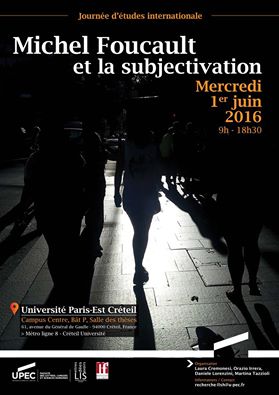
Journée d’études internationale
MICHEL FOUCAULT ET LA SUBJECTIVATION

Organisée par mf / materiali foucaultiani
(Laura Cremonesi, Orazio Irrera, Daniele Lorenzini, Martina Tazzioli)
avec le soutien de l’EA 4395 « Lettres, Idées, Savoirs » de l’Université Paris-Est Créteil

1er juin 2016, 9h – 18h30
Université Paris-Est Créteil, Salle des Thèses

Argumentaire
Cette journée d’études internationale se propose de problématiser la manière dont Michel Foucault, après avoir âprement critiqué la notion même de Sujet (fondateur) dans ses travaux des années 1960, s’est de plus en plus intéressé dans les années suivantes aux modalités historiques de constitution de la subjectivité, en mettant en lumière une duplicité – heuristiquement très prometteuse – entre mécanismes d’assujettissement et processus de subjectivation. Ces deux concepts sont aujourd’hui largement exploités dans une multiplicité de contextes et de champs disciplinaires, mais cela ne s’accompagne que très rarement d’une mise à point sérieuse concernant leur statut philosophique. C’est pourquoi il est important de « revenir » aux analyses de Foucault afin d’éclairer la signification et la valeur éthico-politique dont ces concepts sont chargés au sein de son œuvre, et d’ouvrir ainsi l’espace pour s’interroger de manière féconde sur les « usages » qu’il est possible d’en faire aujourd’hui – non seulement pour décrire les mécanismes contemporains de pouvoir à travers lesquels les hommes et les femmes sont constitués en sujets plus ou moins « assujettis », mais aussi pour poser le problème crucial de la résistance (individuelle et collective) au-delà des simples tactiques de désassujettissement.

Programme

9h – Accueil

9h15 – Introduction par Laura CREMONESI, Orazio IRRERA, Daniele LORENZINI et Martina TAZZIOLI

Matinée – Présidence : Ali BENMAKHLOUF (Université Paris-Est Créteil)

9h30 – Pierre MACHEREY (Université Lille 3) : Subjectivité et normativité chez Canguilhem et Foucault
Répondant : Ariane REVEL (Université Paris-Est Créteil)

10h30 – Guillaume LE BLANC (Université Paris-Est Créteil) : N’être personne ! Variations sur les usages critiques de la fonction-sujet
Répondant : Gianvito BRINDISI (Università degli Studi di Napoli “Suor Orsola Benincasa”)

11h30 – Pause

11h45 – Philippe SABOT (Université Lille 3) : Des sujets-limites
Répondant : Arianna SFORZINI (Université Paris-Est Créteil)

Après-midi – Présidence : Pascal SÉVÉRAC (Université Paris-Est Créteil)

14h – Miguel DE BEISTEGUI (The University of Warwick) : Le gouvernement du désir : la généalogie à l’épreuve du libéralisme
Répondant : Laura CREMONESI (Università degli Studi di Pisa)

15h – Bernard HARCOURT (Columbia University & EHESS) : L’âge numérique et le désir de s’exposer
Répondant : Daniele LORENZINI (Université Paris-Est Créteil)

16h – Pause

16h15 – Judith REVEL (Université Paris Ouest Nanterre La Défense) : La subjectivation comme exédence
Répondant : Martina TAZZIOLI (Aix Marseille Université)

17h15 – Étienne BALIBAR (Université Paris Ouest Nanterre La Défense & Kingston University London) : Parrêsia « philosophique » et « politique » dans les cours de Foucault de 1983 et 1984
Répondant : Orazio IRRERA (Université Paris 1 Panthéon-Sorbonne)

ed-hp

Ecole Doctorale de Philosophie ED 280

Centre de Philosophie Contemporaine de la Sorbonne
Institut des sciences Juridique & Philosophique de la Sorbonne UMR 8103
Université Paris 1 Panthéon-Sorbonne

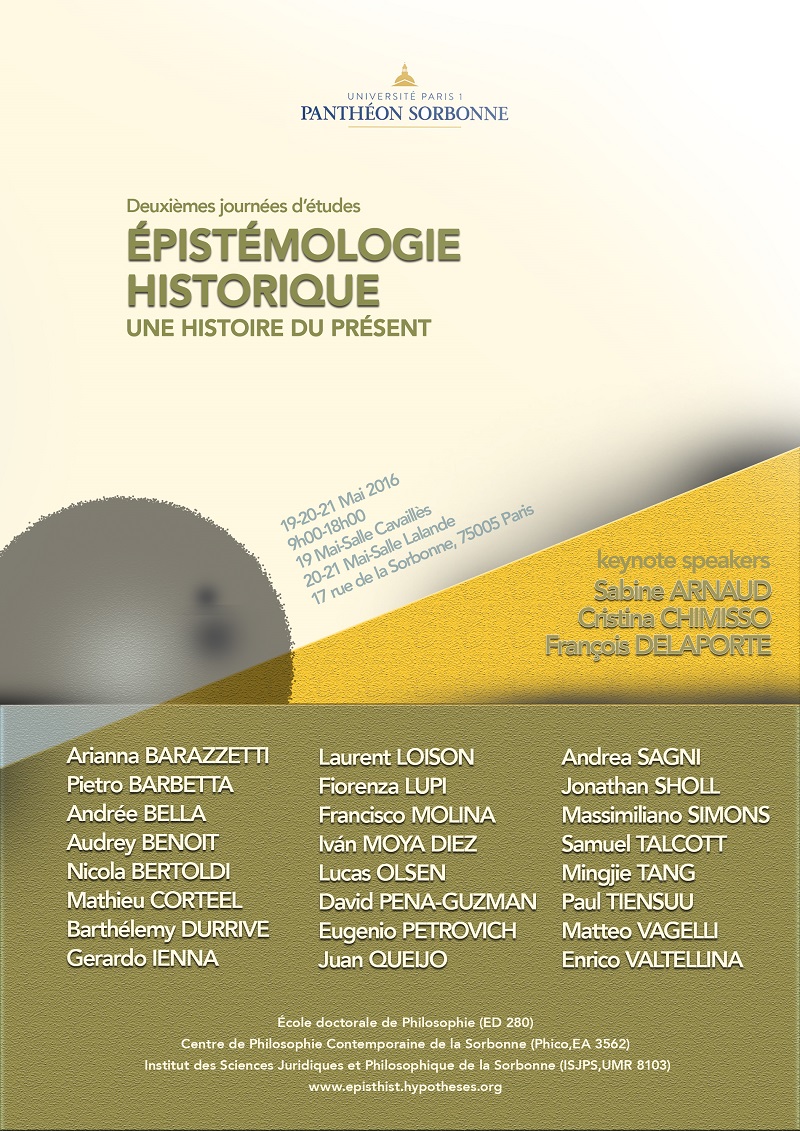
Programme 2èmes Journées d’études
Epistémologie Historique: une histoire du présent
Historical Epistemology: a history of the present
19-20-21 mai 2016
Inscriptions sur https://episthist.hypotheses.org/

Jeudi 19 mai
Salle Cavaillès (17 rue de la Sorbonne, 75005, Escalier C, 1er étage)

Matinée 9h00-13h00
Modérateur : Luca Paltrinieri

Bienvenue
Pr. Pierre-Marie MOREL, Directeur Ecole Doctorale de Philosophie
Pr. Sandra LAUGIER, Directrice Centre de Philosophie Contemporaine de la Sorbonne
Pr. Jean-François BRAUNSTEIN, Comité scientifique des journées

« La physionomie en mouvement »
KEYNOTE ADDRESS par François DELAPORTE, Université d’Amiens

10h50-11h00 Pause-café

« Pour en finir avec l’analyse conceptuelle : Les mécanismes pathologiques et la philosophie biologique chez Canguilhem »
Jonathan SHOLL, KU Leuven

« Le concept d’obésité et son statut épistémologique »
Andrea SAGNI, Université Jean Moulin Lyon 3

« Autism: an Historical Ontology »
Arianna BARAZZETTI, University of Bergamo; Pietro BARBETTA, University of Bergamo/Milan Centre for Family Therapy; Andrée BELLA, University of Milano-Bicocca; Enrico VALTELLINA, University of Venice/ UERJ, Rio de Janeiro.

APRES-MIDI 14H30-18H00
Modérateur : Ferhat Taylan

« Sur le matérialisme conceptuel de Cavaillès et la méthodologie de l’épistémologie historique »
Paul TIENSUU, University of Helsinki

« Deux formes de vérité sans vérité. Foucault entre Canguilhem et Nietzsche »
Ivan MOYA DIEZ, Université Paris 1 Panthéon-Sorbonne

15h50-16h00 Pause-café
« Ce que change la prise en compte du présent. Le cas de la théorie cellulaire au XIXe siècle »
Laurent, LOISON, Centre Cavaillès, ENS Paris

« Des normes de l’évolution à l’évolution des normes. Pour une archéologie des théories évolutionnaires des interactions sociales »
Nicola BERTOLDI, Université Paris 1 Panthéon-Sorbonne

« History from the Inside: Synthetic Biologists as Historians of Science »
Massimiliano SIMONS, University of Leuven

Vendredi 20 mai
Salle Lalande (17 rue de la Sorbonne, 75005, Escalier C, 1er étage)

MATINEE 9h00-13h00
Modérateur : Laurent Loison

« Normativité et présentisme. L’épistémologie historique et la question du « mariage » entre philosophie et histoire des sciences »
Matteo VAGELLI, Université Paris 1 Panthéon-Sorbonne

« Can the History of an Epistemic Norm Bear a Normative Value? Some Reflections on the Status and the Tasks of an Historical Epistemology »
Eugenio PETROVICH, University of Milan

« The Logic of Epistemological Recurrence. Methodology and Normativity in the History and Philosophy of the Sciences »
David PENA-GUZMAN, Laurentian University, Canada

11h30-11h40 Pause-café

« Medicine and the Individual: Reflections on Georges Canguilhem »
KEYNOTE ADDRESS par Cristina CHIMISSO, Open University, UK

APRES-MIDI 14H30-18H00
Modérateur : Orazio Irrera

« Une phénoménotechnique à partir de Spinoza : Quelques remarques critiques à propos de Physique et Métaphysique de Gaston Bachelard »
Gerardo IENNA, Alma Mater Studiorum – Università di Bologna

« L’apport de l’épistémologie historique bachelardienne au marxisme : science, idéologie et construction de la réalité chez Althusser »
Audrey BENOIT, Université Paris 1 Panthéon-Sorbonne

15h50-16h00 Pause-café

« L’émergence de l’épistème computationnelle en médecine »
Mathieu CORTEEL, Université Paris-Sorbonne.

« Reflex and Resistance: Canguilhem and the Power of the Concept »
Samuel TALCOTT, University of the Sciences in Philadelphia

« Quels rôles jouent les arguments physiologiques dans l’évolution du concept de « situation de travail » dans la « physiologie professionnelle » (1860-1960) ? »
Barthélemy DURRIVE, Université Aix-Marseille

Samedi 21 mai
Salle Lalande (17 rue de la Sorbonne, 75005, Escalier C, 1er étage)

MATINEE 9h45-13h00
Modérateur : Daniele Lorenzini

« The Critical Elements of Foucault’s Figure of Man »
Lucas OLSEN, University of Memphis

10h50-11h00 Pause-café
Séance conjointe avec le Séminaire Foucault animé par Jean-François Braunstein

« De la disciplinarisation des savoirs, enjeux et perspectives de recherche »
KEYNOTE ADDRESS par Sabine ARNAUD, Max Planck Institut für Wissenschaftsgeschichte, Berlin

APRES-MIDI 14H30-17H30
Modérateur : Claude-Olivier Doron

« Le milieu, concept relationnel. Normativité des vivants et adaptation: de Canguilhem à Gould et Lewontin »
Fiorenza LUPI, Université de Roma “La Sapienza”

« Une réflexion archéologique de la MTC holistique à travers les problématiques d’événement QingHaoSu »
Mingjie TANG, Institut de philosophie, Académie chinoise des sciences sociales

15h50-16h00 Pause-café

« The Biomedical Formation of “Homosexuality” in the Iberian Contemporary Authoritarianisms: A Comparative Epistemological, Historical case »
Francisco MOLINA, UNED, Madrid

« “Humor”: from Biology to Culture in an Historical Epistemology´s Perspective »
Juan QUEIJO, University of the Republic, Uruguay

Comité scientifique
Christian BONNET, CHSPM, Université Paris 1 Panthéon-Sorbonne
Jean-François BRAUNSTEIN, PhiCO, ISJPS, Université Paris 1 Panthéon-Sorbonne
Arnold I. DAVIDSON, Université de Chicago
Pierre WAGNER, IHPST, Université Paris 1 Panthéon-Sorbonne

Comité organisateur
Ivan MOYA DIEZ, Matteo VAGELLI (coordinateurs)
Tiago ALMEIDA, Audrey BENOIT, Nicola BERTOLDI
Marcos CAMOLEZI, Wenbo LIANG

Yngfalk, C.
Bio-politicizing consumption: neo-liberal consumerism and disembodiment in the food marketplace
(2016) Consumption Markets and Culture, 19 (3), pp. 275-295.

DOI: 10.1080/10253866.2015.1102725

Abstract
How consumerism proliferates in society is central to consumer culture studies, yet little research has examined the power of consumerist discourses in shaping consumption at the intersection of marketing with State regulation. Drawing on Foucault’s notions of governmentality and bio-power, a discourse analysis is conducted of food date labeling regulation. The study problematizes how labeling actualizes a form of neo-liberal consumerism within manufacturing and retail in which consumption is enacted as a site of bio-political control. Labeling, it is argued, fosters unsustainable excess consumption in the name of life and health of people by temporalizing and standardizing consumption, as well as disembodying the marketplace as an area for knowledge creation in consumption. Accordingly, the study discusses two processes “bio-politicizing” consumption that seek to dispense responsibility and re-distribute embodied consumption competence. Finally, it highlights the potential in people to resist such consumerism by developing alternative subjectivities and embodiments in the marketplace. © 2015 Taylor & Francis.

Author Keywords
bio-power; Consumerism; food date labeling; governmentality; state regulation; the body

Moore, F.
‘A band of public-spirited women’: Middle-class female philanthropy and citizenship in Bolton, Lancashire before 1918
(2016) Transactions of the Institute of British Geographers, 41 (2), pp. 149-162.

DOI: 10.1111/tran.12114

Abstract
In the 19th and early 20th centuries, despite the cultural ideal of private and public as separate spheres and a lack of formal voting rights, many middle-class women engaged in philanthropic and social work outside the home. Taking as its focus a group of middle-class women in Bolton, Lancashire, this paper conducts a prosopography, or group biography, in order to shed light on female citizenship and make a historical contribution to literature on citizenship beyond voting rights. The paper uses archive traces to reconstruct the experience of the female philanthropist and understand her motivations. The focus of the paper is a new theoretical approach to women’s citizenship in the early 20th century. Using Michel Foucault’s concept of biopolitics, or life politics, the paper reconceptualises women’s social work as a form of biopolitical patriotism that was the basis of a scalar claim to citizenship. This historical evidence from Bolton reveals that biopolitical action was not solely the preserve of the state. Women claimed fitness for citizenship and the vote by nation-building, carrying out work that shaped children into the citizens of the future and safeguarded the moral and physical health of the nation. Copyright © 2016 Royal Geographical Society (with the Institute of British Geographers).

Author Keywords
Biography; Biopolitics; Citizenship; Gender; Lancashire; Philanthropy

Clinton, M.E., Springer, R.A.
Foucault’s legacy for nursing: Are we beneficiaries or intestate heirs?
(2016) Nursing Philosophy, 17 (2), pp. 119-131.

DOI: 10.1111/nup.12113

Abstract
Drawing upon selected literature from the United Kingdom, Denmark, and Canada we examine how Foucault’s concepts of ‘episteme’, ‘rupture’ ‘parrhesia’ ‘care of the self’, and ‘problemitization’ have been applied to particular contexts of leadership development, pedagogy, nursing knowledge, and the relationship between caring and politics. Our aims are threefold: to give examples of how selected Foucauldian concepts have been taken up in practice; to clarify how we are positioned today as nurses; and to invite more nurses to engage critically with historical inquiry and to engage in deep philosophical reflection about their relationship with nursing. We begin by examining the conditions and circumstances of Foucault’s life, and conclude by posing the question in our subtitle to stimulate debate about the philosophical relevance of Foucauldian scholarship to nursing. © 2015 John Wiley & Sons Ltd.

Author Keywords
Care of the self; Episteme; Foucault; Parrhesia; Problematization; Rupture