Editor: For those of you who, like myself, are involved in teaching Foucault: I find this analysis by Slavoj Žižek of John Carpenter’s 1988 film They Live, from Sophie Fiennes’ 2012 film The Pervert’s Guide to Ideology to be particularly apt.

Editor: For those of you who, like myself, are involved in teaching Foucault: I find this analysis by Slavoj Žižek of John Carpenter’s 1988 film They Live, from Sophie Fiennes’ 2012 film The Pervert’s Guide to Ideology to be particularly apt.
Maurice Stierl, A Foucauldian Take on Border Violence and Mediterranean Acts of Escape , 04/25/16
The unauthorized mass-movements of 2015, when more than a million people crossed maritime borders into European space, demonstrated more clearly than ever before that Europe’s deterrence politics had failed. The necropolitical obstacle course created by its border regime proved unable to prevent these disobedient mobilities. What we witness today, while often termed a “migrant or refugee crisis,” is in fact a crisis of the European project. Current processes of internal re-bordering along sovereign nation-state lines and logics significantly undermine Europe’s supposed post-national ethos and trans-border imaginary. In this talk Stierl explores “Europe in crisis” and relates to some of the experiences he made through his own activist involvement in “border struggles,” as part of the activist collective ‘WatchTheMed Alarm Phone’ that has created a “hotline” for people in distress at sea. Advocating the freedom of movement and seeking to democratize maritime borderzones, the collective has created a presence in spaces seemingly reserved for sovereign state actors and has facilitated the safe arrival of thousands of travelers. In this talk he also draws from three “moments” in Michel Foucault’s writing and thought that help us think conceptually through the relationship between (migrations’) excess and (borders’) control and prompt us to reflect on the ways in which “Mediterranean acts of escape” transform the European socio-political landscape and community.
Co-sponsored by the Center for the Study of Law and Society, Townsend Center for the Humanities: Course Thread on Law and the Humanities, and the Institute of European Studies.
Stuart Elden on Brexit and the border implications.
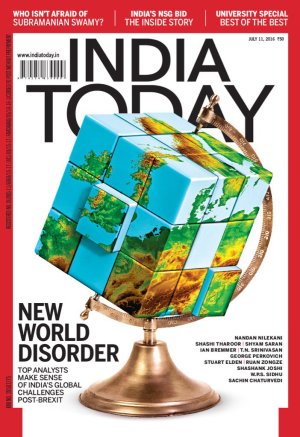 I have a short piece in the new issue of India Today on ‘The legacies of the Leave EU vote’. The piece is available open access.
I was asked to write about this for an international audience, so for UK or other European readers some of the discussion is likely to be quite familiar. Given the fast-moving nature of events, it is hard not to be overtaken by the news – notably it was written before Boris Johnson said he would not run.
Perhaps the distinctive contribution is that I begin thinking about the territorial and boundary implications of this vote. That is a topic which I may explore in future academic work.
Colin Gordon, The will of the people in post-truth times. Notes on the current situation (2016)
10th July 2016
Daniel Cohn-Bendit gave an interview this week on French TV, discussing Brexit, referendums and democracy, in which he said that “we should stop saying that the people is always right”.1 Should we always, unconditionally, irrevocably defer to the expressed will of the people, right or wrong, as a definitive sovereign decision? If not, when, and on what legitimate grounds?
We are seeing the beginnings of a critique of the conception and conduct of the UK Brexit referendum, a critique which, if it is properly carried through, could influence the further course of public action. This critique relates primarily to (a) the manner in which the result was procured, through what has been justly described as an industrial-scale exercise in political lying, and (b) the fact that the best received formulation of the practical proposition which the UK people is deemed to have accepted is a de facto impossibility, namely the combination of full, unimpeded UK access to the EU single market with UK exemption from EU single market rules of free movement (except perhaps where such movement might benefit the UK and its citizens) – together with an assurance that immigration levels will be cut, and a promise that funds falsely described as being currently transferred from the UK to the EU would in future be used to supplement the funding of the National Health Service. The British public has voted, by a small majority, to award itself a round square and a free lunch. Or in the letter-day Marie Antoinette formula of the lead demagogue and charlatan of the Leave campaign, the nation has now adopted his policy on cake – let them have it and let them eat it. Professors of democracy are now offering to certify the binding legitimacy of such irrational sovereign volitions. A Leave majority composed of the poor, the uneducated and the post-industrial regions is hailed by commentators as having defied – at the instigation of the demagogues of Leave – the advice of “toffs and boffins, the chief executives, tycoons and clever-clogs”.
Michel Foucault: Discourse Theory and the Archive
Convention Center at the Historical Observatory; Geismar Landstraße 11, 37083 Göttingen
16 July 2016
See also this link.
This year marks not only Michel Foucault’s 90th birthday, but also the 50th anniversary of the publication of his seminal book Les Mots et les Choses, which made Foucault a prominent intellectual figure throughout Europe. We would like to commemorate this double anniversary with a one-day symposium organised by the Department of British Literature and Culture at Göttingen University in cooperation with the Göttingen Center for Gender studies and the Center for Theory of Culture and Society.
While Foucault has introduced many persistent concepts to the fields of critical, cultural, and literary theory, one that has increasingly attracted attention during the past ten to fifteen years is the archive.
Foucault himself employs the term ‘archive’ ambiguously (cf. Eliassen). Depending on context, the archive signifies
a) an analytical and systematic concept in Foucault’s historical epistemology as put forward in The Archaeology of Knowledge;
b) a historically embedded institution that registers, stores, processes, and provides data about populations and nations; and, last but not least,
c) a singular space that can be experienced aesthetically and that therefore belongs to a group of socially and historically constructed spaces that Foucault referred to elsewhere as ‘heterotopias’.
As concept, ‘the archive’ thus finds itself at the centre of several current academic debates and concerns. What is more, ‘the archive’ can often be seen as a driving force behind recent transformations of the fields of literary and cultural studies, heralding important turns such as the material, the spatial, or the medial turn.
Programm
9:00 Registration
9:15-9:30 Welcome & Opening Remarks:
Ralf Haekel, Johannes Schlegel & Julia Kroll
9:30-10:30 Keynote: Prof Dr Gerold Sedlmayr (TU Dortmund)
“The Value of Value, or: The (Un-)Thinkability of a Postcapitalist Order of Things”
10:30-11:00 Coffee Break
11:00-12:30 Panel I: Transforming the Archive: Feminism and Queer Studies
– Thinking sexual archives with Michel Foucault (Cornelia Möser)
– Queering the archive – The Lesbian archives of Cheryl Dunye’s „The Watermelon Woman“ and „The Owls“ (Nadine Dannenberg)
– Affect in the archive? Literary practices in the context of the Neue Frauenbewegung (Matthias Lüthjohann)
12:30-14:00 Lunch Break
14:00-15:00 Panel II: Reading History through the Foucauldian Archive
– Contradiction and the archive (Martin Mauersberg)
– The Archive as Chronotopos. On Foucault’s understanding of the Archive as a Symbol of Modernity (Sina Steglich)
15:00-15:30 Coffee Break
15:30-17:00 Panel III: Contemporary Practices of the Archive in Context
– Archiving Folk Culture: The Emergence of Folklore Studies and the control of ethnic discourses (Johannes Müske)
– Literature in Other Spaces. Understanding Literary Museum Exhibitions Through Michel Foucault’s Concept of Heterotopia (Sebastian Böck)
– Foucault, archival science and the changing practice of the archivist (Knut Langewand)
17:00-18:00 Panel IV: Foucault and the Digital Age
– Foucault’s “film archive” and its inventory (Ulrike Allouche)
– Excavating Media (Jermain Heidelberg)
Venue: Convention Center at the Historical Observatory; Geismar Landstraße 11, 37083 Göttingen
Convenors: Ralf Haekel, Johannes Schlegel & Julia Kroll
Attendance is free of charge. However, we would kindly like to ask you to register via email!
Kontakt
Johannes Schlegel
Käte-Hamburger-Weg 3
37073 Göttingen
johannes.schlegel@phil.uni-goettingen.de
Foucault Studies
Number 21: June 2016: Counter-Conduct
| Editorial | |
| Sverre Raffnsøe et al. | 1-2 |
| Introduction: Counter-Conduct | |
| Sam Binkley, Barbara Cruikshank | 3-6 |
| From Counter-Conduct to Critical Attitude: Michel Foucault and the Art of Not Being Governed Quite So Much | |
| Daniele Lorenzini | 7-21 |
| Foucault Among the Stoics: Oikeiosis and Counter-Conduct | |
| James F. Depew | 22-51 |
| Rituals of Conduct and Counter-Conduct | |
| Corey McCall | 52-79 |
| The Counter-Conduct of Medieval Hermits | |
| Christopher Roman | 80-97 |
| Revisiting the Omnes et Singulatim Bond: The Production of Irregular Conducts and the Biopolitics of the Governed | |
| Martina Tazzioli | 98-116 |
| Foucault and the Madness of Classifying Our Madness | |
| Drew Ninnis | 117-137 |
| Towards a Foucauldian Urban Political Ecology of water: Rethinking the hydro-social cy-cle and scholars’ critical engagement | |
| Paola Rattu, René Véron | 138-158 |
| The Nineteenth Century in Ruins: A Genealogy of French Historical Epistemology | |
| David M. Peña-Guzmán | 159-183 |
| Beyond the Analytic of Finitude: Kant, Heidegger, Foucault | |
| J. Colin McQuillan | 184-199 |
| What is Psychology? | |
| David M. Peña-Guzmán | 200-213 |
| Foucault: The Materiality of a Working Life An interview with Daniel Defert by Alain Brossat, assisted by Philippe Chevallier | |
| Colin Gordon | 214-230 |
| New Books “By” Foucault | |
| Timothy O’Leary | 231-237 |
| Review of Torben Bech Dyrberg, Foucault on the Politics of Parrhesia (London: Palgrave Macmillan, 2014), i-vi, 1-141, electronic £36.99 (UK), ISBN: 978-1-137-36835-5 | |
| Martin Paul Eve | 238-240 |
| Martin Heidegger, Bremen and Freiburg Lectures: Insight Into That Which Is and Basic Principles of Thinking, Translated by Andrew J. Mitchell (Bloomington: Indiana University Press, 2012), ISBN: 978-0-253-00231-0 | |
| Eric Guzzi | 241-244 |
| Brian Lightbody, Philosophical Genealogy I: An epistemological reconstruction of Nietzsche and Foucault’s Genealogical Method (New York: Peter Lang Publishing Inc., 2010). | |
| Eric Guzzi | 245-247 |
| Lynne Huffer, Are the Lips a Grave? A Queer Feminist on the Ethics of Sex (New York: Columbia University Press, 2013), ISBN: 978-0-231-16417-7 | |
| Sarah Hansen | 248-252 |
| James D. Faubion (ed.), Foucault Now: Current Perspectives in Foucault Studies (Cambridge: Polity Press, 2014), ISBN-13: 978-0-7456-6378-4. | |
| Denise Mifsud | 253-258 |
| Jean-Francois Bert and Elisabetta Basso (eds.), Foucault à Münsterlingen; À l’origine de l’Histoire de la folie, Avec des photographies de Jacqueline Verdeaux (Paris: Éditions de l’école des hautes études en sciences sociales, 2015) | |
| Sverre Raffnsøe | 259-261 |
| Mark G.E. Kelly, Foucault’s History of Sexuality Volume I; The Will to Knowledge (Edinburgh: Edinburgh University Press, 2013), vi-ix, 1-150, ISBN 978-0-7486-4889-4. | |
| Max Rosenkrantz | 262-266 |
| Antonella Cutro, Technique et vie: biopolitique et philosophie du bios dans la pensée de Michel Foucault (Paris: L’Harmattan, 2010), ISBN: 978-2-296-54085-9. | |
| Samuel Talcott | 267-271 |
| Nadine Ehlers, Racial Imperatives: Discipline, Performativity, and Struggles Against Subjection (Bloomington: Indiana University Press, 2012), 185 pages. | |
| R. D. Wood | 272-274 |
Michel Foucault, Prisons And The Future Of Abolition: An Interview, Critical Theory, JUNE 25, 2016
“Active Intolerance: Michel Foucault, the Prisons Information Group, and the Future of Abolition” explores the Prison Information Group (GIP), an organization founded by notable academics, including Michel Foucault and Gilles Deleuze, to expose the deplorable conditions of the French Prison system.
“Little information is published on prisons,” Foucault announced on behalf of the GIP. “It is one of the hidden regions of our social system, one of the dark zones of our life. We have the right to know; we want to know.”
In this interview, I spoke with the book’s editors, Perry Zurn and Andrew Dilts, about the legacy and lessons of the GIP.
Eugene Wolters: What was the GIP?
Perry Zurn: The GIP (or Le Groupe d’information sur les prisons, the Prisons Information Group) was a prison activist organization in France, conceived of in 1970 and operational well into 1973. Beyond this simple description, the GIP can be characterized in a number of competing ways.
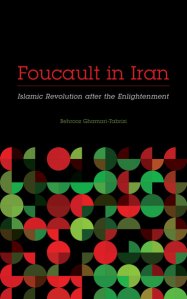 Out shortly is Behrooz Ghamari-Tabrizi, Foucault in Iran: Islamic Revolution after the Enlightenment. Thanks to Chathan Vemuri for the link.
Foucault in Iran centers on the significance of Foucault’s writings on the Iranian Revolution and the profound mark it left on his lectures on ethics, spirituality, and fearless speech. This interdisciplinary work will spark a lively debate in its insistence that what informed Foucault’s writing was his conviction that Enlightenment rationality has not closed the gate of unknown possibilities for human societies.
Foucault in Iran is a courageous and thought-provoking invitation to understand the Iranian revolution, and Foucault’s reaction to it, in an original way. A splendid work that goes beyond simple binaries, it has no sympathy for the clichéd vocabulary used by Progressivists to describe these events—or to criticize Foucault for his alleged romanticisation of the Iranian revolution.
Talal Asad, City University of New York
Brendon Murphy, Deceptive apparatus: Foucauldian perspectives on law, authorised crime and the rationalities of undercover investigation, Griffith Law Review, Published online: 19 Jun 2016
DOI: 10.1080/10383441.2016.1194956
ABSTRACT
Investigation of crime is central to the function and purpose of law enforcement. Contemporary investigation depends on a sophisticated arsenal of theories and techniques interacting with law and its institutions in a variety of ways, including authorised unlawful activity. Drawing on Foucault, this article re-imagines the investigation and associated legal architectures as apparatus; a rationality and strategy of governance shaped by intersecting knowledge formations. The paper considers the key characteristics of investigation and its relationship with law, concluding that investigations practices are a form of apparatus, and that aspects of these practices are grounded in a theological dynamic based on surveillance.
Kurt Borg, ‘Exploring Michel Foucault’s Move from Power and Knowledge to Ethics and the Self’, Dissertation presented in partial fulfilment of the requirements for the Master of Arts in Philosophy, Department of Philosophy, University of Malta, February 2014
Full text available on academia.edu
Abstract
In this dissertation, I will consider the multiple trajectories of the thought of Michel Foucault in the 1970s and 1980s, offering an approach through which his writings on power and knowledge on one hand, and ethics and the self on the other can be understood fruitfully in relation to each other without being seen as representing a radical break in his work. I will do this by, first, locating the question of the subject and its formation within Foucault’s works on disciplinary power and sexuality, paving the way for this question to be revisited through his later writings on ethics. I will then consider how the development of Foucault’s ideas on power into biopower and governmentality enable an approach through which continuity within Foucault’s works can be identified through the rel ations between power, conduct and modes of individualisation. This will lead to considering Foucault’s genealogy of ethics and the modern subject not as a departure from his earlier ideas, but as the culmination of his interest in analysing knowledge, power and ethics. I will consider but go beyond the notions of aesthetics of existence and care of the self in Foucault’s discussion of ancient Greek and Hellenistic ethics in order to deal with his ideas on parrhēsia and truth-telling from his final lecture courses at the Collège De France that show that his late ideas reflect his earlier concerns. Therefore, by appealing to the conceptual developments within his writings as well as his approach to philosophical analysis, Foucault’s philosophical projects need not be seen as disparate and so the issue of continuity in his work can be raised and positively viewed.

 Foucault News